The newly opened Lucas Museum of Narrative Art in Los Angeles is poised to become a significant cultural landmark, sparking a fascinating comparison with the recently inaugurated David Geffen Galleries at the Los Angeles County Museum of Art (LACMA). While both institutions represent monumental investments in the city’s cultural landscape and share a forward-thinking curatorial ethos, their initial receptions, architectural executions, and overarching philosophies offer a compelling study in contrasts, highlighting differing approaches to public art, civic engagement, and the very definition of narrative itself.
Genesis and Investment: A Billion-Dollar Vision Versus a Public-Private Endeavor
The Lucas Museum, a project spearheaded by cinematic visionary George Lucas, represents an extraordinary personal commitment of approximately $1 billion. This substantial private funding underscores Lucas’s singular vision for an institution dedicated to the art of storytelling, encompassing a vast collection that spans from traditional fine arts to beloved cinematic artifacts from his own iconic franchises like Star Wars. The museum’s establishment in Exposition Park, a historically significant cultural and recreational hub, signals an intention to weave itself into the fabric of a diverse and dynamic urban community.
In stark contrast, LACMA’s David Geffen Galleries, which debuted across town on Museum Row in the Miracle Mile neighborhood approximately four months prior to the Lucas Museum’s opening, is the result of a complex public-private partnership. The project’s reported $724 million price tag reflects a significant undertaking involving substantial public resources alongside private philanthropy. David Geffen himself contributed $150 million, securing naming rights for the building. Los Angeles County taxpayers shouldered a considerable burden, contributing $125 million in direct funds and extending $300 million in credit, with the remaining costs covered by other private donors. This multi-faceted funding model inherently brings different expectations and accountability to the fore.
Curatorial Approaches: Embracing Narrative Versus Encyclopedic Scope
At the heart of the comparison lies the distinct curatorial philosophies of the two institutions. The Lucas Museum, as its name suggests, is fundamentally built around the concept of narrative. Its collection, described as a "cabinet of curiosities," prioritizes the storytelling potential inherent in various forms of art. While it boasts significant holdings of cinematic production pieces from Lucas’s celebrated filmography, the museum also aims to explore the universal threads of human experience through thematic groupings such as "love," "play," and "motherhood." This approach, while occasionally simplified to a degree that some critics find bordering on the whimsical, allows for unexpected and arresting connections. For instance, the juxtaposition of 19th-century American cowboy figures from its "Western stories" section with similarly posed manga heroes from postwar Japan creates a potent dialogue across cultures and eras, demonstrating a commitment to exploring narrative across diverse artistic expressions. However, the museum’s "show-over-tell" instinct, characterized by minimal wall text, has led to criticism that insufficient context is provided for the creative choices on display, potentially leaving visitors seeking deeper understanding without adequate guidance.
LACMA, on the other hand, stands as one of the world’s preeminent encyclopedic art museums, boasting an expansive and historically rich collection that spans global cultures and millennia. The David Geffen Galleries, designed with a similar circular, interconnected gallery layout to the Lucas Museum, also embraces a thematic approach to curation, de-emphasizing strict chronological and geographical organization. This curatorial radicalism, while intended to foster new dialogues and connections, has been met with mixed reactions. Critics have described the experience at LACMA as a "chaotic ping-pong across art history," leading visitors on a disorienting journey from ancient Asian pottery to European modernist paintings without clear navigational cues. The absence of a discernible beginning or endpoint, coupled with the thematic leaps, can leave visitors feeling adrift, questioning their location and purpose within the museum’s vast narrative.

Architectural Design and Environmental Considerations: Light, Space, and Civic Integration
The architectural endeavors of both institutions also present significant points of divergence. The David Geffen Galleries, designed by the Pritzker Prize-winning Swiss architect Peter Zumthor, has faced considerable criticism, particularly concerning its integration with the natural environment. Zumthor, an architect with no prior experience building at such a massive scale or in the relentless desert light of Los Angeles, conceived of galleries with floor-to-ceiling windows. This design choice, intended to offer expansive views, has proven problematic due to persistent glare and reflection issues that occlude significant portions of the artwork, even with the implementation of semi-transparent metallic curtains. The building’s monumental scale, rising 30 feet and consuming 85,000 cubic yards of concrete, casts a long shadow over a vast, starkly paved outdoor expanse. This hardscape, described as bleak and unwelcoming, evokes dystopian urbanism and offers little respite for visitors, particularly children and the elderly. The landscape design, or lack thereof, has been seen as a missed opportunity for civic integration and environmental harmony.
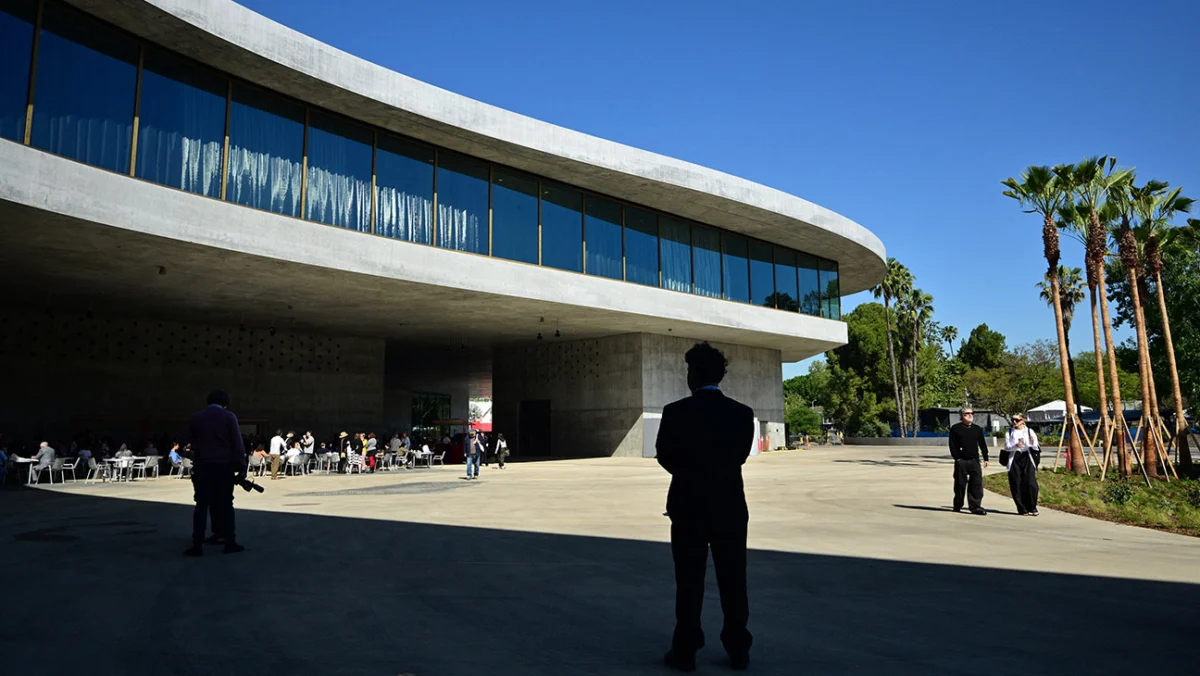
In contrast, the Lucas Museum, designed by Ma Yansong of MAD Architects, appears to have learned from the challenges faced by its LACMA counterpart. Yansong’s design, often characterized as organic and cloud-like, prioritizes controlled interior lighting essential for the preservation and viewing of art, while still incorporating dedicated alcoves that offer elevated views of the city. This thoughtful calibration of light, a skill honed by Lucas’s own career in filmmaking, ensures a more conducive viewing experience within the galleries. Furthermore, the museum’s grounds, meticulously designed by veteran local landscape designer Mia Lehrer, offer a striking counterpoint to LACMA’s concrete expanse. Lehrer’s approach emphasizes topographical storytelling, utilizing regional vegetation that draws inspiration from California’s diverse terrain. This integration of natural elements, including extensive rooftop greenery, not only complements Yansong’s architectural vision but also imbues the museum with a palpable sense of community spirit and environmental consciousness, transforming Exposition Park into a more inviting and engaging public space.
Leadership and Governance: Intertwined Boards and Potential Influence
The leadership structures and board affiliations of both institutions reveal a fascinating interplay, particularly concerning LACMA director Michael Govan and Mellody Hobson, George Lucas’s wife and a key figure in the Lucas Museum’s development. Govan serves on the board of the Lucas Museum, while Hobson, a prominent executive, is a member of the LACMA board. This overlap raises questions about potential cross-pollination of ideas and influence. It is conceivable that Govan might advocate for Lucas’s inclusion on the LACMA board, potentially bringing an "idiosyncratic and dyspeptic if public-minded voice" to its deliberations. This prospect gains further significance in light of recent revelations concerning board members Casey Wasserman and Steve Tisch, who have had to relinquish ownership of their respective business enterprises due to their connections with Jeffrey Epstein. The potential for Lucas to join the LACMA board could introduce a powerful, albeit unconventional, perspective into the museum’s governance.
Broader Implications and Future Trajectories
The contrasting trajectories of the Lucas Museum and LACMA’s David Geffen Galleries carry significant implications for the future of Los Angeles’s cultural landscape. The Lucas Museum, with its singular vision and substantial private backing, offers a compelling model for how a deeply personal artistic mission can manifest as a public institution. Its success could redefine the role of mass culture in art, challenging traditional hierarchies and inviting broader definitions of artistic merit.
LACMA’s challenges, particularly the substantial public investment in a facility that has drawn significant criticism, highlight the complexities and risks inherent in large-scale public-private cultural projects. The institution faces the pressing need to address the architectural and experiential shortcomings of the David Geffen Galleries. Should George Lucas, known for his "contrarian" nature, remain actively involved in the cultural discourse of Los Angeles, his insights could prove invaluable to LACMA as it navigates these challenges.
Ultimately, the arrival of the Lucas Museum of Narrative Art acts as a powerful lens through which to examine the value placed on mass culture, the evolving identity of Los Angeles as a global cultural capital, and the enduring legacy of its artistic pioneers. The comparison with LACMA’s new galleries underscores the ongoing dialogue about what constitutes meaningful public art, how it is funded and realized, and its ultimate impact on the communities it serves. As both institutions continue to evolve, their successes and stumbles will undoubtedly shape the artistic and cultural discourse for years to come.