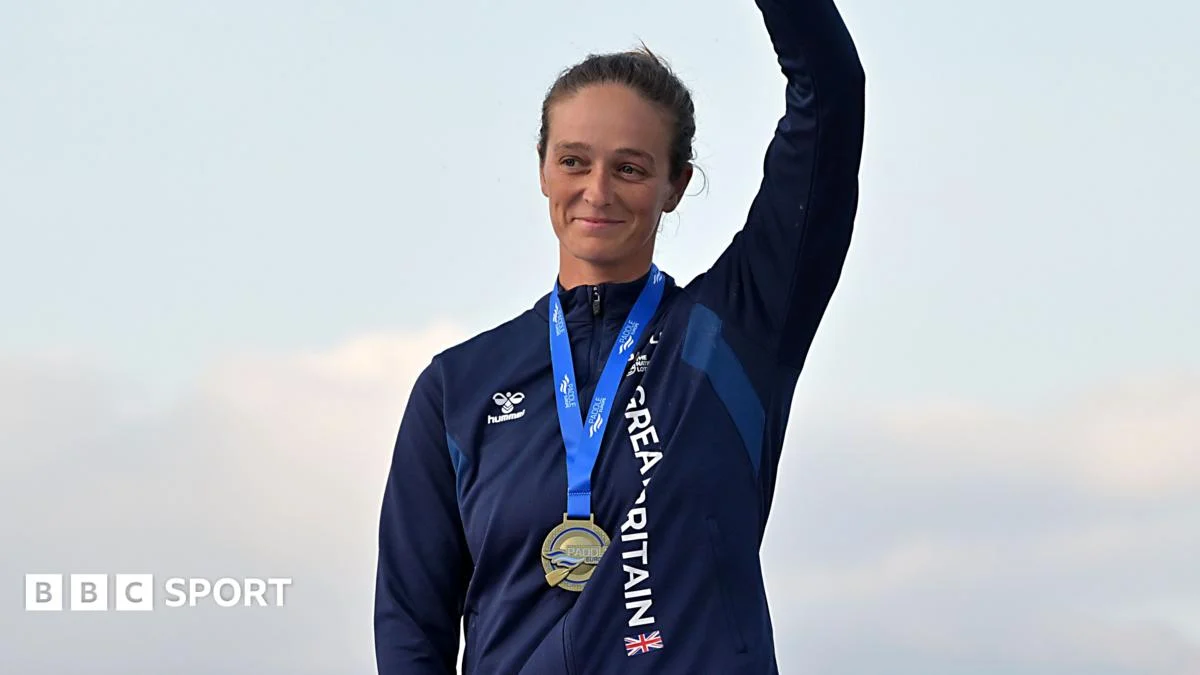
Olympic medallist Mallory Franklin has made a triumphant return to competitive action, clinching a gold medal in the canoe discipline and a silver in kayak cross at the prestigious Paddle Europe Slalom Championships held in Ivrea, Italy. This significant achievement marks Franklin’s first individual medal since the birth of her daughter, underscoring a remarkable comeback for the 32-year-old athlete. Her performance at the championships, which concluded this past weekend, signifies a strong resurgence and positions her as a formidable contender heading into future international competitions.
A Dominant Performance in Canoe Slalom
Franklin’s dominant display in the women’s C1 (canoe single) event was a highlight of the championships. She navigated the challenging Ivrea course with a flawless, penalty-free run, clocking an impressive time of 100.47 seconds. This exceptional performance edged out her closest competitor, France’s Doriane Delassus, by a mere 0.03 seconds, securing Franklin her third career European C1 title. The margin of victory, though narrow, speaks volumes about the intense level of competition and Franklin’s precision under pressure.
The C1 discipline, a cornerstone of canoe slalom, demands exceptional strength, balance, and technical skill. Athletes must maneuver their single-bladed canoes through a series of upstream and downstream gates, often in turbulent water. Any touch of the poles or missing a gate incurs time penalties, making a clean run a testament to an athlete’s mastery of the course and their equipment. Franklin’s penalty-free run signifies not just speed but also an immaculate execution of the complex maneuvers required.
This victory holds particular significance for Franklin, not only as a European title but also as her first individual medal since welcoming her daughter. She had previously opened her week in Italy with a bronze medal in the team event, demonstrating her immediate impact upon returning to the sport. Franklin herself expressed her satisfaction with the outcome, stating, "It’s a really nice way to end the year. It’s been a tough one coming back and getting back on the start line. I’ve been building throughout the year and it’s just a nice way to finish it." Her words reflect the dedication and perseverance required to balance elite athletic pursuits with personal milestones.
The Paddle Europe Slalom Championships, often considered a crucial stepping stone and a high-level preparatory event for major international championships, attract top talent from across the continent. The Ivrea course, known for its technical demands and often dynamic water conditions, provides a stern test for athletes. This year’s event saw participation from over 20 European nations, with athletes vying for supremacy across various disciplines including K1 (kayak single), C1 (canoe single), and the increasingly popular Kayak Cross. The championships serve as a vital platform for athletes to gauge their form, test new strategies, and accumulate valuable ranking points.
Silver in Kayak Cross Adds to a Stellar Championship
Franklin’s success did not end with her canoe gold. On the final day of the championships, she completed a full set of medals by securing a silver in the Kayak Cross discipline. This exciting, head-to-head format, which has gained considerable traction in recent years, saw Franklin battle through intense knockout rounds under the floodlights. Her impressive performance culminated in a silver medal, finishing behind the formidable Tereza Kneblova of the Czech Republic.
Kayak Cross, formerly known as Extreme Slalom, is a thrilling spectacle that pits four athletes against each other simultaneously on a shortened course featuring challenging obstacles and rapids. The format is designed for speed and aggression, with athletes needing to exhibit quick reflexes, tactical awareness, and the ability to make decisive passes. The close-quarters racing and the potential for dramatic upsets make it a fan favorite. Franklin’s ability to adapt her skills from the more traditional slalom disciplines to the fast-paced Kayak Cross demonstrates her versatility and competitive spirit.
British Success Across Disciplines
Great Britain’s performance at the Ivrea championships was particularly strong, with multiple athletes achieving podium finishes. In addition to Franklin’s impressive haul, two-time Olympic medallist Kimberley Woods delivered a stellar performance in the women’s Kayak Cross, clinching the individual gold medal. Woods dominated the morning time trial, posting a winning time of 48.02 seconds, ahead of Poland’s Klaudia Zwolinska. Her victory further solidifies her reputation as a leading figure in women’s kayak cross.
The British team also secured a bronze medal in the men’s K1 team event, with Ben Haylett, Sam Leaver, and Joe Clarke forming a formidable trio. This success in the team K1 category, where three athletes race together and their combined time determines the result, highlights the depth of talent within the British men’s kayak slalom program. Furthermore, the women’s C1 team, comprising Woods, Franklin, and Ellis Miller, also contributed to Great Britain’s medal count by securing a bronze medal in their respective team event.
While the British athletes showcased exceptional talent, the men’s events also saw strong performances from international competitors. In the men’s K1 final, both Joe Clarke and Sam Leaver narrowly missed out on podium places, finishing fifth and sixth respectively. The gold medal in this highly competitive category was claimed by Czech Republic’s Jakub Krejci, underscoring the fierce international rivalry in men’s kayak slalom.
Broader Impact and Future Implications
The Paddle Europe Slalom Championships serve as a critical benchmark for athletes as they build towards major international events such as the ICF World Cups and, ultimately, the Olympic Games. Mallory Franklin’s return to individual medal-winning form is a significant development for British canoeing. Her ability to compete and win at such a high level after a period of absence is a testament to her dedication and the effectiveness of her training and support systems. This success provides a considerable confidence boost and momentum as she continues her Olympic journey.
The performances of Kimberley Woods and the various British teams in the C1 and K1 team events also highlight the strength and depth of the national program. The cohesive efforts in the team disciplines demonstrate effective collaboration and strategic execution, crucial elements for success in medal-winning nations. The younger athletes gaining experience and achieving podiums, such as the bronze in the men’s K1 team, indicate a promising future for British slalom canoeing.
The inclusion and growing popularity of Kayak Cross as a discipline within major championships also present new opportunities and challenges for athletes. The format’s emphasis on speed, agility, and tactical racing requires a different skill set compared to traditional slalom. Franklin and Woods’ success in this discipline suggests that British athletes are adapting well to its demands, further diversifying their competitive edge.
The Ivrea championships, with their challenging course and strong international field, provide invaluable data for coaches and athletes. Analyzing performance metrics, comparing race times, and observing the strategies of rivals are all part of the meticulous preparation that underpins elite athletic careers. For Mallory Franklin, this successful return to the international stage is not merely a personal triumph but a significant indicator of her readiness to contend for major titles in the seasons to come. The journey back to peak performance is often arduous, and her achievements at the Paddle Europe Slalom Championships are a powerful affirmation of her resilience and unwavering commitment to the sport of canoe slalom.