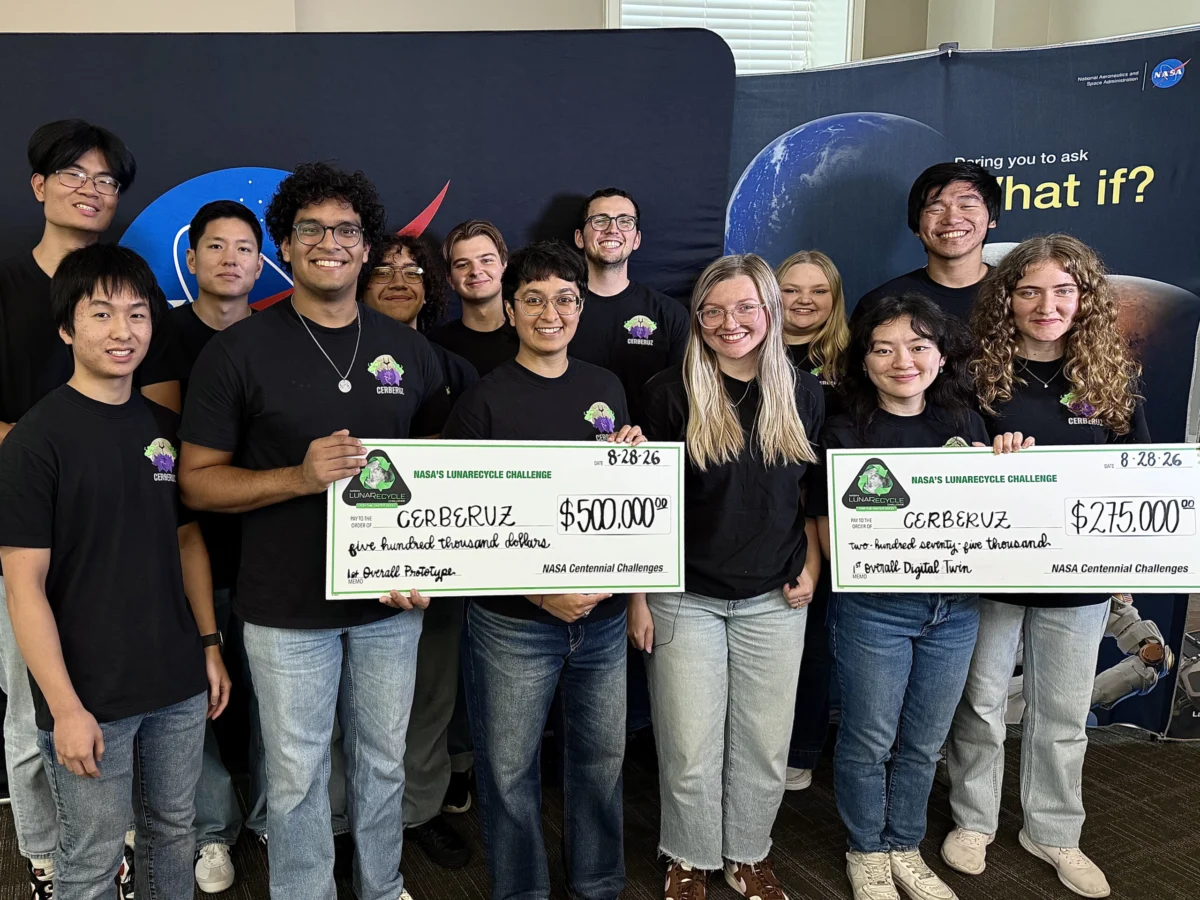
A groundbreaking team from the Massachusetts Institute of Technology (MIT) has been awarded the first prize in Phase 2 of NASA’s LunaRecycle Challenge, a prestigious competition aimed at fostering innovative solutions for waste reduction during future lunar and deep-space missions. The MIT contingent, known as the Composites for Extraterrestrial Recycling By Engineering the Reuse and Upcycling of Zotek (CERBERUZ) team, clinched the top spot, earning a substantial $775,000 in awards for their pioneering technology designed to transform common space-generated waste into reusable materials. This significant achievement marks a crucial step forward in NASA’s broader vision for sustainable long-duration human spaceflight, addressing the critical need to manage and repurpose materials like fabrics, plastics, foam, and metals far from Earth.
The CERBERUZ team, a diverse group comprising undergraduate, graduate, and doctoral students, impressed judges with their sophisticated system that takes mixed trash and processes it into a fine powder. This innovative approach effectively repurposes materials, notably including Zotek foam, which would typically be considered contamination requiring complex sorting. Instead, the CERBERUZ system integrates it as a reinforcement agent. The resulting powder then serves as a versatile feedstock, capable of being used for injection-molding finished parts or extruded into 3D-printing filament. This dual functionality offers unprecedented flexibility for in-situ resource utilization, enabling astronauts to manufacture tools, replacement parts, or structural components directly from their mission’s waste stream. The MIT team’s dominance in the competition was further underscored by their victory in both the prototype development track and the digital twin track, which focused on creating virtual models of recycling systems, demonstrating both practical application and robust theoretical understanding.
The Imperative of Waste Management in Space Exploration
The LunaRecycle Challenge is more than just a competition; it’s a direct response to one of the most pressing logistical and environmental hurdles facing humanity’s sustained presence beyond Earth: waste management. As NASA prepares for the Artemis missions to return humans to the Moon and establish a long-term lunar presence, and with ambitious plans for crewed missions to Mars, the sheer volume of waste generated by extended missions becomes an increasingly critical concern. Every item launched from Earth adds to the mission’s cost, and every piece of discarded material on the Moon or in deep space contributes to a growing problem. Current space missions typically involve bringing all supplies from Earth and disposing of waste by either jettisoning it or returning it, both of which are unsustainable for longer durations and larger crews.
The challenge, a $3 million, two-phase competition, was developed in partnership with The University of Alabama Lee J. Styslinger Jr. College of Engineering. Its core objective was to solicit innovative solutions that could enable future space missions to become more self-sufficient, reducing their reliance on costly resupply missions and minimizing their environmental footprint in extraterrestrial environments. By focusing on recycling common materials, the challenge aimed to close the loop on resource consumption, transforming what was once waste into valuable assets. This aligns perfectly with NASA’s broader strategy of "living off the land" and establishing sustainable habitats in space.
A Chronology of Innovation: From Global Concepts to U.S. Prototypes
The LunaRecycle Challenge unfolded in two distinct phases, each designed to progressively narrow down and refine innovative concepts into tangible technologies.
-
Phase 1: Global Design and Concept Generation
Phase 1 of the competition, which had previously concluded its submission and evaluation phase, garnered record-breaking interest from the global innovator community. It attracted over 1,200 registrations, setting a new benchmark for participation in the 20-year history of NASA’s Centennial Challenges program. This unprecedented engagement highlighted the universal appeal and critical importance of sustainable space exploration. Participants from around the world were invited to submit designs in either or both of the prototype or digital twin tracks. A panel of 50 expert judges meticulously evaluated nearly 200 Phase 1 submissions, ultimately selecting 17 winning teams representing five countries and nine U.S. states. This initial phase served as a global ideation incubator, identifying a diverse pool of promising concepts. -
Phase 2: Prototype Development and Demonstration
Building on the success of Phase 1, Phase 2 specifically required U.S. teams to submit and demonstrate a physical prototype of their recycling technology. An optional digital twin, serving as a virtual model of the system, was also encouraged to provide comprehensive insights into performance and scalability. For the culminating event of Phase 2, 14 finalist teams from across the United States converged at The University of Alabama’s Lee J. Styslinger Jr. College of Engineering in Tuscaloosa. From August 24 to August 28, these teams presented and demonstrated their technology prototypes, showcasing years of development and ingenuity. The digital twin models submitted by some teams were presented alongside their respective physical prototypes, offering a holistic view of their proposed solutions. The diversity of the competitors was notable, ranging from university students and faculty to seasoned entrepreneurs and dedicated space technology enthusiasts, all united by a common goal of advancing sustainable space exploration.
The Winning Technology: CERBERUZ in Detail
The CERBERUZ system’s core innovation lies in its ability to treat mixed waste streams, rather than requiring meticulous pre-sorting. This is a significant advantage for space missions where crew time and resources are extremely limited. Traditional recycling often necessitates complex separation processes, which can be impractical in the confines of a spacecraft or lunar habitat. By grinding various materials into a fine powder, the CERBERUZ system effectively homogenizes the waste stream. The strategic inclusion of materials like Zotek foam, known for its lightweight and insulating properties, as a reinforcement agent rather than a contaminant, exemplifies a truly circular economy approach. This not only eliminates a disposal problem but also adds structural integrity to the recycled product.
The resulting powder’s versatility as a feedstock for both injection molding and 3D printing is another critical feature. Injection molding allows for rapid production of standardized parts with high precision, while 3D printing offers unparalleled flexibility for on-demand manufacturing of custom tools, replacement components, or even architectural elements for habitats. This adaptive manufacturing capability is paramount for long-duration missions, where unexpected needs or equipment failures could be addressed without waiting for resupply from Earth. The dual victory in both the prototype and digital twin tracks demonstrates the team’s ability to not only conceptualize and build a working system but also to model its performance, predict its behavior, and optimize its design in a virtual environment, a crucial step for future deployment in complex space environments.
Voices from NASA: Celebrating Innovation and Collaboration
NASA officials lauded the ingenuity and collaborative spirit that defined the LunaRecycle Challenge. Jennifer Edmunson, program manager for Centennial Challenges at NASA’s Marshall Space Flight Center in Huntsville, Alabama, underscored the competition’s impact. "The LunaRecycle Challenge finale is the culmination of two years of innovation spurred by this competition," Edmunson stated. "It’s incredible to see these technologies go from concept to prototype and digital twin demonstrations in that time. Driving rapid and creative innovation is what NASA challenges are all about." Her remarks highlight the rapid development cycle fostered by such challenges, accelerating the pace of technological advancement beyond traditional research pathways.
Echoing this sentiment, Chris Frangione, who manages the LunaRecycle Challenge in support of NASA Centennial Challenges through Amentum Space Exploration Division, emphasized the power of partnership. "This competition highlights how collaborations can lead to incredible solutions," Frangione remarked. "Between the solver teams, The University of Alabama, and NASA, this finale showcases what can be achieved when we bring together resources and great ideas towards a common goal." This emphasis on collaboration underscores NASA’s strategic approach to leveraging external expertise and fostering a vibrant ecosystem of innovators to tackle complex space challenges. The University of Alabama’s role as a partner, hosting the Phase 2 finale and providing critical logistical support, was instrumental in the success of the competition.
Broader Implications: Earthly Benefits and the Future of Space Exploration
The technologies developed through the LunaRecycle Challenge hold profound implications, not only for future space missions but also for terrestrial applications. Teams were explicitly encouraged to envision solutions that could have dual-use benefits on Earth. The concept of converting mixed waste into usable materials, for instance, could revolutionize recycling efforts in remote communities, disaster zones, or environments with limited infrastructure. Imagine compact, self-contained recycling units that can transform local waste into construction materials or essential tools in humanitarian aid scenarios or isolated scientific outposts. The ability to repurpose diverse waste streams efficiently, without extensive sorting, has significant potential to reduce landfill waste and promote a more circular economy on our home planet.
For space exploration, the success of the LunaRecycle Challenge is a cornerstone for realizing NASA’s long-term objectives. Sustainable lunar outposts and eventual human missions to Mars will necessitate closed-loop systems that minimize waste and maximize resource utilization. The CERBERUZ system and other innovations from the challenge move us closer to a future where astronauts can truly "live off the land," manufacturing what they need from what they have, thereby dramatically reducing launch mass, operational costs, and the overall risk profile of extended missions. This shift towards in-situ resource utilization (ISRU) is critical for transitioning from short-duration visits to a sustained human presence in space.
The LunaRecycle Challenge is managed by Centennial Challenges at NASA’s Marshall Space Flight Center, a program renowned for its legacy of more than 20 years in engaging the public to solve complex problems that benefit NASA’s broader initiatives. Previous challenges have spurred significant advancements in fields such as robotics, additive manufacturing, power and energy, textiles, chemistry, and biology, directly contributing to NASA’s technological readiness. The LunaRecycle initiative is further supported by subject matter experts from NASA’s Kennedy Space Center in Florida, NASA’s Ames Research Center in California’s Silicon Valley, and NASA’s Langley Research Center in Hampton, Virginia, highlighting a broad agency commitment to this critical area of research.
In addition to the MIT team’s first prize, nine other teams received awards across various categories, including additional prototype track winners, digital twin track winners, and a People’s Choice winner who received $25,000. While not individually detailed here, their collective contributions underscore the breadth of innovative thinking brought forth by the challenge. This diverse array of solutions reinforces the robust ecosystem of talent and ingenuity that NASA seeks to tap into through its Centennial Challenges program.
The success of the LunaRecycle Challenge marks a pivotal moment in the journey toward sustainable space exploration. By fostering innovative solutions for waste management and resource utilization, NASA and its partners are not only preparing for the challenges of future lunar and Martian missions but also inspiring advancements that can benefit life on Earth. The MIT CERBERUZ team’s triumph exemplifies the ingenuity and collaborative spirit required to overcome the daunting challenges of space and usher in a new era of sustainable human presence beyond our home planet.