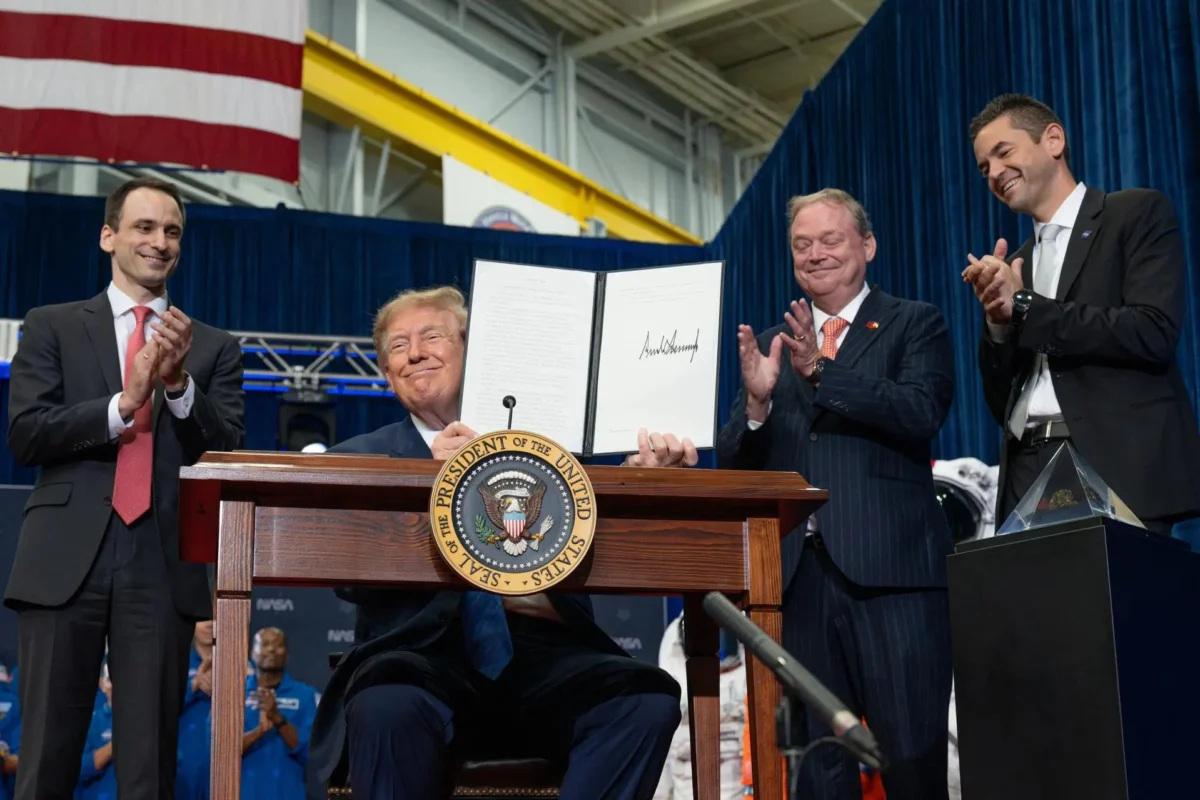
Less than two weeks after a landmark Executive Order was signed to establish the United States Space Academy, NASA-led initiatives are in full swing, demonstrating an aggressive commitment to transform this visionary concept into a tangible reality. This monumental undertaking aims to cultivate the next generation of America’s aerospace workforce and leadership, securing the nation’s preeminence in the burgeoning space domain. The urgency and strategic importance of this endeavor underscore a broader national pivot towards solidifying leadership in an increasingly competitive cosmic frontier.
The swift operationalization began with NASA Administrator Jared Isaacman presiding over the inaugural meeting of the Presidential Commission on the United States Space Academy on September 9. This pivotal gathering convened a diverse array of high-ranking government officials and experts, signaling a unified federal commitment to the academy’s success. Following this foundational meeting, NASA wasted no time, publishing a comprehensive Request for Information (RFI) on Thursday, September 10. This RFI extends an open invitation to governors and their designated representatives across the nation, seeking detailed proposals from states interested in hosting and sponsoring this groundbreaking institution. The selection of a host state is not merely a logistical decision but a strategic one, expected to significantly shape the academy’s identity, operational capabilities, and its long-term impact on regional and national economies.
Administrator Isaacman articulated the profound enthusiasm and dedication driving the initiative, stating, "Our first Commission meeting made clear how much talent and commitment we have behind President Trump’s vision for the U.S. Space Academy. I’m grateful to our partners across government for getting right to work. Now, with the RFI underway, states across the country have an opportunity to help us shape a legacy institution built for America’s future in space." His remarks highlight the collaborative spirit essential for such a complex, multi-faceted project and emphasize the national significance of the academy as a cornerstone for future space endeavors.
The Genesis of a National Imperative: President Trump’s Vision for Space Dominance
The creation of the U.S. Space Academy is a direct outcome of President Donald J. Trump’s Executive Order, signed on August 28, marking a significant milestone in his administration’s ambitious space policy agenda. This executive action followed years of focused efforts to reassert American leadership in space, notably including the establishment of the U.S. Space Force in 2019 and the articulation of the Artemis program, which aims to return humans to the Moon by 2025 and eventually to Mars. The President’s vision for the academy is rooted in a recognition of the critical need for a dedicated pipeline of highly skilled and strategically minded professionals to meet the demands of an accelerating space economy and an evolving geopolitical landscape.
Historically, the United States has relied on a robust ecosystem of civilian universities and existing military academies to produce aerospace talent. However, the unique challenges and opportunities presented by the modern space era—encompassing everything from advanced satellite systems and lunar exploration to deep-space missions and commercial space tourism—necessitate a specialized institution. The U.S. Space Academy is envisioned to be distinct, focusing on interdisciplinary training that integrates scientific, engineering, operational, and strategic aspects of space. This holistic approach is designed to produce graduates who are not only technically proficient but also possess the leadership acumen required to navigate the complexities of space exploration, defense, and commerce.
Assembling the Architects: The Commission’s Inaugural Deliberations
The inaugural Commission meeting at NASA Headquarters in Washington brought together a formidable group of leaders from across the federal government, underscoring the inter-agency priority placed on this initiative. Chaired by NASA Administrator Jared Isaacman and co-chaired by Deputy Administrator Matt Anderson, the gathering included key commission members such as U.S. Secretary of War Pete Hegseth, Director of the National Economic Council Kevin Hassett, Secretary of the United States Air Force Troy Meink, and U.S. Chief Technology Officer Ethan Klein, representing Director of Office and Technology Policy Michael Kratsios. Further representation came from the U.S. Office of Management and Budget, the National Security Council, and the White House, ensuring a comprehensive federal perspective on the academy’s foundational principles.
During the collaborative discussion, commission members embarked on the critical task of defining the structure and priorities of the proposed U.S. Space Academy. Key areas of focus included its governance model, the development of a cutting-edge curriculum, the establishment of service commitments for graduates, the forging of vital partnerships with industry and academia, and a detailed implementation roadmap. These initial deliberations are crucial for laying the groundwork for an institution that must balance rigorous academic standards with the practical demands of space operations and national security. The involvement of defense, economic, and technological leadership highlights the multi-faceted national interest in cultivating a specialized space cadre.
A Nationwide Competition: The Call for a Strategic Home
The Request for Information (RFI) launched by NASA is more than a procedural step; it’s a nationwide call to action for states to demonstrate their capacity and vision to host an institution of unparalleled strategic importance. Deputy Administrator Matt Anderson emphasized the critical role of location, stating, "The location of the U.S. Space Academy is foundational to its success. We’re asking states to bring their strongest vision – the infrastructure, the partnerships, and the community that can compete with the elite options this caliber of student will have and match the boundless ambition of our future space leaders." This statement sets a high bar, signaling that the chosen location must offer a symbiotic environment where the academy can thrive, attracting top talent and fostering innovation.
The RFI explicitly invites governors or their designees to submit comprehensive proposals detailing their state’s ability to host and sponsor the academy. Each state is permitted one submission, emphasizing the need for a unified and robust proposal. The input sought goes beyond mere land availability, delving into the existing educational, industrial, and community ecosystems that could support the academy. This includes details about available resources, potential partnerships with local universities, aerospace companies, and research institutions, as well as the overall quality of life and infrastructure in the proposed region. The competitive nature of this selection process is expected to elicit innovative and compelling proposals, as states recognize the immense prestige, economic benefits, and long-term strategic advantages associated with hosting such a flagship national institution.
Ambitious Milestones: A Clear Path to Operationalization
The timeline outlined in the RFI is notably ambitious, reflecting the urgency of the nation’s space objectives. Responses to the RFI are due by 6 p.m. EDT on Monday, October 26, providing states with a concentrated window to develop their compelling cases. This rapid turnaround underscores the commission’s 120-day mandate, which began with the signing of the Executive Order on August 28, to develop comprehensive recommendations for President Trump on how to establish the academy and build the technical talent and leadership pipeline crucial for America’s long-term goals in space.
The RFI lays out a clear, albeit challenging, operational schedule:
- Groundbreaking no later than 2027: This target aims to initiate construction within the next few years, signaling rapid progression from planning to physical development.
- Temporary hosting of the first 300 students in 2028: This interim phase will allow the academy to begin its educational mission even as permanent facilities are being completed, ensuring a continuous flow of talent.
- Permanent location in operation by 2031: This final phase envisions the full functionality of the academy within a decade, establishing it as a fully operational, state-of-the-art institution.
This detailed chronology demonstrates a methodical yet accelerated approach to establishing the academy, minimizing delays and maximizing the impact of its graduates on the nation’s space endeavors.
Broad Implications: Elevating America’s Standing in the Cosmos
The establishment of the U.S. Space Academy carries profound implications across multiple sectors, extending far beyond the confines of its future campus.
National Security: In an era where space has become a critical domain for national defense, the academy will be instrumental in training future officers and leaders for the U.S. Space Force and other branches of the military with space-related missions. It will provide specialized education in areas such as orbital mechanics, satellite operations, space-based intelligence, and strategic space warfare, ensuring that the nation maintains a decisive advantage in the increasingly militarized final frontier. The curriculum is expected to foster a deep understanding of geopolitical dynamics in space, cybersecurity threats to space assets, and the strategic implications of emerging space technologies.
Economic Impact and STEM Advancement: The academy is poised to become a significant catalyst for STEM education and regional economic development. The host state will benefit from substantial infrastructure investments, job creation (both directly at the academy and indirectly through supporting industries), and an influx of highly skilled professionals and researchers. Nationally, the academy will inspire a new generation of students to pursue careers in science, technology, engineering, and mathematics, addressing a critical shortage of aerospace talent. According to the Bureau of Labor Statistics, the demand for aerospace engineers alone is projected to grow, with thousands of new jobs expected over the next decade, and the broader space economy, valued at over $400 billion globally, is experiencing rapid expansion, necessitating a robust talent pipeline.
Global Leadership and Innovation: By creating a dedicated institution for space leadership, the United States reaffirms its commitment to pioneering space exploration and innovation. Graduates will be equipped to lead both government and private sector initiatives, from designing next-generation spacecraft to managing complex international space collaborations. This investment in human capital will bolster America’s competitive edge against other spacefaring nations, ensuring a steady stream of innovators and leaders who can push the boundaries of scientific discovery and technological advancement.
Curriculum, Governance, and Partnerships: A Holistic Approach
While specific details are still under development by the commission, the academy’s curriculum is anticipated to be highly interdisciplinary, drawing from engineering, physics, astronomy, computer science, and even international relations and ethics. It will likely integrate hands-on experience with cutting-edge technology, including simulations, laboratory work, and potentially access to real-world space assets or mission control centers. The emphasis will not only be on technical proficiency but also on developing critical thinking, problem-solving skills, and leadership qualities essential for complex space missions.
The governance structure is expected to be robust, potentially modeled after existing federal service academies, ensuring accountability, academic rigor, and alignment with national strategic objectives. Partnerships will be crucial: collaborations with leading aerospace companies like SpaceX, Blue Origin, Boeing, and Lockheed Martin could provide internship opportunities, access to industry expertise, and pathways for graduates into the private sector. Academic partnerships with universities renowned for their aerospace programs could facilitate research collaborations and specialized advanced degrees.
Addressing Critical Workforce Needs
The current aerospace workforce faces significant challenges, including an aging demographic and a rapidly evolving technological landscape. A 2022 Aerospace Industries Association (AIA) report indicated a strong demand for skilled workers, with many companies struggling to fill critical positions. The U.S. Space Academy will directly address this gap by providing a tailored educational pathway, ensuring a steady supply of new talent ready to tackle the demands of the 21st-century space domain. This proactive investment in human capital is vital for maintaining the nation’s technological superiority and economic competitiveness.
The academy’s focus on service commitments, similar to other military academies, will ensure that a significant portion of its graduates dedicate their early careers to government service, directly contributing to national security and space exploration programs. This model provides a reliable talent pipeline for critical federal agencies and the Space Force, strengthening the nation’s capabilities in a vital strategic area.
Challenges and Opportunities
Establishing an institution of this magnitude is not without its challenges. Securing adequate long-term funding, recruiting world-class faculty, designing a dynamic curriculum that adapts to rapid technological change, and navigating complex inter-agency coordination will all require sustained effort. Furthermore, the selection of a host state will involve careful consideration of political, economic, and logistical factors.
However, the opportunities presented by the U.S. Space Academy far outweigh these challenges. It represents a generational investment in America’s future, solidifying its role as a global leader in space exploration, defense, and innovation. For the chosen host state, it will be a transformative event, bringing prestige, economic growth, and an enduring legacy. For the nation, it will forge the human capital necessary to explore new frontiers, defend vital assets, and inspire future generations to look to the stars with boundless ambition.
Next Steps: A Nation Awaits
As the October 26 RFI deadline approaches, states across the country are meticulously crafting their proposals, vying for the opportunity to host this landmark institution. The Presidential Commission, with its 120-day mandate, will then undertake the arduous task of evaluating these submissions, conducting site visits, and ultimately formulating its recommendations to President Trump. The journey from Executive Order to operational academy is a testament to national determination, promising a future where America’s leadership in space is not just maintained, but vigorously advanced through the dedication and ingenuity of its next generation of space pioneers. The eyes of the nation, and indeed the world, are now fixed on the unfolding narrative of the U.S. Space Academy, a beacon of future aspiration in the vast expanse of the cosmos.