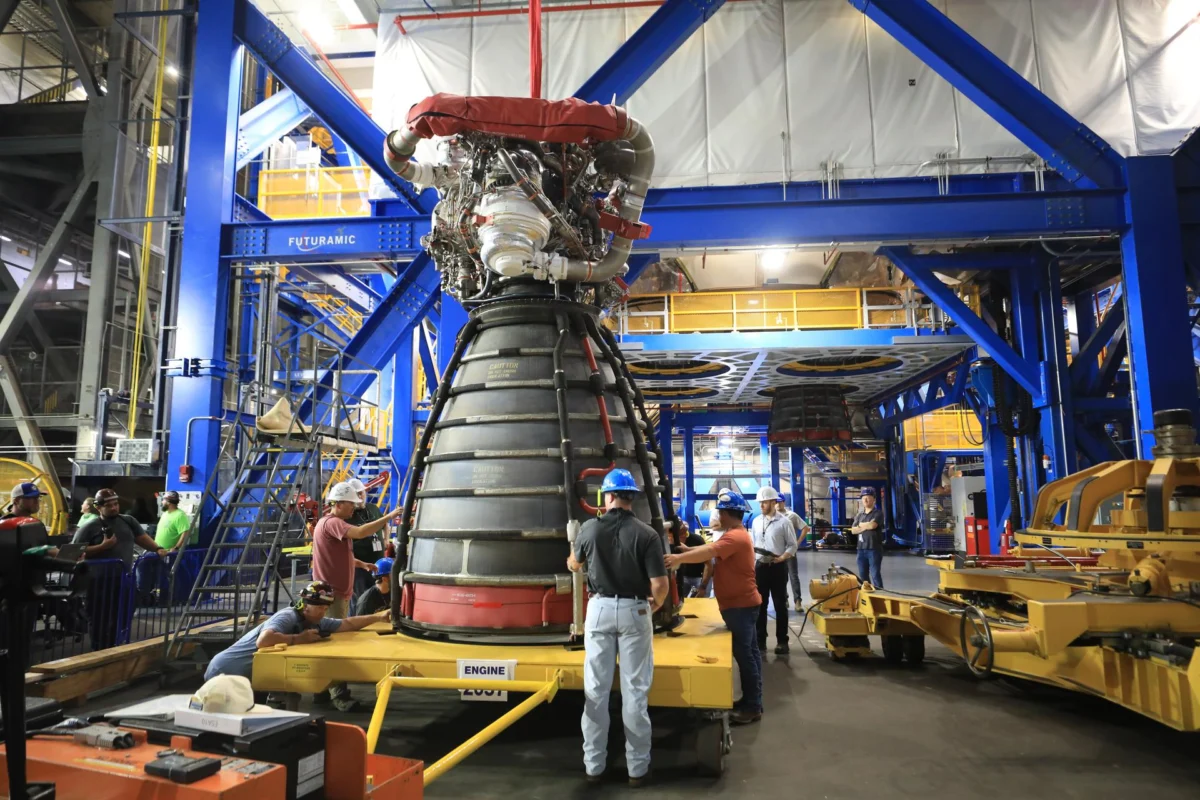
On August 24, technicians at NASA’s Kennedy Space Center (KSC) in Florida commenced the pivotal installation of the four RS-25 engines into the core stage of the agency’s Space Launch System (SLS) rocket, the formidable launch vehicle destined to propel the Artemis III crew toward low Earth orbit in 2027. This milestone marks a significant step in preparing for humanity’s return to the lunar surface, a mission that promises to build upon the legacy of the Apollo era and pave the way for sustainable deep-space exploration.
A Critical Milestone for Artemis III
The intricate process of integrating these high-performance engines into the SLS core stage is a testament to the meticulous engineering and rigorous safety protocols governing human spaceflight. Each RS-25 engine, a powerhouse of propulsion technology, is designed to deliver immense thrust, operating under extreme pressures and temperatures. The installation involves carefully lowering each engine into its designated position at the aft end of the 212-foot-tall core stage, followed by precise mechanical and electrical connections. This intricate dance of machinery and human expertise ensures that the engines are perfectly aligned and ready to withstand the colossal forces of launch. The core stage, manufactured by Boeing, serves as the backbone of the SLS rocket, housing the propellant tanks for liquid hydrogen and liquid oxygen that feed these powerful engines.
The Enduring Legacy of the RS-25 Engine
The RS-25 engine, also known as the Space Shuttle Main Engine (SSME), boasts a distinguished heritage rooted in three decades of the Space Shuttle Program. Originally developed by Rocketdyne (now Aerojet Rocketdyne), these engines are renowned for their incredible reliability, reusability, and unparalleled performance. Unlike expendable rocket engines, the RS-25s were designed to be recovered and refurbished after each Space Shuttle flight, a testament to their robust construction and advanced design.
For the Artemis III mission, four specific RS-25 engines have been assigned: E2054, E2057, E2048, and E2052. Each carries a unique serial number that chronicles its detailed flight history, underscoring the profound reusability and enduring capability of this technology. These particular engines are not new; they are battle-tested veterans, having collectively powered multiple space shuttle missions. This refurbishment and reuse strategy not only honors their legacy but also provides significant cost efficiencies and leverages proven technology for the demanding SLS program.
One engine, E2048, holds a particularly notable place in space history. It previously helped launch NASA astronaut Randy Bresnik’s earlier mission aboard space shuttle Atlantis during STS-129 in November 2009, a mission focused on delivering critical spare parts to the International Space Station. Even more famously, Engine 2048 also flew on Space Shuttle Discovery during STS-95 in October 1998. This mission captured global attention as it returned 77-year-old space pioneer U.S. Senator John Glenn to orbit, making him, at the time, the oldest person to fly in space. Glenn, one of the original Mercury Seven astronauts and the first American to orbit Earth in 1962, undertook this second flight to participate in research on the aging process, bringing full circle his remarkable contributions to human spaceflight. The continued service of these engines, refined and upgraded, symbolizes a continuity of purpose and an evolution of technology from the Shuttle era to the lunar ambitions of Artemis.
Technical Prowess of the RS-25
The RS-25 engines are among the most efficient and powerful liquid-fueled rocket engines ever built. Operating on cryogenic propellants—liquid hydrogen (LH2) as fuel and liquid oxygen (LOX) as oxidizer—they employ a sophisticated staged combustion cycle. This design allows for extremely high thrust-to-weight ratios and specific impulse, meaning they convert propellant mass into thrust with exceptional efficiency. Each RS-25 engine generates 512,000 pounds of thrust at sea level and an astounding 735,000 pounds of thrust in the vacuum of space. For the SLS Block 1 configuration, the four core stage engines, combined with two solid rocket boosters (SRBs), produce a staggering 8.8 million pounds of thrust at liftoff, making the SLS the most powerful rocket in the world.
For the SLS program, the RS-25 engines have undergone significant upgrades. While retaining their core design, they have been enhanced with new controllers, thermal insulation, and nozzle modifications to optimize their performance for the SLS’s specific flight profile, which differs from that of the Space Shuttle. These upgrades ensure that the engines can perform reliably throughout the more demanding thrust profiles required for deep-space missions, operating at 109% of their original rated power level during initial ascent.
The Space Launch System: NASA’s Deep-Space Workhorse
The Space Launch System (SLS) is NASA’s super heavy-lift expendable launch vehicle, designed to carry the Orion spacecraft, astronauts, and cargo on missions beyond low Earth orbit. The Block 1 configuration, which will launch Artemis III, stands at an imposing 322 feet (98 meters) tall. It comprises a core stage powered by the four RS-25 engines, two five-segment solid rocket boosters (derived from the Space Shuttle’s four-segment boosters), and an Interim Cryogenic Propulsion Stage (ICPS) that provides the thrust necessary to send Orion on its trajectory to the Moon.
The development of SLS has been a monumental engineering undertaking, born from the Constellation program’s Ares V design and tailored to meet the evolving needs of human deep-space exploration. Its purpose is singular: to enable humanity to return to the Moon and, ultimately, journey to Mars. The SLS represents a significant investment in national infrastructure, supporting thousands of jobs across the United States and driving advancements in aerospace technology. Its capabilities far exceed any currently operational rocket for human spaceflight, allowing for the direct transport of substantial payloads and the Orion spacecraft to lunar orbit.
Artemis III: Humanity’s Return to the Lunar Surface
Artemis III is poised to be a landmark mission, marking the first time humans will land on the Moon since Apollo 17 in 1972, and notably, the first time a woman and a person of color will step foot on the lunar surface. Scheduled for 2027, this mission will see the Orion spacecraft, carrying four astronauts, launch atop the SLS rocket from Launch Complex 39B at Kennedy Space Center. After reaching lunar orbit, two of the astronauts will transfer to a Human Landing System (HLS) – likely provided by SpaceX’s Starship or Blue Origin’s Blue Moon – which will descend to a pre-selected landing site near the Moon’s South Pole.
The South Pole region is of particular scientific interest due to the presence of permanently shadowed regions that are believed to harbor significant reserves of water ice. Accessing and studying this ice is crucial for understanding the Moon’s geological history and for potentially utilizing it as a resource for future lunar habitats and missions to Mars. The Artemis III crew will conduct extensive geological surveys, collect samples, and perform scientific experiments during their several-day stay on the lunar surface, before ascending back to Orion and returning to Earth.
The Broader Artemis Program: A New Era of Lunar Exploration
The Artemis III mission is a crucial component of NASA’s ambitious Artemis program, a multi-phase endeavor aimed at establishing a long-term human presence on and around the Moon. The program began with the uncrewed Artemis I mission in November 2022, which successfully launched an Orion spacecraft on a test flight around the Moon, demonstrating the capabilities of the SLS and Orion systems. Artemis II, slated for 2025, will be the first crewed flight of Orion around the Moon, serving as a critical dress rehearsal for the lunar landing.
Beyond Artemis III, the program envisions a sustained lunar presence, including the development of the Gateway lunar orbiting outpost, a small space station that will provide a staging point for lunar surface missions and deep-space exploration. The ultimate goal of Artemis is to use the Moon as a proving ground for technologies and procedures necessary for a human mission to Mars, extending humanity’s reach further into the solar system. The program represents a shift from flag-and-footprint missions to one of sustainable exploration, scientific discovery, and commercial partnership.
Kennedy Space Center: The Gateway to the Cosmos
The Kennedy Space Center plays an indispensable role in the Artemis program, serving as NASA’s primary launch site for human spaceflight. KSC’s Vehicle Assembly Building (VAB), one of the largest buildings in the world by volume, is where the SLS core stage and its components are integrated, including the delicate operation of installing the RS-25 engines. The center’s extensive facilities, including launch pads 39A and 39B, control centers, and processing facilities, are all critical to preparing and launching the complex SLS and Orion stack.
KSC’s highly skilled workforce, comprising engineers, technicians, and support staff, possesses decades of experience in assembling, testing, and launching some of the world’s most sophisticated spacecraft. Their meticulous work ensures that every component, from the smallest bolt to the mighty RS-25 engines, is perfectly aligned and functional, ready for the stresses of launch. The center is not just a launch facility; it is a hub of innovation, collaboration, and historical significance, where the dreams of space exploration are transformed into reality.
Official Perspectives and Future Implications
While specific official statements regarding this particular engine installation were not provided in the original context, one can infer the profound sentiment within NASA and its partner organizations. NASA Administrator Bill Nelson has consistently emphasized the importance of the Artemis program as a national imperative, stating on numerous occasions that "We are going back to the Moon, and this time, we are going to stay." The installation of these flight-proven engines would undoubtedly be hailed as a crucial step, demonstrating tangible progress toward that goal. Officials from Aerojet Rocketdyne, the manufacturer of the RS-25, would likely express pride in the continued performance and reliability of their engines, highlighting their adaptability and essential role in both past and future human spaceflight endeavors.
For the Artemis program manager, these milestones represent the culmination of years of design, testing, and manufacturing, bringing the mission closer to its launch window. The meticulous integration work at KSC underscores the dedication of the entire team. This ongoing work at KSC symbolizes a renewed commitment to space exploration, inspiring a new generation of scientists, engineers, and astronauts.
The successful installation of the RS-25 engines for Artemis III carries significant implications beyond the immediate mission. It reinforces the United States’ leadership in heavy-lift launch capabilities and human deep-space exploration. It also validates the strategy of refurbishing and upgrading existing, highly capable technology for new applications, demonstrating a sustainable approach to complex space missions. The continuity of engine technology from the Space Shuttle to SLS provides a valuable institutional knowledge base and mitigates risks associated with entirely new propulsion systems.
Looking Ahead: The Path to the Moon and Beyond
As the RS-25 engines are secured within the SLS core stage, the countdown to Artemis III truly begins in earnest. The remaining years will see the integration of the solid rocket boosters, the ICPS, and finally, the Orion spacecraft. Extensive testing, both at the component level and as a fully integrated stack, will ensure every system is ready for the unprecedented demands of a lunar mission.
The journey to the Moon is fraught with challenges, but each successful step, such as this engine installation, builds confidence and momentum. Artemis III represents not just a return to the Moon, but a forward leap for humanity, pushing the boundaries of scientific discovery, technological innovation, and our collective aspirations to explore the cosmos. The legacy of engines like E2048, having carried pioneers like John Glenn, now stands ready to propel a new generation of explorers to the lunar surface, bridging the past triumphs with the future wonders of space exploration.