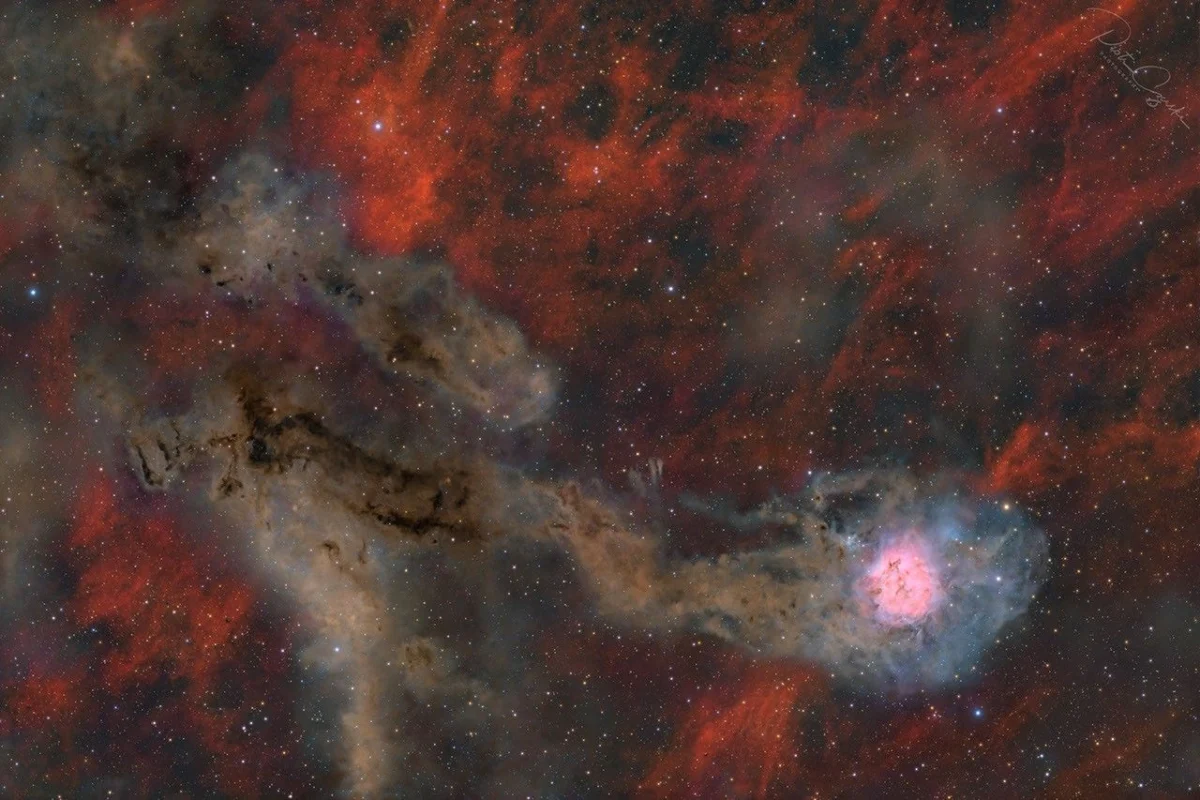
The Astronomy Picture of the Day (APOD) program, a collaborative initiative by NASA and Michigan Technological University, continues its daily tradition of unveiling the universe’s breathtaking wonders, today featuring the magnificent Cocoon Nebula, officially cataloged as IC 5146. This captivating celestial object, nestled within the expansive constellation Cygnus, the Swan, presents a vivid tapestry of cosmic creation and destruction, distinguishing itself with an uncanny resemblance to a colossal comet streaking across the interstellar medium. The image, captured recently in July from the clear, dark skies of Death Valley, California, USA, offers a high-resolution glimpse into a dynamic region where new stars are forged amidst swirling clouds of gas and dust.
The Cosmic Cocoon: A Stellar Birthplace Unveiled
The Cocoon Nebula (IC 5146) is a prime example of an active star-forming region, a celestial cradle where the raw materials of the universe coalesce under gravity to ignite new suns. What immediately draws the eye in the featured APOD image is its striking morphology: a bright, compact head of glowing gas and dust, giving way to an elongated, dark tail of interstellar matter. This unique configuration has earned it the moniker "Cocoon Nebula" due to its shape, but it is its comet-like appearance in this particular deep-sky photograph that truly captures the imagination. The bright head, a vibrant pink and white region against a patchy red-glowing background, spans approximately 10 light-years across. Extending from this luminous core are two irregular brown trails, the lower of which culminates in the nebula’s brilliant center. Trailing off to the left, a vast expanse of dark interstellar dust clouds stretches for nearly 100 light-years, forming the "tail" that completes the illusion of a cosmic comet.
Located approximately 2,500 light-years from Earth, IC 5146 resides in a region of the Milky Way known for its rich stellar nurseries and complex nebulae. The constellation Cygnus itself is a treasure trove for astronomers and astrophotographers alike, featuring prominently in the summer night sky as the "Northern Cross." This area is abundant with the raw materials—hydrogen, helium, and heavier elements—necessary for stellar genesis, often manifesting as brilliant emission nebulae, reflective clouds, and obscuring dark nebulae. The Cocoon Nebula exhibits all three characteristics, making it an excellent laboratory for studying the intricate processes of star formation and the life cycle of the interstellar medium.
The Science Behind the Spectacle: Emission, Reflection, and Dark Nebulae
The multifaceted appearance of the Cocoon Nebula is a direct consequence of the interplay between young, massive stars and the surrounding gas and dust. The bright, colorful head of the nebula is a combination of an emission nebula and a reflection nebula. An emission nebula forms when intense ultraviolet radiation from hot, young stars ionizes nearby hydrogen gas. As the excited hydrogen atoms recombine, they emit light at specific wavelengths, predominantly in the red part of the spectrum (the H-alpha line), giving many star-forming regions their characteristic reddish glow. The powerful central star within IC 5146, likely a newly formed O-type or early B-type star, is the primary engine behind this ionization, supplying the energy that makes the gas glow. This star’s intense stellar winds and radiation also play a crucial role in clearing out a cavity around it, pushing away surrounding material and sculpting the nebula’s intricate structures.
Adjacent to and intermingled with the glowing emission regions are areas of reflection nebula. These occur when starlight, not energetic enough to ionize the gas, scatters off microscopic dust particles within the cloud. Unlike emission nebulae, reflection nebulae tend to appear blue because blue light scatters more efficiently than red light, a phenomenon similar to why Earth’s sky appears blue. The "patchy red-glowing background" and the "bright pink and white region" described in the image’s alternative text perfectly illustrate these combined phenomena, with the pink indicating hydrogen emission and the white/blue suggesting a mix of emission and reflection, or hotter, denser regions.
The long, dark trail extending from the luminous head is an archetypal dark nebula. These are dense clouds of interstellar gas and dust that are so opaque they block out the light from stars and nebulae behind them. In the case of IC 5146, these dusty filaments are not merely inert shadows; they are themselves sites of ongoing star formation. Within these seemingly empty voids, gravity works silently, slowly drawing together denser knots of material, eventually forming protostars that will one day ignite and emerge from their dusty cocoons. The APOD explanation specifically notes that these dark dusty filaments "hide stars in the process of formation," underscoring their critical role in the cosmic cycle of stellar birth.
The Role of the Central Star and Stellar Feedback
The explanation accompanying the APOD image highlights that a bright star near the colorful nebula’s center "supplies power and helps clear out a cavity." This is a classic example of "stellar feedback," a fundamental process in astrophysics. Massive young stars, with their fierce stellar winds and prodigious output of ultraviolet radiation, dramatically influence their immediate surroundings. They can compress nearby gas and dust, potentially triggering further star formation in adjacent regions, or they can disperse existing material, halting star formation and sculpting the nebulae into complex shapes. The cleared-out cavity observed in the Cocoon Nebula is a direct result of this powerful feedback, creating a bubble of hot, ionized gas around the central star. Understanding these feedback mechanisms is crucial for comprehending how star formation proceeds in galaxies and how the interstellar medium evolves over cosmic timescales.

Astrophotography from Death Valley: A Window to the Universe
The fact that this stunning image was captured in July from Death Valley, California, USA, speaks volumes about the advancements in amateur astrophotography and the importance of dark sky locations. Death Valley National Park, renowned for its extreme desert landscapes, is also a designated International Dark Sky Park, offering some of the darkest night skies in the contiguous United States. Such pristine conditions are essential for capturing faint, extended objects like nebulae, as light pollution from urban areas can easily overwhelm their delicate glow. The mention of the image’s origin underscores the significant contributions of skilled astrophotographers, who, armed with sophisticated telescopes, cameras, and image processing techniques, can produce professional-grade astronomical images that rival those from professional observatories. These images not only serve as powerful tools for public outreach but also occasionally contribute to scientific research by revealing subtle features or changes in celestial objects.
APOD’s Enduring Legacy and Future Trajectory
The Astronomy Picture of the Day program, launched on June 16, 1995, has become a cornerstone of public astronomy education. Conceived by astrophysicists Dr. Robert Nemiroff and Dr. Jerry Bonnell, APOD’s mission is elegantly simple yet profoundly impactful: to feature a different image or photograph of our fascinating universe each day, accompanied by a brief explanation written by a professional astronomer. For over two decades, APOD has consistently delivered on this promise, accumulating a vast archive of cosmic imagery and engaging millions worldwide with the wonders of space. Its longevity and consistent quality have made it a trusted and beloved resource for anyone curious about the cosmos, from casual enthusiasts to professional researchers.
In a significant development for the program, APOD’s main NASA site is currently undergoing a migration. Previously hosted at apod.nasa.gov, the platform is transitioning to science.nasa.gov/apod. This move signifies a strategic effort by NASA to integrate APOD more seamlessly into its broader science communication ecosystem. By situating APOD within the main science.nasa.gov portal, NASA aims to provide users with a more unified experience, offering easier access to related scientific articles, missions, and educational resources. This integration is expected to enhance the program’s reach and impact, ensuring that the daily dose of cosmic inspiration remains accessible and discoverable for years to come. Such a transition, while involving technical complexities, ultimately serves to strengthen the program’s foundation and align it with NASA’s overarching goals of public engagement and scientific dissemination.
Implications and Broader Context
The daily feature of celestial objects like the Cocoon Nebula by APOD has far-reaching implications beyond mere aesthetic appreciation. Firstly, it plays a pivotal role in science communication and public engagement. By presenting complex astronomical phenomena in an accessible and visually stunning format, APOD demystifies the universe, sparking curiosity and fostering a deeper appreciation for scientific inquiry. This regular exposure to cosmic wonders can inspire future generations of scientists, engineers, and explorers.
Secondly, these images contribute to a collective understanding of stellar evolution and galaxy dynamics. Each nebula, galaxy, or planetary vista featured by APOD offers a snapshot of processes that shape our universe. The Cocoon Nebula, for instance, provides a tangible illustration of star formation, a process fundamental to the existence of planets, and ultimately, life. Studying such nebulae helps astronomers refine models of how stars are born, how they interact with their environment, and how they contribute to the chemical enrichment of the universe through their life cycles and eventual deaths.
Thirdly, the consistent delivery of high-quality astronomical imagery highlights the advancements in observational astronomy and imaging technology. From ground-based telescopes in dark sky locations like Death Valley to sophisticated space observatories, the ability to capture such intricate details of distant cosmic objects is a testament to human ingenuity and technological progress. These images often represent the culmination of hours of exposure time, advanced optics, and sophisticated digital processing, pushing the boundaries of what is observable.
Finally, the anticipation for future APOD features, such as "tomorrow’s picture: triple eclipse," underscores the program’s ability to maintain sustained interest in astronomy. The universe is a dynamic and ever-changing place, and APOD serves as a daily reminder of the endless discoveries awaiting us. Whether it’s a rare celestial alignment like a triple eclipse, a distant galaxy, or a nebula within our own Milky Way, APOD consistently brings the frontier of cosmic exploration directly to the public, reinforcing the idea that the universe is not just a subject of study, but a source of profound wonder and inspiration. The Cocoon Nebula, with its delicate balance of destructive stellar winds and creative star-forming dust, stands as a testament to the continuous, majestic dance of cosmic forces.