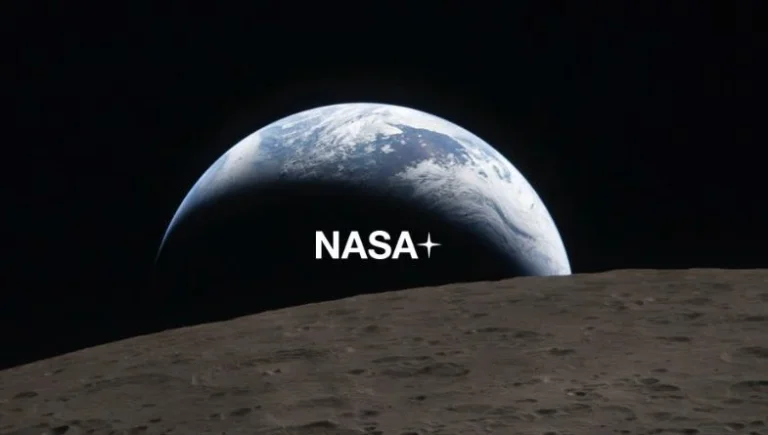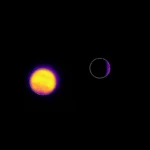

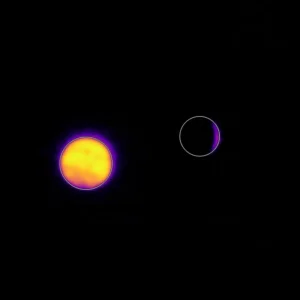

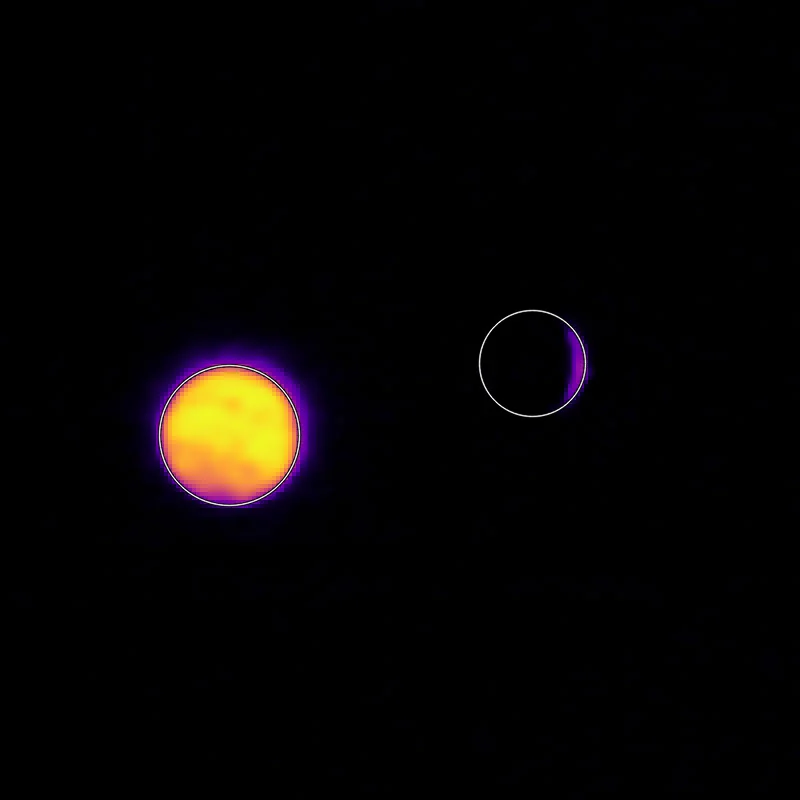
On July 3, 2024, one of NASA’s twin ESCAPADE (Escape and Plasma Acceleration and Dynamics Explorers) spacecraft achieved a significant milestone, capturing remarkable images of Earth and its Moon. These images, taken in both visible and thermal infrared light, not only offer a unique perspective of our home planet and its natural satellite from deep space but also served as a crucial calibration exercise for the mission’s scientific instruments. At the moment of capture, the spacecraft was positioned approximately 363,250 miles (584,600 kilometers) from Earth and 115,600 miles (186,100 kilometers) from the Moon, a distance that rendered the Moon appearing notably large in relation to Earth from the spacecraft’s vantage point.
A Tale of Two Lights: Visible and Thermal Infrared Perspectives
The images present a compelling contrast between how celestial bodies appear under different wavelengths. The visible light image, captured when the Sun was only partially illuminating Earth and the Moon, depicted both bodies as slender crescents. In this perspective, only about 8% of each celestial face was directly sunlit, illustrating the vast expanse of shadow cast by the Sun’s position relative to the spacecraft. This crescent phase is a common sight from deep space when viewing planets from an oblique angle relative to the Sun.
However, the thermal infrared image revealed a dramatically different picture, especially for Earth. In this spectrum, the shadowed hemisphere of Earth, which would appear dark in visible light, glowed vividly. This illumination was not from reflected sunlight but from the planet’s own emitted heat, a combination of warmth retained by its atmosphere and radiated from its surface. Earth’s "night side" registered temperatures ranging from minus 10 to minus 44 degrees Fahrenheit (250 to 280 kelvins). This thermal signature is a testament to Earth’s dynamic climate system, where oceans, landmasses, and atmospheric circulation work to redistribute heat, preventing extreme temperature drops even on the unlit side.
In stark contrast, the Moon’s thermal infrared signature was significantly different. Without the insulating blankets of a substantial atmosphere and vast oceans, the Moon’s far side, also unlit by the Sun, registered a much colder minus 280 degrees Fahrenheit (100 kelvins). This profound temperature difference underscores the critical role of atmospheres and hydrospheres in moderating planetary temperatures, a fundamental aspect of habitability. The comparison between Earth and Moon’s thermal profiles serves as a powerful demonstration of atmospheric insulation in action, providing valuable context for ESCAPADE’s future studies of Mars’s tenuous atmosphere.
The ESCAPADE Mission: Unveiling Martian Atmospheric Dynamics
The images were captured using the Visible and Infrared Observation System (VIOS) cameras, a sophisticated instrument suite developed and provided by Northern Arizona University in Flagstaff. While these images are aesthetically captivating, their primary purpose extends far beyond a mere "road trip photo album." As Rob Lillis, the mission’s principal investigator at the University of California, Berkeley, stated, "We are thrilled that ESCAPADE was able to accommodate these excellent space-qualified cameras which will search for visible Martian aurora and investigate thermal properties of the Martian surface and atmosphere. Since Earth and the Moon are well-known targets, imaging them provides an important calibration check for ESCAPADE’s cameras."
This calibration is paramount for ensuring the accuracy and reliability of the data ESCAPADE will collect at Mars. By imaging familiar celestial bodies with known characteristics, scientists can fine-tune the instruments, confirm their operational integrity, and validate their ability to detect specific phenomena. For instance, the VIOS cameras are designed to detect visible Martian aurora, a phenomenon caused by solar wind particles interacting with the planet’s upper atmosphere, and to map the thermal properties of the Martian surface and atmosphere, similar to how they observed Earth and the Moon.
ESCAPADE is a unique mission, comprising two identical spacecraft built by Rocket Lab. The name "Escape and Plasma Acceleration and Dynamics Explorers" precisely encapsulates its scientific objectives. The mission aims to investigate how the solar wind interacts with the Martian environment and how this interaction drives the ongoing loss of the Martian atmosphere to space. The solar wind is a continuous stream of charged particles, primarily electrons and protons, emanating from the Sun’s corona at speeds that can reach a million miles per hour. While Earth is largely protected by its strong global magnetic field, Mars lost its global magnetic field billions of years ago, leaving its atmosphere vulnerable to the relentless bombardment of solar wind.
Scientists believe that understanding this process is crucial to comprehending why Mars, once potentially a warmer, wetter planet, evolved into the cold, arid world it is today. Atmospheric loss due to solar wind stripping is a key mechanism in planetary evolution, and ESCAPADE’s dual spacecraft approach will provide unprecedented spatial and temporal coverage, allowing scientists to disentangle the complex interplay of solar wind conditions, Martian atmospheric response, and the rate of atmospheric escape.
A Strategic Journey: From L2 Loiter to Martian Orbit
Currently, the ESCAPADE spacecraft are in a "loiter" orbit around Lagrange point 2 (L2). Lagrange points are specific positions in space where the gravitational forces of two large bodies, such as the Sun and Earth, balance the centrifugal force on a third, smaller body. L2, located approximately a million miles (1.5 million kilometers) directly opposite the Sun from Earth, is a stable gravitational "parking spot" that requires minimal fuel to maintain orbit. This strategic location allows the spacecraft to observe Earth and the Moon from a unique vantage point while awaiting their next critical maneuver.
The journey to Mars is a carefully choreographed ballet of celestial mechanics. In November 2026, the ESCAPADE spacecraft will execute a precisely timed Earth flyby. This maneuver will leverage Earth’s gravitational pull to perform a "gravity assist" or "slingshot" maneuver. By passing close to Earth, the spacecraft will gain significant momentum and alter its trajectory, accelerating towards Mars without expending large amounts of onboard fuel. This highly efficient method is a cornerstone of deep-space exploration, enabling missions to reach distant targets with smaller, more cost-effective spacecraft.
Following this gravity assist, the twin explorers are projected to arrive at Mars in September 2027. Upon arrival, they will settle into their operational orbits, commencing their primary scientific mission. Over an extended period, the spacecraft will make simultaneous measurements from different locations around Mars, providing a comprehensive, multi-point view of the planet’s interaction with the solar wind. This approach is vital for distinguishing between spatial and temporal variations in the solar wind and its effects on the Martian atmosphere, which has been a challenge for single-spacecraft missions.
Broader Implications and Collaborative Endeavors
The ESCAPADE mission is funded by NASA’s Heliophysics Division, which focuses on understanding the Sun and its influence throughout the solar system. It is also a key part of the NASA Small Innovative Missions for Planetary Exploration (SIMPLE) program. The SIMPLE program champions cost-effective, high-impact science missions that often utilize innovative approaches and commercial partners to achieve ambitious scientific goals. ESCAPADE exemplifies this philosophy, showcasing how smaller, more agile missions can contribute significantly to our understanding of fundamental planetary processes.
The mission is led by the University of California, Berkeley’s Space Sciences Laboratory, a renowned institution with a long history of pioneering space science research. This endeavor is a testament to the power of collaboration, bringing together a diverse array of partners and expertise. Key partners include Rocket Lab, responsible for building the high-performance spacecraft; NASA’s Goddard Space Flight Center in Greenbelt, Maryland, which provides expertise in mission management and instrument development; Embry-Riddle Aeronautical University, contributing to mission operations and data analysis; Advanced Space, involved in navigation and trajectory design; and Blue Origin, a commercial space company. This multi-institutional and public-private partnership model is increasingly common in modern space exploration, allowing for the pooling of resources and specialized knowledge to tackle complex scientific questions.
The scientific insights gained from ESCAPADE will have far-reaching implications. By providing a detailed understanding of solar wind interaction and atmospheric escape on Mars, the mission will contribute to our broader knowledge of planetary habitability, not just within our solar system but also for exoplanets. As scientists search for potentially habitable worlds beyond Earth, understanding the factors that govern atmospheric retention and loss is critical. Furthermore, the data collected will inform future human missions to Mars, helping engineers and mission planners better understand the radiation environment and the long-term prospects for utilizing Martian resources, including any remnants of its once more substantial atmosphere. The initial calibration images, therefore, represent more than just beautiful photographs; they are a critical first step in a journey to unlock some of the deepest secrets of planetary evolution and the dynamic relationship between stars and their orbiting worlds.