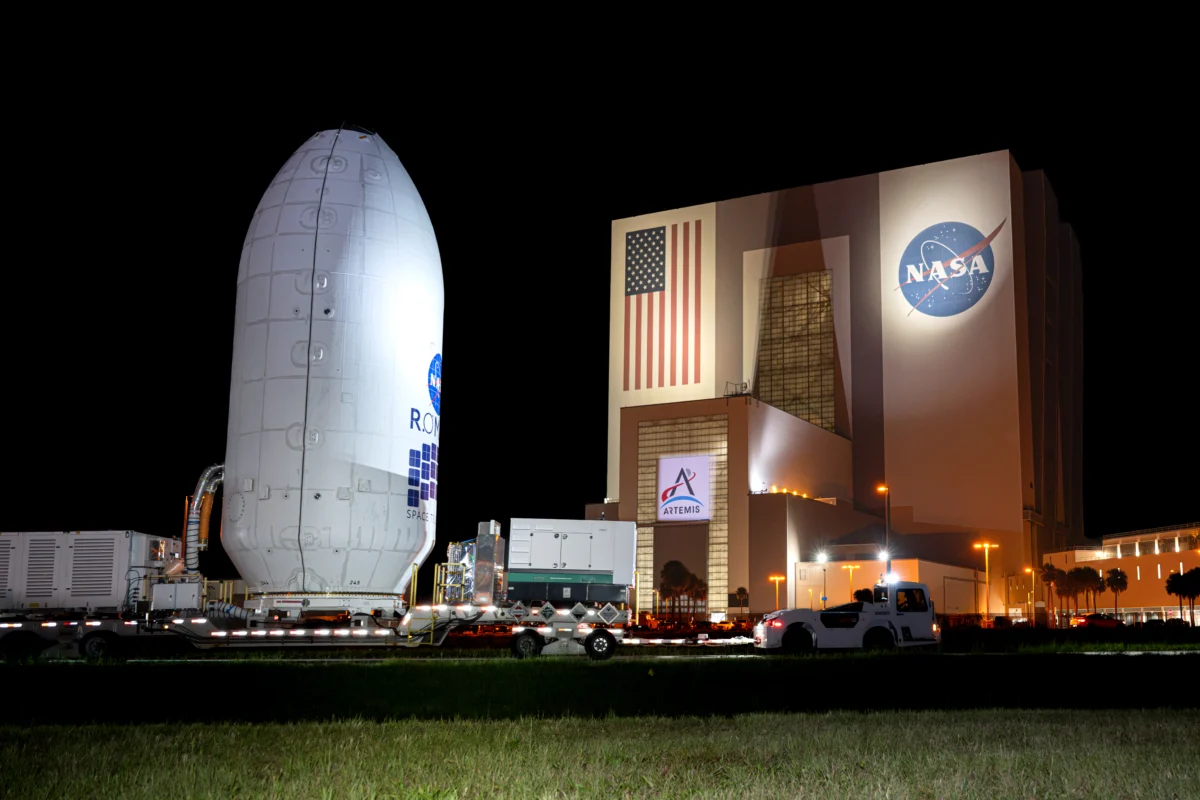
NASA’s Nancy Grace Roman Space Telescope, meticulously encapsulated within its protective payload fairing, completed a critical phase of its pre-launch preparations on Tuesday, August 25, 2026, by traversing from the Payload Hazardous Servicing Facility to the SpaceX hangar at Launch Complex 39A (LC-39A) at NASA’s Kennedy Space Center. This pivotal movement positions the advanced observatory for its imminent integration with a powerful SpaceX Falcon Heavy rocket, with liftoff from the historic Florida spaceport targeted no earlier than Sunday, August 30, 2026. The Roman Space Telescope is set to embark on a groundbreaking mission to explore two of the universe’s most enigmatic phenomena: dark energy, the mysterious force accelerating cosmic expansion, and dark matter, the unseen gravitational scaffolding of the cosmos.
A New Eye on the Cosmos: The Roman Space Telescope’s Scientific Prowess
Named in honor of Nancy Grace Roman, often hailed as the "Mother of Hubble" for her pivotal role in planning the Hubble Space Telescope, the Roman Space Telescope represents a significant leap in space-based astronomical observation. Unlike its predecessors, Roman is engineered with a primary focus on wide-field infrared surveys, designed to capture vast swathes of the cosmos with unprecedented detail and speed. Its 2.4-meter primary mirror, identical in size to Hubble’s, combined with a sophisticated Wide Field Instrument (WFI), will deliver an imaging area 100 times larger than Hubble’s infrared camera, allowing it to survey enormous volumes of space in a fraction of the time. This expansive field of view is critical for statistical analyses of cosmological phenomena, enabling scientists to gather data on billions of galaxies over its five-year primary mission.
The WFI is equipped with a 300-megapixel camera, providing a panoramic view of the universe in near-infrared light. This capability is essential for observing distant galaxies, whose light is redshifted into the infrared spectrum due to the universe’s expansion. By looking further into the infrared, Roman can effectively look further back in time, studying the universe’s structure and evolution when it was much younger. In addition to the WFI, Roman also carries the Coronagraph Instrument (CGI), a cutting-edge technology demonstrator designed to directly image exoplanets by blocking the blinding light of their host stars. While primarily a technology testbed, the CGI holds the potential to capture the first direct images and spectra of exoplanets in reflected visible light, offering invaluable insights into their atmospheric compositions and habitability. This dual-instrument approach underscores Roman’s versatility, positioning it as a powerful tool for both cosmology and exoplanetary science.
Unraveling the Universe’s Greatest Mysteries: Dark Energy and Dark Matter
The Roman Space Telescope’s primary scientific objectives revolve around a deeper understanding of dark energy and dark matter, which together constitute approximately 95% of the universe’s total mass and energy content, yet remain largely unknown.
Dark Energy: Discovered in the late 1990s, dark energy is the hypothetical form of energy responsible for the observed accelerating expansion of the universe. Prior to this discovery, scientists believed the universe’s expansion was either slowing down due to gravity or was constant. The acceleration implies a repulsive force, dubbed dark energy, counteracting gravity on cosmic scales. Roman will employ three primary methods to probe dark energy:
- Type Ia Supernovae: These exploding stars serve as "standard candles" because they consistently reach a peak luminosity. By measuring their apparent brightness and redshift, astronomers can determine their distance and how quickly the universe was expanding at different points in cosmic history. Roman will observe thousands of Type Ia supernovae across vast distances, building a comprehensive cosmic distance ladder to precisely map the expansion rate.
- Baryonic Acoustic Oscillations (BAO): These are fossilized sound waves from the early universe imprinted on the distribution of galaxies. BAO provide a "standard ruler" in the cosmos. Roman’s wide-field surveys will map the positions of millions of galaxies, allowing scientists to measure the characteristic BAO scale at different epochs and thus track the expansion history of the universe.
- Weak Gravitational Lensing: The gravity of massive objects, including dark matter halos, subtly distorts the light from more distant galaxies, an effect known as weak gravitational lensing. Roman will measure these minute distortions across billions of galaxies, creating a 3D map of the universe’s matter distribution, including the invisible dark matter. By observing how this distribution evolves over time, scientists can infer the properties of dark energy and how it influences cosmic structure growth.
Dark Matter: While dark energy drives cosmic expansion, dark matter provides the gravitational glue that holds galaxies and galaxy clusters together. Its existence is inferred from its gravitational effects on visible matter, such as the anomalous rotation curves of galaxies and the strong lensing of light around galaxy clusters, yet it does not emit, absorb, or reflect light, making it invisible to conventional telescopes. Roman’s weak gravitational lensing observations will be crucial for mapping the distribution of dark matter throughout the universe. By tracing the influence of dark matter on the formation, clustering, and evolution of galaxies over cosmic time, Roman will help elucidate the nature of this mysterious substance, distinguishing between competing theoretical models like the Cold Dark Matter (CDM) paradigm.
The mission’s insights into these two cosmic constituents are expected to revolutionize our understanding of fundamental physics, cosmology, and the ultimate fate of the universe.
A Meticulous Journey to Launch: From Facility to Fairing
The journey of the Roman Space Telescope to the launchpad has been a meticulous and carefully orchestrated process, spanning years of development and culminating in the recent critical pre-launch activities. The transfer on August 25, 2026, marked a significant milestone, signifying the observatory’s readiness for its final integration.
The Payload Hazardous Servicing Facility (PHSF) at Kennedy Space Center is a state-of-the-art cleanroom environment specifically designed for processing delicate spacecraft and their payloads. Within its controlled atmosphere, engineers and technicians performed final checks, fueled the spacecraft, and enclosed it within its payload fairing – the protective nose cone that shields the telescope during its ascent through Earth’s atmosphere. This fairing is crucial for protecting the sensitive optical instruments from aerodynamic forces, acoustic vibrations, and thermal stresses during launch. The encapsulation process itself is a testament to precision engineering, ensuring the telescope is securely nestled and environmentally protected for its journey.
Following encapsulation, the entire assembly was carefully transported to the SpaceX hangar adjacent to Launch Complex 39A. LC-39A holds a storied history, having been the launch site for numerous Apollo missions, including the first crewed lunar landing, and many Space Shuttle missions. In recent years, it has been leased and modernized by SpaceX, becoming the primary launchpad for their Falcon 9, Falcon Heavy, and future Starship missions. The integration of the Roman Space Telescope with the Falcon Heavy rocket is a complex ballet of engineering. The fairing, with the telescope inside, will be hoisted and carefully mated atop the Falcon Heavy’s second stage. This process requires absolute precision to ensure all mechanical and electrical interfaces are perfectly aligned and secured, preparing the entire stack for rollout to the launchpad.
The choice of the SpaceX Falcon Heavy for Roman’s launch underscores the telescope’s substantial mass and the requirement for a powerful vehicle to deliver it to its designated orbit – a Sun-Earth L2 Lagrange point. The Falcon Heavy, currently the world’s most powerful operational rocket, consists of a reinforced Falcon 9 central core booster flanked by two additional Falcon 9 first-stage boosters acting as strap-on side boosters. This configuration utilizes 27 Merlin engines at liftoff, generating over 5 million pounds of thrust, making it capable of lifting payloads weighing over 63,000 kilograms to low-Earth orbit, and substantial masses to beyond. The rocket’s proven reliability and heavy-lift capabilities make it an ideal choice for a mission of Roman’s scientific magnitude and cost.
Voices from the Mission: Anticipation and Aspiration
The impending launch of the Nancy Grace Roman Space Telescope has generated immense excitement within the scientific community and at NASA. Officials and scientists involved in the mission articulate a profound sense of anticipation for the groundbreaking discoveries that lie ahead.
"The Nancy Grace Roman Space Telescope represents a monumental leap forward in our quest to understand the fundamental forces shaping our universe," stated a senior NASA official during a recent briefing. "Its unique wide-field capabilities will allow us to map the cosmos with unprecedented detail, offering insights into dark energy, dark matter, and the formation of galaxies that were previously unattainable. This mission is poised to redefine our cosmological models and deepen humanity’s understanding of its place in the vastness of space."
Similarly, project scientists emphasize the collaborative spirit and meticulous preparation that have brought Roman to this critical juncture. "Years of dedicated effort by scientists and engineers across the globe have culminated in this moment," remarked the Roman Project Scientist. "We are on the cusp of revolutionary discoveries, from precise measurements of the universe’s expansion history to potentially imaging new exoplanets. The data Roman will provide promises to be a treasure trove for generations of researchers, pushing the boundaries of what we know about the universe."
Representatives from SpaceX also expressed their pride in supporting such a pivotal scientific endeavor. "We are honored to partner with NASA on the launch of the Nancy Grace Roman Space Telescope aboard our Falcon Heavy rocket," a SpaceX spokesperson commented. "Our teams have worked closely to ensure a safe and successful integration and launch. Providing reliable access to space for missions of this caliber is at the core of our commitment to advancing space exploration and scientific discovery." The collective sentiment is one of profound optimism, underscoring the high stakes and transformative potential of the mission.
Broader Implications and Future Horizons
The launch of the Nancy Grace Roman Space Telescope carries profound implications not only for cosmology and astrophysics but also for humanity’s broader scientific and technological progress. The mission is expected to deliver a data deluge, projected to exceed the combined output of all previous NASA astrophysics missions, creating an invaluable public archive for astronomers worldwide. This vast dataset will facilitate countless follow-up studies and unexpected discoveries, ensuring Roman’s scientific legacy extends far beyond its primary mission duration.
Roman’s unique capabilities are highly complementary to other leading observatories. While the James Webb Space Telescope (JWST) excels at deep, narrow-field observations of specific targets, and the Hubble Space Telescope provides unparalleled visible and ultraviolet views, Roman’s strength lies in its expansive wide-field surveys in the infrared. This synergy will allow scientists to combine Roman’s large-scale cosmological maps with JWST’s detailed spectroscopic analyses of individual objects, painting a more complete picture of cosmic evolution. Furthermore, Roman’s data will beautifully complement ground-based observatories like the Vera C. Rubin Observatory, which will conduct massive optical sky surveys. Together, these observatories form a powerful network for cosmic exploration, each providing a unique piece of the puzzle.
Beyond its primary scientific goals, Roman’s Coronagraph Instrument could lay the groundwork for future missions specifically designed to characterize potentially habitable exoplanets, pushing the boundaries of our search for life beyond Earth. The technological advancements made in developing Roman, particularly in its detectors and data processing, will undoubtedly find applications in other scientific and even commercial ventures.
Ultimately, the Nancy Grace Roman Space Telescope stands as a testament to human ingenuity and our insatiable curiosity about the universe. By addressing some of the most fundamental questions in cosmology, it promises to reshape our understanding of the universe’s origin, evolution, and ultimate fate. Its successful launch and operation will not only advance scientific knowledge but also inspire a new generation of scientists, engineers, and explorers, reminding us of the enduring power of inquiry and discovery. The countdown to August 30, 2026, marks the eve of a new era in cosmic exploration, one where the universe’s deepest secrets may finally begin to yield to the discerning gaze of humanity’s most advanced instruments.