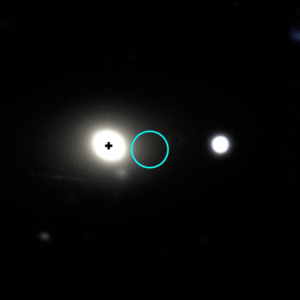



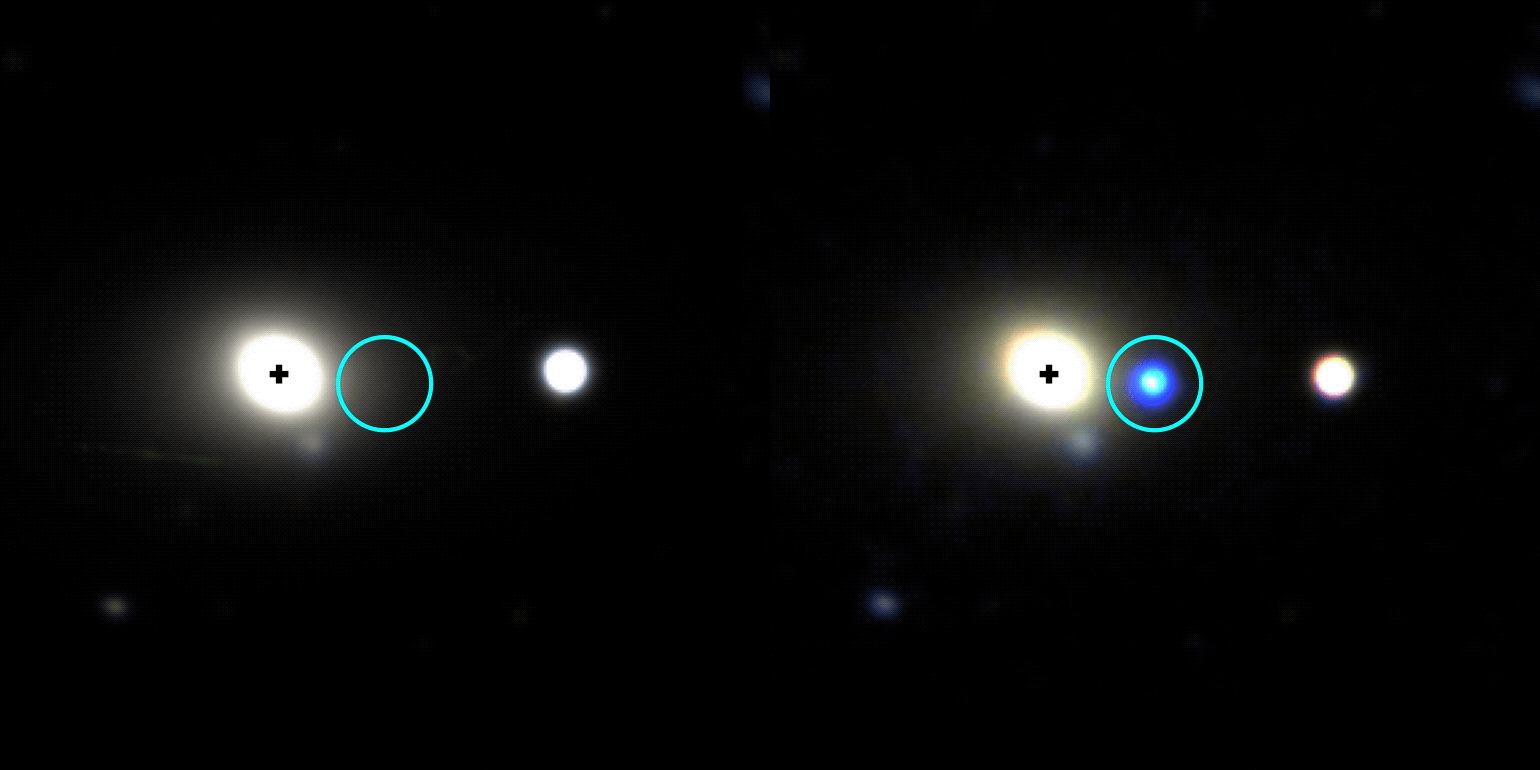
The Neil Gehrels Swift Observatory, a cornerstone of NASA’s multi-wavelength astronomical fleet, has achieved a groundbreaking observation: capturing an "orphan" supermassive black hole as it violently devoured a star on the distant fringes of a faraway galaxy. This rare phenomenon, known as a tidal disruption event (TDE), is inherently uncommon, but its detection so profoundly removed from a galaxy’s central core marks an unprecedented milestone in astrophysics, challenging conventional understanding of black hole distribution and galactic dynamics. This discovery not only provides direct evidence for the existence of supermassive black holes (SMBHs) wandering far from their typical galactic anchors but also validates a novel methodology for identifying these elusive cosmic behemoths.
Unveiling the Cosmic Predator: The Tidal Disruption Event
At the heart of this extraordinary observation lies a tidal disruption event (TDE), a cataclysmic cosmic ballet where a star, straying too close to a black hole, is ripped apart by immense gravitational forces. Such events are among the most energetic transient phenomena in the universe, briefly outshining entire galaxies. In this particular instance, the black hole responsible for the stellar demise boasts a mass approximately a million times that of our Sun, placing it firmly in the supermassive category. The raw power unleashed during this event was staggering; for several months, the TDE radiated with the luminosity of about 10 billion Suns in ultraviolet wavelengths, temporarily dominating the light profile of its entire host galaxy.
The physics behind a TDE are brutal yet elegant. As a star approaches a black hole beyond a critical distance, known as the tidal radius, the gravitational pull on the side of the star closer to the black hole becomes significantly stronger than on the farther side. This differential gravitational force, or "tidal force," stretches the star, elongating it into a spaghetti-like strand of gas—a process colloquially termed "spaghettification." A portion of this stellar material is then flung into space, while the remainder falls into the black hole, forming a superheated accretion disk around it. It is the intense friction and gravitational energy within this newly formed disk that generates the brilliant flares observed across the electromagnetic spectrum, from X-rays to radio waves, providing a temporary beacon for astronomers to detect these otherwise invisible black holes.
A Chronology of Discovery: From Flickers to Flares
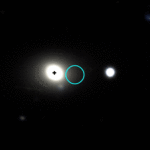
The journey to pinpoint this wandering black hole began in November 2025, when the Zwicky Transient Facility (ZTF), operated by the Palomar Observatory in Southern California, first flagged an unusual brightening in a galaxy located approximately 750 million light-years away. ZTF, renowned for its wide-field surveys of the night sky, specializes in detecting transient astronomical events – phenomena that change rapidly over time. It sifts through an immense volume of data, detecting up to half a million flashes each night.
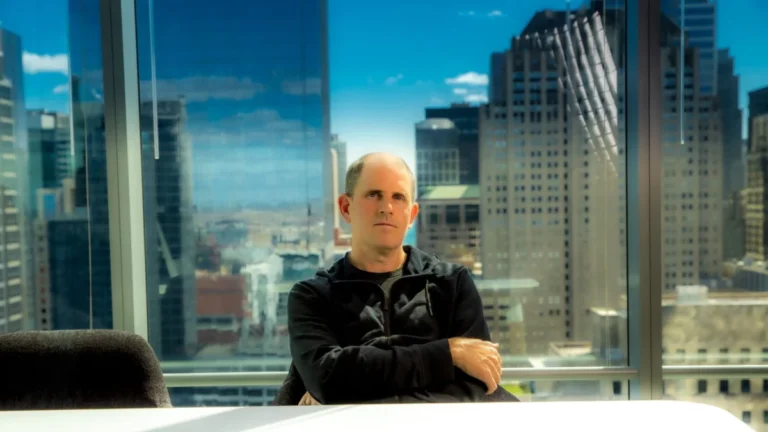
"Out of the half million flashes ZTF detects each night, our new artificial intelligence algorithm automatically recognized a flare that looked a lot like a tidal disruption event, despite its unusual location in the outskirts of a galaxy," explained Robert Stein, a research fellow at The University of Maryland, College Park, and NASA’s Goddard Space Flight Center in Greenbelt, Maryland, and the lead author of the paper describing these results. The application of advanced artificial intelligence algorithms has become indispensable in modern astronomy, enabling researchers to rapidly identify subtle patterns indicative of rare events amidst a deluge of observational data, thereby significantly accelerating the discovery process.
Following the initial detection by ZTF, a coordinated campaign of follow-up observations was initiated. Telescopes worldwide pivoted to examine the source, confirming its unusual characteristics. The Southern Astrophysical Research (SOAR) telescope in Chile played a crucial role, capturing the event’s spectrum. Spectral analysis, which breaks down light into its constituent wavelengths, revealed key features consistent with a TDE, offering strong preliminary evidence for the stellar destruction.
However, to fully characterize the event and rule out other explanations, astronomers turned to NASA’s Swift Observatory. Swift, equipped with instruments capable of observing across a broad spectrum, including ultraviolet and X-ray wavelengths undetectable by ground-based telescopes, provided critical complementary data. Swift’s Ultraviolet/Optical Telescope (UVOT) measured the temperature of the blip, revealing an astonishingly high temperature of approximately 54,000 degrees Fahrenheit (30,000 degrees Celsius). This extreme temperature, coupled with the unique spectral signatures, solidified the interpretation.
"The combination of all this data helped us rule out other explanations and confidently say it’s a tidal disruption event, despite its strange location," stated Jonathan Carney, a doctoral student at the University of North Carolina at Chapel Hill, whose early spectral observations were instrumental in supporting the TDE interpretation. The comprehensive multi-wavelength approach, leveraging both ground-based and space-based observatories, proved essential in confirming the nature of this extraordinary cosmic spectacle. The findings, led by Robert Stein, were formally published in The Astrophysical Journal Letters, marking a significant contribution to the field of transient astronomy.
The Enigma of the Wandering Black Hole
The true uniqueness of this discovery lies not just in observing a TDE, but in the location of the black hole itself. Nearly every large galaxy in the universe is believed to harbor a supermassive black hole at its very center, acting as a gravitational anchor around which stars and gas orbit. Tidal disruption events typically occur in these dense galactic cores, where the probability of a star straying too close to the central black hole is highest—roughly once every 100,000 years per galaxy. Astronomical surveys typically spot about 30 such events across millions of galaxies each year.
Prior to 2024, virtually all confirmed TDEs had been observed squarely within the central regions of galaxies. This was largely due to observational biases; astronomers naturally focused their search efforts where the known supermassive black holes resided, and lighter black holes lack the gravitational might to cause a full tidal disruption. However, a significant shift occurred in 2024 with the detection of a star being shredded approximately 2,600 light-years from the center of its host galaxy. That discovery served as a catalyst, inspiring astronomers to broaden their search parameters beyond the conventional galactic nuclei.
The current discovery pushes this boundary dramatically further: the black hole responsible for this TDE is located more than 30,000 light-years away from its host galaxy’s center, effectively placing it in the far outskirts, a region previously thought unlikely to host such a massive and active black hole. This unprecedented distance gives rise to its designation as an "orphan" or "wandering" black hole, challenging established models of galactic structure and black hole demographics.
So, how did a black hole weighing a million times the Sun’s mass end up so far from a galactic core? Researchers have outlined two primary hypotheses, both rooted in the violent and dynamic processes of galaxy evolution.
"It must have originated in a galaxy’s center, but not the one it’s in the outskirts of now," Stein postulated. "We think the host galaxy’s supermassive black hole is still at its core, but the one eating the star could have started off in a small galaxy that merged with the big one we see today."
The first possibility involves a complex scenario of multiple galactic mergers. When three or more galaxies collide and merge, the gravitational interactions between their respective central supermassive black holes can become incredibly chaotic. In such a cosmic "game of billiards," the lightest of the merging black holes can be gravitationally slingshotted out of the newly formed, larger galaxy, propelled into the intergalactic void or, as observed here, into its far-flung outskirts. Such gravitational recoils are predicted by theoretical models but have been notoriously difficult to observe directly.
The second scenario suggests that a smaller, dwarf galaxy might be in the midst of merging with a larger galaxy. As the dwarf galaxy is progressively torn apart by the gravitational forces of its larger companion, its constituent stars and its own central supermassive black hole are absorbed into the larger structure. In this process, a star from the dwarf galaxy could have passed too close to its own supermassive black hole, triggering the observed TDE, while both the star and the black hole were already displaced from their original galactic center and still on a trajectory within the merging system.
These hypotheses underscore the dynamic and often violent nature of galaxy formation, where gravitational interactions play a pivotal role in shaping the distribution and activity of black holes. The existence of such wandering black holes has profound implications for our understanding of how galaxies assemble over cosmic time and how black holes evolve within these merging structures.
NASA’s Swift Observatory: A Veteran’s Enduring Legacy
The Neil Gehrels Swift Observatory, launched in 2004, has been a workhorse in transient astronomy for over two decades, far exceeding its initial two-year primary mission. Its ability to rapidly slew to newly detected transient events and observe them across multiple wavelengths—from gamma-rays with its Burst Alert Telescope (BAT) to X-rays with its X-Ray Telescope (XRT) and ultraviolet/optical light with its UVOT—has made it invaluable for phenomena like gamma-ray bursts, supernovae, and, as demonstrated, tidal disruption events.
The recent discovery highlights Swift’s continued relevance, even as newer, more powerful observatories come online. Its UVOT and XRT instruments were critical in providing the multi-wavelength data necessary to confirm the TDE’s nature and characterize the black hole. However, after more than 20 years of continuous operation, Swift faces a new challenge. Due to atmospheric drag, the spacecraft is slowly but surely losing altitude.
"Pointed science observations with Swift’s UVOT and XRT instruments are temporarily suspended as the mission awaits an orbit boost, which is planned for this summer," noted co-author S. Bradley Cenko, Swift’s principal investigator at NASA Goddard. This orbital maneuver, a testament to the mission’s engineering resilience, is designed to propel Swift into a higher, more stable orbit, thereby extending its operational lifetime potentially for several more years. "Once it resumes normal operations, Swift could continue searching for more examples of out-of-place black holes," Cenko added, emphasizing the observatory’s ongoing potential to contribute to this emerging field of study. The extension of Swift’s mission is a strategic investment, allowing a proven platform to collaborate with next-generation observatories and contribute to a more comprehensive understanding of the transient universe.
Pioneering the Future: Next-Generation Observatories
The detection of this wandering black hole marks not just a singular discovery but also the validation of a new observational strategy that promises to revolutionize the hunt for similar phenomena. The current era of astronomy is characterized by the advent of powerful new observatories, both ground-based and space-based, designed to conduct wide, deep, and rapid surveys of the cosmos. These facilities are perfectly poised to build upon Swift’s pioneering work.
In the coming years, two particular observatories are anticipated to play a transformative role: the Vera C. Rubin Observatory in Chile and NASA’s Nancy Grace Roman Space Telescope.
The Vera C. Rubin Observatory, jointly funded by the U.S. Department of Energy and National Science Foundation, is poised to commence its Legacy Survey of Space and Time (LSST). This ambitious ten-year survey will image the entire visible sky every few nights with unprecedented depth and breadth. Its massive 8.4-meter primary mirror and exceptionally wide field of view will allow it to detect millions of transient events, including a significantly larger sample of TDEs than current observatories are capable of collecting. "Rubin’s wide, deep surveys will reveal a much larger sample of tidal disruption events than current observatories are capable of collecting, including ones that are off-center," Carney explained. This capability is crucial for identifying statistically significant numbers of off-center TDEs, which are essential for understanding the prevalence and distribution of wandering black holes.
Complementing Rubin’s wide-field optical capabilities will be NASA’s Nancy Grace Roman Space Telescope. Roman, scheduled for launch later this decade, is designed to conduct wide-field surveys in infrared wavelengths. Its unique optical design will provide a field of view 100 times larger than the Hubble Space Telescope, enabling it to capture vast swathes of the cosmos with remarkable sensitivity. "And Roman’s space-based surveys will extend the current search zone by seeing ones that are farther away, looking back through 9 billion years of cosmic history," Carney elaborated. By peering further back in time, Roman will offer insights into the distribution of wandering black holes in the earlier universe, potentially revealing how their prevalence has changed as galaxies have evolved and merged.
The synergy between these observatories is critical. While Rubin will provide a comprehensive census of relatively nearby TDEs across optical wavelengths, Roman will extend this search to greater cosmic distances and infrared wavelengths, allowing astronomers to probe different epochs of the universe and potentially detect events that are obscured by dust in the optical spectrum. Adding their observations to Swift’s and those from ground-based observatories will bring astronomers closer than ever before to completing a comprehensive census of the universe’s colossal black holes, both those anchored at galactic centers and those traversing the cosmic wilderness.
Broader Scientific Implications and Future Outlook
The discovery of this distant, wandering supermassive black hole through its destructive encounter with a star opens up a new frontier in black hole research and galaxy evolution studies. The key scientific question that now drives much of the research is: "How common are wandering black holes?" The answer to this question holds profound implications for several areas of astrophysics.
Firstly, understanding the abundance and distribution of these rogue black holes could redefine our models of galaxy formation and evolution. If wandering black holes are more common than previously thought, it suggests that galactic mergers play an even more significant role in shaping cosmic structures and scattering their central engines. It could also provide indirect evidence for the existence of intermediate-mass black holes, which are theorized to be the building blocks of supermassive black holes but have been incredibly difficult to detect.
Secondly, these observations could shed light on the dynamics of gravitational interactions within merging galaxies. The gravitational slingshot mechanism, while theoretically predicted, requires specific conditions and a precise dance of multiple black holes. Detecting more wandering black holes would provide crucial observational constraints for these complex simulations.
Thirdly, this new technique for detecting otherwise invisible supermassive black holes through their TDEs offers a powerful new tool in the astronomical toolkit. Many black holes, particularly those not actively accreting material, are extremely difficult to detect directly. TDEs provide a temporary, brilliant flare that can illuminate their presence, regardless of their location.
The future of black hole research, propelled by discoveries like this and empowered by the next generation of observatories, promises to be exceptionally dynamic. The quest to map the universe’s behemoth black holes, to understand their origins, their movements, and their impact on their host galaxies, is fundamental to unlocking the secrets of cosmic structure formation. As astronomers continue to refine their techniques and deploy increasingly sophisticated instruments, the answers to these profound questions may soon be within reach, offering an unprecedented view into the lives and migrations of the universe’s most enigmatic objects.
To learn more about the Swift mission, visit: https://nasa.gov/swift
By Ashley Balzer
NASA’s Goddard Space Flight Center, Greenbelt, Md.
Media contact:
Claire Andreoli
NASA’s Goddard Space Flight Center, Greenbelt, Md.
301-286-1940