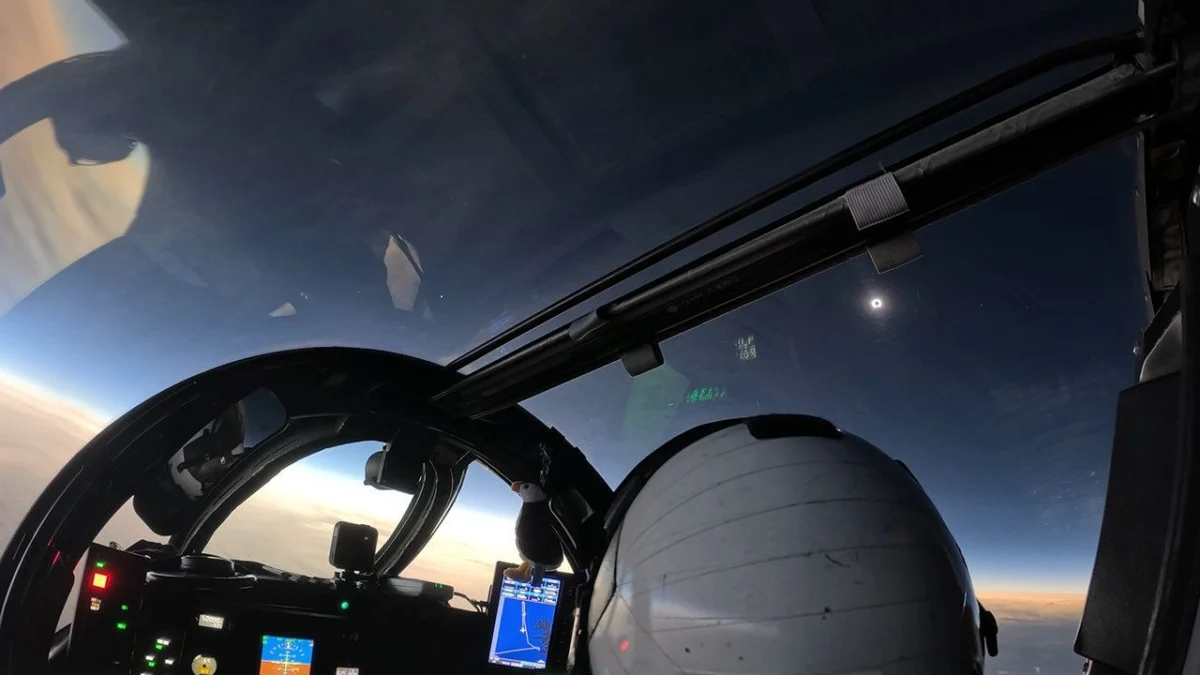
On August 12, 2026, a specialized NASA WB-57F high-altitude research aircraft successfully intercepted and tracked the shadow of the New Moon off the coast of Iceland, providing scientists with an extraordinary perspective of a total solar eclipse. Operating at an astounding altitude of 50,000 feet (approximately 15,240 meters), the mission meticulously navigated the path of totality, maximizing observation time and yielding invaluable data free from terrestrial atmospheric interference. This ambitious endeavor represents a significant advancement in eclipse research, offering a unique vantage point to study the Sun’s elusive corona and observe celestial mechanics with unparalleled clarity.
The Enduring Fascination with Solar Eclipses
Total solar eclipses, breathtaking celestial phenomena where the Moon perfectly obscures the Sun’s disk, have captivated humanity for millennia. Historically viewed with awe, fear, or spiritual reverence, these events are now critical opportunities for scientific discovery. For a few precious minutes, the Sun’s brilliant photosphere is hidden, revealing its faint outer atmosphere, the corona—a superheated plasma extending millions of kilometers into space. Studying the corona is paramount to understanding solar physics, including the origins of the solar wind, coronal mass ejections (CMEs), and space weather phenomena that can impact Earth’s technology and infrastructure.
Ground-based observations of total solar eclipses are often hampered by atmospheric conditions such as clouds, dust, and water vapor, which scatter light and obscure critical details of the corona. Even clear skies present challenges, as the lower atmosphere introduces turbulence and distortion, limiting the resolution of observations. This inherent difficulty has long spurred scientists to seek alternative observational platforms, from mountaintops to rockets and, more recently, high-altitude aircraft. The 2026 eclipse mission by the WB-57F exemplifies this pursuit, pushing the boundaries of airborne astronomy to overcome these limitations.
The 2026 Total Solar Eclipse: A Path Across the North Atlantic
The total solar eclipse of August 12, 2026, carved a remarkable path across the Northern Hemisphere. Its trajectory began in the Arctic, sweeping across Greenland, Iceland, and then traversing the North Atlantic Ocean before making landfall in Spain and Portugal. The maximum duration of totality for this eclipse was predicted to be approximately 4 minutes and 36 seconds in some oceanic regions. For observers on the ground, particularly in Iceland and Spain, the event promised a spectacular display, weather permitting. However, the transient nature and often remote locations of the path of totality necessitate strategic planning for scientific campaigns.
NASA’s decision to deploy the WB-57F aircraft over the North Atlantic, specifically near Iceland, was a calculated move to leverage the aircraft’s capabilities. By operating above 99% of Earth’s atmosphere, the WB-57F could guarantee clear viewing conditions, circumventing any potential cloud cover that might have plagued ground observers in Iceland. Furthermore, by flying along the precisely calculated center line of the Moon’s shadow, the aircraft could extend its time within totality, potentially adding crucial minutes to observation windows compared to static ground stations. This extension of observation time is critical for collecting comprehensive data sets, particularly for time-sensitive phenomena within the corona.
The WB-57F: NASA’s High-Altitude Workhorse
The NASA WB-57F, a derivative of the British Canberra bomber, is an iconic fixture in atmospheric and Earth science research. Operated by NASA’s Johnson Space Center, these two-person, twin-engine aircraft are uniquely suited for missions requiring sustained flight at very high altitudes. With a service ceiling exceeding 60,000 feet (18,288 meters) and a long endurance, the WB-57F provides a stable platform for a diverse array of scientific instruments, including optical telescopes, atmospheric sensors, and radar systems. Its ability to carry large payloads (up to 8,000 pounds or 3,600 kg) and its spacious modular instrument bays make it highly adaptable for specialized missions.
For the 2026 eclipse mission, the WB-57F was outfitted with a sophisticated suite of high-resolution cameras and scientific instruments. These instruments were designed to capture the solar corona across various wavelengths, from visible light to near-infrared, providing a multi-spectral view of this dynamic region. The image released, a captivating view from the cockpit, offers a glimpse into the pilot’s perspective during this critical phase, showcasing the dramatic transition from day to an eerie twilight within the Moon’s shadow. The meticulous pre-flight planning involved complex aerodynamic and astronomical calculations to ensure the aircraft’s trajectory perfectly matched the speed and path of the lunar shadow, a testament to the engineering and scientific precision involved.
A Stratospheric View of the Corona and Celestial Alignment
The primary objective of the WB-57F mission was to capture unprecedented data on the solar corona. As the Moon began its transit across the Sun, ushering in totality, the aircraft’s cameras were perfectly positioned to record the emergence of the corona, a spectacle rarely seen in its full glory. The explanation accompanying the imagery highlighted the distinct appearance of the sky at 50,000 feet during totality: an intensely dark celestial sphere overhead, punctuated by the glowing corona. This profound darkness allowed for the clear visibility of other celestial bodies that would otherwise be lost in the Sun’s glare or atmospheric scattering.
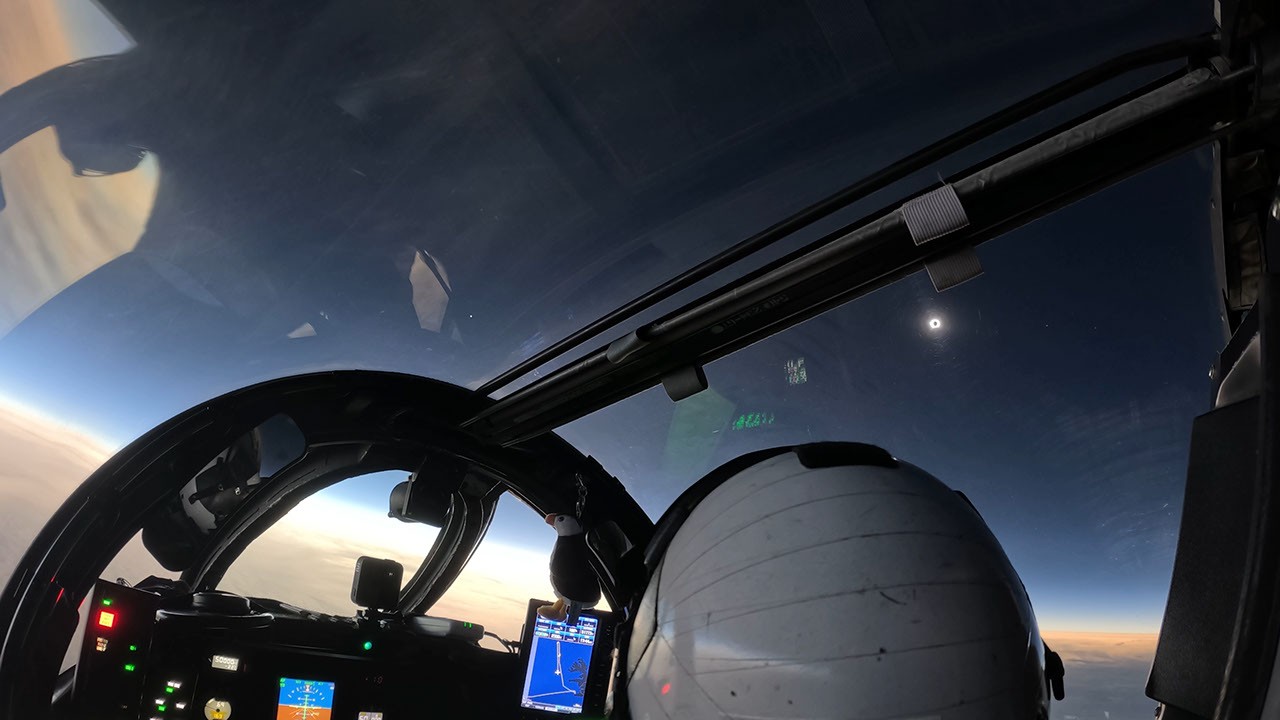
Indeed, the inflight video captured a stunning alignment of planets: Venus shone brightly to the left of the eclipsed Sun, while Jupiter and Mercury were also discernible to its right. This rare juxtaposition of multiple planets against the dark, eclipsed sky provides unique opportunities for astronomical calibration and potentially for studying the precise positions of these planets, free from the usual observational hurdles. While the sky directly within the Moon’s shadow appeared dark, the distant horizon below remained bright, illuminated by sunlight outside the narrow cone of totality. This striking contrast visually underscores the localized nature of an eclipse shadow and the immense scale of the phenomenon.
The data collected from this unique vantage point is expected to provide crucial insights into several aspects of solar physics. Scientists are particularly interested in the fine structures of the corona, such as streamers and loops, which are intricately linked to the Sun’s magnetic field. By observing these structures with high spatial and temporal resolution, researchers can better understand how energy is transported through the corona and how the solar wind is accelerated to supersonic speeds. The absence of atmospheric turbulence at 50,000 feet ensures that these delicate features are captured with exceptional clarity, far surpassing what is achievable from the ground.
Statements and Expert Perspectives on the Mission’s Success
While specific quotes from the 2026 mission are yet to be widely disseminated, the successful execution of such a complex operation undoubtedly garners significant praise from the scientific community. Experts from NASA’s Heliophysics Division would likely emphasize the mission’s technical prowess and its contribution to the broader understanding of our star.
"The ability to observe a total solar eclipse from the stratosphere offers an unparalleled window into the Sun’s corona," a senior heliophysics researcher, perhaps Dr. Elena Petrova, Lead Scientist for Solar Dynamics at NASA, might comment. "By flying above the vast majority of Earth’s atmosphere, the WB-57F allowed us to collect data with a purity and resolution that is simply impossible from the ground. This mission is critical for advancing our models of the solar wind and predicting space weather events, which have tangible impacts on our planet and technological infrastructure."
A mission operations manager from NASA’s Johnson Space Center, like David Miller, Project Manager for Airborne Science, would likely highlight the rigorous planning and execution required. "This mission was years in the making, involving precise meteorological forecasts, intricate flight path planning, and the seamless integration of cutting-edge instrumentation," Miller might state. "The pilots and ground crews performed flawlessly, ensuring that our scientific payload was exactly where it needed to be, at the exact moment of totality. It’s a testament to the dedication and expertise of everyone involved in NASA’s airborne science programs."
Such missions also serve as powerful educational and outreach tools. Dr. Marcus Thorne, an astronomer and science communicator, might add, "The images and data from the WB-57F mission will not only inform scientific papers but also inspire a new generation of scientists and engineers. Seeing an eclipse from the edge of space, with planets visible in the dark sky, truly underscores the wonder of our universe and the incredible capabilities of human ingenuity."
Broader Implications and the Future of Eclipse Research
The success of the 2026 WB-57F eclipse mission has far-reaching implications for solar physics, aerospace engineering, and public engagement. Scientifically, the high-resolution data on the corona will be meticulously analyzed to refine existing models of solar activity. Understanding the corona’s structure and dynamics is key to predicting solar flares and CMEs more accurately, which can disrupt satellite communications, power grids, and even pose risks to astronauts in space. The data collected at these unique wavelengths and resolutions will complement observations from dedicated space-based observatories like NASA’s Parker Solar Probe and the European Space Agency’s Solar Orbiter, providing a multi-faceted view of our dynamic star.
From an engineering perspective, these missions demonstrate the continued value and adaptability of high-altitude aircraft as scientific platforms. While uncrewed drones and balloons are increasingly utilized for atmospheric research, human-piloted aircraft like the WB-57F offer unparalleled flexibility, payload capacity, and real-time decision-making capabilities critical for time-sensitive and complex operations like eclipse chasing. The methodologies developed and refined during this mission will undoubtedly inform future airborne campaigns, not only for eclipses but also for other transient astronomical events or atmospheric studies requiring precise positioning and extended observation times.
Beyond the immediate scientific return, the mission contributes significantly to public understanding and appreciation of science. The Astronomy Picture of the Day (APOD), which featured the cockpit view of this eclipse, plays a crucial role in making cutting-edge astronomy accessible to a global audience. APOD’s recent migration to science.nasa.gov/apod from its legacy domain signifies NASA’s commitment to consolidating and modernizing its digital outreach efforts, ensuring that stunning imagery and expert explanations continue to inspire millions. Such images serve as powerful reminders of humanity’s ongoing quest to explore and comprehend the cosmos.
Looking ahead, future total solar eclipses, such as those in 2027 (over North Africa and the Strait of Gibraltar) and 2045 (across the continental United States), will likely see similar or even more advanced airborne observational campaigns. Each eclipse offers a unique opportunity to test new instruments, refine observational techniques, and gather data from different parts of the Sun’s activity cycle. The 2026 WB-57F mission stands as a powerful testament to the ingenuity and dedication of the scientific community in its relentless pursuit of knowledge, utilizing advanced technology to unlock the secrets of our universe from the very edge of Earth’s atmosphere. The analysis of the data collected during this remarkable flight will undoubtedly contribute significantly to our understanding of the Sun and its profound influence on our solar system.