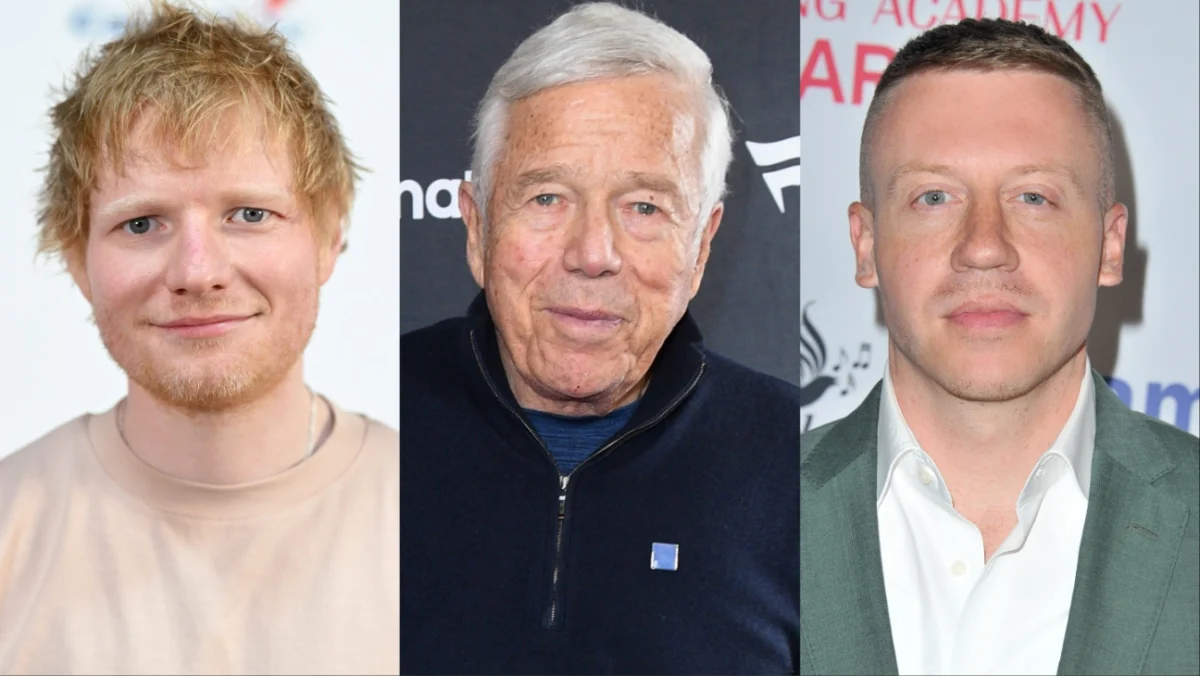
The controversy surrounding Grammy-winning artist Macklemore’s pro-Palestinian statements and his subsequent removal from Ed Sheeran’s "Mathematics Tour" (also referred to as the "Loop Tour") continues to unfold, with new details emerging that suggest assurances were made to NFL stadium owners that the rapper would refrain from further commentary on the issue of Palestine. These reports cast a revealing light on the behind-the-scenes negotiations and pressures that ultimately led to Macklemore’s dismissal from the tour, impacting not only the artists involved but also raising broader questions about artistic expression, venue policies, and the intersection of music and geopolitics.
The latest revelations stem from a detailed report published by The Wall Street Journal, which delves into the communications that transpired between Ed Sheeran’s tour promoters, Messina Touring Group, and owners of various NFL stadiums where the tour was scheduled to perform. According to the report, following Macklemore’s on-stage declaration of "Free Palestine" and his performance of his pro-Palestinian song "Hind’s Hall" at MetLife Stadium on September 4th, a chorus of concerns was raised by prominent figures in the NFL ownership community. These individuals, including Robert Kraft, the owner of the New England Patriots and Gillette Stadium, reportedly communicated their unease to the tour promoters.
Escalating Tensions and Alleged Assurances
The core of the new reporting centers on the alleged assurances provided to these stadium owners. Following Macklemore’s initial statement at MetLife Stadium, representatives acting on behalf of Robert Kraft and other influential NFL stadium owners, such as David Tepper of the Carolina Panthers, Arthur Blank of the Atlanta Falcons, and Jeffrey Lurie of the Philadelphia Eagles, reportedly reached out to Messina Touring Group. The primary objective of these communications was to address the overtly political nature of Macklemore’s remarks. The Wall Street Journal claims that in these discussions, the stadium owners were assured that Macklemore, who was initially slated to be an opening act for ten dates on Sheeran’s tour, would not repeat his public statements regarding Palestine during his subsequent performances. This alleged commitment appears to have been a critical factor in securing continued venue access for the tour.
However, these alleged assurances were seemingly contradicted by Macklemore’s actions at the subsequent MetLife Stadium concert on September 5th. During this performance, the artist explicitly addressed his decision to join the tour, stating, "One of the reasons why I wanted to come on this tour was because I wanted to stand up here on stages and stadiums across America and say two words that are very near and dear to my heart: Free Palestine! I want to say this to all of my Jewish brothers and sisters. Criticism of Israel, criticism of apartheid, being against genocide in no way is a criticism of you." This more emphatic and public declaration reignited the controversy and placed the promoters in a difficult position.
The Catalyst for Removal: A Forty-Minute Phone Call
The gravity of the situation escalated to the point where Robert Kraft himself reportedly engaged in a lengthy phone call with Ed Sheeran to discuss the unfolding controversy. The 40-minute conversation, as detailed by The Wall Street Journal, highlighted Kraft’s perspective. While expressing sympathy for the Palestinian people, Kraft reportedly conveyed his view that Macklemore’s comments constituted hate speech rather than an exercise of free speech. This characterization of the remarks by a prominent figure with significant influence over venue access is seen as a pivotal moment in the sequence of events.
The fallout from Macklemore’s statements was swift and multifaceted. News outlets widely reported on his remarks, and various advocacy groups and individuals called for his removal from the tour. The Israeli-American Council, for instance, formally petitioned Ed Sheeran to drop the rapper. Additional pressure came from organizations like StopAntisemitism and the Combat Antisemitism Movement, as well as public figures like the singer Pink, who also voiced concerns and supported calls for Macklemore’s dismissal. The cumulative effect of this public and private pressure created an untenable situation for the tour promoters.
The Official Statement and Macklemore’s Departure
Faced with mounting media scrutiny and the very real threat of tour cancellations due to venue refusals, Messina Touring Group issued a statement on September 14th, confirming Macklemore’s removal from the remaining eight U.S. tour dates. In their statement to Rolling Stone, the promoters articulated the rationale behind their decision: "As the concert promoter for Ed Sheeran’s U.S. Loop Tour, we have been notified by venues on the upcoming U.S. tour dates that they will not allow a concert to take place with Macklemore on the lineup, which would result in the cancellation of the tour and impact hundreds of thousands of fans. After discussions with stakeholders, Macklemore will not be performing on the remaining support dates." This statement emphasized that the decision was driven by venue mandates and the potential for widespread disruption, rather than a direct directive from Ed Sheeran himself.
In the wake of his removal, Macklemore released a comprehensive statement on Instagram, addressing the controversy and its implications. He began by asserting his position, stating, "Before I get into it, I want to say something that should be obvious. In this moment I think it matters. I am not a victim. Ed Sheeran is not a victim. Pink is not a victim. We have careers, money, opportunities, safety and audiences around the world. Whatever consequences any of us face for what we say, we get to go home to our families. The victims are the Palestinian people." His statement underscored a broader perspective on privilege and the ongoing humanitarian crisis, positioning himself and his fellow artists as far removed from the suffering of those affected by the conflict.
Ed Sheeran’s Response and Broader Ramifications
Ed Sheeran also issued a statement following Macklemore’s removal, clarifying his position and the events that transpired. He explained, "After Macklemore’s performances at my New Jersey shows, venues on my upcoming tour communicated that they would pull the shows if he was still supporting. I was informed that this stance was based on how Macklemore conveyed part of his message during his performance, rather than on everything that was said. I spoke with the venues at length all week to try and build a bridge. One of those people was Robert Kraft. I was also involved in direct talks with promoters along with activists on both sides to try and find a mutual resolution for all, but the venue’s and promoter’s decision was final." Sheeran emphasized that Macklemore’s departure was a decision made by the promoter, not by him directly, and that Macklemore’s contract was with the promoter, not with Sheeran himself.
The repercussions of Macklemore’s dismissal extended beyond the immediate artists involved. In a significant show of solidarity, other opening acts and members of Ed Sheeran’s touring party, including Finneas, Lukas Graham, Aaron Rowe, and the backing band Beoga, collectively withdrew from the remaining tour dates. This coordinated departure underscored a shared sentiment among some artists regarding the perceived silencing of political expression and highlighted the deep divisions that the controversy had exposed within the touring ecosystem.
Financial Repercussions and a Generous Gesture
Adding another layer to the unfolding narrative, Macklemore announced on September 16th that he would be donating his earnings from his appearances on the Loop Tour, estimated to be approximately $1 million, to six organizations dedicated to supporting Palestinians. In a notable move, he publicly called on Robert Kraft to match his donation. Kraft responded swiftly and generously, reportedly donating $2 million. This financial gesture, while separate from the artistic and political debate, demonstrated a willingness from Kraft to engage with the humanitarian aspect of the issue, albeit in a different forum than the concert stage.
Contextualizing the Controversy
The Macklemore incident is not an isolated event but rather a flashpoint within a broader, ongoing global conversation about the Israeli-Palestinian conflict. For years, artists have navigated the complex terrain of expressing solidarity with Palestinian rights, often facing intense scrutiny, accusations of antisemitism, and professional repercussions. The use of music and performance spaces for political advocacy has a long history, but the current geopolitical climate and the pervasive nature of social media have amplified these debates, making them more visible and contentious.
Macklemore, known for his socially conscious lyrics and activism, has previously used his platform to address issues of justice and equality. His decision to perform "Hind’s Hall," named after the Gaza university that was a site of pro-Palestinian protests, and to explicitly call for the liberation of Palestine, placed him directly at the center of this highly charged political discourse. The song itself, a reworking of Pink Floyd’s "Another Brick in the Wall," directly critiques the actions of Israeli forces and calls for an end to the occupation.
The involvement of NFL stadium owners adds another dimension to the controversy. These venues are often privately owned or managed by entities with significant business interests, and they operate under a framework that prioritizes economic viability and avoiding public relations crises. The reported assurances given to these owners suggest a clear intention to maintain a neutral or apolitical environment within their facilities, a stance that directly clashed with Macklemore’s commitment to using his performances for political expression.
Analyzing the Implications
The Macklemore controversy has several significant implications:
- Artistic Freedom vs. Venue Policy: The incident highlights the ongoing tension between an artist’s right to express their views and the policies and pressures faced by venues and promoters. While artists may feel a moral imperative to speak out on pressing global issues, they must also contend with the practical realities of securing performance spaces and maintaining professional relationships.
- The Power of Advocacy Groups: The swift mobilization of advocacy groups and the effectiveness of their pressure campaigns demonstrate the significant influence these organizations wield in shaping public discourse and influencing corporate decisions in the entertainment industry.
- Geopolitical Polarization in the Arts: The intense reactions and divisions sparked by Macklemore’s statements underscore the deep polarization surrounding the Israeli-Palestinian conflict and its increasing infiltration into cultural and artistic spheres.
- Promoter Responsibility: The role of promoters like Messina Touring Group in mediating between artists, venues, and public pressure is crucial. Their decision-making process, as described, reflects a difficult balancing act aimed at preserving the tour’s viability while navigating sensitive political issues.
- The "Boycott, Divestment, Sanctions" (BDS) Movement: While not explicitly mentioned in the initial reporting, the context of pro-Palestinian activism often intersects with discussions around the BDS movement, which advocates for economic and cultural pressure against Israel. Macklemore’s statements align with the broader goals of this movement, which has itself been a subject of considerable debate and controversy.
In conclusion, the ongoing revelations regarding alleged assurances given to NFL stadium owners add a critical layer of understanding to the complex circumstances surrounding Macklemore’s departure from Ed Sheeran’s tour. The incident serves as a potent reminder of the challenges artists face when their political convictions intersect with the business and policy considerations of the entertainment industry, and it continues to fuel a broader conversation about the role of art in advocating for social and political change. The reverberations of this controversy are likely to be felt within the music industry and beyond for some time to come.