


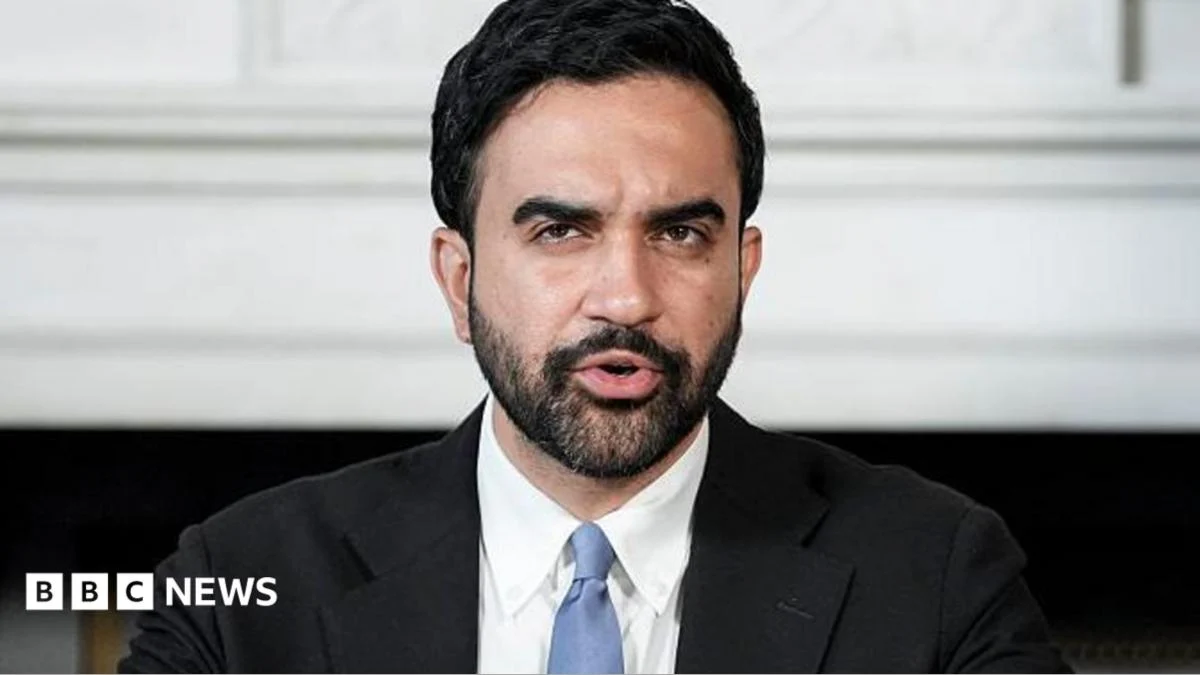
New York City Mayor Zohran Mamdani, who during his mayoral campaign unequivocally pledged to order the arrest of Israeli Prime Minister Benjamin Netanyahu if he were to visit the city, has now publicly acknowledged that his office lacks the independent legal authority to enforce such an action. The mayor’s reversal, communicated via a social media video, follows a period of intense public and political scrutiny sparked by his earlier remarks and a subsequent interview where he indicated ongoing discussions with law enforcement regarding the possibility of executing an International Criminal Court (ICC) arrest warrant. Instead of a direct arrest, Mamdani is now calling upon the United States federal government to join the ICC and enforce the warrant for alleged war crimes.
This evolving position highlights the intricate interplay between local political aspirations, international law, and the realities of federal jurisdiction, especially concerning foreign heads of state. The controversy underscores the significant legal and diplomatic hurdles involved in the enforcement of international warrants within a non-member state like the United States, and it has ignited a renewed debate over the US’s relationship with the ICC amidst shifting public opinion on the Israeli-Palestinian conflict.
The Genesis of the Controversy: Mamdani’s Campaign Pledge and Subsequent Clarification
Zohran Mamdani, a prominent figure within the progressive wing of the Democratic Party and a vocal critic of Israel’s actions in Gaza, made headlines during his mayoral campaign with a bold promise. He repeatedly characterized Benjamin Netanyahu as a "war criminal" and the conflict in Gaza as a "genocide," vowing that if elected, he would direct the New York City Police Department (NYPD) to arrest Netanyahu should the Israeli Prime Minister set foot in the five boroughs. In an interview with the New York Times during his candidacy, Mamdani explicitly stated, "This is something that I intend to fulfill," asserting that such an arrest would honor a warrant issued by the ICC. These statements resonated with a segment of his progressive voter base, reflecting a growing discontent with US foreign policy regarding Israel.
However, the practical and legal implications of such a pledge quickly became apparent. Mayoral authority, while significant in local governance, is fundamentally subordinate to federal law, particularly concerning international relations, foreign policy, and the treatment of foreign dignitaries. The notion of a municipal leader unilaterally enforcing an international arrest warrant against a sitting head of government, especially in a nation not party to the ICC’s founding treaty, was met with skepticism from legal experts and seasoned politicians alike.
On Tuesday, following an internal review, Mayor Mamdani released a video clarifying his position. He stated that his team had meticulously examined "every avenue available" under the law and concluded, "we do not have the independent legal authority to enforce this." He explicitly pointed to the federal government as possessing the necessary jurisdiction, urging them to "join the ICC and execute this warrant." While retracting his ability to act directly, Mamdani reiterated his strong opposition to Netanyahu’s presence in New York City, asserting that the Israeli leader was "not welcome," particularly ahead of his anticipated visit for the United Nations General Assembly (UNGA) in September.
The International Criminal Court’s Mandate and the Warrant Against Netanyahu
The International Criminal Court (ICC), established by the Rome Statute in 2002, is the world’s first permanent international criminal court with jurisdiction to prosecute individuals for the most serious international crimes: genocide, crimes against humanity, war crimes, and the crime of aggression. Its mandate extends to individuals accused of these crimes on the territory of states party to the Rome Statute, or by nationals of states party, or when a situation is referred to it by the UN Security Council.
In 2024, the ICC issued an arrest warrant for Benjamin Netanyahu, alongside his defense minister Yoav Gallant, over alleged war crimes and crimes against humanity in the Gaza Strip. Concurrently, warrants were also issued for several Hamas leaders, including Yahya Sinwar, Mohammed Deif, and Ismail Haniyeh, on similar charges. The charges against Netanyahu and Gallant include starvation of civilians as a method of warfare, willfully causing great suffering, willful killing, persecution, and other inhumane acts. These warrants were issued following an extensive investigation by the ICC Prosecutor’s office into events unfolding since October 7, 2023, and the subsequent Israeli military operation in Gaza.
Crucially, the ICC relies on the cooperation of its 124 member states for the enforcement of its warrants. If a person subject to an ICC arrest warrant enters the territory of an ICC member state, that state is legally obligated to arrest and surrender them to the court in The Hague. However, the United States is not a party to the Rome Statute. This non-membership significantly complicates any attempt to enforce an ICC warrant within US borders, placing the responsibility squarely on the federal government, which has historically maintained a complex and often adversarial relationship with the ICC.
The United States’ Stance on the ICC: A History of Non-Cooperation
The United States has a long-standing and nuanced relationship with the ICC, characterized primarily by its decision not to ratify the Rome Statute. While the Clinton administration signed the treaty in 2000, President George W. Bush subsequently "unsigned" it in 2002, citing concerns about potential politically motivated prosecutions of US service members and officials. Subsequent administrations, including Obama’s, adopted a policy of "positive engagement" on a case-by-case basis, but without full membership.
The Trump administration took a particularly hostile stance towards the ICC, imposing sanctions on court officials and threatening further punitive measures, especially when the court sought to investigate alleged war crimes by US personnel in Afghanistan or by Israelis in Palestine. President Donald Trump, responding to Mamdani’s initial comments, emphatically stated that Netanyahu would not be "arrested, in any way, shape or form" while in the US. In a Truth Social post, Trump defended Netanyahu by linking him to a fight against the Islamic Republic of Iran, claiming Iran "recently killed 52,000 innocent protestors [sic], and has spent the last 47 years killing American Soldiers, and others." This statement underscores the strong political protection Netanyahu enjoys from significant factions within the US political establishment, particularly among Republicans.
The US position is rooted in concerns over sovereignty, the scope of the court’s jurisdiction, and the belief that the American justice system is robust enough to handle any alleged misconduct by its citizens. This stance means that while the US supports the concept of international justice in principle, it rejects the ICC’s authority over its own citizens or in situations where it perceives its national interests to be challenged. Consequently, there is no legal framework or obligation for the US federal government to enforce an ICC arrest warrant. Any such enforcement would require a significant shift in US foreign policy and domestic law, an unlikely prospect given current political realities.
Reactions from Key Stakeholders and Diplomatic Implications
Mayor Mamdani’s initial pledge and subsequent clarification have drawn a range of reactions from various political and diplomatic circles. Beyond former President Trump’s immediate and forceful rejection, the Israeli government has also weighed in. Danny Danon, the Israeli ambassador to the UN, directly criticized Mamdani, stating, "You were elected to serve New Yorkers, not Hamas’ propaganda." This sharp rebuke reflects Israel’s consistent position that the ICC lacks jurisdiction over its citizens and that its investigations are politically motivated and biased.
The episode also highlights the growing divide within the Democratic Party regarding Israel. A recent Associated Press poll indicated a significant shift in Democratic voter sentiment, with 58% now believing the US is too supportive of Israel, a notable increase from 45% in 2024. This trend provides a political backdrop for Mamdani’s strong anti-Netanyahu stance, suggesting he is tapping into a genuine, albeit evolving, current within his party’s base. For progressive politicians, taking a hard line against Netanyahu and advocating for accountability aligns with broader calls for human rights and international law.
However, the legal limitations of a mayor in such a situation are undeniable. Legal scholars and former diplomats have consistently pointed out that arresting a foreign head of state, particularly one who may enjoy diplomatic immunity, falls under the exclusive purview of the federal government, specifically the State Department and federal law enforcement agencies. Even without full diplomatic immunity (which is typically granted to heads of state on official visits), the principle of sovereign immunity often applies, further complicating any local legal action.
Broader Impact and Implications for US Foreign Policy and Domestic Politics
The saga surrounding Mayor Mamdani’s statements carries several significant implications. Domestically, it illuminates the growing chasm between local progressive activism and federal foreign policy, particularly concerning the Israeli-Palestinian conflict. While mayors and city councils can pass resolutions and make symbolic gestures, their practical power to influence international relations is severely constrained. This incident serves as a stark reminder of those boundaries.
For US foreign policy, the debate reinforces the country’s unique and isolated position regarding the ICC. While the US frequently advocates for accountability for war crimes and crimes against humanity globally, its non-membership in the ICC means it cannot directly leverage the court’s mechanisms. Calls from figures like Mamdani for the federal government to join the ICC or enforce its warrants will likely add to the pressure from international human rights organizations and some allied nations for the US to reconsider its stance, though a fundamental shift remains unlikely in the short term. The US typically prefers to use its own justice system or ad hoc international tribunals for such matters, maintaining control over the process.
The timing of this controversy, ahead of Netanyahu’s expected visit to the UN General Assembly in September, adds another layer of diplomatic complexity. The UNGA is a critical forum for international diplomacy, and the presence of numerous heads of state necessitates robust security and adherence to diplomatic protocols. Any attempt, however symbolic, to disrupt a visiting head of state would have significant diplomatic ramifications, potentially straining relations not only with Israel but also with other nations that rely on the inviolability of such international gatherings.
Moreover, the debate touches upon the very nature of international law enforcement in a world where powerful nations often operate outside the direct jurisdiction of global bodies. The ICC’s ability to hold powerful figures accountable remains a significant challenge, particularly when non-member states, especially those with considerable global influence, are involved.
In conclusion, Mayor Zohran Mamdani’s journey from pledging to arrest Benjamin Netanyahu to acknowledging his lack of authority reflects a complex convergence of local political ambition, the realities of international law, and the unique position of the United States on the global stage. While his initial promise energized a specific political base, his eventual clarification underscores the enduring primacy of federal authority in matters of foreign policy and international diplomacy. The incident serves as a potent reminder of the ongoing debates surrounding the ICC’s legitimacy, the shifting dynamics of US public opinion on Israel, and the inherent limitations of local governance in the realm of international affairs. As Netanyahu’s potential visit to the UN General Assembly approaches, the focus will now shift to Washington and the federal government’s unwavering stance on its non-cooperation with the International Criminal Court.