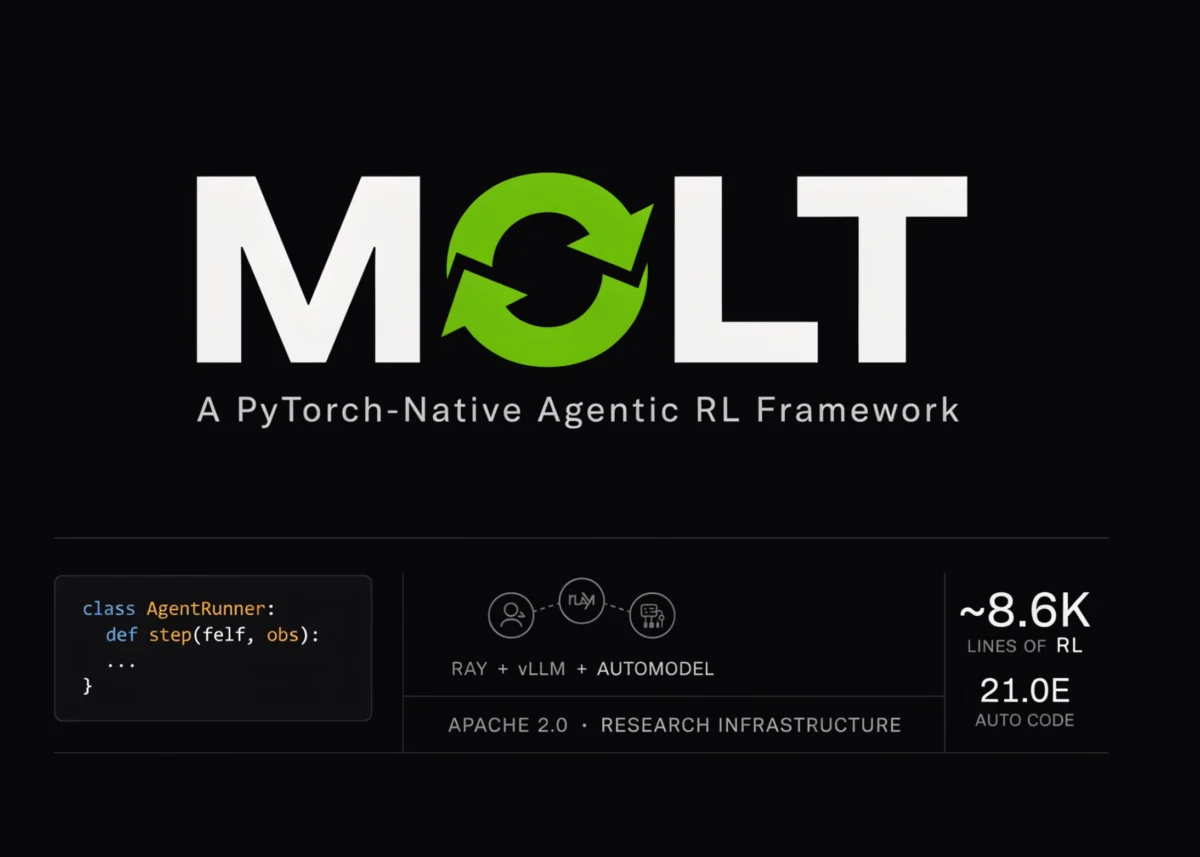
The landscape of agentic reinforcement learning (RL) has long been characterized by a paradox: while the field demands constant, rapid iteration of algorithms, estimators, and rollout schemes, the underlying software frameworks have become increasingly monolithic and difficult to modify. To address this friction, the NVIDIA NeMo team has released Molt, a PyTorch-native agentic RL framework designed specifically to lower the cognitive and technical overhead for researchers. By prioritizing a compact codebase and a "zero-fork" integration strategy, Molt aims to bridge the gap between high-performance distributed training and the flexibility required for cutting-edge experimental research.
The Research Overhead in Modern Reinforcement Learning
In contemporary machine learning, reinforcement learning from human feedback (RLHF) and agentic RL—where models interact with environments, tools, or other models—have become the standard for post-training large language models (LLMs). However, the infrastructure required to execute these processes at scale is notoriously complex. Standard frameworks often require researchers to navigate deep abstractions across trainers, distributed backends, and rollout "glue" code. Every minor adjustment to an algorithm can necessitate changes across multiple layers of the stack, a cost that compounds over every research iteration.
Molt targets this specific pain point. Developed by NVIDIA’s NeMo labs, the framework is built with an unusual design constraint: the codebase must be small enough for a single researcher to hold in their head and for an AI coding assistant to process within a single context window. This focus on "reasonability" is a direct response to the increasing reliance on LLM-based coding tools, which struggle with the sprawling repositories common in enterprise-grade ML infrastructure.
Comparative Footprint and Framework Positioning
The design philosophy of Molt is best illustrated by its code volume. NVIDIA researchers utilized a method of tracing the import graph from each framework’s RL entry point to determine the actual volume of code a developer must interact with. Under this metric, Molt occupies approximately 8,600 lines of RL-specific code.
When compared to other prominent frameworks in the ecosystem, the difference in scope becomes clear:
- verl: Approximately 62,000 lines of code.
- slime: Approximately 25,000 lines of code.
- OpenRLHF: Approximately 7,200 lines of code.
While OpenRLHF maintains a slightly smaller footprint, Molt distinguishes itself by its specific focus on agentic workflows and its integration with NVIDIA’s specialized hardware acceleration libraries. Unlike many "all-in-one" frameworks that fork external libraries to ensure compatibility, Molt adopts a "compositional" approach. It utilizes Ray for distributed placement, vLLM for high-throughput rollout, and NVIDIA AutoModel with Fully Sharded Data Parallel 2 (FSDP2) for training—all without forking the original source code. This ensures that improvements in those upstream libraries can be integrated simply by updating a container pin, rather than performing a complex code rebase.
Architectural Framework: Three Components, One Loop
The Molt runtime environment is structured as a streamlined loop involving three primary actors: an agent pool, a set of vLLM engines, and a single trainable policy actor. To maintain high hardware utilization, Molt employs a streaming pool mechanism that keeps prompt groups in flight. This prevents the vLLM engines from "draining"—sitting idle while waiting for the trainer—and ensures that the training actor remains saturated with data.
One of the more innovative aspects of the Molt architecture is its handling of partial rollouts. In many RL setups, if a training step is required mid-trajectory, the rollout engines must often discard their current state and restart. Molt avoids this by pausing the engines, broadcasting updated actor shards over the NVIDIA Collective Communications Library (NCCL) directly to each engine, and then resuming the retained requests. This "in-place" update significantly reduces the temporal overhead associated with weight synchronization in distributed environments.
The Evolution of the Agentic Interface
Molt shifts the paradigm of what constitutes an "agent" in an RL framework. Rather than forcing the researcher to conform to a rigid API, an RL run in Molt simply identifies a Python module that exports an AgentRunner class. This allows the agent’s logic to remain "ordinary code," including the implementation of reward functions and tool-use logic.
The framework supports two primary interaction modes:

- Env Mode: Aligned with the traditional Gymnasium (formerly OpenAI Gym) interface, the framework manages the LLM loop within a standard
step()function. This is ideal for classic RL tasks where the environment is a well-defined external system. - ChatAgent Mode: Designed for modern agentic workflows, this mode allows the user to own the loop using standard OpenAI or Anthropic SDKs. Molt facilitates this by launching a loopback server that speaks both wire protocols. Every request is decoded server-side into a "token-exact" accumulation, ensuring that the researcher has total control over the interaction history while the framework handles the underlying RL mechanics.
This flexibility is particularly relevant for long-horizon agents. When an agent compacts its context or rewrites a prefix to save on token costs, the Molt server automatically seals the current segment and opens a fresh one, maintaining the integrity of the training data without requiring manual intervention from the researcher.
Technical Invariants for Training Correctness
To ensure that the efficiency of the framework does not come at the cost of mathematical rigor, Molt is organized around three core correctness invariants. These invariants address the subtle bugs that often plague distributed RL implementations:
1. Token Identity: The framework ensures that sampled token IDs define the trajectory, rather than a retokenized transcript. Retokenization can lead to subtle shifts in meaning or formatting that degrade the quality of the policy gradient.
2. Policy-Version Semantics: In asynchronous training, it is vital that trainable tokens maintain their behavior-policy log-probabilities. Molt uses a sequence-level gate to correct for asynchronous updates on a per-token basis.
3. Forward Consistency: This invariant requires that the rollout engine (vLLM) and the training actor agree perfectly on model semantics.
The challenge of forward consistency is most acute in Mixture-of-Experts (MoE) models, such as Mixtral or DeepSeek-V3. In these architectures, rollout and training routers select experts independently. Even minute numerical differences in floating-point math can cause a "top-k" choice to flip, leading to a divergence between what was generated and what is being trained. To solve this, Molt implements "rollout routing replay," a technique where vLLM returns its per-token expert IDs, and the training forward pass replays those exact choices rather than recalculating them.
Hardware Requirements and Deployment Strategy
Molt is released under the Apache 2.0 license and includes the necessary infrastructure for immediate deployment, such as Slurm scripts and prebuilt containers. However, the framework’s high-performance targets necessitate significant hardware resources. The "shipped recipes" provided by the NeMo team assume a configuration of two nodes, each containing eight NVIDIA H100 GPUs.
In this reference architecture, one node (8 GPUs) is dedicated to training, while the second node (8 GPUs) is dedicated to rollout. This 1:1 ratio is optimized for the heavy throughput requirements of agentic RL, where generating trajectories is often the primary bottleneck.
Given these requirements, Molt is positioned for a specific segment of the AI ecosystem:
- Frontier Labs: Organizations developing the next generation of foundation models.
- Post-Training Startups: Well-funded entities focusing on specialized fine-tuning and agentic behavior.
- Enterprise Research Groups: Firms in sectors like finance, healthcare, and robotics that need to train agents against proprietary, high-security environments.
- Academic Institutions: Tier-1 research labs with access to multi-node H100 or H200 clusters.
Broader Implications for the AI Research Community
The release of Molt represents a strategic shift in how NVIDIA approaches the software side of the AI revolution. By providing a "compact" framework, NVIDIA is acknowledging that the complexity of modern ML stacks has become a barrier to entry for many researchers. If the "researcher tax" can be lowered, the pace of innovation in agentic RL—a key component of the path toward General Purpose AI—is likely to accelerate.
Furthermore, Molt’s compatibility with AI coding assistants suggests a future where framework design is influenced by the capabilities of the tools used to write them. As context windows grow and reasoning capabilities improve, "reasonability" may become as important a metric for software as performance or scalability.
The applications for Molt are diverse, ranging from multi-turn tool-use agents and code-execution environments to vision-language models and LLM-as-judge reward loops. By providing a stable, high-performance, and easily modifiable foundation, NVIDIA is positioning NeMo and Molt at the center of the post-training ecosystem. As the industry moves away from simple prompt-response models toward autonomous agents capable of complex reasoning and environmental interaction, the infrastructure that supports these agents will be the deciding factor in the speed of their development.