


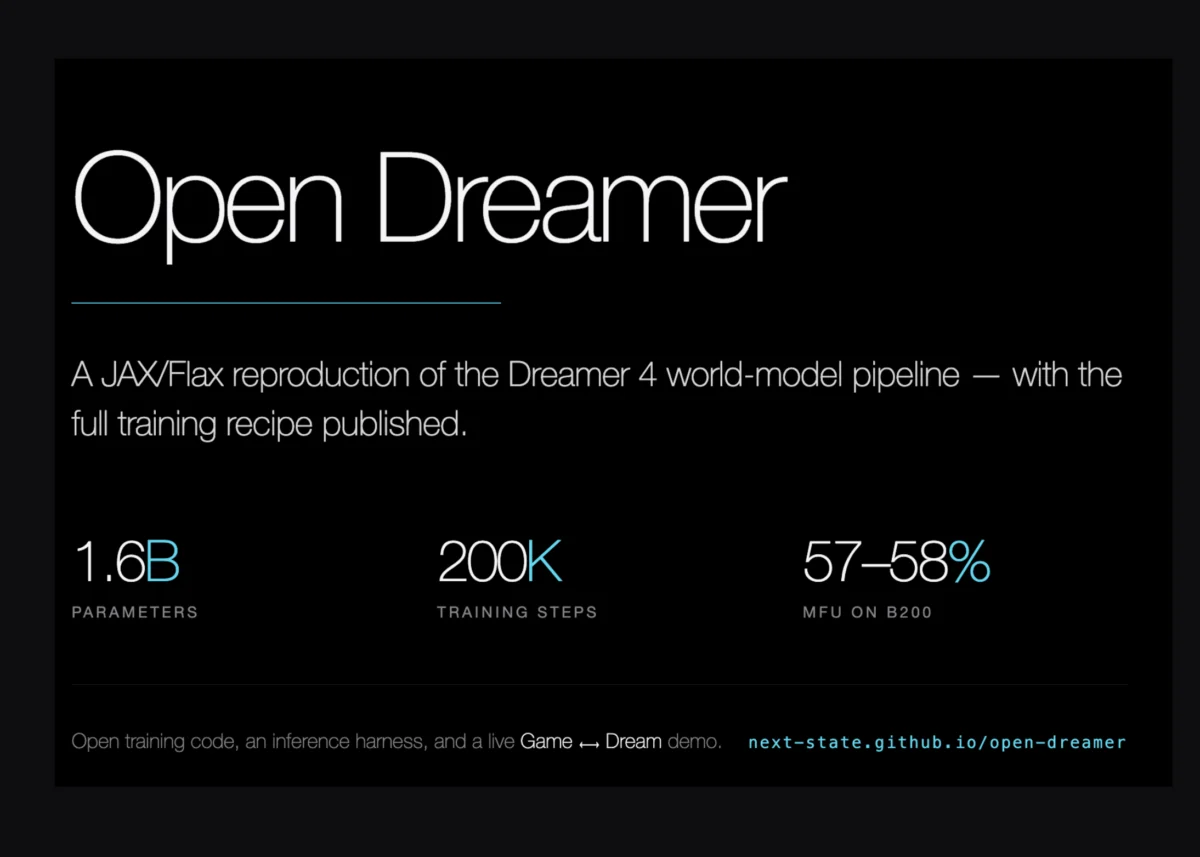
The emergence of world models represents a pivotal shift in artificial intelligence, moving from static pattern recognition toward systems that can simulate and predict the physical consequences of actions within complex environments. In a significant contribution to the open-source research community, a specialized group of AI researchers known as Reactor has officially released Open Dreamer. This project provides an open-source implementation of the Dreamer 4 world-model pipeline, built using the JAX high-performance numerical computing library and the Flax NNX neural network framework. The release aims to democratize access to the advanced architectures described in recent generative world model research, specifically the Dreamer 4 framework, which has demonstrated remarkable capabilities in simulating interactive environments like Minecraft.
The Scope of the Open Dreamer Release
The Open Dreamer project is comprised of three primary artifacts designed to facilitate both the training and deployment of world models. The first and most substantial component is the next-state/open-dreamer repository, which serves as the core training pipeline. This repository includes a causal video tokenizer, an action-conditioned latent dynamics model, a rollout generation system, and a Fréchet Video Distance (FVD) scoring harness. These tools are essential for researchers looking to train their own models from scratch or fine-tune existing architectures on custom datasets.
The second component is the reactor-team/open-dreamer repository, which provides a streamlined local rollout harness. This tool allows users to generate video frames from an MP4 file paired with a matching action file, effectively demonstrating how the model interprets and extends visual sequences based on specific inputs.
The third artifact is a browser-based demonstration hosted on the Reactor runtime. This demo provides a real-time stream of a generated Minecraft world, featuring a unique "Game ↔ Dream" toggle. This functionality allows users to see the seamless transition from a real game engine to the world model’s internal simulation, frame by frame. This transition highlights the model’s ability to maintain visual and logical consistency even when it is no longer receiving data from the actual game environment.
Project Objectives and Development Chronology
The primary objective of the Reactor team was to faithfully reproduce the findings of the Dreamer 4 research paper (arXiv:2509.24527). To ensure the integrity of the reproduction and to keep the search space manageable, the researchers strictly adhered to the methods outlined in the original paper, deliberately avoiding external techniques that might obscure the results.
The development process followed a logical progression of complexity. The team began their work on CoinRun, a procedurally generated 2D platformer. CoinRun was chosen because it is computationally efficient, allowing for the training of a full pipeline on a single GPU. This initial phase served as a "proof of concept" to validate the architecture and training stability. Once the pipeline was proven effective in a 2D environment, the team scaled the system to handle the significantly more complex Minecraft environment, utilizing Video Pre-Training (VPT) style gameplay footage. This scaling process required addressing substantial challenges in data throughput, memory management, and model stability.
Architectural Innovations: One Backbone, Two Models
At the heart of Open Dreamer is a unified architectural philosophy. Both the tokenizer and the dynamics model utilize the same block-causal transformer backbone. This backbone is designed to handle the dual nature of video data: spatial information (what is in a frame) and temporal information (how frames change over time). The architecture alternates between two types of attention layers: Space layers, which propagate information among the elements within a single frame, and Causal Time layers, which propagate information between frames while ensuring that future information does not leak into the past.
The tokenizer represents a departure from traditional Variational Autoencoders (VAEs). Instead, the team implemented a transformer-based Masked Autoencoder (MAE). The researchers reported that this design achieves approximately 100× compression without the need for Kullback-Leibler (KL) divergence or adversarial losses, which are often difficult to balance during training. They argue that the use of masking makes the latent space more "diffusible," facilitating better performance for the subsequent dynamics model.
The dynamics model is responsible for next-frame prediction and is trained using a combination of diffusion forcing, flow matching, and shortcut models. A key feature of this model is that it also predicts the next action. In many prior world models, the system alternated between a separate transition module and a policy module. In Open Dreamer, the rollout is "folded" into per-timestep blocks containing the previous action, the state, and the policy. Spatial attention operates within these blocks, while causal temporal attention connects the blocks across the timeline. Critically, the world-model tokens are restricted from reading the agent tokens, ensuring that task and policy information can only influence future states through the predicted next action.
Detailed Training Recipe and Minecraft Configuration
The release includes concrete configurations for training the model on Minecraft data, providing a blueprint for the computational requirements of high-fidelity world models. The dynamics model features 1.6 billion parameters, consisting of 30 block-causal layers with a model dimension (d_model) of 1920. It utilizes 30 attention heads and 3 Key-Value (KV) heads for grouped-query attention. Every fourth layer in the stack is dedicated to time attention, which operates on a 192-step sliding window to maintain long-term coherence.
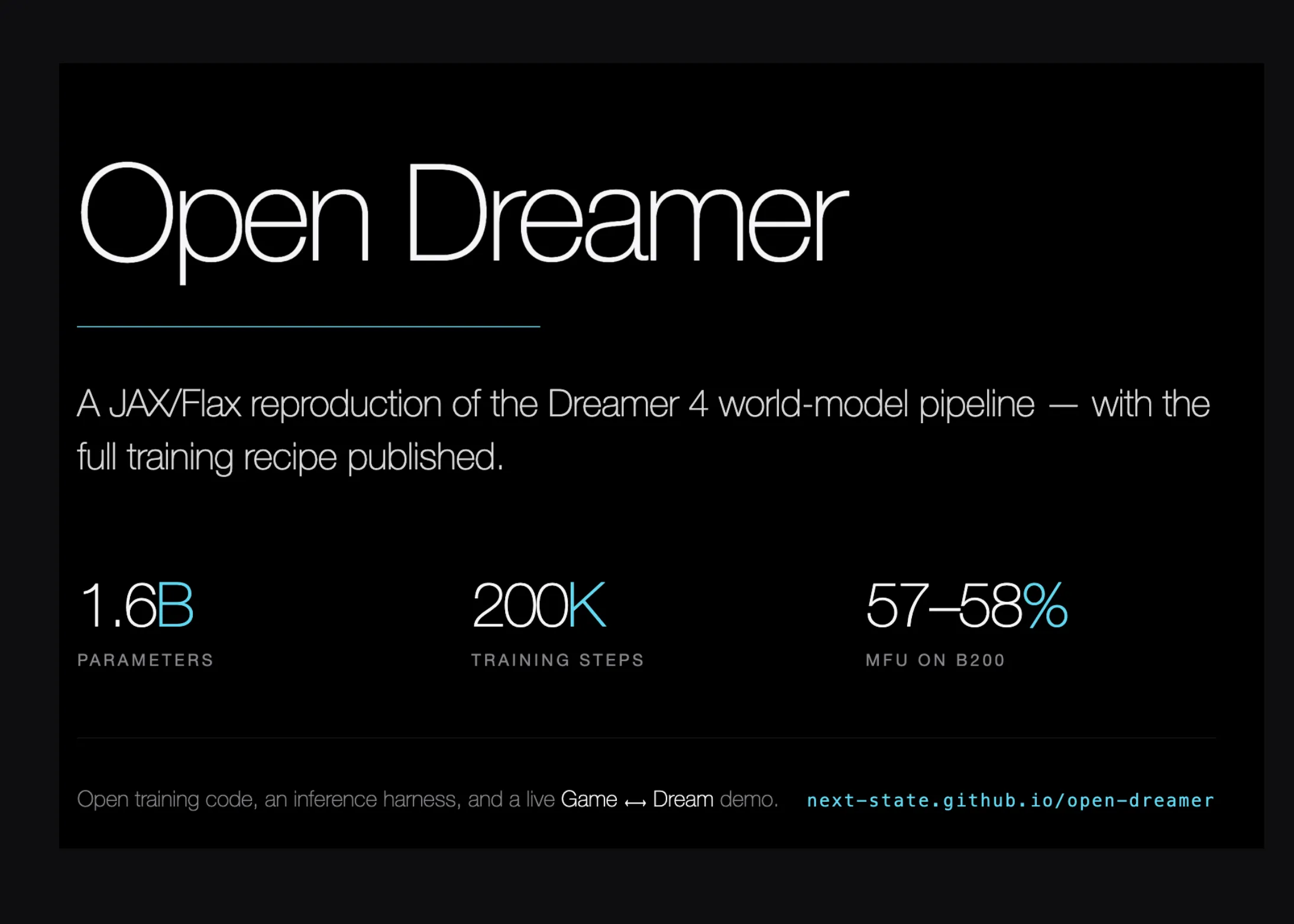
The training process for the Minecraft model spans 200,000 steps. It utilizes the Muon optimizer and a "Warmup-Stable-Decay" (WSD) schedule, reaching a peak learning rate of 3e-4. To improve long-term prediction accuracy, shortcut and bootstrap samples are introduced at step 100,000, eventually accounting for 25% of the training batch. The tokenizer configuration is equally detailed, emitting 512 latent tokens per frame at a bottleneck width of 16. Raw 360×640 video frames are padded to 368×640 to ensure they are perfectly divisible into 16×16 patches. The encoder has a depth of 12 layers, while the decoder has 8 layers.
Action parsing is another critical component of the Minecraft setup. The model processes VPT actions into 27 binary action channels and 121 categorical mouse classes. Notably, the team opted not to use continuous channels for action representation, focusing instead on a discrete but high-resolution categorical space.
Optimization and the Hardware "Memory Wall"
The training of Open Dreamer was conducted on NVIDIA B200 hardware, where the researchers achieved a model FLOPs utilization (MFU) of 57–58%. This is remarkably close to the 60% benchmark generally considered the upper limit for healthy transformer training. The team utilized a "roofline argument" to explain their efficiency: on a B200, the crossover point between being bandwidth-bound and compute-bound occurs at 292 FLOP/byte. By feeding 256 frames per GPU, they were able to push the workload into the compute-bound regime, maximizing the utility of the hardware.
Interestingly, the team found that the primary bottleneck was not the model parameters themselves but rather the activations. At 1.6 billion parameters, the entire model state (parameters, gradients, optimizer state, and EMA) fits within 24 GiB of memory, which is well within the capacity of a B200. However, the memory required for activations during the forward and backward passes was substantial. After experimenting with various sharding strategies, including Fully Sharded Data Parallelism (FSDP) and tensor parallelism, the team settled on standard data parallelism combined with aggressive activation checkpointing.
Dataloading also presented a significant hurdle. Standard ffmpeg decoding was found to be too slow to keep the GPUs saturated. To solve this, the researchers pre-tokenized the entire dataset into .arrayrecord files and used the Grain library with a GPU-side prefetch buffer to ensure a continuous stream of data to the training loop.
Addressing the Stability Paradox
Perhaps the most valuable contribution of the Open Dreamer project is the documentation of training stability. The research team noted that the largest portion of their development time was spent ensuring the model did not collapse or degrade during long training runs. They identified a "stability paradox" where Mean Squared Error (MSE) loss would continue to decrease while the actual quality of generated video would visibly degrade.
To combat this, the team implemented six specific fixes:
- Muon Optimizer: They replaced the LaProp optimizer with Muon. LaProp was found to cause random spikes in loss that became more frequent as the model scaled. Muon provided a more stable trajectory over the 400 B200-hours required for a full run.
- Mandatory EMA: Exponential Moving Average (EMA) weights were found to be essential for diffusion inference; using raw weights often resulted in "noisy" or nonsensical generations.
- Precision Management: While most of the model used BF16 for efficiency, parameters were kept in Float32. Crucially, normalization layers and the dynamics flow output head were also kept in Float32 to prevent numerical instability.
- Loss Weighting: The team utilized x-prediction with a v-space loss, which effectively acts as a weighting term that improves upon the original Dreamer 4 formulation.
- Optimal Transport: The use of minibatch barycentric optimal transport between noise and latent sequences helped stabilize the rollout generation process.
- μ-Parametrization: While tested, μ-P was ultimately deemed unnecessary because the Muon optimizer naturally held hyperparameters steady across different model sizes.
Broader Impact and Future Outlook
The release of Open Dreamer is a milestone for the AI community, particularly for those interested in autonomous agents and interactive simulations. By providing a high-quality, JAX-based implementation of a state-of-the-art world model, Reactor has lowered the barrier to entry for studying how AI can learn to navigate and understand complex environments.
However, the team was transparent about what is currently missing from the release. The repository does not yet include the behavior-cloning (BC) or Reinforcement Learning (RL) training loops required to create a fully autonomous agent. These features remain on the project’s roadmap. Additionally, while the tools for calculating FVD scores are included, the team has not yet published official benchmark scores for their Minecraft implementation.
Despite these omissions, Open Dreamer stands as a robust foundation for future research. It demonstrates that with careful attention to optimization and stability, large-scale world models can be reproduced and studied outside of the world’s largest industrial AI labs. As researchers continue to build upon this codebase, the industry moves closer to creating AI that does not just predict pixels, but understands the underlying logic of the worlds it inhabits.