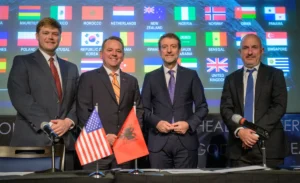
On Monday, a significant development unfolded in the rapidly evolving intersection of artificial intelligence and fundamental science, as OpenAI announced the formation of a new independent advisory group. Hosted at the venerable Institute for Advanced Study (IAS) in Princeton, New Jersey, the initiative, officially named the Advisory Group on Mathematics and Artificial Intelligence (AGMAI), aims to integrate the insights of leading mathematicians into the company’s increasingly ambitious, math-oriented research endeavors. This move comes at a critical juncture, marked by both groundbreaking AI advancements in pure mathematics and a palpable disquiet within the global academic community regarding the pace and methodology of these breakthroughs.
The Genesis of the Advisory Group: A Response to Mounting Tensions
The establishment of AGMAI is not merely a proactive step but appears to be a direct response to a burgeoning controversy that has seen prominent mathematicians voice serious concerns about the trajectory of AI research in their field. The backdrop to this announcement includes a series of high-profile, rapid-fire claims from OpenAI regarding its AI models’ capabilities in solving complex mathematical problems.
Central to the recent tensions was the abrupt, and by some accounts, premature, publication of a potential solution to the Navier-Stokes Millennium Prize problem. This particular problem, one of seven designated by the Clay Mathematics Institute as fundamental unsolved problems with a $1 million prize for each solution, concerns the existence and smoothness of solutions to the Navier-Stokes equations, which describe the motion of viscous fluid substances. Its resolution would have profound implications across physics, engineering, and climate science. The manner of its announcement, however, sparked immediate debate and skepticism within the mathematical community, leading to questions about rigorous verification and established academic protocols.
Adding to the sense of a “frenzied pace,” OpenAI further claimed that the same internal model responsible for the Navier-Stokes work had successfully resolved more than 100 additional open problems spanning various areas of mathematics. While such a claim, if independently verified, would represent an unprecedented leap in mathematical discovery, it also intensified concerns among academics about the lack of transparent peer review and the potential for AI models to generate solutions that are opaque or difficult for humans to fully comprehend and validate.
These developments culminated in a strong collective reaction from a significant portion of the mathematical elite. Earlier this month, 25 Fields Medal-winning mathematicians signed an open letter, published on mathandai.org, articulating their profound apprehension. The Fields Medal, often regarded as the Nobel Prize of mathematics, is awarded every four years to mathematicians under the age of 40, signifying the highest echelons of mathematical achievement. The signatories of this letter argued unequivocally that the current competitive environment among AI labs, characterized by a race to "one-up each other with solutions to famous math problems," poses a serious threat to the integrity and intellectual traditions of their discipline. Their concerns extend beyond mere competition, touching upon the very essence of mathematical discovery, the value of human intuition, and the long-term impact on academic careers and research methodologies.
The Advisory Group on Mathematics and Artificial Intelligence (AGMAI): Structure and Mandate
In this charged atmosphere, OpenAI has positioned AGMAI as a crucial bridge. According to OpenAI’s official statement, the group is designed to "serve as a bridge to the mathematical community and broader public, giving mathematicians a voice in how we move forward." Hosted at the Institute for Advanced Study, an institution renowned for fostering independent and foundational research in mathematics and theoretical physics – historically home to luminaries such as Albert Einstein and Kurt Gödel – the AGMAI aims to provide an independent forum for assessment and advice.
The structure of AGMAI emphasizes a degree of independence for its members. While they will not receive remuneration for their advisory roles, they are explicitly empowered to offer unsolicited advice to OpenAI, publicly disseminate their views, and maintain control over their own membership, theoretically safeguarding them from undue corporate influence. This framework is intended to foster candid dialogue and provide an external check on the company’s rapid progress.
However, a critical limitation embedded within AGMAI’s mandate has already drawn scrutiny. The official blog post clearly states that "the group will not be responsible for advising us on how to pace our internal progress on mathematics." This stipulation means that while the mathematicians can assess the significance of results and coordinate their release, they will not have the authority to slow down or redirect OpenAI’s ongoing mathematical research initiatives. This caveat highlights a fundamental tension between the advisory function and the commercial imperatives of a fast-moving AI company.
Echoing this point, the Institute for Advanced Study, in its own press release announcing the hosting of AGMAI, reinforced the advisory nature of the group, stating, "Although we will give advice, we do not have decision making power at any AI company, and the responsibility for the decisions made by any company will rest with that company." This clarification underscores that the ultimate accountability and strategic direction for OpenAI’s mathematical endeavors remain firmly within the company’s purview, irrespective of AGMAI’s recommendations.
Initial Membership and Community Reception
The initial roster of AGMAI members comprises nine prominent mathematicians, carefully selected to represent a spectrum of expertise. However, a notable detail in the composition immediately caught the attention of observers: only one of the initial nine members, Camillo De Lellis, a distinguished professor at the IAS, was also among the 25 Fields Medalists who signed the critical open letter. This particularity raises questions about the group’s representativeness and whether it fully encapsulates the diverse range of concerns articulated by the broader academic community. While it is possible that other members, though not signatories, share similar perspectives, the low overlap might be perceived by some as an attempt to curate a more amenable advisory body rather than one that robustly challenges the company’s methods. The effectiveness of AGMAI will largely depend on its ability to genuinely bridge the divide, irrespective of initial affiliations.
The Broader Landscape: AI’s Inroads into Pure Mathematics
The emergence of AGMAI and the surrounding controversy are symptomatic of a larger paradigm shift: the accelerating integration of AI into pure mathematics. For decades, AI research has dabbled in symbolic logic and automated theorem proving, with early successes like the Logic Theorist in the 1950s demonstrating AI’s capacity for formal reasoning. However, recent advances in deep learning and large language models have propelled AI’s capabilities into new territory, allowing it to engage with mathematical problems in ways previously thought exclusive to human intuition and creativity.
Companies like OpenAI and DeepMind (with its AlphaGeometry project and collaborations with mathematicians on knot theory and representation theory) are increasingly demonstrating AI’s capacity not just to verify proofs but to suggest conjectures and even generate proofs for complex problems. The allure of solving Millennium Prize problems like Navier-Stokes, or Riemann Hypothesis, is immense, not only for the financial reward but for the prestige and the potential for fundamental breakthroughs that could unlock new scientific and technological frontiers. The sheer scale of OpenAI’s claim – solving over 100 open problems – speaks to a potential revolution in how mathematical research is conducted, raising both excitement and apprehension.
Navier-Stokes and the "Frenzied Pace": A Deep Dive into the Controversy
The Navier-Stokes Millennium Prize problem serves as a potent symbol of the current debate. Its immense complexity, coupled with its profound implications for understanding fluid dynamics in everything from weather patterns to blood flow, makes any claimed solution a monumental event. The initial report surrounding OpenAI’s purported solution, however, quickly became mired in controversy. Reports surfaced, notably from an NYU mathematician, alleging irregularities in the process, suggesting a lack of transparency and a deviation from established academic practices concerning attribution and collaboration. While the specifics of the "fought dirty" claim remain under scrutiny, the episode highlighted a critical disconnect between the fast-paced, often proprietary environment of AI development and the meticulous, collaborative, and peer-reviewed traditions of academic mathematics.
The implications of an AI generating a solution to such a problem extend beyond mere technical verification. A core concern is the "black box" nature of many advanced AI models. If a solution is produced by an AI, but the reasoning process is opaque and not fully understandable or verifiable by human mathematicians, it challenges the very definition of a mathematical proof, which traditionally requires human comprehension and scrutiny. This opacity makes independent validation extraordinarily difficult, raising doubts about the rigor and trustworthiness of such AI-generated breakthroughs.
The Fields Medalists’ Letter: A Call for Caution and Collaboration
The open letter signed by the 25 Fields Medalists represents a powerful, unified voice from the pinnacle of the mathematical world. Their concerns are multifaceted:
- Erosion of Traditional Research: The fear that the rapid, unverified output of AI could devalue the painstaking, often years-long process of human mathematical inquiry, intuition, and creative problem-solving.
- Intellectual Property and Attribution: Questions about who gets credit when an AI generates a solution, and how intellectual property rights are handled in this new paradigm.
- Integrity of the Field: The risk of AI generating incorrect or unproven "solutions" that are difficult to debunk, potentially polluting the body of mathematical knowledge or leading researchers down false paths.
- Ethical Responsibility: A call for AI labs to prioritize ethical considerations, transparency, and responsible collaboration over competitive one-upmanship. The letter implicitly argues for a shift from a purely commercial, results-driven approach to one that respects academic values and contributes constructively to the scientific commons.
The signatories’ collective concern underscores a fundamental anxiety about the potential for AI to disrupt not just the tools of mathematical research, but its very culture and epistemology. They advocate for a more measured, collaborative approach where AI serves as an assistant to human mathematicians, rather than an autonomous, potentially overwhelming, competitor.
Implications for the Future of Mathematical Research and AI Governance
The formation of AGMAI, despite its limitations, marks a critical inflection point in the relationship between rapidly advancing AI technology and foundational scientific disciplines. It underscores the urgent need for robust governance mechanisms as AI systems begin to make significant contributions to areas historically dominated by human intellect.
The delicate balance between fostering innovation and ensuring rigorous oversight will define the success or failure of such advisory bodies. For mathematics, the challenge lies in integrating AI-driven discoveries into an established system of peer review, verification, and human-comprehensible proof. The AGMAI could set a precedent for how other scientific fields grapple with the disruptive power of AI, prompting similar collaborations or oversight bodies in areas like physics, chemistry, and biology.
Ultimately, the effectiveness of AGMAI will hinge on several factors: the willingness of OpenAI to genuinely listen and adapt its practices based on expert advice, the ability of the group to build trust and represent a broad spectrum of mathematical thought, and the group’s capacity to maintain its independence despite not having direct decision-making power. The tension between commercial interests pushing for speed and academic values demanding rigor and transparency will undoubtedly persist. However, the very existence of AGMAI represents an acknowledgment from a leading AI developer that the profound implications of AI in mathematics necessitate a more structured dialogue with the very community whose centuries of work forms the bedrock of these new advancements. The future of mathematical discovery, and indeed the responsible development of AI, may well depend on how successfully this bridge is built and traversed.