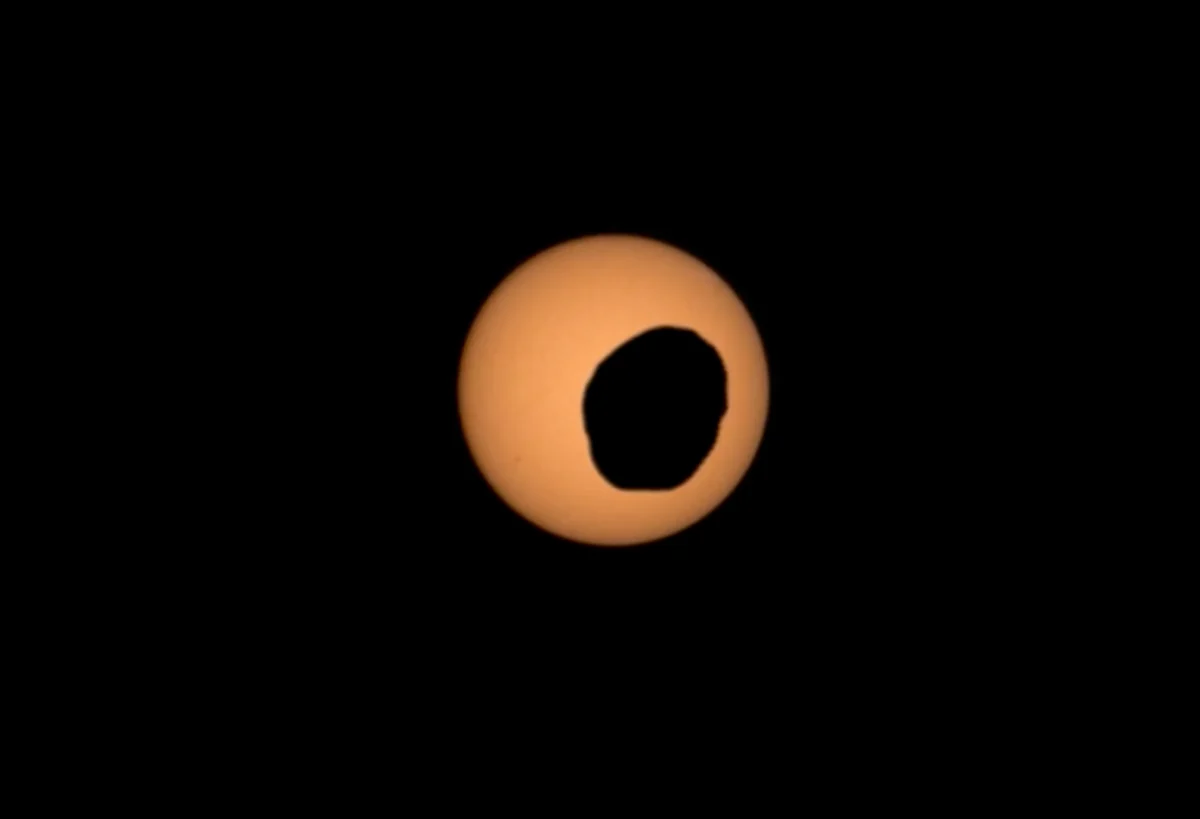
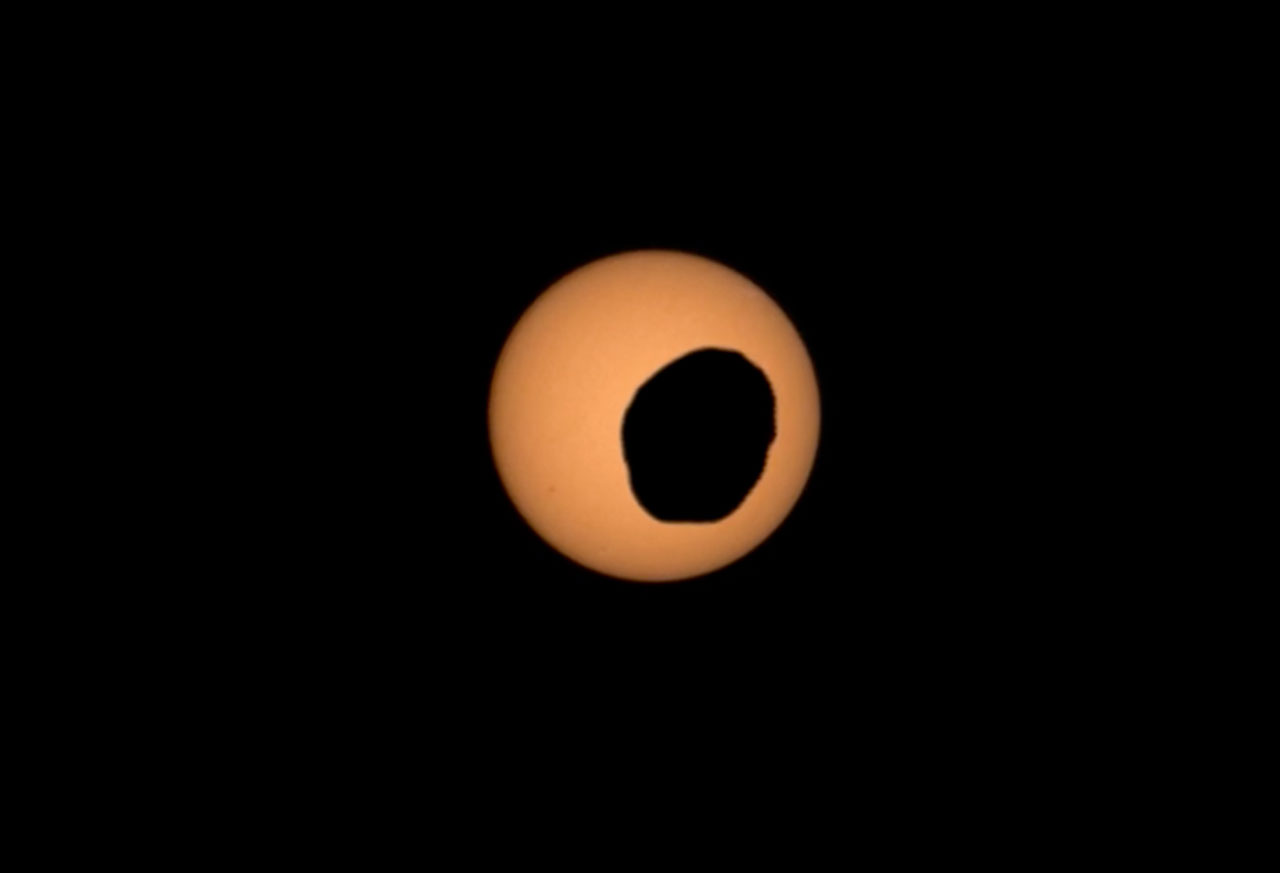
NASA’s Perseverance Mars rover, operating from the ancient river delta of Jezero Crater, successfully captured a remarkable solar transit of Phobos, one of Mars’s two enigmatic moons, on August 12, 2026. This celestial event, recorded by the rover’s advanced Mastcam-Z imager on the 1,948th Martian day, or sol, of its mission, provides scientists with crucial data to refine their understanding of Phobos’s orbital mechanics and its inevitable, dramatic fate. The animation of the transit has been meticulously tinted to simulate the view a human observer would experience from the Martian surface, gazing through protective solar eclipse glasses, offering a vivid glimpse into the Red Planet’s unique sky.
The Phenomenon: A Martian Eclipse Unveiled
A solar transit occurs when a celestial body passes directly between a larger body and an observer, temporarily obscuring a portion of the larger body. On Earth, we are familiar with spectacular total or partial solar eclipses caused by our Moon. On Mars, the experience is distinctly different due to the nature of its two small moons, Phobos and Deimos. Phobos, the larger and closer of the two, is an irregularly shaped, potato-like body measuring approximately 27 by 22 by 18 kilometers. Its close proximity to Mars – orbiting at an average altitude of only 6,000 kilometers above the Martian surface – and its relatively swift orbital period of just over 7 hours and 39 minutes mean that it crosses the Sun frequently and quickly.
Unlike Earth’s Moon, which is large enough to completely obscure the Sun’s disk, Phobos is too small to cause a total solar eclipse from the Martian surface. Instead, it appears as a dark, irregularly shaped silhouette traversing the bright solar disk, creating what is technically termed a "transit" rather than an "eclipse." These events, while less dramatic in terms of total obscuration, are invaluable for scientific observation. The precise timing and trajectory of Phobos’s shadow across the Martian surface, as recorded by assets like Perseverance, allow researchers to calculate minute variations in its orbit with unprecedented accuracy.
The Mastcam-Z camera system, a pair of zoomable, color, and stereoscopic cameras mounted high on Perseverance’s mast, is perfectly suited for such observations. Its high resolution and ability to capture detailed imagery across multiple spectral bands enable scientists to gather comprehensive data. Dr. Jim Bell, principal investigator for Mastcam-Z at Arizona State University, commented on the significance of these captures, stating, "Each transit provides a unique data point. By combining these observations over time, we build an increasingly accurate picture of Phobos’s journey, which is fundamentally linked to the gravitational tug-of-war between the moon and Mars itself."
A Chronology of Martian Moon Watching
Perseverance’s observation on August 12, 2026, was not an isolated event but part of an ongoing scientific campaign. Since its landing in Jezero Crater in February 2021, the rover has regularly turned its cameras skyward to document these celestial ballet performances. Early in its mission, Perseverance captured its first Phobos transit in April 2022, providing stunning imagery that immediately improved upon previous observations from earlier missions. Prior to Perseverance, other Mars rovers, including Curiosity and Opportunity, also recorded Phobos transits, albeit with less advanced imaging capabilities.
For instance, NASA’s Curiosity rover, which landed in Gale Crater in 2012, captured numerous Phobos transits using its Mastcam instrument. These earlier observations confirmed the general orbital decay of Phobos. However, Perseverance’s Mastcam-Z, with its enhanced zoom capabilities and higher frame rates, offers a more detailed and dynamic view, allowing for even finer measurements of the moon’s position and speed. The collective data set, spanning over a decade of observations from multiple locations on Mars, forms a powerful tool for planetary scientists.
The timeline of observations is critical:
- February 18, 2021: Perseverance lands in Jezero Crater.
- April 2, 2022 (Sol 402): Perseverance captures its first Phobos solar transit, marking a new era of high-resolution observations.
- August 12, 2026 (Sol 1948): The latest documented transit, further enriching the dataset for orbital modeling.
- Ongoing: Perseverance continues to monitor Phobos and Deimos, contributing to a long-term observational record.
Each successive observation builds upon the last, allowing scientists to detect subtle changes and refine predictive models of Phobos’s future.
Supporting Data and Scientific Rationale
The primary scientific motivation behind observing Phobos transits is to precisely track its orbital evolution. Phobos is unique among the moons of the inner solar system in that its orbit is decaying. This means it is gradually spiraling closer to Mars, a process driven by tidal forces. Mars’s gravity exerts a differential pull on Phobos, stretching it slightly and causing a bulge. As Mars rotates faster than Phobos orbits, this bulge tries to pull Phobos forward, but the gravitational interaction also causes Phobos to lose orbital energy, slowly dragging it inward.
Current estimates suggest Phobos is drawing closer to Mars at a rate of approximately 1.8 meters (6 feet) per century. While this seems slow on human timescales, over astronomical eons, it will lead to a catastrophic event. Scientists predict that in roughly 30 to 50 million years, Phobos will either crash into the Martian surface or, more likely, be torn apart by Mars’s immense tidal forces, scattering its fragments into a ring system around the planet. This ring, similar to Saturn’s rings but composed of rocky debris, could persist for millions of years before eventually raining down onto the Martian surface.
By meticulously comparing the various recordings of Phobos transits, scientists can:
- Refine Orbital Models: The exact timing and path of the transits allow for highly precise measurements of Phobos’s orbital parameters, including its period, inclination, and eccentricity. Deviations from predicted paths can indicate gravitational perturbations.
- Understand Tidal Forces: The rate of orbital decay provides direct evidence of the strength of tidal interactions between Mars and Phobos. This, in turn, offers insights into the internal structure of Mars itself, as the planet’s elasticity and mass distribution influence how it responds to tidal stresses.
- Investigate Phobos’s Interior: Subtle variations in the transit profile or orbital behavior could potentially reveal clues about Phobos’s internal density distribution and composition, helping to constrain theories about its formation. Is it a captured asteroid, a fragment of a larger body, or something else entirely?
The potato-shaped moon’s irregular geometry and heterogeneous density distribution also contribute to the complexity of its orbital dynamics, making precise observations even more valuable.
Official Responses and Institutional Collaboration
The success of these observations is a testament to the collaborative efforts of numerous institutions and dedicated scientists and engineers. NASA’s Jet Propulsion Laboratory (JJPL), managed by Caltech in Pasadena, California, is responsible for building and operating the Perseverance rover. JPL’s expertise ensures the rover’s continued health and its ability to execute complex scientific commands, such as precisely pointing Mastcam-Z at the Sun.
Arizona State University (ASU) leads the operations of the Mastcam-Z instrument, overseeing the scientific planning and data analysis. Dr. Tanya Harrison, a planetary scientist affiliated with ASU’s Mastcam-Z team, expressed enthusiasm for the continuous stream of data. "Every transit Phobos makes across the Sun offers a chance to refine our models," she noted. "The long-term dataset from Perseverance, combined with previous rover observations, is truly invaluable for understanding the dynamic processes shaping the Martian system."
Malin Space Science Systems (MSSS) in San Diego played a critical role in the design, fabrication, testing, and operation of the Mastcam-Z cameras. Their engineering prowess ensured the instrument’s robustness and capability to function in the harsh Martian environment. Additionally, the Niels Bohr Institute of the University of Copenhagen collaborated on the design, fabrication, and testing of the calibration targets, essential for ensuring the accuracy and scientific integrity of the images.
A spokesperson from JPL highlighted the precision engineering required for such observations: "Executing these transit captures requires meticulous planning, from predicting the exact timing and trajectory of Phobos to commanding the rover to point its cameras with extreme accuracy. It’s a testament to the skill of our operations team and the reliability of the Perseverance hardware." These coordinated efforts ensure that the scientific community receives high-quality data to advance our understanding of Mars and its moons.
Broader Impact and Future Implications
The study of Phobos’s transits and its orbital decay has profound implications for our understanding of planetary dynamics and the evolution of moon systems. It serves as a natural laboratory for observing tidal forces in action, a fundamental process that shapes many celestial bodies across the cosmos. The eventual fate of Phobos, whether it forms a temporary ring or directly impacts Mars, provides a unique case study for planetary scientists.
Beyond pure scientific curiosity, understanding Mars’s environment, including its moons, is crucial for future human exploration. Phobos, despite its small size, has been considered a potential target for human missions due to its low gravity, which could make it an accessible location for staging missions to Mars or for resource utilization. Knowledge of its precise orbit and long-term stability is therefore of practical importance for mission planners.
Moreover, the captivating images and animations of these Martian eclipses serve a vital role in public engagement. They inspire awe and curiosity about space exploration, making complex scientific concepts tangible and accessible to a global audience. The "human view" tint applied to the Perseverance transit animation particularly resonates, allowing individuals to vicariously experience the Martian sky and envision a future where humanity might witness such events firsthand.
The ongoing mission of Perseverance, including its systematic observation of Phobos transits, continues to push the boundaries of planetary science. Each data point contributes to a grander narrative of how planets and their moons interact, evolve, and ultimately meet their destinies. As Perseverance continues its exploration of Jezero Crater, seeking signs of ancient microbial life and collecting samples for eventual return to Earth, its "moon-gazing" activities remain a critical, ongoing contribution to our comprehensive understanding of the Red Planet and its fascinating celestial companions.