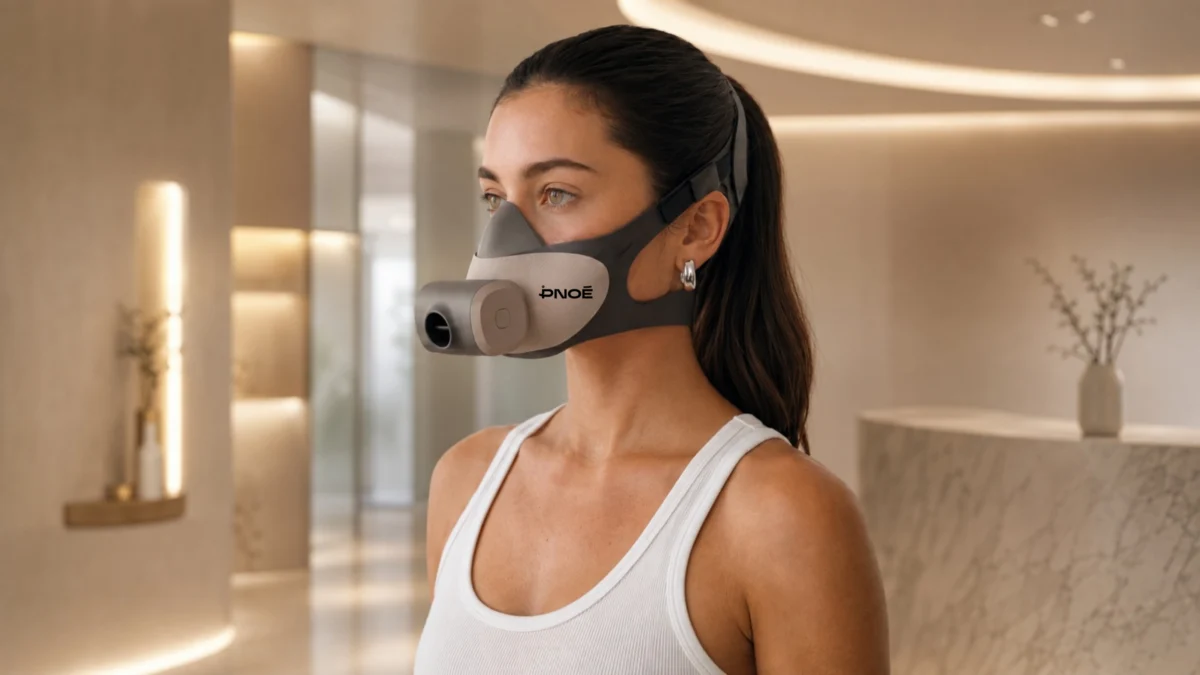
PNOĒ, a company based in Malden, Massachusetts, with operations extending to Athens, Greece, is poised to launch its latest innovation, the PNOĒ 2.0, on October 1. This new device, while initially striking a visual resemblance to the formidable mask worn by Batman’s adversary Bane, serves a profoundly beneficial purpose: to precisely measure oxygen consumption and carbon dioxide exhalation, subsequently translating this intricate metabolic data into actionable insights for diet, exercise, and ultimately, enhanced longevity. This advancement marks a significant stride in making sophisticated physiological assessment readily available to a broader public.
The PNOĒ 2.0: A New Era of Metabolic Insight
The most significant evolution in the PNOĒ 2.0, compared to its predecessor, lies in its self-administration capability. Co-founder and CEO Apostolos Atsalakis highlighted the streamlined user experience in a recent Zoom interview from the company’s Athens hub: "Someone can walk into a gym, just wear the mask, push the button, sit down, and breathe for eight minutes. That’s it. It’s that easy." This ease of use fundamentally transforms the accessibility of metabolic testing, which traditionally required specialized oversight.
The shift to a self-serve model is a strategic move designed to broaden PNOĒ’s market reach. The current device necessitates a trained operator, thereby limiting its deployment to facilities with dedicated staff. The PNOĒ 2.0, by contrast, opens doors to a vast array of new venues, including fitness centers without specialized personnel and potentially even pharmacies, making high-precision metabolic analysis a more commonplace offering. This expansion reflects a growing demand for personalized health metrics outside traditional clinical settings, catering to a wellness-conscious population increasingly seeking data-driven approaches to health optimization.
Democratizing a Century of Science: The Power of Metabolic Testing
The underlying scientific principles guiding PNOĒ are not novel; metabolic testing, which involves analyzing respiratory gases to ascertain how the body generates energy, boasts a history spanning over a century. For decades, it has stood as the undisputed gold standard for determining VO₂ max – the maximum volume of oxygen an individual can utilize during strenuous exercise. VO₂ max is widely recognized as a critical indicator of cardiorespiratory fitness, a powerful predictor of overall health and longevity. However, the traditional application of these tests has been confined by the necessity for bulky, expensive equipment, primarily found in specialized sports laboratories and hospitals. Consequently, access has historically been restricted to elite athletes, participants in executive wellness programs, and clinical research subjects, creating a significant barrier for the general public.
PNOĒ, a company now celebrating its tenth anniversary, bridges this gap by offering comparable accuracy in a portable, user-friendly package. Its accompanying software intelligently processes the raw data, transforming complex physiological measurements into clear, personalized recommendations. Atsalakis emphasizes this commitment to accessibility, stating, "We made it accessible to everyone." This democratizing approach aligns with broader trends in healthcare, where technology is increasingly leveraged to empower individuals with greater control and understanding of their own health data.
The PNOĒ system captures an impressive 23 biomarkers. Beyond VO₂ max, it precisely measures an individual’s resting metabolic rate (RMR), indicating the number of calories burned at rest, and metabolic flexibility, which quantifies the body’s efficiency in switching between burning fats and carbohydrates for energy. Atsalakis asserts that these metrics provide answers to critical questions that conventional blood tests often cannot address, such as an individual’s precise caloric needs or the optimal training regimen for their unique physiology. Understanding RMR is crucial for effective weight management, as it dictates baseline energy expenditure. Metabolic flexibility, meanwhile, is gaining recognition as a key indicator of metabolic health, with impairments linked to conditions like insulin resistance and type 2 diabetes. By providing insights into these fundamental processes, PNOĒ aims to offer a holistic view of an individual’s metabolic health.
Riding the Wave of Longevity and Wellness
PNOĒ’s emergence is particularly timely, coinciding with a burgeoning interest in longevity and preventive health. VO₂ max has become a prominent term within the longevity community, propelled by a growing body of research that unequivocally links higher cardiorespiratory fitness to significantly reduced mortality rates. Studies have consistently shown that individuals in the highest quintile of cardiorespiratory fitness can experience up to a 50% lower risk of all-cause mortality compared to those in the lowest quintile. Atsalakis positions VO₂ max as "the strongest predictor of human longevity," and views PNOĒ’s comprehensive data as an essential "scorecard" for the rapidly expanding wellness industry.
The global wellness market, estimated to be a multi-trillion-dollar industry, continues its robust growth trajectory, fueled by an aging population, increasing health consciousness, and technological advancements. Within this landscape, the longevity sector, focused on extending human healthspan, has seen exponential growth in recent years, attracting significant investment and public attention. PNOĒ’s ability to provide tangible, personalized metrics that directly correlate with longevity positions it as a key player in this evolving space, offering concrete data points for individuals navigating complex health decisions and for businesses catering to their wellness needs.
Design and User Experience Innovations
The PNOĒ 2.0 represents not only a technological leap but also a significant design evolution. It is notably smaller and more compact than its predecessor, featuring fewer components, which Atsalakis notes enhances its reliability. The device was developed in collaboration with the Milan-based Design Group Italia, a process Atsalakis described as involving "a lot, a lot, a lot of iterations." This extensive design phase was crucial, given the unprecedented nature of creating a self-administered metabolic testing device that combines clinical accuracy with consumer-grade usability and aesthetic appeal. The design challenges included ensuring comfortable fit, intuitive operation, and robust performance in diverse environments.
A critical design consideration, particularly in a post-pandemic world, was addressing hygiene concerns. The PNOĒ 2.0 ingeniously tackles the question of "who wore it last?" by designing the electronics to detach seamlessly from the silicone mask and straps. This modular approach allows multiple users to share the more costly hardware component, while each individual maintains their own personal, hygienic mask and strap set. This thoughtful design not only promotes hygiene but also optimizes the cost-efficiency for businesses offering the service, making it a practical solution for high-traffic environments like gyms and spas.
Navigating the Regulatory Landscape: Wellness vs. Medical Device
Despite its sophisticated capabilities and clinical aspirations, PNOĒ maintains a clear distinction regarding its regulatory standing. The PNOĒ 2.0 is not cleared by the U.S. Food and Drug Administration (FDA), and Atsalakis explicitly states, "we do not provide medical recommendations." Instead, PNOĒ firmly classifies itself as a wellness device. Atsalakis draws an analogy, explaining, "It’s like a body composition device, like a scale. A doctor cannot prescribe medication based on our results." This classification is crucial, as it dictates the claims the company can make and the environments in which its device can be marketed and used. Medical devices undergo rigorous testing and approval processes to ensure safety and efficacy for diagnostic or treatment purposes, a path PNOĒ has not pursued for its current iteration.
However, the long-term vision for PNOĒ could potentially involve a shift in this classification. Researchers have long investigated the potential of compounds found in human breath as biomarkers for various diseases, including cancer. Atsalakis believes that PNOĒ’s expanding repository of metabolic data could eventually be leveraged to flag potential health issues. Yet, he acknowledges that achieving full diagnostic capabilities is "definitely a couple of years away," with stringent regulatory hurdles likely extending this timeline further. "We’re not there yet," he concludes, underscoring the company’s cautious and phased approach to potential medical applications. This strategic stance allows PNOĒ to operate effectively within the wellness sector while laying the groundwork for future advancements that may require deeper engagement with medical regulatory bodies.
The Genesis of PNOĒ: From Cambridge to Global Expansion
The origins of PNOĒ can be traced back to Apostolos Atsalakis’s PhD research in sensing technologies at the University of Cambridge. During a period when wearable technology was rapidly gaining traction, Atsalakis became captivated by the profound insights that could be gleaned from analyzing human breath. This academic fascination evolved into a entrepreneurial venture when he co-founded the company with Panos Papadiamantis, a childhood friend who now serves as PNOĒ’s Chief Product Officer. Their shared vision was to translate cutting-edge scientific understanding into practical, accessible tools for personal health optimization.
The startup gained early momentum by participating in Y Combinator’s Winter 2019 batch. At that time, the concept of "longevity" had not yet matured into the expansive industry it is recognized as today. This early incubation provided PNOĒ with crucial mentorship, networking opportunities, and initial funding that propelled its development. Since then, the company has successfully raised approximately $22 million in capital, including a recently concluded $11 million funding round. Notable investors include 50 Years, a venture capital firm focused on companies solving the world’s biggest problems, and Lars Rasmussen, co-founder of Google Maps, who himself is now based in Athens, further highlighting the global reach and appeal of PNOĒ’s mission. These investments underscore investor confidence in PNOĒ’s technology, market strategy, and potential for significant impact within the health and wellness space.
A Business-to-Business Model for Widespread Adoption
PNOĒ operates on a business-to-business (B2B) model, selling its devices and services directly to organizations that then offer the metabolic testing to their own clientele. This strategy allows PNOĒ to scale efficiently and reach a broad consumer base without directly managing individual customer relationships. The company’s impressive roster of clients includes prestigious names such as Equinox, where the PNOĒ test is available at nearly all clubs, as well as Four Seasons hotels, Red Bull, the National Basketball Association (NBA), the Mount Sinai Health System, and the burgeoning med spa chain Restore Hyper Wellness. These diverse partnerships demonstrate the wide applicability of PNOĒ’s technology across high-performance sports, luxury hospitality, and advanced wellness clinics.
Approximately 85% of PNOĒ’s business currently originates from the United States, a market Atsalakis characterizes as "by far the most advanced market globally" for longevity-focused solutions. Recognizing the global demand for advanced wellness tools, the company is now actively expanding its footprint in Europe and, through strategic partnerships, into Latin America and Asia. This international expansion reflects a growing global awareness of preventive health and the universal appeal of personalized health data.
Businesses subscribe to PNOĒ’s services through a tiered model, with monthly fees ranging from $400 to over $1,000. This subscription encompasses not only the hardware and software but also comprehensive training and marketing materials, a package Atsalakis aptly describes as a "business in a box." A key feature of PNOĒ’s offering is its ability to link test results directly to the services a business provides. For instance, a gym or spa can utilize a customer’s metabolic profile to recommend highly specific and effective offerings, such as tailored nutrition plans, personalized training regimens, or targeted wellness therapies. Many clients integrate the PNOĒ test into their onboarding processes, positioning it as an invaluable tool that occupies a unique middle ground between a full clinical workup and the often-estimated metrics provided by consumer smartwatches. This strategic integration enhances client engagement and provides a strong value proposition for businesses seeking to offer data-driven, personalized wellness solutions.
The Competitive Arena: PNOĒ’s Unique Position
The "middle ground" that PNOĒ occupies is becoming increasingly competitive. On one end of the spectrum are popular consumer wearables such as Apple Watch, Garmin, and Whoop, all of which estimate VO₂ max using heart-rate variability data. While convenient, these estimates often lack the precision and comprehensive biomarker analysis of direct metabolic testing. Furthermore, consumer devices like Lumen analyze breath to provide insights into fat and carbohydrate burning, offering a glimpse into metabolic flexibility but typically without the full scope of PNOĒ’s 23 biomarkers or its clinical-grade accuracy. At the other end of the spectrum, traditional metabolic carts remain the undisputed standard in specialized laboratories and hospitals, offering unparalleled accuracy but at a significant cost and with the requirement for expert operation.
PNOĒ positions itself uniquely by combining the accuracy and comprehensive data traditionally found in high-end lab equipment with the accessibility and user-friendliness approaching consumer wearables. It provides a level of detail and personalization that often surpasses the capabilities of smartwatches, while being significantly more affordable and accessible than traditional clinical setups. This strategic positioning allows PNOĒ to appeal to a broad market segment that desires precise metabolic insights without the barriers of cost, complexity, or location. The ability to measure 23 biomarkers, including precise RMR and metabolic flexibility, sets it apart from simpler breath analyzers.
Growth Trajectory and Future Outlook
PNOĒ, which currently employs 110 individuals across its global operations, has recently achieved profitability, a significant milestone for a rapidly growing technology company. The company reports an impressive annual growth rate exceeding 100%, indicative of strong market demand and effective execution of its business model. Looking ahead, Atsalakis stated that PNOĒ plans to raise a Series B funding round within the next six to twelve months. This capital infusion will be critical as the company endeavors to further expand its reach and put its distinctive mask – Bane comparisons and all – in front of an ever-increasing number of faces worldwide. The continued investment in research and development, coupled with strategic market expansion, will solidify PNOĒ’s position as a leader in the accessible metabolic health space.
PNOĒ’s journey from a Cambridge PhD project to a globally expanding company underscores the transformative potential of making sophisticated health technology accessible. By empowering individuals and businesses with precise, actionable metabolic data, PNOĒ is not just measuring health; it is actively shaping the future of personalized wellness and contributing significantly to the burgeoning longevity movement. Its innovative approach promises to redefine how individuals understand, manage, and ultimately enhance their own metabolic health, moving beyond generalized health advice to truly personalized insights.