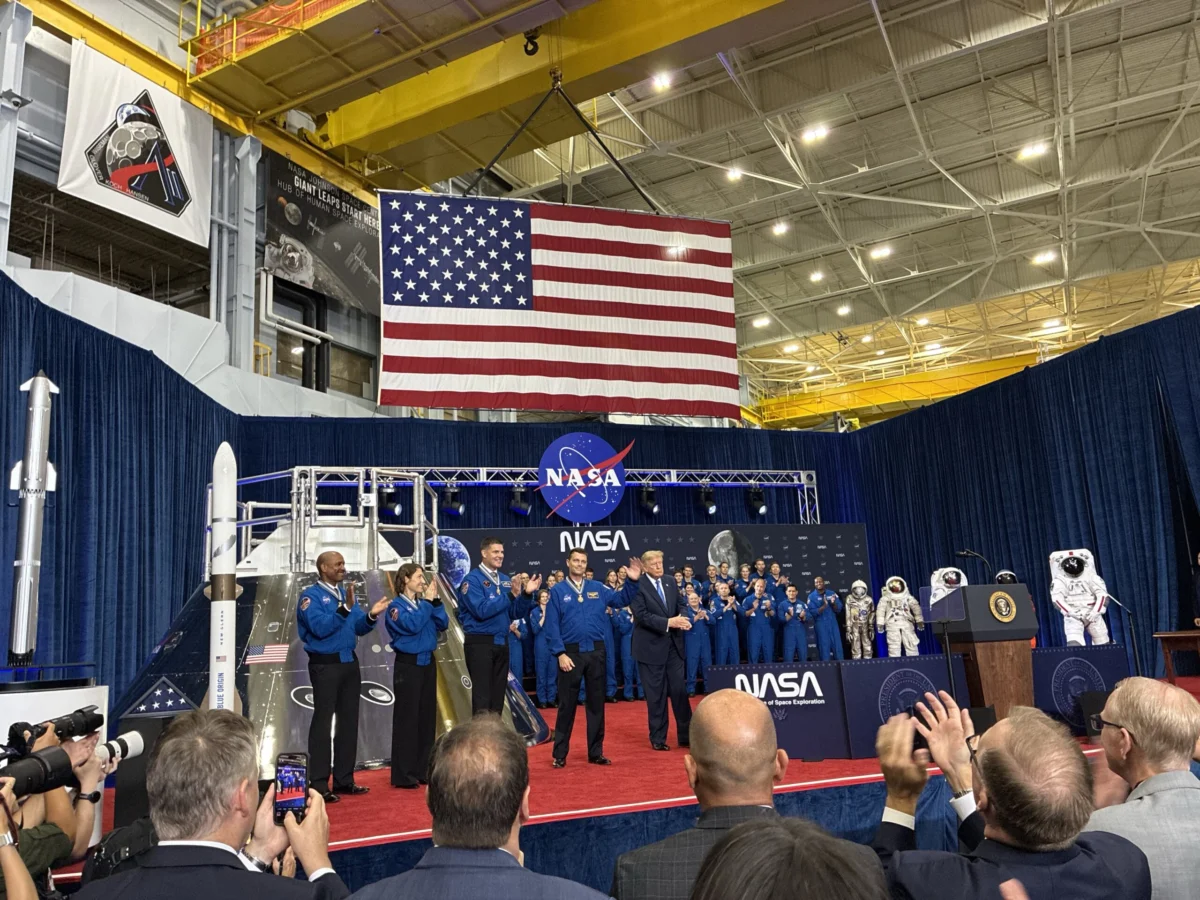
In a momentous ceremony held at NASA’s Johnson Space Center in Houston on Friday, President Donald J. Trump bestowed the Congressional Space Medal of Honor upon the four intrepid astronauts of the historic Artemis II mission: NASA’s Reid Wiseman, Victor Glover, and Christina Koch, alongside Canadian Space Agency (CSA) astronaut Jeremy Hansen. This prestigious recognition, the first of its kind since 2023, celebrated their unparalleled service and groundbreaking achievements during a mission that pushed the boundaries of human spaceflight, setting new records for distance traveled beyond Earth. The event not only honored the courage and dedication of the crew but also underscored the collective effort of thousands of engineers, scientists, and support personnel who made the mission a resounding success, propelling humanity further into the cosmos.
The Artemis II Mission: A Journey Beyond Limits
The Artemis II mission, a critical precursor to returning humans to the lunar surface, launched on April 1 and concluded with a safe splashdown in the Pacific Ocean on April 10. Over its nine-day duration, the mission marked several significant milestones, showcasing the capabilities of NASA’s next-generation deep space exploration hardware. The crew became the first astronauts to launch aboard the agency’s formidable Space Launch System (SLS) rocket, the most powerful rocket ever developed by NASA, designed to carry humans and cargo far beyond low Earth orbit. Aboard the Orion spacecraft, which the crew affectionately named "Integrity," they embarked on a voyage that tested the limits of human endurance and technological prowess.
The mission’s primary objective was to thoroughly test Orion’s systems, including life support, navigation, communications, and thermal control, in a deep space environment, ensuring its safety and functionality before future crewed lunar landings. The spacecraft executed a complex trajectory, including a lunar flyby that brought it within approximately 6,400 miles of the Moon’s surface. During this record-setting journey, the Artemis II astronauts traveled an astonishing 252,756 miles from Earth, farther than any humans have ever journeyed before. This extraordinary feat surpassed the previous record set in 1970 by the Apollo 13 astronauts, whose unplanned slingshot around the Moon during their aborted mission took them 248,655 miles from Earth. In total, including the various orbital maneuvers and the lunar flyby, the Artemis II crew accumulated a travel distance of 695,081 miles, meticulously proving the readiness of the Orion capsule and the SLS for the ambitious lunar missions to follow.
The SLS rocket, standing taller than the Statue of Liberty and generating 8.8 million pounds of thrust at launch, represents a monumental leap in launch capability, designed to be the backbone of NASA’s deep space endeavors. Its sheer power is essential for propelling the Orion spacecraft and its crew, along with heavy payloads, on trajectories towards the Moon and eventually Mars. The Orion spacecraft itself is a marvel of engineering, built to withstand the harsh environment of deep space, including radiation, extreme temperatures, and the high-speed reentry into Earth’s atmosphere. Its robust design, advanced avionics, and redundant systems are crucial for ensuring crew safety on missions lasting weeks or even months away from Earth. The naming of the capsule "Integrity" by the crew was a testament to the trust they placed in the vehicle and the countless individuals who built and prepared it.
The Congressional Space Medal of Honor: A Legacy of Courage
The Congressional Space Medal of Honor stands as the highest civilian award for space exploration, authorized by Congress in 1969 at the zenith of the Apollo program. It is bestowed upon an astronaut who, in the performance of duties, "has distinguished himself or herself by exceptionally brave and meritorious efforts, and contributions to the welfare of the nation and humanity." The rarity and prestige of this medal are profound; with the Artemis II crew, there are now only 34 recipients in the entire history of the U.S. space program.
The list of recipients includes some of the most revered figures in space exploration, many of whom made the ultimate sacrifice. Notably, the crews of Apollo 1, Space Shuttle Challenger, and Space Shuttle Columbia received the award posthumously, recognizing their immense courage and dedication that led to tragic losses but significantly advanced human understanding of spaceflight. Their inclusion underscores the inherent risks and profound bravery associated with space exploration, highlighting that the pursuit of knowledge and the expansion of human presence beyond Earth often come at a great cost. The medal serves not only as a recognition of individual heroism but also as a powerful symbol of national commitment to scientific discovery and the indomitable human spirit of exploration. Awarding it to the Artemis II crew solidifies their place among these legendary figures, acknowledging their direct contribution to pushing the boundaries of what is possible.
Leadership Perspectives and Collective Triumphs
During the solemn yet celebratory ceremony, President Trump delivered an impassioned address, emphasizing the magnitude of the crew’s achievements and the collaborative spirit behind them. "We gather on these historic grounds to celebrate the immense courage of four intrepid space heroes whose sense of daring and adventure led them further from Earth than anyone has ever traveled ever before," said President Trump. His remarks resonated with the national pride associated with America’s return to deep space exploration. He continued, "Today we’re proudly awarding the Congressional Space Medal of Honor to the remarkable crew of Artemis II. These astronauts did not do it alone. I want to salute all of the engineers, and scientists, launch and landing specialists, everyone at NASA who helped make this mission a great success." This acknowledgment of the vast support network, from the factory floor to mission control, highlighted that space exploration is a collective human endeavor, requiring diverse talents and unwavering dedication.
NASA Administrator Jared Isaacman echoed the sentiment of national leadership and a renewed commitment to space. "President Trump’s leadership has put America back on a path to lead the world in space, from creating the Artemis program to giving NASA the resources and mandate to win this new space race," Isaacman stated. His comments reflected a strategic vision to reassert American preeminence in space exploration, building upon the legacy of Apollo while forging new paths. He praised the Artemis II crew, noting, "The Artemis II crew answered that call with extraordinary skill and courage, showing the world the Moon again and what American leadership and exploration look like at their best. Their achievement was made possible by the exceptional NASA workforce, alongside our industry and international partners, who showed once again what can be accomplished when we commit to big, bold endeavors. We will build on this success as we return to the lunar surface and establish an enduring presence on the Moon." This statement articulated the broader goals of the Artemis program – not just to visit the Moon, but to establish a sustainable presence there, leveraging global partnerships and industrial innovation.
The astronauts themselves offered humble and reflective insights into their experience, emphasizing the team effort that underpinned their mission. Commander Reid Wiseman, leading the groundbreaking flight, expressed his profound gratitude: "It was the honor of my lifetime to fly on Integrity around the Moon with Victor, Christina, and Jeremy. Having President Trump here at the agency’s Johnson Space Center to honor NASA and my crew underscores the significance of what our teams accomplished." Wiseman, whose leadership was critical in navigating the complexities of the mission, also looked to the future, adding, "I can’t wait to see my friends continue this legacy on Artemis III," signaling the continuity of exploration.
Victor Glover, the pilot of the Orion spacecraft, conveyed the immense responsibility and pride associated with his role. "Piloting Orion for the first time in space was a profound honor, made possible because of the years of hard work, dedication, and expertise by countless individuals dedicating their time and talents to the mission," Glover remarked. He underscored the collaborative nature of spaceflight, stating, "We share this recognition with the thousands of people who launched us around the Moon and brought us safely back to Earth."
Mission Specialist Christina Koch, renowned for her record-setting long-duration spaceflight experience, spoke to the mission’s broader impact. "The response to our mission here on Earth was beyond anything we ever imagined and all we ever hoped for. We are grateful every time we hear from people who followed along with our journey. As team members on this shared mission, we accept this award to honor those who made it happen, from factory floors to clean rooms and mission control rooms," Koch said. Her words highlighted the global inspiration generated by space missions and the intricate web of human effort required to achieve them.
Jeremy Hansen, the first Canadian to fly on a deep space mission, provided an international perspective on the achievement. "It is a privilege to receive the Congressional Space Medal of Honor alongside my Artemis II crewmates," Hansen stated. He emphasized the spirit of global cooperation: "I share this recognition with the dedicated teams in Canada, the United States, and our international partners who made the mission possible. Artemis II showed what we can accomplish for humanity when we set ambitious goals and work together. For Canada, the mission and the Artemis program as a whole are about much more than just going back to the Moon. It is about the pursuit of excellence and collaboration." Hansen’s presence on Artemis II underscored the critical role of international partnerships, particularly with Canada, which has a long history of contributing to human spaceflight, including the iconic Canadarm robotic systems and future contributions to lunar exploration, such as advanced robotics for the Lunar Gateway space station.
Charting the Future: The Artemis Program’s Ambitious Path
The successful completion of Artemis II is a monumental stride in NASA’s broader Artemis program, which aims to return humans to the Moon, establish a sustainable lunar presence, and ultimately pave the way for crewed missions to Mars. This program envisions a new era of lunar exploration, building a "Moon Base" and fostering long-term scientific and technological development on the lunar surface.
The path forward is clearly delineated with upcoming missions. Following the success of Artemis II, the program anticipates the 2027 Artemis III mission, which, as detailed in the current planning, will involve a critical test flight in low Earth orbit. This mission will focus on demonstrating rendezvous and docking capabilities between the Orion spacecraft and commercial human landing systems – a crucial step for transferring crew to lunar landers in future missions. This intricate maneuver is vital for establishing the logistical infrastructure necessary for sustained lunar operations.
This foundational work then leads to the highly anticipated Artemis IV mission in 2028, which is slated to return American astronauts to the lunar surface. This mission will mark humanity’s first return to the Moon since Apollo 17 in 1972, ushering in a new chapter of lunar exploration. Unlike the fleeting visits of the Apollo era, Artemis aims for a sustained human presence, utilizing the Moon as a proving ground for technologies and procedures essential for even more distant destinations.
The Artemis program is fundamentally an international endeavor, with the Artemis Accords – a set of principles guiding peaceful and responsible space exploration – signed by numerous nations, including Canada, Japan, European countries, and others. These partnerships are crucial for sharing expertise, resources, and risks, thereby accelerating the pace of exploration and ensuring its benefits are shared globally. The development of the Lunar Gateway, a small space station orbiting the Moon, will serve as a multi-purpose outpost for science, communications, and as a staging point for lunar surface expeditions and potential deep space missions.
Economically, the Artemis program is a catalyst for innovation, driving advancements in propulsion, life support systems, robotics, and advanced manufacturing. It stimulates the private space industry, creating jobs and fostering new technologies that have applications far beyond space exploration. Scientifically, establishing a lunar base will enable unprecedented access to the Moon’s unique environment, facilitating research into lunar geology, water ice resources, and the history of the solar system, providing invaluable data for planetary science.
A New Golden Age of Exploration: Legacy and Inspiration
The accomplishments of the Artemis II crew and the broader Artemis program herald a new "Golden Age of innovation and exploration." This era is characterized by ambitious goals, advanced technology, and extensive international collaboration, reminiscent of the pioneering spirit that defined the Apollo missions. The journey to the Moon is not merely a repetition of past achievements but a stepping stone towards humanity’s ultimate goal of sending astronauts – specifically, the first Americans – to Mars.
The successful testing of the SLS and Orion, the record-breaking distance traveled, and the recognition of the Artemis II crew with the Congressional Space Medal of Honor serve as powerful inspirations for future generations. They underscore the importance of STEM education, encouraging young minds to pursue careers in science, engineering, and space exploration. The enduring human drive to explore, to push boundaries, and to understand our place in the cosmos continues to be a defining characteristic of our species. The Artemis II mission stands as a critical and inspiring chapter in this ongoing narrative, laying a robust foundation for humanity’s sustained presence on the Moon and its eventual journey to the Red Planet.