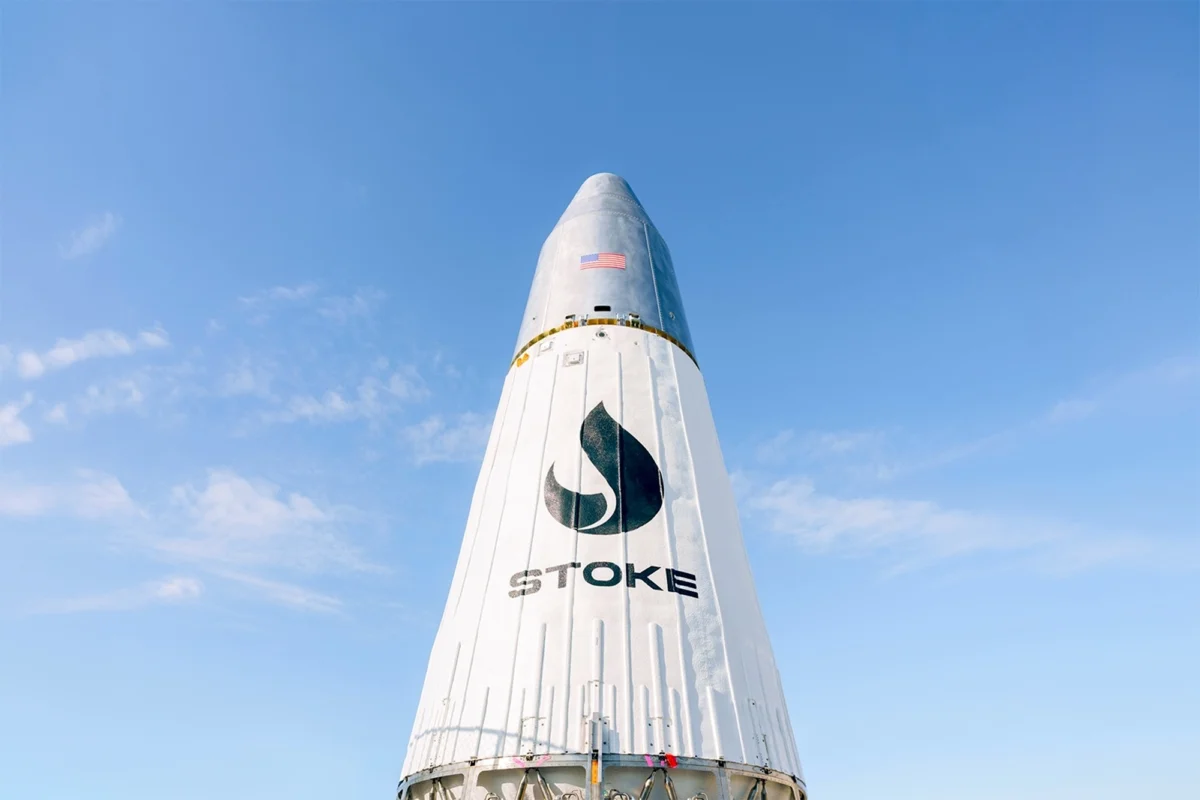
Stoke Space Technologies has announced the successful initial closing of a monumental $1 billion Series E funding round, propelling the company forward in its ambitious quest to achieve truly low-cost, fully reusable access to space. This substantial capital infusion, which brings Stoke’s total funding to an impressive $2.3 billion, is earmarked for critical scaling initiatives, including the expansion of infrastructure, acceleration of production and flight frequency, and crucially, the expedited development of its next-generation launch vehicle.
The investment round was co-led by prominent entities Point72 Ventures, the technology investment arm of hedge fund billionaire Steve Cohen, and Spark Capital. Additional significant contributions came from a diverse syndicate of investors, including General Innovation, Glade Brook Capital, US Innovation Technology, Washington Harbour Partners, Woven Capital, and Y Combinator, among others. This robust backing underscores a growing confidence in Stoke Space’s innovative approach to space launch, particularly its unwavering focus on developing a fully reusable rocket system, a capability widely regarded as the "holy grail" of the commercial space industry.
The Economic Imperative of Full Reusability
In the rapidly evolving landscape of commercial space, the ultimate frontier of cost reduction lies not merely in reusable booster stages, but in the complete reusability of the entire launch system, including the payload-carrying second stage. While pioneers like SpaceX have revolutionized the industry with the reusable first stage of their Falcon 9 rockets and are aggressively pursuing the fully reusable Starship, no company has yet achieved routine, cost-effective reuse of both stages. This remains a significant technical and economic challenge, largely due to the extreme conditions encountered during atmospheric reentry, particularly for the second stage.
Andy Lapsa, CEO of Stoke Space, articulated the strategic importance of this funding, stating, "This round is really to scale. To lay the infrastructure, to scale in production and flight frequency, and importantly to fund the development of the second generation vehicle." His statement highlights not just the immediate goal of reaching orbit, but the long-term vision of establishing a sustainable, high-cadence launch capability that can truly unlock the space economy. The capital will be instrumental in bridging the gap between innovative design and operational reality, enabling Stoke to move beyond developmental testing to commercial flight readiness.
Stoke’s Differentiated Technological Approach: Active Cooling
The journey towards fully reusable second stages is fraught with engineering complexities, primarily centered on thermal management during reentry. SpaceX’s Starship, for instance, has grappled with the challenge of identifying suitable materials and configurations for its second-stage heat shield to withstand the immense heat generated upon atmospheric re-entry. The repeated testing and iterative design of Starship’s thermal protection system underscore the difficulty of this problem.
Stoke Space, however, is charting a unique course with an innovative active cooling solution for its second stage. Unlike passive ablative or ceramic tile systems, Stoke’s design actively circulates super-cooled liquid hydrogen through its thermal shielding. This "transpiration cooling" or "regenerative cooling" technique leverages the rocket’s own propellants to protect the vehicle’s structure from extreme temperatures. Lapsa confirmed that this proprietary system has undergone extensive ground testing and is slated for deployment on the Nova Pathfinder’s inaugural flight. "We can flow excess coolant – more than we think we need in order to overcool the surface of the vehicle – and take a conservative stance from that perspective in early flights," Lapsa explained, indicating a prudent approach to initial flight operations. This active cooling system could potentially offer advantages in terms of durability, inspection, and rapid turnaround compared to systems that require extensive refurbishment or replacement of heat shield components after each flight.
A Detailed Roadmap: Nova Pathfinder and Nova Block 2
Stoke Space has laid out an ambitious, yet detailed, development and deployment timeline for its rocket fleet. The company’s first vehicle, the Nova Pathfinder, is projected to achieve its maiden flight in early 2027. In an industry often characterized by delays, Lapsa expressed confidence in this target, citing a series of successful structural and operational tests conducted on the rocket’s first stage at the company’s Moses Lake facility. The next critical steps involve ground test-firing both stages of the rocket to ensure their readiness for flight. "The ground system is checked out to the extent that we can do it without the rocket, and the rocket’s checked out to the extent that we can do it without the launch pad," Lapsa noted, emphasizing the methodical progression towards integrated testing. "So the next step is to do them together."
The Nova Pathfinder is designed to carry three metric tons to low-Earth orbit (LEO). Lapsa believes this payload capacity will make it the largest debut vehicle from any U.S. rocket manufacturer, signifying Stoke’s intent to enter the market with a robust capability from the outset. Despite the inherent challenges in rocket development, the company has already secured launch contracts for the Pathfinder, demonstrating early market validation and customer interest. Lapsa affirmed the company’s commitment, stating, "We have multiple Pathfinder vehicles in production, and we have confidence that we will bring Pathfinder to market and into orbit regardless of this round." This indicates a strong internal conviction and a diversified production strategy to mitigate risks.
Looking beyond the Pathfinder, Stoke also unveiled plans for an even larger launch vehicle, the Nova Block 2. This second-generation rocket, which has been under development for several years, will leverage the same foundational technologies as the Pathfinder, including the innovative engines and the active heat shield. The Nova Block 2 is designed to significantly increase payload capacity, capable of delivering 15 metric tons to LEO – a figure slightly exceeding that of the highly successful Falcon 9. The deployment target for Nova Block 2 is 2029.
Navigating the Competitive Landscape and Market Demand
Stoke Space operates within a highly competitive and capital-intensive industry, vying with established giants and a cohort of well-funded startups. SpaceX, with its reusable Falcon 9 and the colossal Starship under development, remains the dominant player and the benchmark for reusability. However, the commercial space sector is vast and growing, creating opportunities for new entrants with differentiated offerings.
Other notable players include Rocket Lab, focusing on small-to-medium lift with its Electron and Neutron rockets; Relativity Space, pioneering 3D-printed rockets; and Firefly Aerospace, developing its Alpha and Beta launch vehicles. While these companies are also pushing the boundaries of reusability and launch efficiency, Stoke’s direct aim at fully reusable two-stage systems sets it apart. The ambition to recover and reuse the second stage positions Stoke to potentially achieve unparalleled cost reductions and rapid turnaround times, a critical factor for the burgeoning satellite constellation market.
The timing of Nova Block 2’s planned deployment in 2029 is particularly strategic. Elon Musk has indicated that SpaceX’s Falcon 9 might be phased out around this period, with Starship taking over its capabilities. This potential shift creates a unique market opportunity for Stoke. Lapsa acknowledged this dynamic, admitting, "It amplifies the mismatch between launch supply and demand for launch, there’s no question about that." He further elaborated on the fundamental market principle: "Regardless of Falcon 9 retiring or not retiring, the space industry and the space economy scales exactly as fast as rockets get off the ground, particularly rockets that serve third-party customers."
This "dog whistle" remark resonates deeply with satellite operators and government agencies. As Starship matures, SpaceX’s internal projects, such as Starlink, are expected to heavily utilize its capacity. This could lead to reduced availability or premium pricing for external customers seeking launch services. Stoke, by contrast, has not revealed plans to operate its own space assets, positioning itself as a dedicated third-party launch provider. This focus could attract customers seeking reliable, cost-effective access to orbit without competing with the launch provider’s own payload priorities. The global space economy, valued at over $400 billion in 2022 and projected to exceed $1 trillion by 2030 by some estimates, is heavily reliant on consistent, affordable launch capabilities, making Stoke’s mission critical for its continued expansion.
Investment Trends and the Future of Space Access
The $1 billion Series E round for Stoke Space is indicative of a broader trend of significant venture capital investment flowing into the "New Space" sector. Investors are increasingly recognizing the long-term potential of commercial space, driven by demand for satellite broadband, Earth observation, in-space manufacturing, and scientific research. Companies like SpaceX, Blue Origin, and Rocket Lab have collectively raised billions, demonstrating investor appetite for high-risk, high-reward ventures that promise to fundamentally reshape access to space.
However, the capital requirements for developing advanced launch vehicles are immense. SpaceX’s Starship program alone has reportedly consumed well over $10 billion over the last decade, and it has yet to achieve orbital flight, although that milestone is anticipated with its next test mission. Stoke’s $2.3 billion in total funding places it among the most well-capitalized startups in the launch industry, providing the necessary runway to execute its ambitious engineering and manufacturing plans.
The success of Stoke, and indeed the broader commercial space industry, hinges on overcoming substantial technical hurdles while simultaneously scaling production and maintaining a competitive cost structure. The ability to achieve rapid, low-cost access to space is not just a technological feat but an economic enabler. It allows for the deployment of vast satellite constellations, facilitates more frequent scientific missions, and opens up new avenues for in-space commercial activities.
Challenges and the Road Ahead
Despite the significant funding and technological promise, the path to routine, fully reusable spaceflight is fraught with challenges. Rocket development is notoriously difficult, often marked by delays, technical setbacks, and even failures. Stoke Space will need to navigate the complexities of rigorous testing, regulatory approvals, and establishing a reliable supply chain. The transition from successful ground tests to consistent orbital flights, followed by routine reusability, is a monumental undertaking.
Yet, the potential rewards are equally immense. As Andy Lapsa succinctly put it, "Now is the time to get moving so that we can finally start deploying a lot of the constellations and applications that we aspire to as an industry but have been stuck on the ground." This sentiment encapsulates the urgency and the opportunity that Stoke Space aims to capitalize on. By securing this transformative funding, Stoke is not just building rockets; it is actively shaping the future accessibility and economic viability of humanity’s expansion into space. The coming years will be critical in determining whether Stoke Space can translate its significant financial backing and innovative engineering into operational success and establish itself as a cornerstone of the next era of space exploration and utilization.