


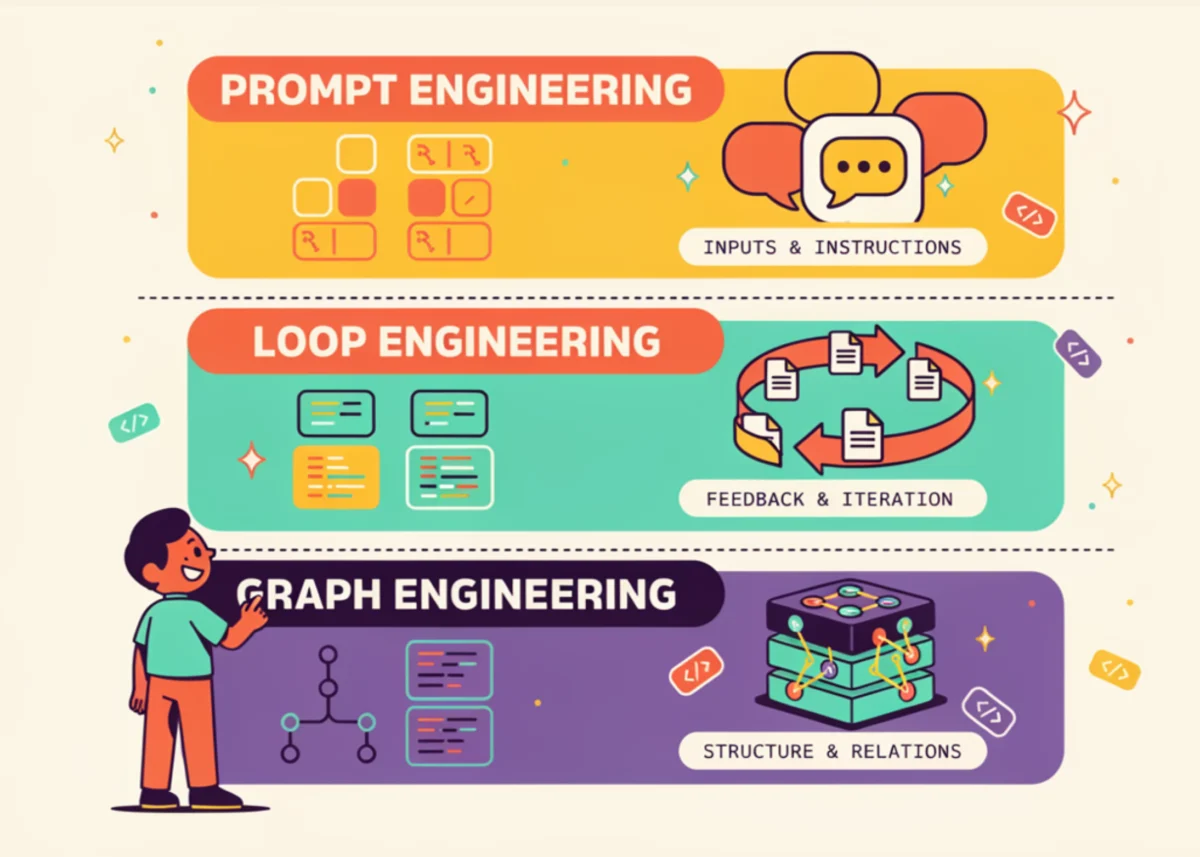
The field of artificial intelligence engineering is currently undergoing a rapid nomenclature and conceptual transformation as developers transition from simple input-output interactions toward complex, multi-layered agentic systems. As of mid-2026, three distinct terms have come to define the modern AI job description: prompt engineering, loop engineering, and graph engineering. While these terms are frequently used interchangeably in recruitment and technical discourse, they represent fundamentally different units of control within an increasingly sophisticated architectural stack. Far from being competing techniques, these layers are cumulative; each new iteration preserves and utilizes the layer beneath it, shifting the role of the engineer from a writer of instructions to an architect of autonomous systems.
The Architectural Stack: A Hierarchy of Control
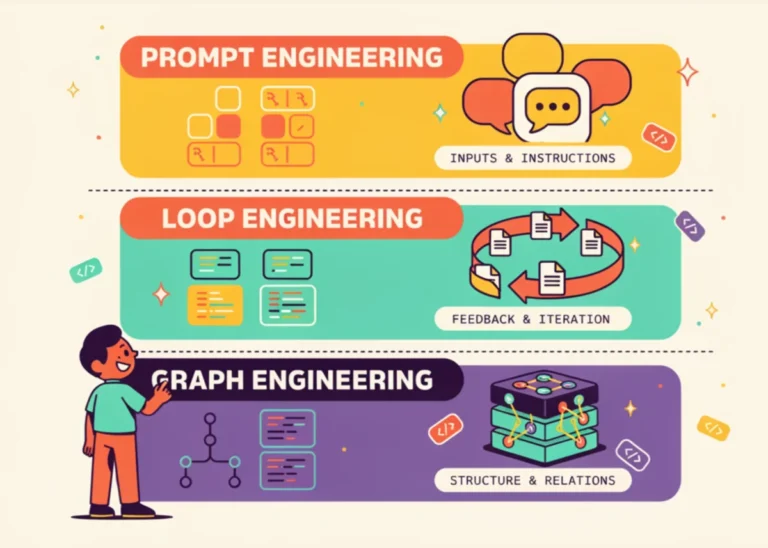
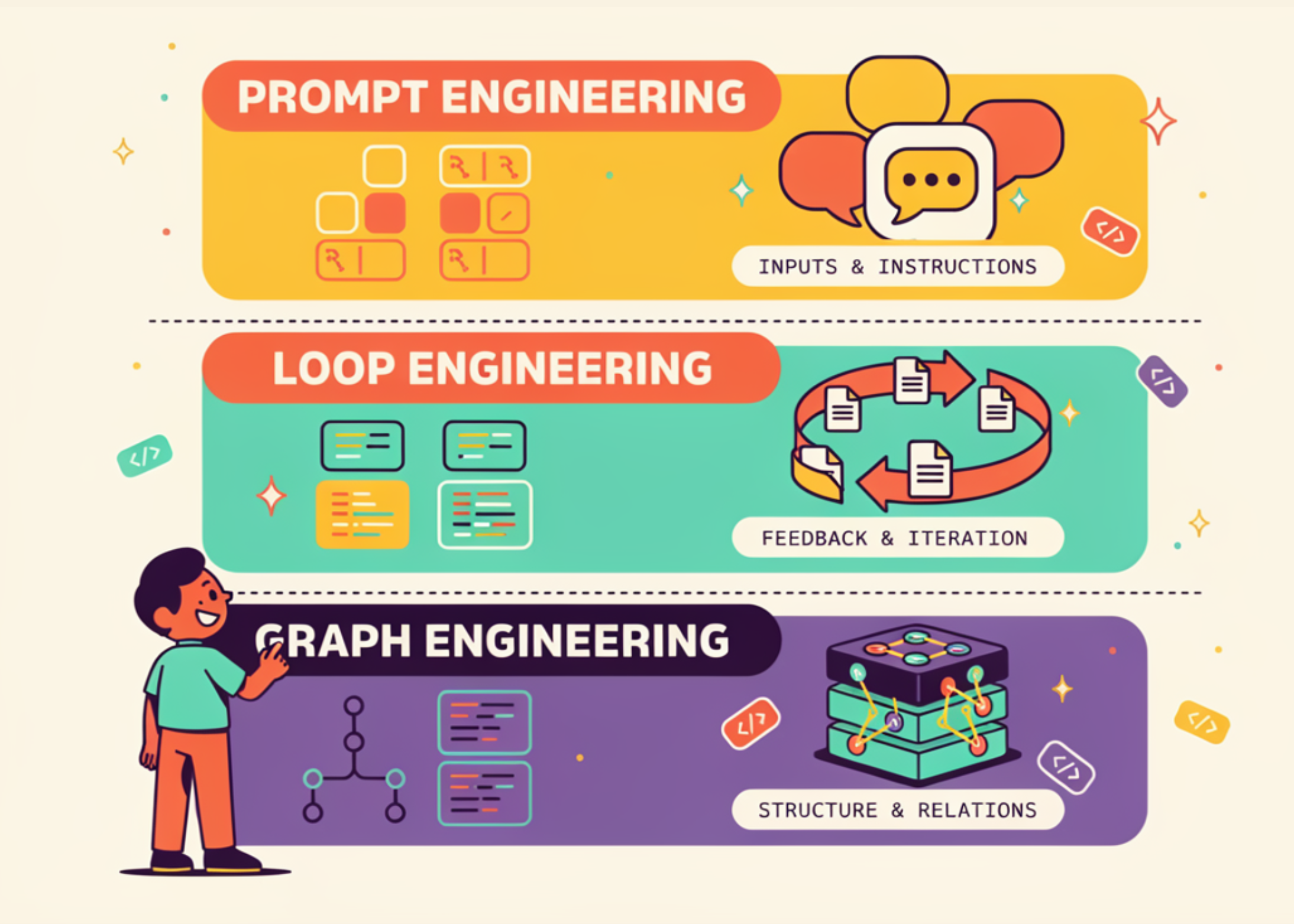
To understand the current state of AI development, one must view these three disciplines as a vertical stack. Prompt engineering serves as the foundational layer, focusing on the control of a single model response. Loop engineering, which gained prominence in late 2025, represents the second layer, controlling the behavioral cycle of an individual autonomous agent. Graph engineering, the most recent evolution emerging in mid-2026, occupies the third layer, governing the organization and interaction of multiple agents working in concert.
The transition between these layers is typically driven by the failure of the layer below to meet specific operational demands. When a task requires high volume, multi-step execution, or lacks a human available to grade every intermediate output, the prompt-only approach becomes insufficient. However, the higher layers do not render the lower ones obsolete. For instance, in complex multi-agent systems, prompt engineering remains the primary lever for resolving coordination failures between sub-agents. Even as the industry moves toward graph-based architectures, the quality of the underlying prompts remains the ultimate determinant of system performance.
Layer 1: The Persistence of Prompt Engineering
Prompt engineering is defined by the assumption of human presence at every iteration. In this paradigm, a human writes a prompt, the model generates a response, the human judges the output, and the prompt is revised accordingly. This iterative loop is manual and highly dependent on human intuition.
While some industry analysts predicted the "death of the prompt" with the advent of more autonomous systems, data suggests the opposite. Research published by Anthropic regarding their multi-agent systems indicates that refined prompting remains the most effective way to fix "topology failures." In early 2026, developers noted that systems designed to handle simple queries were spawning upwards of 50 unnecessary sub-agents. The solution was not to redesign the entire agent network but to refine the high-level prompts governing the orchestrator.
Prompt engineering ceases to be the primary focus only when the surrounding conditions change. The shift to higher layers is necessitated by three specific triggers:
- High Volume: When the scale of requests makes human review impossible.
- Multi-step Complexity: When a task requires a sequence of interdependent actions.
- Automated Feedback: When the results of one step must immediately feed the next without manual intervention.
Layer 2: The Rise of Loop Engineering and Autonomous Agents
By late 2025, the limitations of static prompting led to the rise of loop engineering. This layer treats the AI model as a "brute-force" tool for problem-solving rather than a simple conversationalist. The craft of loop engineering involves designing the goal, the tools, and the iterative cycle that allows an agent to attempt a task, evaluate its own progress, and try again.
The mainstreaming of this term occurred in June 2026, following a pivotal shift in the development of coding agents. Developers realized that instead of trying to write the perfect prompt to generate a complex piece of software, they should design a loop that allows the agent to write, test, and debug code autonomously.
The Five Primitives of Loop Engineering
Technical breakdowns of loop engineering identify five essential primitives that constitute a functional agentic cycle:
- The Cadence: The frequency and triggers for the agent’s actions.
- The Goal: A persistent objective that survives individual model turns.
- The Toolset: The external capabilities (APIs, file access, compilers) available to the agent.
- The State: The memory of what has been attempted and what has been achieved.
- The Evaluator: A separate model or logic gate that judges whether the goal has been met.
A critical feature of loop engineering is the separation of the "worker" and the "grader." In advanced implementations like Claude Code and the Codex app, a primary agent generates the work while a smaller, specialized model checks the output against the written condition. This prevents the "hallucination of success," where an agent incorrectly believes it has completed a task.
The primary risk in loop engineering is the "stop condition." A loop that cannot mechanically distinguish between being "done" and being "stuck" does not fail loudly; instead, it continues to consume tokens and computational resources indefinitely. Designing robust exit strategies is therefore the hallmark of a skilled loop engineer.
Layer 3: Graph Engineering and Multi-Agent Organizations
In July 2026, the technical conversation shifted toward graph engineering. If loops make individual agent behavior programmable, graphs make the organization of those agents programmable. This layer addresses the complexities of having multiple specialized agents working on different parts of a massive project.
The most significant contribution of graph engineering is the distinction between two types of graphs running simultaneously in production systems: the Org Graph and the Work Graph.
The Org Graph vs. The Work Graph
The Org Graph is a stable, long-lived structure. It defines agents with specific roles—such as a "Security Auditor," a "Frontend Developer," or a "Database Architect." These agents hold their positions over time, accumulate context, and are only changed during a system redeploy. The Org Graph answers the question of "who" is responsible for what.
The Work Graph is ephemeral and task-specific. It exists only for the duration of a specific job. In a Work Graph, nodes represent specific task milestones, and edges represent the flow of data. These graphs are dynamic; edges may split to allow for parallel processing or merge when different branches of work converge. Once the work is completed, the Work Graph disappears. The Work Graph answers the question of "what" is being done right now.
Technical Implementation and State Management
Frameworks like LangGraph have been instrumental in the rise of graph engineering. In these systems, a StateGraph is declared over a specific state schema. Nodes are added as plain functions that receive a state and return partial updates. The most critical aspect of this architecture is that context does not cross a node boundary unless an edge explicitly carries it. This strict control over state prevents the "context pollution" that often plagues simpler AI systems, where irrelevant information from one task interferes with another.
Chronology of the AI Engineering Evolution
The transition through these layers has followed a distinct timeline:
- December 2024: Initial workflow patterns are identified, including prompt chaining, routing, and parallelization. These are described as prose but lay the groundwork for graph topology.
- Late 2025: Loop engineering enters the professional vocabulary as developers seek to automate coding and research tasks.
- June 2026: Loop engineering dominates developer forums. Major AI providers release dedicated agentic tools (e.g., Claude Code) that emphasize goal-oriented cycles over single prompts.
- July 2026: Graph engineering emerges as the dominant paradigm for enterprise-scale AI. The focus shifts to orchestrating "swarms" or "organizations" of agents.
- Late 2026: Academic papers (e.g., July 2026 arXiv publications) codify the relationship between the three layers, establishing them as a unified stack.
Economic and Technical Implications
The shift to higher layers of engineering has profound implications for the cost and reliability of AI systems. While loop and graph engineering allow for much greater autonomy, they also introduce new failure modes. A poorly designed graph can lead to "infinite loops" of agent communication, where sub-agents pass tasks back and forth without reaching a conclusion, leading to massive token expenditures without output.
Furthermore, the "operator factor" remains a significant variable. Two engineers can build identical loops but achieve vastly different outcomes based on their underlying domain knowledge. An engineer who understands the work deeply can design a loop that moves faster and more accurately. Conversely, an engineer who uses a loop to avoid understanding the work often creates fragile systems that fail under edge cases.
Choosing the Right Layer
For organizations and developers, the choice of which layer to employ depends on the specific requirements of the task. The industry has moved toward a "first-no" heuristic:
- Can a human grade every output? If yes, stay at Layer 1 (Prompt Engineering).
- Is the task a single, straightforward step? If yes, stay at Layer 1.
- Is the goal a single cycle of "try-evaluate-retry"? If yes, move to Layer 2 (Loop Engineering).
- Does the task require multiple roles or parallel workstreams? If yes, move to Layer 3 (Graph Engineering).
As the AI landscape continues to mature, the distinction between these layers will likely become even more pronounced. The successful AI engineer of the future will not be someone who simply "talks to the model," but an architect capable of designing the complex organizational structures and autonomous cycles that allow AI to operate at scale. The transition from prompt to loop to graph is not just a change in terminology; it is the professionalization of AI development into a true engineering discipline.