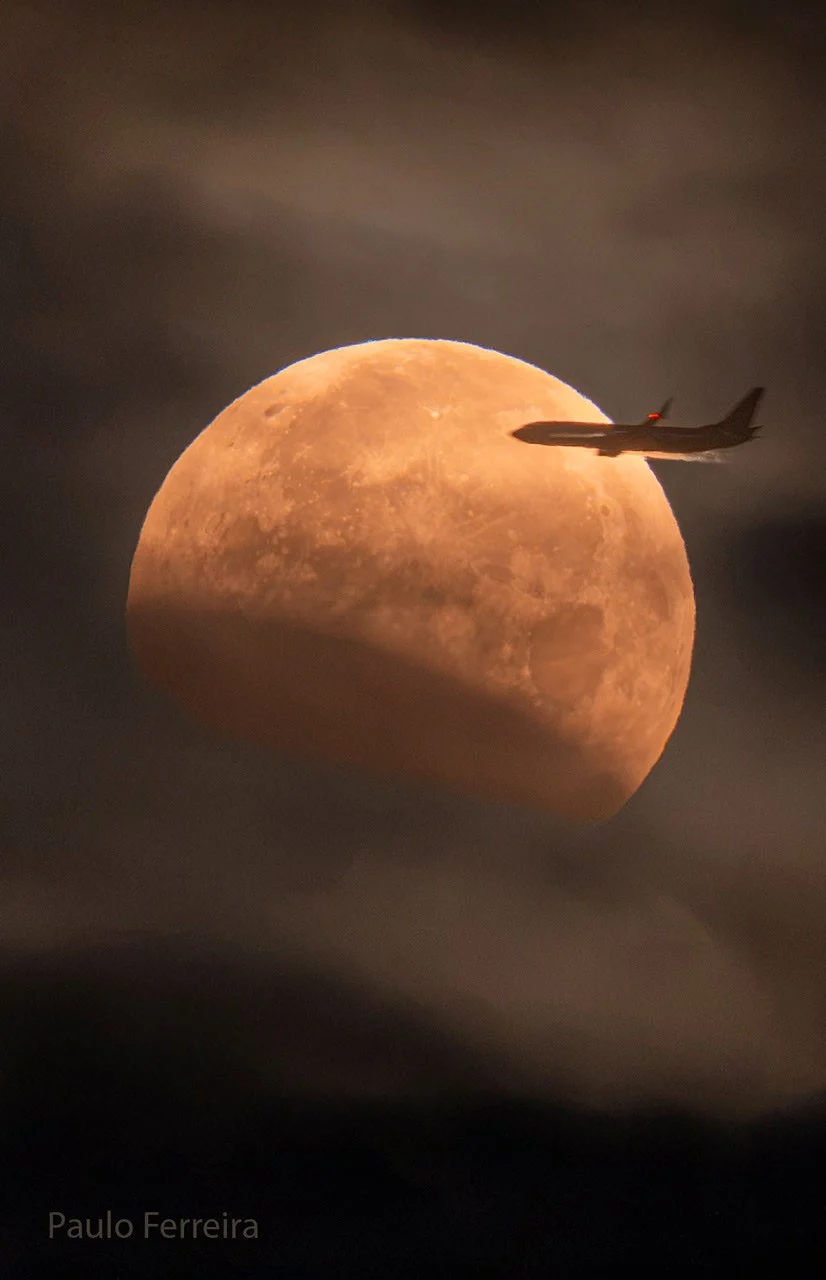
The cosmos delivered a moment of striking beauty and unique photographic opportunity, highlighted on September 1, 2026, by NASA’s Astronomy Picture of the Day (APOD). The featured image, captured by astrophotographer Paulo Ferreira from Portugal, immortalized a partial lunar eclipse with an airplane dramatically silhouetted against the darkened lunar disk, providing a terrestrial counterpoint to a celestial event. This particular spectacle, part of the August 2026 lunar eclipse series, underscored the widespread accessibility and visual splendor of lunar phenomena, offering a reminder that some of the universe’s most profound shows require nothing more than the unaided eye.
The Celestial Spectacle of August 2026
The image released by APOD on the first day of September 2026 documented a specific phase of the lunar eclipse that unfolded across the night skies of August 28-29, 2026. Lunar eclipses occur when the Earth passes directly between the Sun and the Moon, casting a shadow on our natural satellite. This particular event was a partial lunar eclipse, meaning only a portion of the Moon entered Earth’s darkest shadow, known as the umbra. For observers across Europe, Africa, Asia, and Australia, the eclipse offered varying degrees of visibility, with the deepest part of the partial eclipse occurring late on August 28th or early on August 29th, depending on the observer’s time zone.
The mechanics behind a lunar eclipse are a testament to the precise orbital dance within our solar system. The Moon orbits Earth approximately once every 27.3 days, while Earth orbits the Sun once a year. However, the Moon’s orbit is tilted by about 5 degrees relative to Earth’s orbit around the Sun (the ecliptic plane). Eclipses can only occur when the Sun, Earth, and Moon align almost perfectly in a straight line, which happens when the Moon crosses the ecliptic plane at or near its full phase. These points of intersection are called nodes. When the Moon is full and near one of these nodes, it can pass into Earth’s shadow.
Earth’s shadow has two main parts: the outer, fainter penumbra, and the inner, darker umbra. A penumbral lunar eclipse occurs when the Moon passes only through the penumbra, causing a subtle dimming that can be difficult to discern. A partial lunar eclipse, like the one captured in August 2026, happens when a portion of the Moon enters the umbra, making that part appear distinctly darker. A total lunar eclipse, the most dramatic of the three, sees the entire Moon immersed in the umbra, often glowing with a beautiful coppery-red hue due to Rayleigh scattering of sunlight through Earth’s atmosphere, which filters out blue light and bends red light into the shadow cone. The "unusually dark" lower-left portion of the Moon in Ferreira’s photograph is characteristic of a partial eclipse, where a segment of the lunar surface was deeply immersed in Earth’s umbral shadow.
A Fortuitous Frame: The Airplane’s Ephemeral Passage
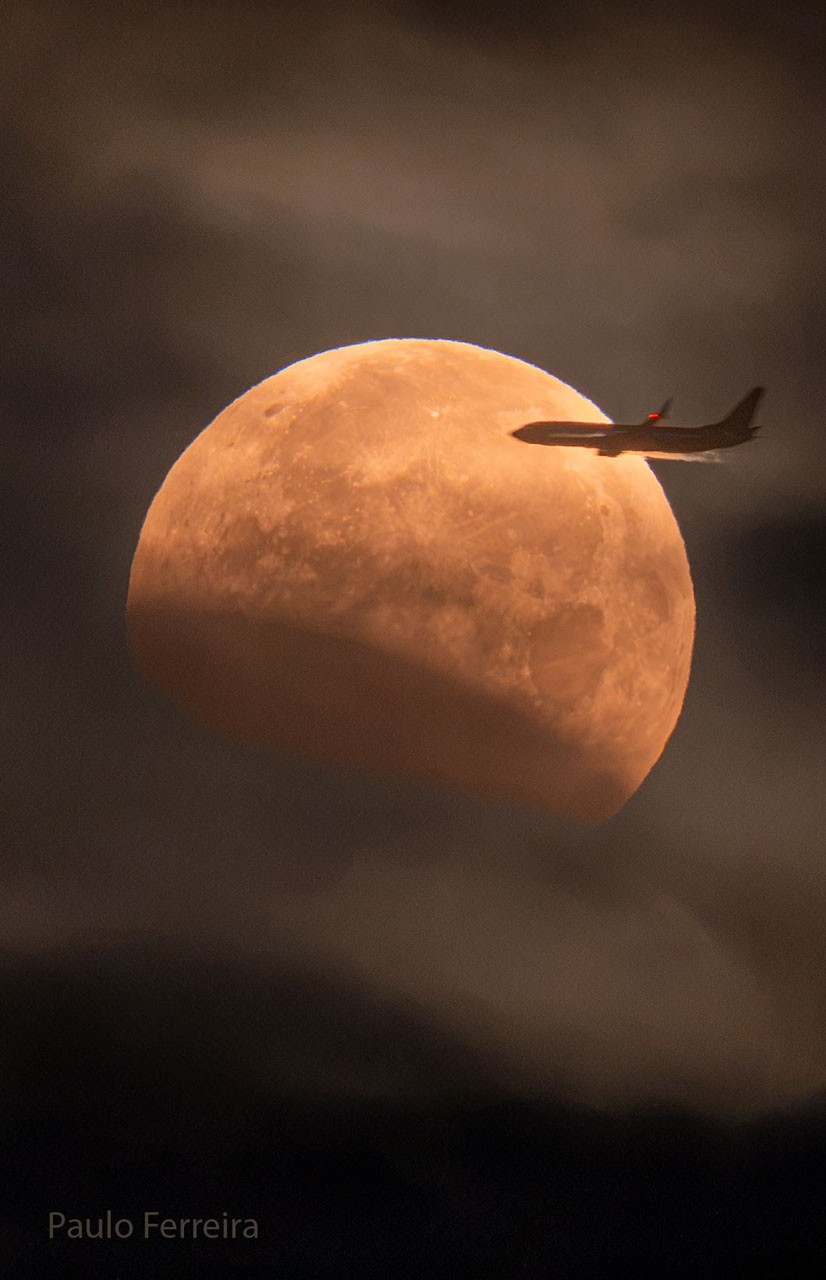
The APOD image, titled "PlaneEclipse," presented not just a celestial event but a moment of remarkable terrestrial timing. Against the partially eclipsed Moon, an airplane appeared to be flying directly into its disk, its dark silhouette a fleeting counterpoint to the distant lunar sphere. This conjunction of a human-made machine and a cosmic phenomenon is what elevates Ferreira’s photograph beyond a standard astrophoto. It highlights the often-overlooked fact that our daily lives unfold beneath an active and dynamic sky, constantly offering opportunities for wonder.
Paulo Ferreira, credited for the striking image, likely employed significant skill and perhaps a measure of luck to capture this precise moment. Astrophotography, especially involving foreground objects, demands meticulous planning, including knowledge of astronomical timings, aircraft flight paths, and precise camera positioning. While the APOD explanation humorously questioned the optimal viewing side of the airplane, the photograph itself serves as a testament to the confluence of timing and artistic vision. Such shots are incredibly challenging; the plane moves rapidly, and its intersection with the lunar disk is momentary. The photographer must anticipate the plane’s trajectory and trigger the shutter at the exact right instant, often through a series of rapid-fire shots. This level of precision underscores the dedication of astrophotographers who contribute significantly to public astronomy.
Understanding Lunar Eclipses: Earth’s Shadow Play
Lunar eclipses are generally more common and significantly safer to observe than solar eclipses. Unlike solar eclipses, which require specialized eye protection to prevent severe retinal damage from direct sunlight, lunar eclipses pose no threat to eyesight. The Moon, even when full, reflects sunlight rather than emitting its own, making it perfectly safe to view with the unaided eye, binoculars, or a telescope. This inherent safety contributes to their status as one of the most widely witnessed astronomical events globally.
The duration of a lunar eclipse also sets it apart. While total solar eclipses last mere minutes at any given location, a total lunar eclipse can span several hours from its initial penumbral phase to its conclusion, with the period of totality often lasting over an hour. This extended duration provides ample opportunity for observation, photography, and even for viewers on a moving platform, such as an airplane, to adjust their position. As the APOD explanation playfully suggested, even if one were initially on the "wrong side" of an aircraft during takeoff, the hours-long nature of a lunar eclipse would likely allow time to cross the aisle and witness the spectacle, a luxury not afforded by the fleeting nature of most solar eclipses.
The August 2026 partial lunar eclipse, visible across vast swaths of the Eastern Hemisphere, showcased this accessibility. Millions would have had the chance to observe the Moon’s gradual darkening as it dipped into Earth’s shadow. For many, it would have been a casual glance skyward; for others, a dedicated viewing event with friends and family. This widespread visibility fosters a collective appreciation for astronomy, transcending geographical and cultural boundaries.
The Art of Astrophotography and Public Engagement
The APOD feature on September 1, 2026, is part of a long-standing tradition by NASA to bring the universe closer to the public. APOD, or Astronomy Picture of the Day, has been a daily staple since 1995, offering "a different image or photograph of our fascinating universe… along with a brief explanation written by a professional astronomer." This initiative serves as a critical bridge between cutting-edge astronomical research and the general public, demystifying complex celestial phenomena and inspiring new generations of scientists and space enthusiasts.
Paulo Ferreira’s contribution, like countless others featured on APOD, underscores the vital role of citizen scientists and amateur astrophotographers. Their dedication to capturing the beauty and intricacies of the cosmos provides a rich repository of images that complement professional astronomical observations. These photographs often possess a unique aesthetic or a relatable human element, like the airplane in this instance, that resonates deeply with a broad audience. They transform abstract scientific concepts into tangible, awe-inspiring visuals.
The selection of this particular image for APOD’s daily feature reflects its capacity to engage. It’s not just a scientific record of an eclipse; it’s a narrative in a single frame, marrying the vastness of space with the immediate human experience of flight. This ability to tell a story through imagery is a cornerstone of effective science communication and a core mission of APOD.
Viewing from the Ground and the Sky: A Global Phenomenon
The August 2026 lunar eclipse offered varied viewing experiences depending on location. In Portugal, where Ferreira captured his image, the eclipse would have been visible during a convenient evening or early morning window, allowing for terrestrial observations. However, the mention of an airplane in the APOD explanation also invites consideration of how celestial events are viewed from non-terrestrial vantage points.
From the cabin of an airplane, the experience of witnessing a lunar eclipse could be uniquely profound. Above the light pollution and often above cloud cover, the sky takes on a deeper, more pristine darkness, enhancing the visibility of celestial objects. While the plane’s motion might complicate long-exposure photography, the naked-eye view would offer an unobstructed panorama. Commercial airline pilots and passengers occasionally report spectacular views of astronomical events, from meteor showers to eclipses, that are simply not possible from the ground. The very nature of air travel, spanning continents and time zones, sometimes places individuals in unique positions to observe transient celestial phenomena, adding another layer of wonder to the journey.
The global nature of lunar eclipses, observable from any location on Earth where the Moon is above the horizon during the event, makes them powerful shared experiences. While a solar eclipse is a localized event visible only along a narrow path, a lunar eclipse paints the entire night side of Earth with its subtle, reddish glow. This broad accessibility makes it a truly communal astronomical event, fostering a sense of connection among disparate populations united under the same moonlit sky.
NASA’s Enduring Commitment to Astronomical Outreach
The APOD article also contained an important announcement regarding the platform’s future: "APOD’s main NASA site is moving: From apod.nasa.gov to science.nasa.gov/apod." This seemingly technical detail highlights NASA’s ongoing commitment to evolving its digital presence and centralizing its vast scientific resources. The migration of APOD to the broader science.nasa.gov domain signifies an integration into a more comprehensive hub for NASA’s scientific endeavors, making it easier for the public to navigate from a daily astronomical image to deeper scientific explorations and educational content.
This strategic move aligns with NASA’s broader objectives under initiatives like NASA Science Activation, which aims to enable lifelong learners to discover NASA science through a diverse portfolio of experiences. By consolidating platforms, NASA ensures that its rich archive of images, data, and explanations remains accessible, well-maintained, and easily discoverable by students, educators, researchers, and the general public. It’s a proactive step to ensure the longevity and relevance of one of the internet’s longest-running and most beloved astronomical outreach programs. The collaboration with Michigan Technological University, also credited in the APOD release, further underscores the academic and institutional support that underpins such significant public science communication efforts.
Conclusion: Inspiring Future Generations
The "PlaneEclipse" image, featuring the August 2026 lunar eclipse, is more than just a beautiful photograph; it is a microcosm of effective science communication. It combines a natural wonder with a relatable human element, presented through a highly accessible platform like APOD. It reinforces the idea that astronomy is not confined to observatories but is a pervasive and accessible part of our world.
Such images serve as powerful catalysts for curiosity, prompting questions about orbital mechanics, light scattering, and the sheer scale of the universe. They inspire individuals, young and old, to look up and ponder their place in the cosmos. In an increasingly digital age, the ability of a single image to spark such widespread interest in science and space exploration remains invaluable. As APOD transitions to its new digital home, its mission to "Discover the cosmos!" continues, fueled by the captivating visuals and expert explanations that daily illuminate our fascinating universe, one picture at a time. The legacy of events like the August 2026 eclipse, captured with such creativity and shared globally, will undoubtedly continue to inspire future generations to explore, understand, and appreciate the wonders that lie beyond our immediate horizons.