In a significant expansion of its future product roadmap, Lotus has confirmed that its upcoming flagship supercar, codenamed Type 135, will be offered with both V6 and V8 hybrid powertrains. The announcement, made by Lotus CEO Feng Qingfeng during the company’s second-quarter earnings call on August 27, marks a pivotal moment for the British marque as it recalibrates its "Vision80" strategy to include high-performance internal combustion engines (ICE) alongside its electric ambitions. The Type 135, which is widely expected to adopt the iconic "Esprit" nameplate upon its scheduled 2028 launch, is being engineered to bridge the gap between the mid-engine Emira sports car and the 2,000bhp Evija electric hypercar.
By offering a V6 variant alongside the previously confirmed V8 hybrid, Lotus aims to provide a more accessible entry point into its flagship range while strictly adhering to the "added lightness" philosophy established by founder Colin Chapman. The decision to maintain combustion-based hybrid systems reflects a broader industry trend where luxury manufacturers are responding to cooling demand for pure battery-electric vehicles (BEVs) in the high-performance segment. Feng emphasized that the hybrid approach allows the company to meet increasingly stringent global emissions standards without sacrificing the mechanical engagement and "extreme track-focused driving dynamics" that define the brand.
Engineering the 1.5-Tonne Benchmark
The primary engineering hurdle for the Type 135 is the ambitious weight target of 1.5 tonnes (1,500kg) for the V8 hybrid version. In an era where modern hybrid supercars often exceed 1,700kg due to the dual requirements of heavy battery packs and internal combustion hardware, Lotus’s goal represents a significant technical challenge. CEO Feng Qingfeng acknowledged the complexity of this task during the investor call, noting that integrating an 800-volt electrical architecture, a high-output V8 engine, and an electric motor into a lightweight chassis requires unconventional solutions.
To achieve this, Lotus is leveraging technology derived from Formula 1. One of the most notable breakthroughs revealed by Feng is the development of an ultra-lightweight electric motor. While a standard 150-kilowatt (approximately 201bhp) electric motor typically weighs between 75kg and 95kg, Lotus has successfully engineered a unit that weighs just 20kg. This 75% reduction in motor weight is critical to offsetting the mass of the hybrid battery and the V8 engine block.
The powertrain will also feature an eight-speed dual-clutch transmission (DCT) specifically designed to manage the high torque output of a hybrid system while maintaining a compact, low-mass profile. With total system output expected to exceed 1,000bhp, the Type 135 is being positioned to compete with the world’s most advanced "super hybrids," such as the Ferrari SF90 Stradale and the Lamborghini Temerario.
The Role of Horse: A Strategic Powertrain Partnership
The development of the V6 and V8 engines is being facilitated through "Horse," a specialized powertrain joint venture owned by Lotus’s parent company, Geely, and the Renault Group. This partnership allows Lotus to access world-class internal combustion expertise and manufacturing scale that would be difficult to sustain as a standalone low-volume manufacturer.
The turbocharged V8 engine is being designed "from scratch," according to Feng, allowing engineers to optimize the engine’s physical volume and weight from the earliest design phases. By integrating the engine development with the chassis design, Lotus aims to achieve a power-to-weight ratio that sets a new industry benchmark. The V6 version, meanwhile, is expected to share architectural similarities with the hybrid system planned for the eventual successor to the Emira, providing Lotus with a scalable powertrain hierarchy.
A Strategic Reversal: From All-Electric to Multi-Energy
The confirmation of the Type 135’s hybrid powertrains follows a strategic shift within Lotus to move away from its 2021 pledge to become a pure-electric brand by 2028. This reversal is driven by several factors, including the slower-than-expected rollout of high-speed charging infrastructure in key markets and a clear preference among supercar buyers for the auditory and emotional experience of a combustion engine.
This new "multi-energy" strategy will begin in earnest with the launch of the Eletre X, a plug-in hybrid version of the brand’s electric SUV. Scheduled to arrive in the UK and other global markets next year, the Eletre X will feature a 939bhp hybrid setup, serving as a technological precursor to the more extreme systems found in the Type 135.
Feng described the Type 135 as the "emotional link" in the Lotus lineup. It is intended to capture the mechanical purity of the Emira—the brand’s last non-hybrid combustion car—while utilizing the electrified performance benchmarks established by the Evija. This positioning is intended to retain long-term Lotus enthusiasts who may have been alienated by a premature shift to total electrification.
Design Inspiration and the Theory 1 Concept
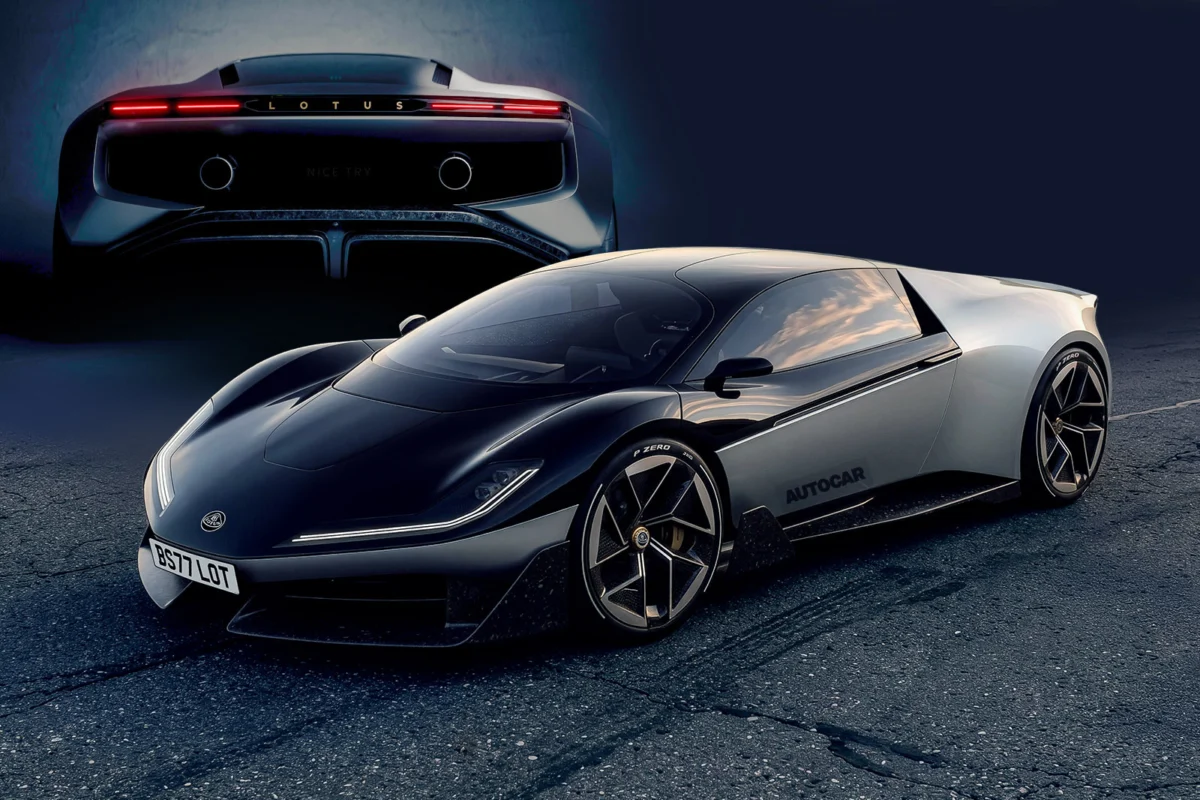
Visually, the Type 135 is heavily influenced by the Lotus Theory 1, an electric supercar concept unveiled earlier in 2024. The Theory 1 served as a design manifesto, showcasing a "Challenge, Deliver, Track" (CDT) design language characterized by sharp aerodynamic surfaces and a minimalist interior.
A teaser image released by Lotus confirms that the production Type 135 will retain the striking rear-end styling of the concept, featuring slim LED light bars and an aggressive integrated diffuser. However, the production car will differ significantly with the inclusion of two prominent, high-mounted exhaust outlets—a clear visual indicator of the hybrid combustion heart beating beneath the carbon-fiber bodywork. The inclusion of these exhaust ports underscores the shift in strategy, signaling to the market that Lotus remains committed to the "visceral" experience of internal combustion.
Economic Impact and Manufacturing at Hethel
In a move that provides long-term security for the brand’s historical base, Lotus confirmed that the Type 135 will be manufactured at its headquarters in Hethel, Norfolk. While Lotus has expanded its global footprint with the production of the Eletre SUV and Emeya sedan in Wuhan, China, the company remains committed to building its flagship sports cars in the United Kingdom.
The production of the Type 135 alongside the Emira at Hethel ensures the retention of specialized automotive engineering jobs and sustains the local supply chain. Industry analysts view this as a vital move to maintain the "Made in UK" prestige that carries significant weight in the luxury supercar market, particularly in North America and Europe. The investment in Hethel also aligns with the UK government’s broader goals of supporting high-tech manufacturing and the transition to electrified transport.
Chronology of the Type 135 Development
- 2018: Lotus announces "Vision80," a ten-year plan to transform the brand under Geely ownership, initially targeting a 100% electric lineup by 2028.
- 2021: The Emira is launched as the final "pure" internal combustion car from Lotus.
- 2023: Internal discussions begin regarding the limitations of a pure-EV flagship, leading to the exploration of hybrid alternatives.
- Early 2024: The Theory 1 concept is revealed, showcasing the design direction for the next generation of Lotus performance cars.
- August 27, 2024: CEO Feng Qingfeng confirms the Type 135 will feature V6 and V8 hybrid powertrains, targeting a 1,500kg curb weight.
- 2025: Launch of the Eletre X (PHEV), marking the first production hybrid of the new era.
- 2028: Planned global launch of the Type 135 "Esprit" successor.
Market Implications and Competitive Landscape
The decision to equip the Type 135 with a V6 hybrid option is a direct challenge to the Ferrari 296 GTB and the McLaren Artura. Both competitors have moved to V6 hybrid setups to balance performance with emissions compliance. However, by offering a 1,000bhp V8 variant as well, Lotus is positioning the Type 135 to punch upward into the territory currently occupied by the Ferrari SF90 and the upcoming successor to the McLaren P1.
The technical specifications suggested by Feng—particularly the 800V architecture—give Lotus a potential advantage in charging speeds and thermal management over some current competitors. Furthermore, the focus on a 1,500kg weight target addresses the most common criticism of modern supercars: that they have become too heavy and disconnected.
Broader Industry Impact
Lotus’s pivot serves as a bellwether for the wider automotive industry. As a low-volume, high-prestige manufacturer, Lotus’s movements often reflect the shifting desires of the most affluent automotive consumers. The move back toward combustion, even in a hybrid capacity, suggests that the "sound and soul" of an engine remains a non-negotiable requirement for many in the supercar segment.
Furthermore, the collaboration with Horse demonstrates a new model for boutique manufacturers. By sharing the immense R&D costs of engine development with giants like Geely and Renault, Lotus can continue to offer bespoke-feeling engines without the prohibitive costs that have historically bankrupted small British car firms.
As 2028 approaches, the Type 135 will be the ultimate test of whether Lotus can successfully blend its lightweight heritage with the heavy demands of modern electrification. If the company meets its 1.5-tonne target while delivering over 1,000bhp, it may well reclaim its position at the very top of the supercar hierarchy, proving that the spirit of Colin Chapman can survive and thrive in a hybrid world.