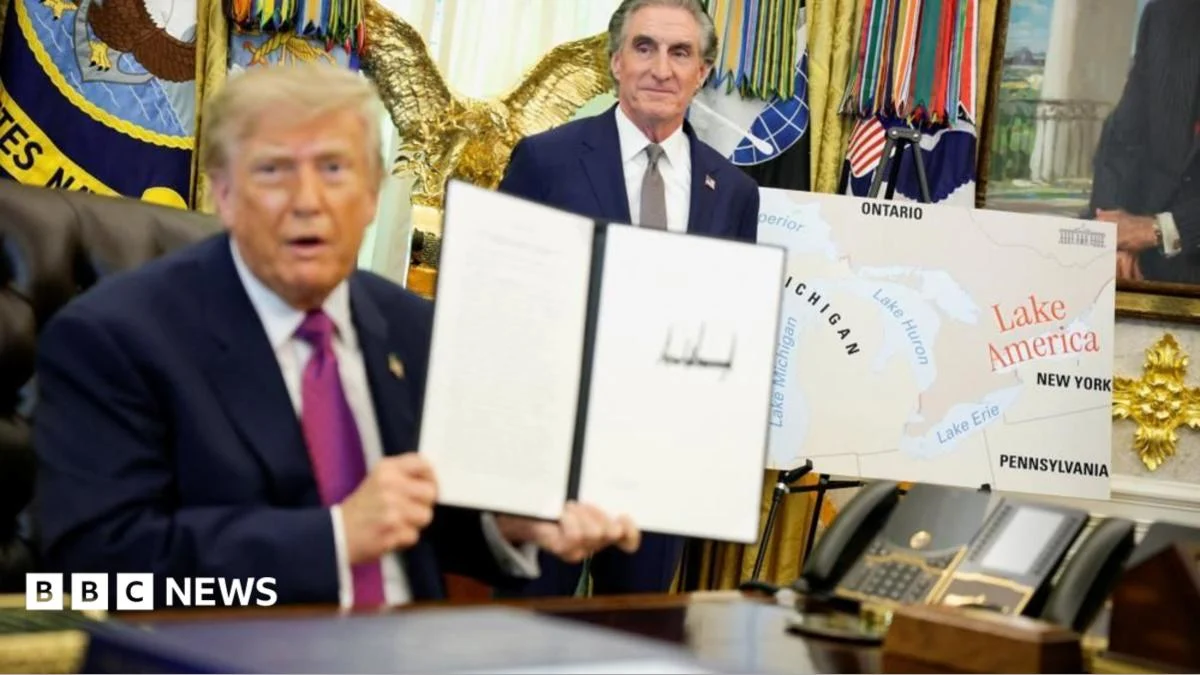
In a move that has sent shockwaves through North America and further inflamed already fraught relations between the United States and Canada, US President Donald Trump has signed an executive order officially seeking to rename Lake Ontario to "Lake America." The unprecedented directive, announced on Thursday, comes on the heels of a dramatic collapse in crucial trade talks between Washington and Ottawa late last week, which immediately led to the US imposing steep 50% tariffs on $20 billion (C$28 billion) worth of Canadian goods. Canada has vowed swift retaliation, preparing to implement "dollar for dollar" counter-tariffs beginning next month.
The renaming of Lake Ontario, one of the five ecologically and economically vital Great Lakes shared by both nations, has been a recurring threat from President Trump on social media amid the escalating trade dispute. On Thursday, Trump declared the name change "official, effective immediately," asserting that his administration had "filed all the necessary papers, documents" to formalize the alteration within US governmental systems. This unilateral action has been met with immediate and forceful rejection from Canadian officials, who view it as a direct affront to their sovereignty and a disregard for centuries of shared history.
A Pattern of Unilateral Actions: The Gulf of America Precedent
This is not the first instance of President Trump attempting to unilaterally rename a significant shared body of water. Upon taking the White House in 2025, he signed a similar executive order that changed the Gulf of Mexico to the "Gulf of America." That previous action provoked an immediate and ongoing legal dispute with Mexico, which firmly rejected the name change, arguing that a single country cannot unilaterally rename a shared international water body. The Gulf of Mexico renaming also led to a high-profile legal battle between Mexico and tech giant Google. Google, adhering to the US executive order, updated its maps application to reflect the new name for US users. Consequently, Google Maps users in the US now see "Gulf of America," while those in Mexico continue to see "Gulf of Mexico." Users in other countries are presented with "Gulf of Mexico (Gulf of America)," reflecting the contested nature of the name.
Further compounding the previous controversy, the White House at the time blocked Associated Press reporters from presidential events over the news agency’s refusal to adopt the name "Gulf of America" in its coverage. The Associated Press, a globally respected news organization, sued the Trump administration in response, a legal battle that remains unresolved and underscores broader concerns about press freedom and governmental overreach in defining nomenclature. These past actions establish a clear pattern of the Trump administration employing geographic renaming as a tool of asserting national dominance and escalating diplomatic pressure.
The Great Lakes: A Shared Heritage and Indigenous Legacy
Lake Ontario, the smallest in surface area of the Great Lakes, holds immense ecological, economic, and cultural significance for both Canada and the United States. Its waters border the Canadian province of Ontario and the US state of New York, serving as a critical artery for shipping, a source of fresh water, a hub for tourism, and home to diverse ecosystems. The lake’s current name, "Ontario," is derived from the Huron (Wyandot) word Ontarí’io, meaning "great lake" or "beautiful lake." This indigenous origin is shared by three other Great Lakes – Huron, Michigan, and Erie – whose names also stem from indigenous languages, reflecting millennia of human habitation and cultural significance predating European colonization. Lake Superior, the fifth Great Lake, was named after an anglicized French word.
Canadian Prime Minister Mark Carney vehemently underscored this historical depth in a social media post on Thursday, noting that the name Lake Ontario can be traced back more than 400 years, predating both the formation of the Canadian Confederation (1867) and the US Declaration of Independence (1776). "We know that the United States is changing. Their trade relations, their foreign policy, their national monuments, their hydronyms," Carney wrote, lamenting the perceived erosion of international norms. He concluded with a resolute statement: "Canadian women and men also know that things must be called by their name, and this lake is called Lake Ontario — today and forever." His message encapsulates the profound cultural and historical attachment Canadians have to the lake’s established identity.
Chronology of Escalation: From Trade Talks to Renaming Threats
The roots of the current crisis lie in a rapidly deteriorating trade relationship between the US and Canada. While tensions have simmered for years, particularly under the Trump administration’s "America First" trade policies that led to the renegotiation of NAFTA (now USMCA) and previous tariffs on steel and aluminum, the latest breakdown began to escalate sharply in recent weeks. President Trump had repeatedly used social media platforms to issue threats about renaming Lake Ontario, framing it as a punitive measure against Canada’s perceived unfair trade practices.
- Late Last Week: Trade talks, which had been ongoing to resolve specific disputes, abruptly collapsed. Both sides accused the other of introducing last-minute demands that scuttled a tentative agreement.
- Following Collapse: The US immediately imposed new 50% tariffs on $20 billion (C$28 billion) worth of Canadian goods, targeting various sectors.
- Tuesday: Canadian Industry Minister Melanie Joly publicly dismissed the idea of renaming the lake, stating, "We’ll always call it Lake Ontario."
- Thursday: President Trump officially signed the executive order to rename Lake Ontario to Lake America. Simultaneously, Premier of Nova Scotia Tim Houston reacted with dismissive incredulity, saying, "We’re into some real foolishness now. It’s Lake Ontario, buddy."
- Next Month: Canada is slated to implement "dollar for dollar" counter-tariffs, further intensifying the trade war.
Official Responses and Unwavering Rejection
The Canadian government’s response has been unified and unequivocal in its rejection of the name change. Beyond Prime Minister Carney’s powerful statement, other Canadian officials have echoed the sentiment. The consistent message from Ottawa and provincial leaders is that Canada will simply not recognize the name change.
On the US side, the executive order has drawn sharp criticism from Democratic lawmakers. Representative Debbie Dingell of Michigan, a state that borders four of the five Great Lakes, announced her intention to introduce a bill in Congress to nullify Trump’s order, branding it "idiotic." Dingell emphasized the shared responsibility and cooperation that has historically defined the US-Canada stewardship of the Great Lakes, stating, "The Great Lakes are a shared treasure that generations of Americans and Canadians have worked together to protect." Other Democratic lawmakers took to social media to mock the president’s initiative, with Wisconsin’s governor jokingly posting a video of himself signing a napkin, proclaiming, "I just renamed Lake Michigan Lake Wisconsin. See, I can sign napkins that say things, too," underscoring the perceived absurdity of Trump’s action. New York Governor Kathy Hochul, whose state is the sole US state bordering Lake Ontario, also stated definitively that her state "won’t be calling it" Lake America.
Conversely, the Trump administration has defended the move. Secretary of the Interior Doug Burgum applauded the order, writing, "We’re on it, Mr. President!" He further elaborated, "The places and waters that border our nation and support our economy should reflect the greatness of the United States," adding that the US Geological Survey "maps our country for the world to see, and we are PROUD to implement your Executive Order to rename LAKE AMERICA." This statement signals the administration’s intent to enforce the name change within its own official mapping and geographic information systems, irrespective of international or Canadian objections.
Legal and International Implications: A Challenge to Sovereignty
The issue of renaming shared international waters is complex and fraught with legal and diplomatic challenges. There is no universally recognized international body or treaty that dictates the naming conventions for international waters. While a US president possesses broad discretion over how his country officially recognizes domestic landmarks and geographic features, this authority typically does not extend to unilaterally renaming shared international bodies of water without the consent or recognition of co-bordering nations. International legal experts generally agree that such a unilateral action would not be recognized under international law and could be seen as a violation of customary international law pertaining to shared resources.
The ongoing legal disputes stemming from the Gulf of Mexico renaming – with Mexico challenging the name change and the Associated Press suing over press freedom issues – highlight the profound implications of such executive orders. The Lake Ontario renaming is likely to trigger similar, if not more intense, legal and diplomatic battles, potentially involving international courts or arbitration, though the immediate practical enforcement remains largely symbolic outside of US government documents.
Beyond the Lake: Trump’s Vision for American Hydronyms
President Trump, in signing the order, explicitly linked the renaming to the broader trade dispute, stating it wasn’t a "direct message" to Canada but asserting that America’s northern neighbor "has been ripping us off for a long time on trade." He also revealed that the idea of renaming the lake had been "for a long time" on his mind. In a statement that hinted at even grander ambitions, Trump mused, "So if you think about it, we have a gulf and we have a lake. Now, all we need is an ocean. So maybe we’ll have to change the name of the Atlantic and or the Pacific. Maybe we’ll change them both." These comments suggest a broader, more aggressive strategy of asserting US dominance through symbolic geographic renaming, potentially setting a precedent for further international disputes over shared natural resources.
A Glimmer of Hope Amidst Diplomatic Chill?
Despite the dramatic escalation, a faint glimmer of hope for future negotiations emerged on Thursday. Canadian US trade minister Dominic LeBlanc posted on X (formerly Twitter) that the US had withdrawn some of its demands around French labelling requirements and "is confirming that measures to promote French language and Canadian culture will not be subject to future US trade actions." LeBlanc added, "We look forward to further constructive US clarifications on their other positions, which would create the possibility of a mutually beneficial trade agreement that respects Canadian sovereignty." This suggests that while the symbolic battle over Lake Ontario rages, there might still be an appetite for a return to the negotiating table on core trade issues, provided certain Canadian red lines, particularly around cultural sovereignty, are respected.
However, the renaming of Lake Ontario represents a significant new low in US-Canada relations, once considered one of the most stable and friendly bilateral relationships in the world. The act of unilaterally attempting to alter the name of a shared natural landmark, steeped in centuries of history and indigenous heritage, is perceived by many as an act of profound disrespect and a direct challenge to Canadian sovereignty. As the trade war intensifies and legal challenges mount, the controversy over "Lake America" is set to become a defining symbol of the strained diplomatic ties between two nations that once prided themselves on their close partnership. The long-term implications for cross-border cooperation, environmental stewardship of the Great Lakes, and international norms regarding shared resources remain to be seen, but the immediate future suggests a period of heightened tension and diplomatic uncertainty.