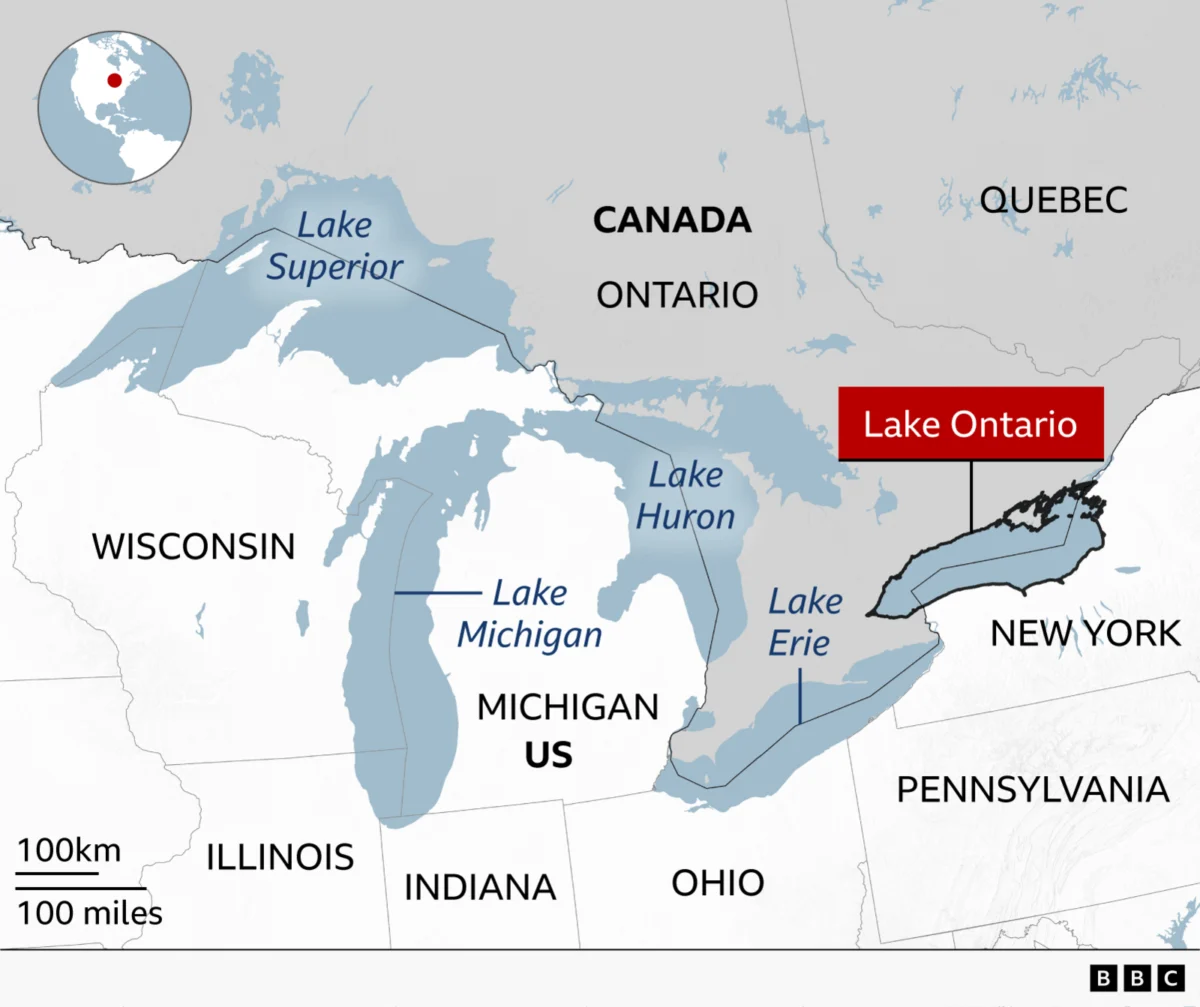
The picturesque shores of Lake Ontario, a vital shared waterway between Canada and the United States, have become the latest battleground in an escalating diplomatic and trade dispute, as Ontario Premier Doug Ford unveiled a prominent sign declaring "Lake Ontario. Now and Always." This defiant act directly counters an executive order signed by U.S. President Donald Trump on Thursday, which sought to unilaterally rename the historic body of water to "Lake America." The symbolic gesture by the Canadian province’s leader underscores a deepening rift between the two North American neighbours, fueled by recently collapsed trade negotiations and the imposition of significant tariffs by the United States on Canadian goods.
The Genesis of the Great Lakes Naming Controversy
The dispute began to boil over following President Trump’s executive order, a move that Canadian officials have swiftly dismissed as an affront to national sovereignty and historical accuracy. On Thursday, President Trump announced his decree, asserting its immediate effectiveness in changing the name of the lake on the U.S. side. While a U.S. President possesses broad discretion over how the United States recognizes domestic landmarks and geographic features, this authority does not extend to dictating international nomenclature or obliging other sovereign nations to conform. This critical distinction forms the bedrock of Canada’s firm rejection of the renaming.
Adding a novel and somewhat perplexing dimension to the controversy, President Trump leveraged social media over the weekend to disseminate a series of AI-generated videos designed to underscore his directive. One particularly provocative video depicted the President symbolically kicking over a sign bearing the name "Lake Ontario" and replacing it with a new one proudly proclaiming "Welcome to Lake America." Another clip, steeped in surreal imagery, showed a flock of Canada geese, conspicuously adorned with the President’s distinctive hairstyle, patrolling the newly dubbed "Lake America" shoreline while brandishing rifles. These digital provocations, widely shared across various platforms, served to amplify the President’s message and draw considerable international attention to the unfolding drama.
Ontario’s Resolute Stand: A Sign of Defiance
Against this backdrop of digital theatrics and executive mandates, Ontario Premier Doug Ford delivered a powerful, unequivocal response. Standing before the newly installed, large-format sign at the Fifty Point Conservation Area, near Grimsby, Ontario, Ford addressed the media and the international community with a message of unwavering Canadian resolve. "Long before President Trump, this lake was called Lake Ontario. Long after President Trump is gone, it will still be called Lake Ontario," Ford stated emphatically, his words resonating with a clear assertion of historical fact and national identity. The newly erected sign, strategically placed on Canada’s shoreline, serves as a tangible, enduring testament to this stance, designed, as Ford explained, "Just in case President Trump or anyone else forgets, we’ve set up this sign to remind them, it’s Lake Ontario, now and forever."
Premier Ford directly attributed President Trump’s renaming effort to a perceived displeasure over Canada’s assertiveness. "President Trump’s renaming of the lake was because he didn’t like Ontario and Canada standing up for ourselves," Ford articulated, linking the symbolic act directly to the underlying trade disagreements. This sentiment echoes the earlier, equally firm declaration from Canadian Prime Minister Mark Carney, who had previously responded to the budding row by insisting that "things must be called by their name, and this lake is called Lake Ontario – today and forever." The unified front presented by Canadian political leadership underscores the depth of feeling surrounding this issue, transcending mere semantics to touch upon fundamental questions of sovereignty and mutual respect.
The Economic Undercurrent: Trade War Escalation
While the renaming of a lake might appear, on the surface, to be a whimsical or symbolic gesture, it is inextricably linked to a much more substantive and economically significant conflict: the collapse of critical trade talks between Canada and the United States. These bilateral negotiations, aimed at resolving ongoing trade disputes and potentially forging new agreements, reached an impasse, leading to immediate repercussions.
In response to the breakdown, the U.S. administration moved swiftly to impose new, substantial tariffs. These tariffs, set at a punitive 50%, target an estimated $20 billion (approximately C$28 billion) worth of Canadian goods. The specific categories of goods affected by these tariffs span a wide range of industries, from raw materials to manufactured products, potentially impacting thousands of Canadian businesses and workers. This aggressive economic measure signals a significant escalation in trade tensions, reminiscent of previous periods of strained relations between the two long-standing allies. Data from the Office of the United States Trade Representative indicates that Canada is the U.S.’s second-largest trading partner, with two-way goods and services trade totaling over $700 billion annually. Such tariffs threaten to disrupt integrated supply chains, particularly in the automotive, energy, and agriculture sectors, which are deeply intertwined across the border.

Canada’s response to these tariffs has been equally firm and decisive. The Canadian government has announced its intention to implement "dollar for dollar" counter-tariffs, slated to take effect next month. This retaliatory measure signifies Canada’s commitment to defending its economic interests and its domestic industries against what it perceives as unwarranted protectionism. Such tit-for-tat tariff battles have historically proven detrimental to both economies involved, disrupting supply chains, increasing consumer costs, and fostering an environment of uncertainty for businesses. The immediate impact is likely to be felt across various sectors, from agriculture and forestry to automotive parts and steel, potentially leading to job losses and reduced economic growth in both nations. The broader context of Canada-U.S. trade relations, which typically involve one of the largest bilateral trade partnerships in the world, makes these developments particularly concerning, threatening the intricate web of economic interdependence built over decades.
A Rich History: The Indigenous Roots of Lake Ontario
Beyond the contemporary political theatre, the name "Lake Ontario" carries profound historical and cultural weight, deeply rooted in the heritage of North America’s Indigenous peoples. The name "Ontario" itself is derived from the Huron (Wyandot) word "Ontarí’io," which translates to "lake of shining waters" or "beautiful lake." This nomenclature reflects not only the breathtaking natural beauty of the lake but also its enduring significance to the Indigenous communities who have lived on its shores for millennia. Archeological evidence suggests human presence around the Great Lakes dating back over 10,000 years, with numerous Indigenous nations, including the Haudenosaunee (Iroquois) and Anishinaabeg, having strong historical and spiritual ties to the lake.
Lake Ontario is the smallest of the five Great Lakes by surface area, covering approximately 18,960 square kilometres (7,320 square miles), but it holds immense importance as a freshwater resource, a vital transportation route, and a rich ecological habitat. It borders the Canadian province of Ontario to the north and the U.S. state of New York to the south, with a maximum depth of 244 metres (802 feet). The Great Lakes as a whole represent the largest group of freshwater lakes on Earth by total area and are an indispensable resource for millions of people in both countries, supplying drinking water, supporting diverse ecosystems, and facilitating vast commercial shipping.
The names of four of the five Great Lakes—Ontario, Huron, Michigan, and Erie—originate from Indigenous languages, reflecting the deep historical connection between these natural wonders and the continent’s First Nations. Lake Superior is the only exception, its name derived from an anglicized French word "Supérieur," meaning "upper lake," given by early French explorers. To unilaterally rename such a historically significant body of water, therefore, is seen by many as not just a political act, but a disregard for the rich tapestry of Indigenous history and cultural identity woven into the fabric of the land. It touches upon issues of cultural appropriation and the erasure of ancestral heritage, sparking outrage far beyond the immediate political sphere. Indigenous leaders in Canada have voiced strong opposition, emphasizing the importance of respecting traditional names as part of reconciliation efforts.
The Precedent: "Gulf of America" and Google Maps Controversy
This is not the first instance of President Trump attempting to unilaterally rename a shared international body of water. When he entered the White House in 2025, one of his early executive orders similarly sought to change the name of the Gulf of Mexico to the "Gulf of America." This move, targeting another shared water body with a neighbouring country, Mexico, drew immediate and forceful condemnation from the Mexican government.
Mexico unequivocally rejected the name change, arguing strenuously that a single country cannot unilaterally rename a shared body of international water. This principle of international law, which upholds the mutual recognition of geographic names, forms a crucial part of diplomatic conduct and respect between nations. The Mexican government’s stance was rooted in the understanding that such shared resources necessitate consensual naming conventions, reflecting shared heritage and sovereignty. Mexico’s Foreign Minister at the time stated that the "historical and internationally recognized name is non-negotiable."
The "Gulf of America" decree also led to a notable legal and technical dispute involving the tech giant Google. Following the executive order, Google, which relies on various official and unofficial geographic data sources, updated its Google Maps application to reflect the new name for users within the United States. Consequently, Google Maps users accessing the service from within the U.S. began to see the "Gulf of America" displayed. However, users in Mexico continued to see the "Gulf of Mexico," in line with their government’s official position and historical usage. For users in other countries, Google Maps adopted a compromise, displaying "Gulf of Mexico (Gulf of America)," acknowledging both names while maintaining the traditional one as primary. This digital schism highlighted the practical complexities and potential for confusion arising from unilateral geographic renaming, demonstrating how political decrees can ripple through the digital landscape and create divergent realities based on a user’s geographical location. The precedent set by the Gulf of Mexico situation offers a stark warning of the potential long-term implications for Lake Ontario, should the U.S. insist on its renaming.
Official Reactions and International Law Considerations
The official reactions from Canadian authorities have consistently reinforced the message that President Trump’s executive order holds no sway over Canadian territory or international norms. Canadian officials have maintained that the name "Lake Ontario" is established by history, tradition, and international understanding, and that no U.S. presidential decree can alter this reality. The consensus among Canadian legal experts and diplomats is that shared bodies of water, particularly those forming international borders, are subject to agreements and long-standing conventions between the bordering nations, not unilateral declarations. Experts in international maritime law and geography have pointed to the United Nations Group of Experts on Geographical Names (UNGEGN) which promotes standardization of geographical names but recognizes the sovereign right of each country to name its features, especially those within its own territory. However, for shared features, bilateral or multilateral agreements are the standard practice.

While the original article does not detail specific international legal challenges, the principles at play are clear. International law often relies on customary practices and bilateral or multilateral agreements for the naming and management of shared resources. A unilateral attempt to rename a body of water that forms an international boundary is generally considered an infringement upon the sovereignty and historical rights of the other bordering nation. This type of action, while perhaps intended to exert political pressure or appeal to domestic audiences, can undermine the very framework of international cooperation and diplomatic goodwill that is essential for managing shared environments and resolving disputes peacefully. The absence of explicit condemnation from international bodies thus far might be attributed to the largely symbolic nature of the U.S. decree from an international legal perspective, as it lacks enforceability beyond U.S. internal mapping and designation. However, the consistent public dismissal by Canada serves as a diplomatic rejection, signalling that this is not a matter for negotiation or acceptance.
Broader Impact and Geopolitical Implications
The Lake Ontario naming dispute, though seemingly trivial in its core subject, carries significant broader implications for the Canada-U.S. relationship and international relations at large. It represents a potent symbol of diplomatic friction, where cultural heritage and national identity become entangled with economic protectionism and political posturing.
Firstly, the incident exacerbates existing tensions stemming from the trade war. The symbolic renaming adds an emotional and nationalistic layer to an already contentious economic standoff, making de-escalation more challenging. It suggests a willingness by the U.S. administration to employ unconventional and provocative tactics, which can erode trust and complicate future negotiations on more substantive issues such as cross-border energy projects, environmental protection of the Great Lakes, or continental security.
Secondly, the use of AI-generated content in this context highlights a concerning trend in modern political discourse. The deployment of digitally manipulated videos, even if understood as satire or hyperbole by some, blurs the lines between reality and fiction, potentially sowing confusion and further polarizing public opinion. It normalizes the use of advanced technology for political propaganda, setting a precedent that could have far-reaching consequences for truth and accountability in public life, especially in an era of widespread misinformation.
Thirdly, the dispute underscores the enduring importance of place names in national identity. For Canadians, "Lake Ontario" is not just a geographical label; it is a part of their heritage, their history, and their connection to the land. Attempts to rename it are perceived as an attack on this identity, galvanizing public opinion and fostering a sense of unity in defiance. This deep emotional attachment makes the issue far more sensitive than a mere administrative change, tapping into a wellspring of national pride and historical memory.
Finally, the incident raises questions about the future trajectory of Canada-U.S. relations. Traditionally, these two nations have maintained one of the most stable and cooperative bilateral relationships in the world, characterized by shared values, extensive trade, and strong cultural ties. Actions such as the attempted renaming of a shared landmark, coupled with aggressive trade policies, risk fundamentally altering this relationship, replacing collaboration with contention and mutual respect with perceived disrespect. The long-term effects could manifest in reduced cross-border investment, diminished diplomatic initiatives, and a general cooling of relations, impacting everything from environmental cooperation on the Great Lakes to joint security efforts. The defiance shown by Premier Ford, mirrored by Prime Minister Carney, signals that Canada is prepared to stand firm in the face of such pressures, indicating a potentially rocky path ahead for the bilateral relationship.
Conclusion: A Name That Endures
In summary, the standoff over the name of Lake Ontario transcends a simple geographical designation; it is a complex interplay of historical identity, economic grievances, and diplomatic principles. Ontario Premier Doug Ford’s unveiling of the "Lake Ontario. Now and Always." sign serves as a powerful visual and verbal declaration of Canadian resolve, directly challenging President Trump’s executive order and the provocative digital content supporting it. Rooted in Indigenous history and solidified by centuries of usage, the name "Lake Ontario" stands as a symbol of Canadian heritage that, according to its leaders, will not be easily altered by external decrees. As trade tensions simmer and diplomatic rhetoric sharpens, the shimmering waters of Lake Ontario remain a steadfast testament to its enduring name, today and, as Canadians assert, forever. The implications of this dispute extend far beyond its immediate subject, pointing to deeper fissures in the Canada-U.S. relationship and the evolving nature of international discourse in an era marked by digital influence and assertive nationalism.