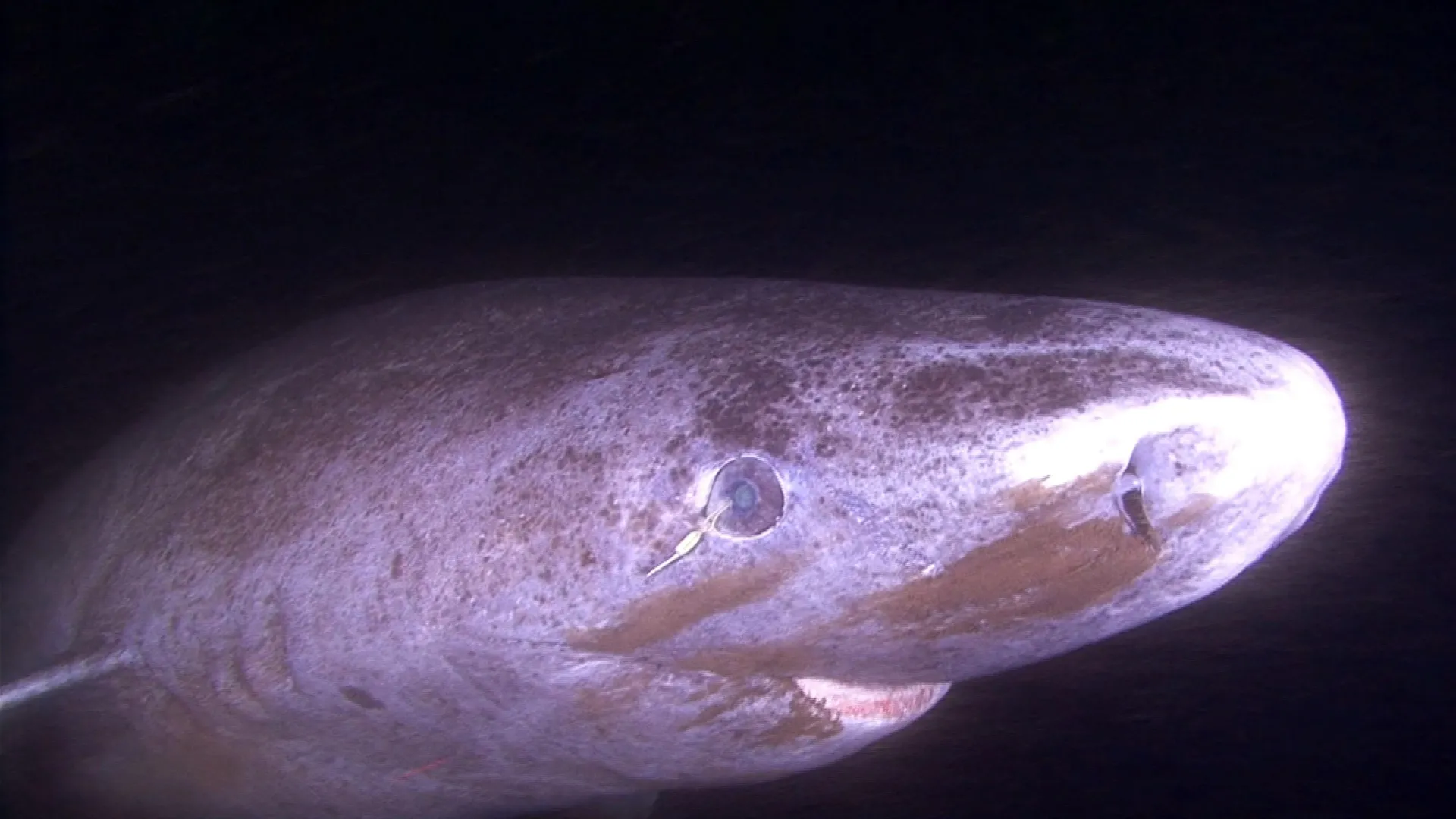
The slow, deliberate movement of a Greenland shark, a creature synonymous with extreme longevity, gliding through the inky blackness of the Arctic on a computer screen, captivated Associate Professor Dorota Skowronska-Krawczyk of the University of California, Irvine. "You see it move its eye," she observed, her finger tracing the path of the spectral eye on the monitor. "The shark is tracking the light — it’s fascinating." This seemingly simple observation, coupled with decades of scientific inquiry into the enigmatic Greenland shark, has culminated in groundbreaking research challenging long-held assumptions about the creature’s vision and offering profound insights into the very mechanisms of aging and the preservation of biological function over centuries.
For years, Greenland sharks (Somniosus microcephalus) have been recognized as the longest-lived vertebrates on Earth, with some individuals estimated to have survived for an astonishing 400 years. Their imposing, thick gray bodies, diminutive heads, and short, rounded snouts are distinctive. However, it is their eyes that have often drawn the most attention and speculation. Characterized by a cloudy appearance, these organs can seem almost devoid of life, further complicated by the frequent presence of parasites that attach directly to the eyeballs. These external factors, combined with the perpetually dark and murky environment of their Arctic habitat, have led many scientists to believe that Greenland sharks might be functionally blind, relying on other senses to navigate their frigid domain.
New research, spearheaded by Skowronska-Krawczyk, a specialist in the molecular processes of age-related eye diseases, presents a compellingly different narrative. This extensive study, co-authored by Walter Salzburger and Lily G. Fogg from the University of Basel in Switzerland, who contributed their expertise in evolutionary biology, not only debunks the notion of widespread blindness in these ancient sharks but also unveils potential biological strategies that could be key to understanding how vision can be maintained for such extraordinary durations.
Unraveling the Mysteries of Ancient Eyes
The findings, published in the prestigious journal Nature Communications, suggest that Greenland sharks possess a sophisticated DNA repair mechanism that may be instrumental in preserving their eyesight, preventing the kind of retinal degeneration typically associated with advanced age. Furthermore, their visual systems appear to be remarkably adapted to the extremely low-light conditions prevalent in their deep-sea Arctic environment.
Skowronska-Krawczyk’s journey into the world of Greenland shark vision began with a pivotal 2016 research paper by John Fleng Steffensen, a professor of marine biology at the University of Copenhagen, published in the journal Science. "One of my takeaway conclusions from the Science paper was that many Greenland sharks have parasites attached to their eyes — which could impair their vision," Skowronska-Krawczyk explained. "Evolutionarily speaking, you don’t keep the organ that you don’t need. After watching many videos, I realized this animal is moving its eyeball toward the light." This keen observation, a departure from the prevailing scientific consensus, ignited a deeper investigation into the sharks’ visual capabilities.
The specimens central to this groundbreaking study were ethically sourced through scientific long-line fishing expeditions conducted between 2020 and 2024. These expeditions were carried out in the vicinity of the University of Copenhagen’s Arctic Station, a renowned research facility located on Disko Island, Greenland. This remote location provided access to a population of Greenland sharks that have likely inhabited these waters for generations, offering a unique opportunity to study their physiology in situ.
A Glimpse into Centuries of Vision
The dissection and analysis of these remarkable eyes were a collaborative effort involving researchers from multiple institutions. Professor Steffensen, a leading authority on Arctic marine life, partnered with Peter G. Bushnell from Indiana University South Bend and Richard W. Brill from the Virginia Institute of Marine Science. Their initial work involved carefully dissecting the sharks’ eyes and preserving them in a specialized fixative solution. This meticulous preservation was crucial to ensure the integrity of the delicate tissues for subsequent microscopic and molecular analysis.
The arrival of these ancient specimens at UC Irvine’s laboratory was an event met with a mixture of awe and scientific rigor. Emily Tom, a Ph.D. student in Skowronska-Krawczyk’s lab and a physician-scientist in training, vividly recalls the moment. "I opened the package, and there was a giant, 200-year-old eyeball sitting on dry ice just staring back at me," she recounted with a laugh. The sheer scale of the specimen was a significant departure from their usual research subjects. "We’re used to working with mouse eyeballs, which are the size of a papaya seed, so we had to figure out how to scale up to a baseball-sized eyeball. Luckily, Dorota is very hands-on, both in her mentoring style and in the lab — which you don’t see a lot of with professors."
The process of preparing the ancient tissues for analysis demanded extreme precision. As the eyeball began to thaw, the laboratory environment took on a distinct aroma. "The lab smelled like a fish market," Tom admitted. Maintaining the correct temperature was paramount; any significant warming above the freezing point could lead to the deterioration of the delicate cellular structures, compromising the integrity of the research.
Preserving the Retinal Integrity
Under the careful guidance of Skowronska-Krawczyk and through Tom’s meticulous histological and vision-specific analyses, the research team meticulously examined the preserved eye tissues. The results were astonishing: there was no discernible evidence of cell death within the retina, a finding that directly contradicts the expected cellular degradation in an organism of such advanced age.
Furthermore, the study revealed that rhodopsin, a critical protein for vision in low-light conditions, remained demonstrably active within the shark retina. This protein appeared to be finely tuned to detect blue light, a spectral range that penetrates deepest into the ocean. This adaptation is highly advantageous for Greenland sharks, allowing them to perceive their surroundings in the faint, ethereal light that filters down into the abyssal depths of the Arctic Ocean.
"Not a lot of people are working on sharks, especially shark vision," Tom commented, highlighting the niche yet vital nature of their research. "We can learn so much about vision and longevity from long-lived species like the Greenland shark, so having the funds to do research like this is very important." The implications of these findings are profound, suggesting that the Greenland shark’s extraordinary lifespan is not accompanied by the severe retinal degeneration one might anticipate in such an ancient animal.
Broader Implications for Human Health and Aging
For Skowronska-Krawczyk, the research opens up a tantalizing prospect: understanding the mechanisms that enable Greenland shark eyes to remain healthy for centuries could pave the way for novel strategies to combat age-related vision loss in humans. The implications extend beyond merely preserving sight; they could inform research into debilitating eye conditions such as macular degeneration and glaucoma, diseases that significantly impact millions worldwide.
This research also prompts broader scientific inquiries into the fundamental principles of vision evolution, the remarkable resilience of biological tissues over immense timescales, and the potential for translating these protective mechanisms to human physiology. Could the ancient secrets of the Greenland shark offer a blueprint for enhancing human health and longevity?
Despite the exhilarating nature of these discoveries, Skowronska-Krawczyk acknowledges the challenges facing scientific research, particularly the uncertainty surrounding federal funding. "What I love about my work is that we are the first in the world to see results — at the forefront, finding new mechanisms, rules and discoveries," she stated, her gaze returning to the paused image of the shark on her screen. "Then, being able to share this joy with students — that’s the best part of it." This dedication to scientific exploration and the dissemination of knowledge, even amidst potential funding uncertainties, underscores the profound importance of this ongoing research into one of the planet’s most ancient and enigmatic inhabitants. The Greenland shark, it seems, is not just a survivor of time, but a living repository of biological secrets that could redefine our understanding of aging and vision.