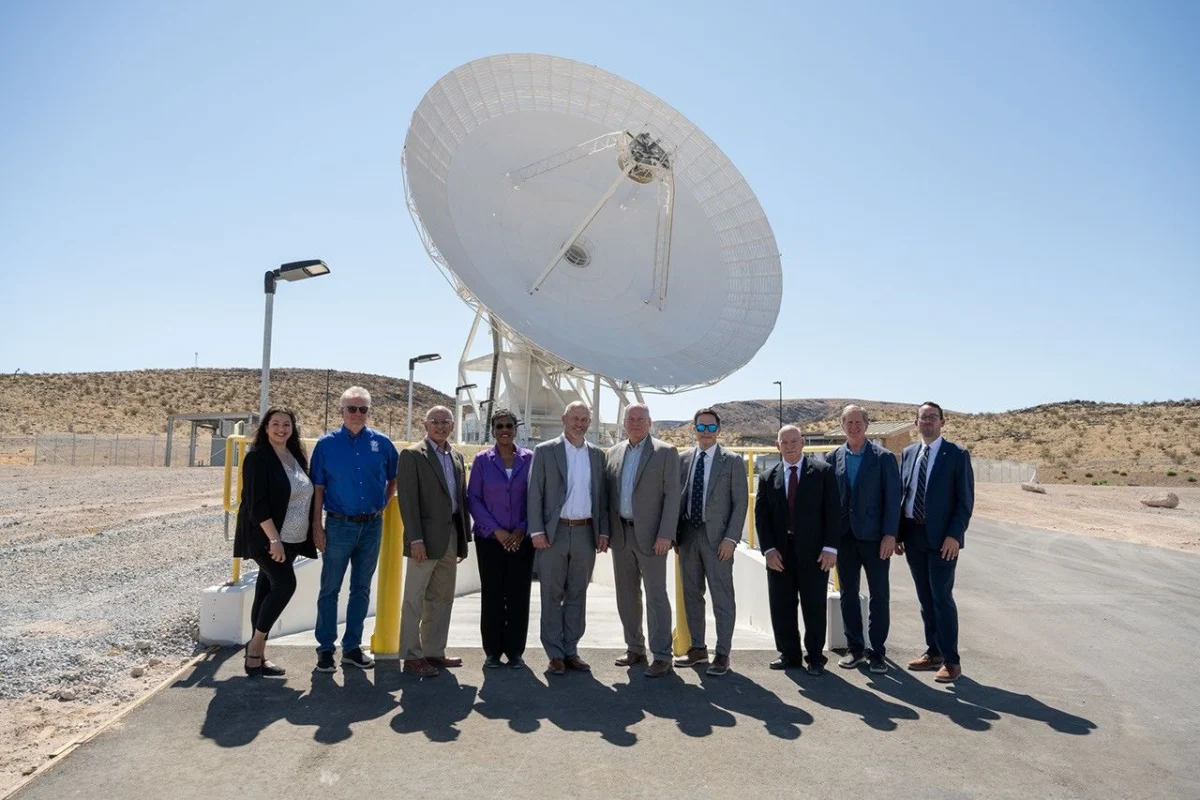
Goldstone, California – In a significant stride for global space communications, NASA officially inaugurated the Deep Space Station 23 (DSS-23) antenna at the Deep Space Network’s (DSN) Goldstone complex near Barstow, California, on August 25, 2026. The ceremonial ribbon-cutting marked the completion of the latest 34-meter (114-foot) multifrequency beam-waveguide antenna, a critical component in the ongoing modernization and expansion of the DSN, which serves as the indispensable link between Earth and humanity’s most distant robotic explorers.
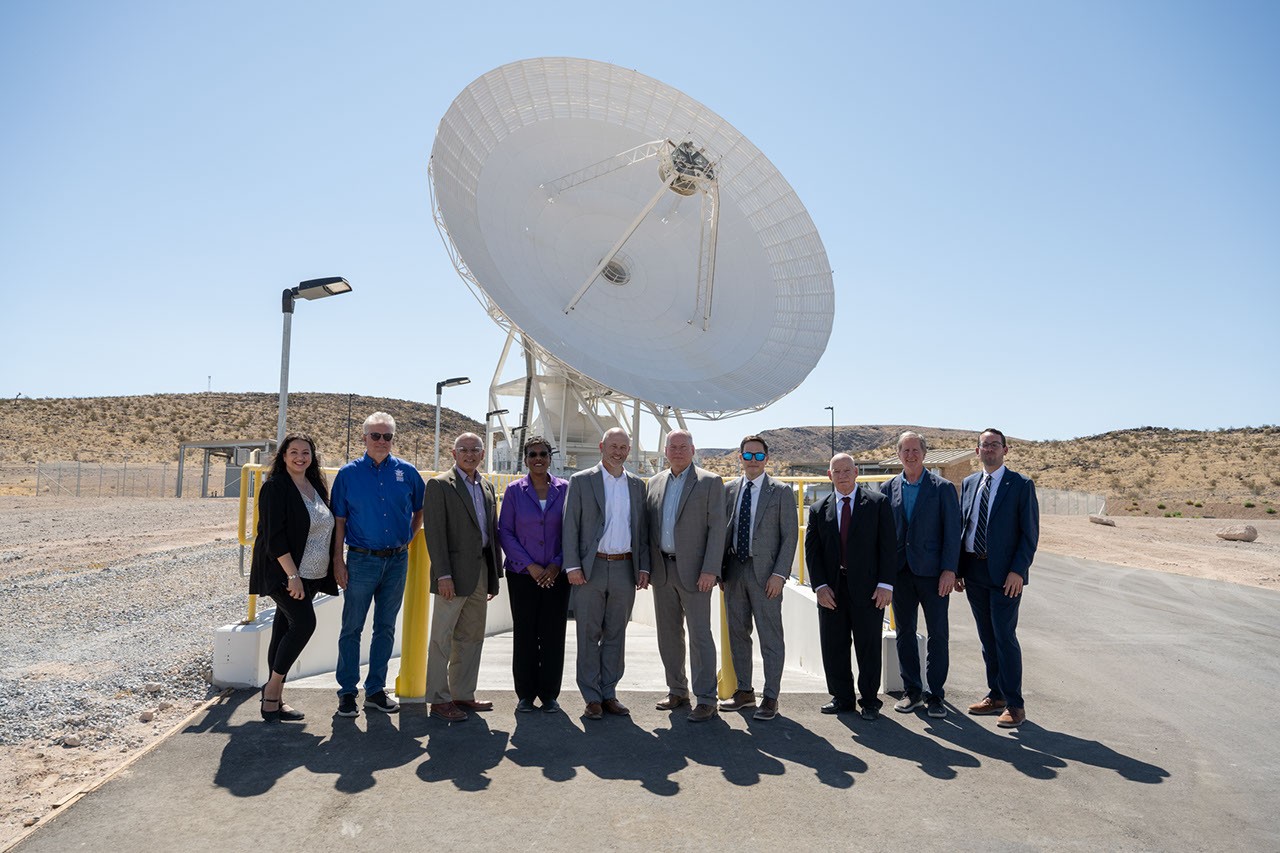
The event drew a distinguished assembly of leadership from NASA Headquarters, the Jet Propulsion Laboratory (JPL), and the Deep Space Network. Standing proudly before the massive white dish under a clear blue sky were Germaine Aziz, Project Manager for the DSN Aperture Enhancement Project (AEP) at JPL; Bradford Arnold, Manager of Telecom Programs & Oversight at JPL; Keyur Patel, Associate Lab Director for Flight Projects & Mission Success at JPL; Wanda Peters, Deputy Associate Administrator for the Research and Technology Mission Directorate (RTMD) at NASA Headquarters; Jimmy Kenyon, Associate Administrator for RTMD at NASA Headquarters; John McCullough, Acting Director of the Space Communications and Navigation (SCaN) Program at NASA Headquarters; Gregory Heckler, Deputy Program Manager for Capability Development for SCaN at NASA Headquarters; William Marinelli, Development Manager for SCaN at NASA Headquarters; Michael Levesque, Project Manager for DSN at JPL; and Frank Kaufholod, Project Manager at NASA Glenn Research Center. Their presence underscored the collaborative effort and strategic importance of this new infrastructure for NASA’s ambitious exploration agenda.
The Deep Space Network: An Unseen Lifeline for Exploration
The Deep Space Network is not merely a collection of antennas; it is the fundamental infrastructure enabling humanity’s reach into the cosmos. Managed by JPL, a division of Caltech, for NASA’s SCaN program, the DSN is the largest and most sensitive scientific telecommunications system in the world. It provides the crucial two-way radio link that allows mission controllers to track, send commands to, and receive invaluable scientific data from spacecraft operating millions, and even billions, of miles away from Earth. Without the DSN, missions like Voyager, the Mars rovers, the James Webb Space Telescope, and upcoming endeavors such as the Europa Clipper and Mars Sample Return would be impossible.
The network is strategically distributed across three primary complexes, approximately 120 degrees of longitude apart, ensuring continuous communication with spacecraft as Earth rotates. These sites are Goldstone, California; Madrid, Spain; and Canberra, Australia. Each complex hosts multiple large parabolic antennas, ranging in size and capability, designed to operate across various radio frequencies to accommodate diverse mission needs. This global distribution is vital for maintaining constant contact, preventing data loss during critical mission phases, and providing redundancy.
The Aperture Enhancement Project: A Decade of Strategic Investment
The completion of DSS-23 is a significant milestone within the DSN’s Aperture Enhancement Project (AEP), an ambitious initiative that commenced in 2009. The AEP was conceived to upgrade and expand the DSN’s capabilities to meet the escalating demands of an increasingly complex and data-intensive portfolio of deep space missions. The project’s goal is to add six new 34-meter multifrequency beam-waveguide antennas across the three global complexes. These modern antennas are designed for enhanced versatility and efficiency, capable of supporting multiple radio frequencies (e.g., X-band, Ka-band, S-band) simultaneously or interchangeably, thereby maximizing data throughput and operational flexibility.
The decision to embark on the AEP was driven by several factors. Firstly, some of the DSN’s legacy antennas, while still operational, were approaching the end of their design life or were less efficient at handling the high data rates required by modern instruments. Secondly, the sheer volume of scientific data anticipated from next-generation missions, coupled with the increasing number of active spacecraft, necessitated a significant boost in the network’s capacity. Missions like the Mars Reconnaissance Orbiter and the Curiosity and Perseverance rovers generate terabytes of data, from high-resolution imagery to atmospheric readings and geological analyses, all of which must be reliably transmitted across vast interstellar distances.
Over the past decade and a half, the AEP has systematically added these advanced antennas. DSS-23 represents a culmination of years of meticulous planning, design, construction, and rigorous testing. Each new antenna integrates cutting-edge technology, including improved cryogenic low-noise amplifiers for detecting faint signals and advanced pointing mechanisms for precise tracking, ensuring that the DSN remains at the forefront of space communications technology.
Technical Prowess of DSS-23
The DSS-23, like its AEP counterparts, is a 34-meter (114-foot) multifrequency beam-waveguide antenna. The "beam-waveguide" design is a key innovation, allowing sensitive receiving equipment and powerful transmitters to be housed in a shielded room at the base of the antenna. This design protects the delicate electronics from environmental factors, reduces noise interference, and simplifies maintenance, leading to improved performance and longevity.
These antennas are capable of operating across a range of radio frequencies, including S-band (primarily for robust command and telemetry), X-band (for higher data rates, commonly used by planetary missions), and Ka-band (offering even higher bandwidth for future missions requiring massive data transfer, such as advanced radar mapping or high-definition video streams). The ability to switch between or utilize these bands simultaneously provides unprecedented flexibility for mission operators. For instance, a spacecraft might use S-band for critical command uplinks during a crucial maneuver, while simultaneously transmitting scientific data on X-band or Ka-band.
This enhanced capability directly translates to faster data returns from distant spacecraft, allowing scientists to receive more detailed images, spectra, and other sensor data in shorter periods. It also improves the precision of spacecraft navigation through Doppler tracking and ranging measurements, critical for complex maneuvers like planetary orbital insertions, atmospheric entry, descent, and landing (EDL) sequences, and deep space rendezvous operations. The increased sensitivity of these new antennas also means they can pick up fainter signals, extending the operational life of older missions like the Voyagers, which are now transmitting from interstellar space with extremely weak signals.
Leadership Perspectives on a Critical Asset
The officials present at the ribbon-cutting emphasized the profound impact of DSS-23 and the broader AEP.
Jimmy Kenyon, Associate Administrator for NASA’s Research and Technology Mission Directorate, underscored the strategic imperative of the DSN. "The Deep Space Network is a national asset, foundational to every robotic mission NASA undertakes beyond Earth orbit," Kenyon stated, inferring a statement from the event. "Our investment in infrastructure like DSS-23 ensures that we can continue to push the boundaries of scientific discovery and human exploration. This antenna is not just steel and electronics; it’s a conduit to the unknown, enabling the next generation of breathtaking images and groundbreaking data from across our solar system and beyond."
Keyur Patel, Associate Lab Director for Flight Projects & Mission Success at JPL, highlighted the engineering excellence and operational significance. "JPL has the immense privilege of managing the DSN for NASA, and seeing the culmination of years of dedicated work on DSS-23 is incredibly rewarding," Patel was inferred to say. "This antenna represents the pinnacle of radio astronomy and communications engineering. It’s a testament to the ingenuity of our teams and their commitment to providing robust, reliable communications for missions that are operating at the very limits of technology and distance. This upgrade directly enhances our ability to communicate with and support the complex missions that define our future in space."
John McCullough, Acting Director of the Space Communications and Navigation (SCaN) Program at NASA Headquarters, articulated the critical role of seamless communication. "Every bit of scientific data, every command sent to a distant probe, relies on the precision and power of the DSN," McCullough’s statement could be inferred. "DSS-23 significantly bolsters our network’s capacity and resilience, ensuring that the invaluable insights gathered by our spacecraft make their way back to Earth. This is about enabling discovery, supporting human endeavors, and inspiring the next generation of scientists and engineers."
Germaine Aziz, the Project Manager for the DSN Aperture Enhancement Project at JPL, spoke to the tangible achievement. "Bringing an antenna like DSS-23 from concept to full operational status is a monumental undertaking," Aziz would have noted. "It involves complex engineering, construction challenges, and meticulous testing. The successful completion of this antenna is a credit to the collaborative spirit of the entire AEP team, our partners, and contractors. It stands as a testament to our collective commitment to advancing space exploration."
Broader Implications and Future Horizons
The operationalization of DSS-23 carries significant implications for both current and future space exploration endeavors. For existing missions, it provides enhanced redundancy and capacity, reducing potential communication bottlenecks and allowing for more frequent and longer communication windows. This can lead to faster data turnaround for scientific analysis and more efficient mission operations.
For upcoming missions, particularly those with high data volume requirements or those venturing to extremely distant targets, DSS-23 and its sister AEP antennas are foundational. Missions like the Europa Clipper, set to explore Jupiter’s icy moon, will rely on Ka-band capabilities to transmit high-resolution images and sophisticated measurements from the outer solar system. The Mars Sample Return campaign, an ambitious multi-mission effort to bring Martian samples to Earth, will demand unprecedented levels of communication precision and data transfer capability for sample collection, launch from Mars, and rendezvous in orbit.
Furthermore, the enhanced DSN capacity is crucial for NASA’s Artemis program, which aims to return humans to the Moon and establish a sustained lunar presence. While lunar communications often utilize closer-range networks, deep space elements like the DSN provide critical backup and can support missions beyond lunar orbit. As humanity contemplates venturing further to Mars with crewed missions, the DSN’s robust and expanded infrastructure will be indispensable for crew safety, mission control, and real-time data exchange.
The DSN is also a key enabler for international collaboration in space. Many international partners utilize DSN services for their own deep space missions, leveraging NASA’s extensive infrastructure for global benefit. The AEP upgrades, including DSS-23, therefore strengthen the global capability for space exploration, fostering a more interconnected and cooperative future in space science.
In an era defined by increasingly ambitious space exploration, the completion of DSS-23 is more than just the addition of a new antenna; it is a vital upgrade to the nervous system of humanity’s robotic presence in the cosmos. It ensures that the whispers from distant worlds can still be heard, and that the commands that guide our spacecraft continue to reach them, propelling forward the endless quest for knowledge and discovery.