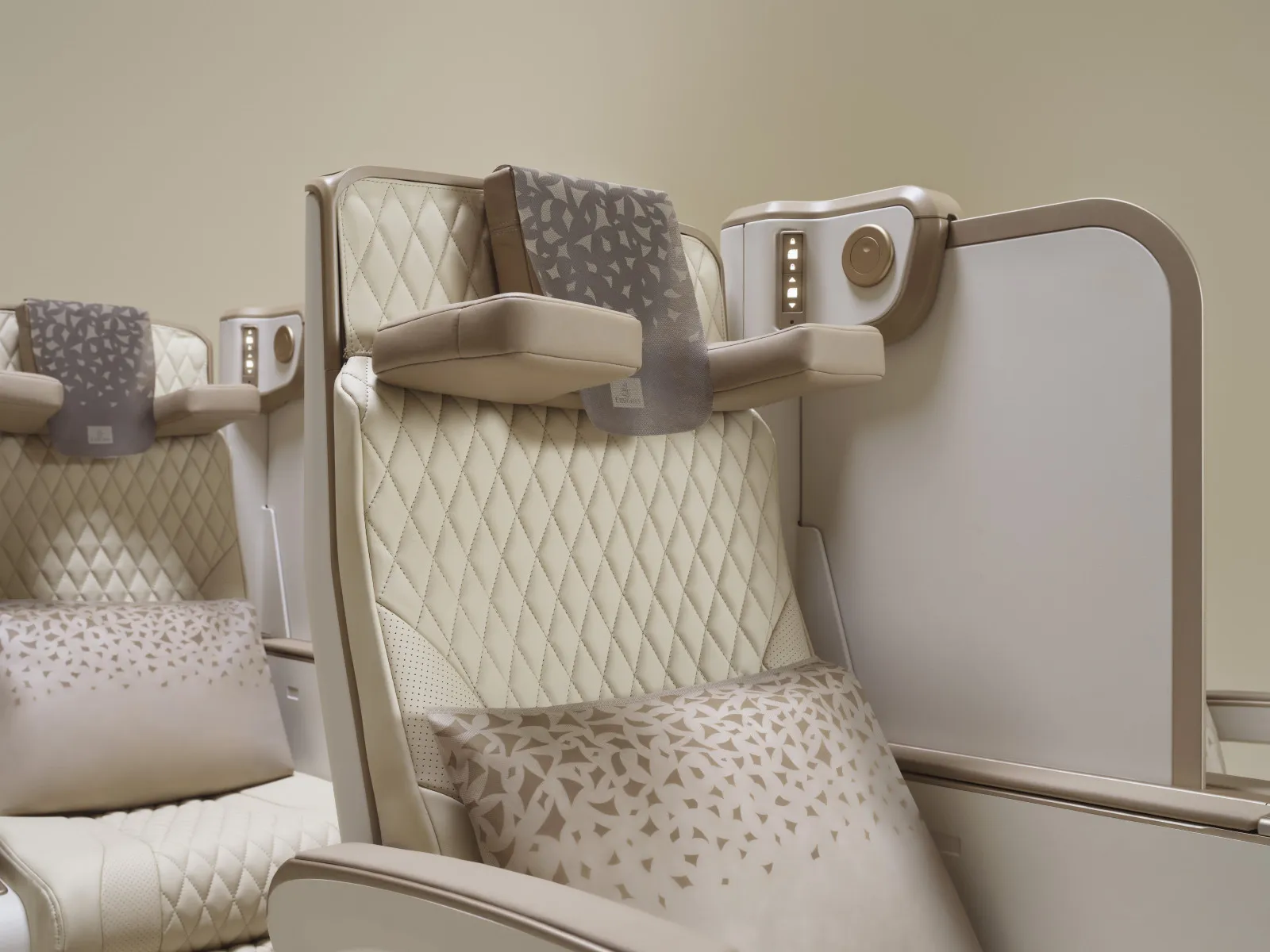
The global aviation landscape is witnessing a strategic realignment as the long-standing "arms race" for luxury, once confined to the ultra-exclusive first-class suites and lie-flat business-class pods, descends into the middle of the aircraft. Emirates, the world’s largest international airline, solidified this trend on Thursday by unveiling a sophisticated new premium economy product specifically designed for its incoming fleet of Airbus A350 aircraft. The centerpiece of this offering is a full-height, electrically operated privacy divider—a feature previously reserved for higher-tier cabins—which passengers can raise and lock via a personal digital control pad.
This latest cabin iteration represents a significant leap in the "premium economy" category, which has evolved from a niche offering into a critical profit engine for global carriers. Beyond the privacy divider, the new Emirates seat features electric recline capabilities with preset modes for lounging and dining, a U-shaped leather headrest designed for ergonomic support, a deployable footrest, integrated wireless charging stations, and high-definition 4K entertainment screens. These features signal a shift in how legacy carriers view the mid-cabin passenger, moving away from a "comfort plus" model toward a "business lite" experience.
Technical Specifications and the Airbus A350 Integration
The introduction of these seats coincides with the delivery of Emirates’ first Airbus A350-900 aircraft, a fleet of 65 jets that will play a pivotal role in the airline’s medium-to-long-haul expansion. The A350 is engineered for efficiency, powered by Rolls-Royce Trent XWB-84 engines, and the inclusion of a high-specification premium economy cabin is designed to maximize the revenue potential of these ultra-efficient airframes.
The new seat hardware is optimized for the A350’s wider cabin cross-section, allowing for a configuration that maintains a sense of spaciousness while incorporating heavy mechanical components like electric motors for recline and privacy screens. By integrating 4K screens and wireless charging, Emirates is addressing the "digital native" traveler who prioritizes connectivity and high-fidelity media consumption during long-haul transit. The U-shaped headrest and multi-stage footrest are aimed at alleviating the physical strain of long-distance flights, bridging the gap between the standard economy experience and the premium tiers.
The Economic Context: From Volume to Yield
The timing of this launch is significant. The aviation industry is transitioning out of its post-pandemic recovery phase, a period characterized by explosive "revenge travel" and rapid capacity restoration. As 2024 progresses, growth is beginning to stabilize into low single digits. According to industry forecasts, global passenger revenue is expected to approach $900 billion by 2027, but the era of easy double-digit expansion has concluded.
In this "new normal," airlines are no longer focusing solely on filling seats at any cost. Instead, the strategic priority has shifted toward maximizing "yield"—the average fare paid per passenger per mile. Premium economy has emerged as the most profitable real estate on the aircraft. While it takes up only slightly more floor space than standard economy, it can command fares two to three times higher. For Emirates, which was relatively late to the premium economy market compared to rivals like Singapore Airlines or Virgin Atlantic, this aggressive product refresh is an attempt to capture a larger share of the "aspirational" traveler market—those willing to pay for significant comfort but unable to justify the cost of a full business-class suite.
A Chronology of Cabin Innovation at Emirates
The journey to this new A350 product reflects a broader evolution in Emirates’ fleet strategy. For decades, the airline built its brand on the scale of the Airbus A380 and the Boeing 777, focusing heavily on the "halo effect" of onboard showers and bars in first and business class.
- Early 2000s – 2010s: Emirates focuses on the "First Class Suites" concept, setting a global standard for privacy with closing doors on its A380 fleet.
- 2020: Despite the global downturn, Emirates announces its first-ever Premium Economy cabin, initially debuting on select A380s. The product featured cream leather seats and wood-grain finishes.
- 2022 – 2023: The airline embarks on a multi-billion dollar retrofit program to install premium economy across 120 existing aircraft, signaling that the cabin was not just a trial but a core part of the future business model.
- 2024: The launch of the A350 premium economy marks the next generation of the product. By introducing electric dividers and 4K technology, the airline is responding to a market where competitors like Lufthansa (with its "Allegris" product) and Air France are also significantly upgrading their mid-cabin offerings.
Industry Reactions and Market Analysis
Market analysts suggest that the introduction of a privacy divider in premium economy is a disruptive move that could force other long-haul carriers to reconsider their own hardware. Traditionally, privacy has been the "moat" that protected the high margins of business class. By blurring this line, Emirates is betting that it can attract business travelers from companies with restrictive travel policies, as well as wealthy leisure travelers who prioritize personal space.
"The premium economy cabin is no longer just an upgraded economy seat; it is becoming a distinct class of travel with its own luxury identifiers," noted an aviation industry consultant. "Emirates’ decision to include an electric privacy divider is a direct response to the increasing demand for personal ‘bubbles’ in a post-pandemic world. It challenges the industry standard and raises the baseline for what a premium economy passenger expects."
From a competitive standpoint, this move puts pressure on regional rivals like Qatar Airways, which has famously resisted a dedicated premium economy cabin in favor of a high-quality economy product and its award-winning QSuite business class. However, as the market trends toward cabin segmentation, the pressure to offer a mid-tier product that captures the "middle-ground" spend is becoming harder to ignore.
Broader Implications for the Global Aviation Market
The shift toward high-end premium economy products like the one unveiled for the Emirates A350 has several long-term implications for the industry:
1. Revenue Resilience: As corporate travel budgets remain under scrutiny, premium economy offers a "compromise" that keeps business travelers within a carrier’s ecosystem. This provides a buffer against fluctuations in first-class demand.
2. Fleet Utilization: Modern aircraft like the A350 and the upcoming Boeing 777X are designed for "long-thin" routes (long distances with moderate demand). A robust premium economy cabin allows airlines to monetize these routes more effectively than a traditional two-class (Business/Economy) or three-class (First/Business/Economy) setup.
3. Environmental and Social Governance (ESG): While premium seats take up more space and thus have a higher carbon footprint per passenger than economy, they are significantly more efficient than first-class suites. For airlines under pressure to improve their environmental metrics while maintaining profitability, premium economy represents a more sustainable way to drive high-yield revenue.
4. Technological Standardization: The inclusion of 4K screens and wireless charging as standard in premium economy reflects the broader consumer electronics market. As passengers carry more sophisticated devices, the aircraft cabin must keep pace to avoid appearing obsolete. Emirates’ integration of these technologies ensures the A350 fleet remains competitive throughout its projected 20-year lifespan.
The Future of the Emirates Fleet
As Emirates prepares to integrate the A350 into its operations, the airline is also looking toward the arrival of the Boeing 777-9. The hardware unveiled this week provides a blueprint for what passengers can expect across the airline’s future long-haul operations. The emphasis on "electric" everything—from recline to privacy—suggests a move toward a more automated, touch-free, and customizable passenger environment.
The airline’s leadership has indicated that the goal is to create a "seamless" experience across different aircraft types. While the A380 remains the flagship for ultra-luxury, the A350 will become the workhorse of the fleet, bringing this new level of premium economy to a wider range of destinations across Europe, Asia, and Africa.
In conclusion, the launch of the new Emirates premium economy seat is more than just a hardware upgrade; it is a calculated response to a maturing aviation market. By investing heavily in the "middle" of the plane, Emirates is positioning itself to capture the highest possible yield in an era where volume growth is no longer guaranteed. As the privacy divider rises on the A350, it marks the beginning of a new chapter in the competitive landscape of global aviation, where the battle for passenger loyalty is fought inch by inch, and row by row.