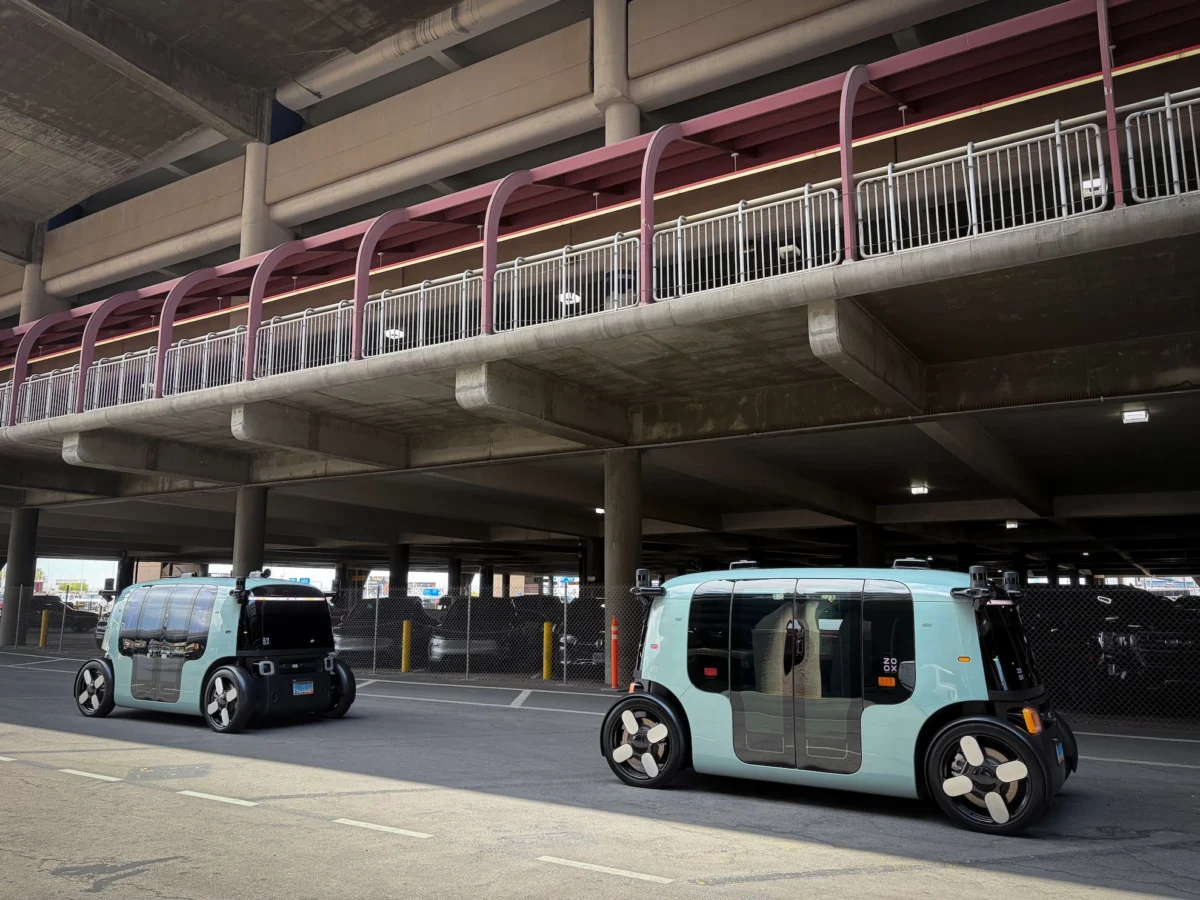
Zoox, the Amazon-owned autonomous vehicle technology company, has significantly escalated its commercial operations in Las Vegas by extending its custom-built robotaxi service to include rides to and from Harry Reid International Airport. This strategic expansion, which allows customers to hail rides to the critical transportation hub starting Thursday, marks a pivotal moment for the company as it capitalizes on recent regulatory approvals and intensifies its competitive stance within the burgeoning autonomous ride-hailing market. The move is not merely an operational update but a clear signal of Zoox’s intent to become a leading player in urban mobility, directly challenging established ride-hailing giants and positioning itself ahead of emerging robotaxi competitors in one of the United States’ most dynamic tourist destinations.
A Decisive Edge in Airport Transit
The integration of Harry Reid International Airport into Zoox’s service network provides the company with a distinct advantage over conventional ride-hailing services like Uber and Lyft. Zoox has announced that its robotaxis will offer direct pick-up and drop-off services at both airport terminals, conveniently located near baggage claim. This stands in stark contrast to the current arrangements for Uber and Lyft passengers, who, while able to be dropped off at the curb, must navigate a five- to ten-minute walk from baggage claim to designated pick-up zones on the upper floor of a nearby parking garage. This superior convenience, especially valuable for travelers with luggage or those unfamiliar with the airport layout, could prove to be a significant differentiator in attracting a substantial customer base seeking seamless airport transfers. For an airport that served over 57.6 million passengers in 2023, a new record, the efficiency and accessibility of ground transportation options are paramount, making Zoox’s offering particularly compelling.
The Road to Commercialization: A Decade of Development and Regulatory Breakthroughs
The current expansion is the culmination of more than a decade of intensive research, development, and rigorous testing by the Silicon Valley-based company. Zoox’s unique approach involved not only the creation of a sophisticated self-driving system but also the design and manufacture of a purpose-built robotaxi, known as the VH5. This revolutionary vehicle fundamentally departs from traditional automotive design, lacking conventional controls such as a steering wheel and pedals, and featuring a symmetrical, bi-directional chassis designed for urban environments. For years, Zoox operated its vehicles in Las Vegas, offering rides to employees and select members of the public, gathering invaluable data and refining its technology. However, the critical hurdle of commercial operation – the ability to charge for rides – remained.
That changed dramatically in August, when federal safety regulators granted Zoox a temporary exemption from certain motor vehicle safety standards. The National Highway Traffic Safety Administration (NHTSA) provided a two-year commercial exemption, allowing Zoox to deploy up to 2,500 vehicles that do not fully comply with eight specific Federal Motor Vehicle Safety Standards (FMVSS). These standards, originally formulated for human-driven vehicles, include requirements for components like windshield defrosting and certain aspects of light vehicle braking systems, which are either irrelevant or necessitate different design solutions in an autonomous, purpose-built vehicle without a human driver interface. This landmark exemption was a monumental victory, signaling regulatory bodies’ growing willingness to adapt existing frameworks to accommodate the innovative designs and operational models of autonomous vehicles.
Post-Exemption Acceleration: A Timeline of Strategic Moves
Following the federal exemption, Zoox wasted no time in activating its commercial strategy, demonstrating a clear intent to rapidly scale operations:

- August 10: Zoox officially commenced charging for robotaxi rides in Las Vegas, transitioning from a testing phase to a fully commercial service. This move immediately validated its business model and provided a revenue stream to fuel further expansion.
- August (Ongoing): The company announced plans to expand testing of its self-driving vehicles into new urban environments, specifically San Diego, California, and Houston, Texas. These cities offer diverse topographical, climatic, and traffic conditions, providing crucial data for the continuous refinement and validation of Zoox’s autonomous driving system across varied operational design domains (ODDs).
- Late July/Early August: Zoox publicly released its comprehensive safety framework, outlining the rigorous protocols, redundant systems, and transparent operational principles governing its autonomous fleet. This proactive disclosure aims to build public trust and demonstrate the company’s commitment to safety as its paramount priority.
- September (Current): The strategic extension of services to Harry Reid International Airport in Las Vegas, enabling a seamless gateway for travelers and significantly broadening the addressable market for Zoox’s commercial service.
These concerted actions collectively underscore a company in hyper-growth mode, moving swiftly to establish its footprint in key markets and solidify its position as a frontrunner in the autonomous mobility sector. The backing of Amazon, which acquired Zoox in 2020 for an estimated $1.2 billion, has provided substantial financial and logistical resources, enabling this rapid scaling and technological advancement.
The Las Vegas Arena: A Hotbed for Autonomous Vehicle Innovation
Las Vegas has long served as a crucial proving ground for autonomous vehicle technologies, attracting numerous companies due to its predictable grid-like street network, generally favorable weather conditions, and a progressive regulatory environment within Clark County. The city’s status as a major tourist destination also presents a unique opportunity for high-volume ridership, making it an ideal market for commercial robotaxi deployment.
While Zoox currently enjoys the exclusive position of being the sole robotaxi operator serving Harry Reid International Airport, the competitive landscape in Las Vegas is poised for rapid intensification. The Nevada Transportation Authority (NTA) recently issued permits to several other major players, signaling an imminent surge in commercial robotaxi operations across Clark County over the next year.
- Waymo: A subsidiary of Alphabet (Google’s parent company), Waymo is widely recognized as a pioneer in autonomous driving. With extensive experience and established commercial operations in Phoenix, Arizona, and San Francisco, California, Waymo’s entry into Las Vegas would bring a formidable competitor with a mature technology stack and a track record of safe deployment.
- Motional: A joint venture between Hyundai Motor Group and Aptiv, Motional has also been actively developing and testing autonomous vehicles, including IONIQ 5-based robotaxis. Motional’s permit is particularly significant as it plans to operate its robotaxis through a strategic partnership with Uber, providing a self-driving option within Uber’s established ride-hailing platform.
- Tesla: Led by Elon Musk, Tesla’s "Full Self-Driving" (FSD) technology has been a subject of intense development and public discussion. While Tesla’s approach differs significantly, relying on camera-only vision and aiming for a future network where owner-operated vehicles could serve as robotaxis, their NTA permit indicates a step towards a more structured commercial deployment in the region.
Collectively, these permits from the NTA could facilitate the deployment of up to 8,000 robotaxis across Clark County within the next 12 months. This impending influx of autonomous vehicles will transform the urban transportation fabric of Las Vegas, creating a dense and highly competitive market for self-driving services.
Broader Implications and the Future of Urban Mobility
The expansion of Zoox’s commercial service to a major international airport carries significant implications, not only for the company itself but for the broader autonomous vehicle industry and the future of urban mobility.
- Validation of the Business Model: Offering airport service is a critical validation point for any ride-hailing company, representing a high-demand, high-value segment of the market. Success here could unlock further investment and accelerate expansion into other cities.
- Enhanced Passenger Experience: The convenience offered by Zoox at Harry Reid International Airport sets a new benchmark for airport ground transportation. If replicated, it could compel traditional ride-hailing services to innovate or partner with AV companies to match the experience.
- Economic Impact: The proliferation of robotaxis could lead to new job categories (e.g., remote operators, maintenance technicians, fleet managers) and potentially reduce urban congestion and parking demands in the long term. For Las Vegas, a city heavily reliant on tourism, efficient and cutting-edge transportation options can enhance its appeal to visitors.
- Public Trust and Acceptance: Operating safely and reliably in complex environments like airports is crucial for building public trust in autonomous technology. Every successful ride contributes to overcoming skepticism and fostering widespread adoption. Zoox’s transparent safety framework is a key component of this strategy.
- Regulatory Evolution: The federal exemption granted to Zoox highlights the ongoing need for regulatory frameworks to evolve alongside technological advancements. As more purpose-built autonomous vehicles emerge, regulators will face continued pressure to create adaptable standards that ensure safety without stifling innovation. This also underscores the intricate dance between federal and state authorities in governing AV deployment.
- Competitive Dynamics: The intense competition anticipated in Las Vegas will likely drive further innovation, cost efficiencies, and improved service offerings across the board. Partnerships, like Uber’s with Motional and potentially Zoox itself, demonstrate a recognition that collaboration may be key to scaling effectively in a capital-intensive industry.
Looking ahead, the successful deployment and scaling of commercial robotaxi services by companies like Zoox represent a significant step towards a future where autonomous vehicles play a central role in urban transportation. Challenges remain, including the continuous refinement of AI for increasingly complex scenarios, scaling manufacturing to meet demand, ensuring cybersecurity, and navigating the ever-evolving regulatory landscape. However, Zoox’s bold move into the critical airport market in Las Vegas unequivocally signals that the era of widespread commercial robotaxis is not a distant dream, but a rapidly unfolding reality.