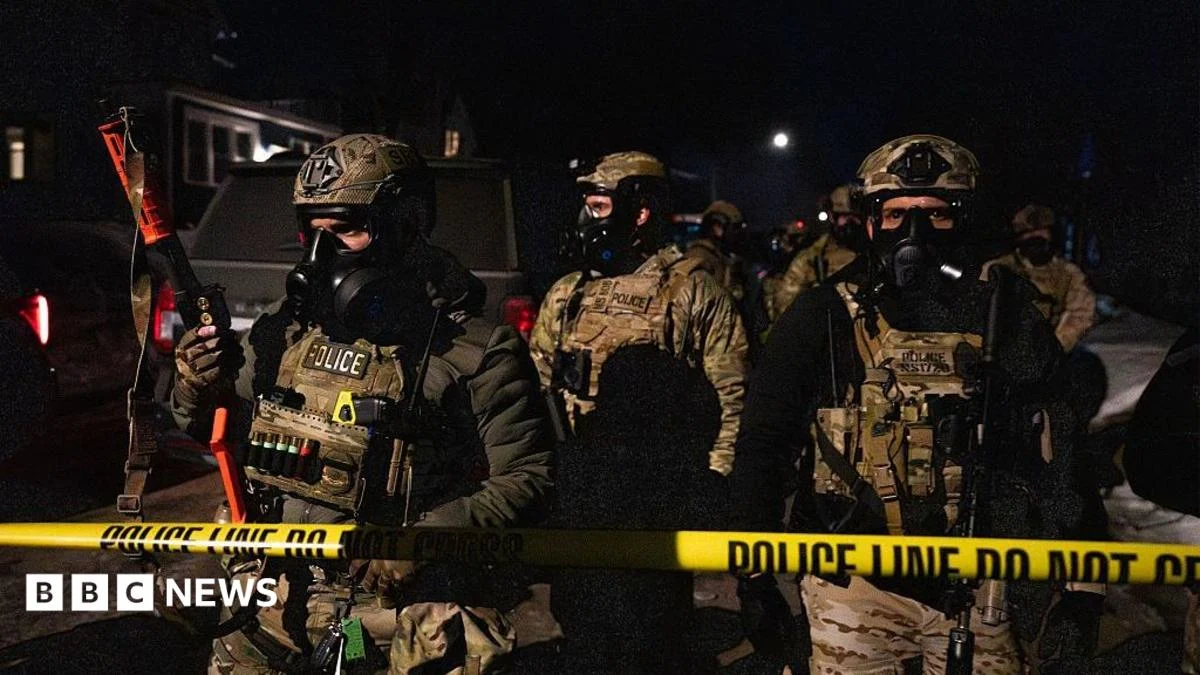
A U.S. Immigration and Customs Enforcement (ICE) agent has been federally indicted on six counts, including making false statements, obstruction of justice, and assault, stemming from the non-fatal shooting of a Venezuelan migrant in Minnesota. The indictment against Christian Castro, who is currently not in custody, marks a rare instance of the Justice Department pursuing criminal charges against a federal agent for actions taken during official duty. The incident, which occurred on January 14, initially involved claims of self-defense against attacking migrants, but subsequent investigations, bolstered by surveillance video, have revealed a starkly different narrative, alleging Castro fired through a closed door, striking a man in the leg. This development unfolds against the contentious backdrop of Operation Metro Surge, a widespread ICE deployment in Minnesota that has drawn significant protest and controversy.
The Incident: A Contested Narrative Emerges
The events of January 14 in north Minneapolis quickly became a flashpoint in the ongoing debate surrounding immigration enforcement. According to initial statements from the Department of Homeland Security (DHS), ICE agent Christian Castro discharged his weapon in self-defense, claiming he was attacked by three Venezuelan migrants wielding a shovel and a broom handle. This account painted a picture of federal agents under assault, necessitating the use of force. Consequently, two of the migrants involved, Alfredo Alejandro Aljorna and Julio Cesar Sosa-Celis, were initially charged with forcibly assaulting, resisting, or impeding federal officers – serious federal offenses that carry substantial penalties. Sosa-Celis was the individual shot in the leg during the confrontation.
However, this official narrative began to unravel as local Minnesota investigators delved deeper. Their findings, reportedly supported by surveillance video footage, contradicted the agents’ initial claims. Investigators now allege that Castro fired his weapon through a closed door, striking Sosa-Celis in the leg. Further details from Minnesota officials indicate the bullet penetrated the door of a residence, ultimately lodging in the wall of a child’s room. This revised account fundamentally shifts the perceived culpability and raises serious questions about the truthfulness of the initial reports provided by federal agents on the scene. The disparity between the initial official statement and the investigative findings underscores the critical role of independent oversight and forensic evidence in evaluating incidents involving law enforcement.
Christian Castro: Facing Federal and State Charges
Christian Castro, the ICE agent at the center of this controversy, now faces a formidable array of legal challenges. The recently unsealed six-count federal indictment includes charges of making false statements, obstruction of justice, and assault. These federal charges signify the gravity with which the Justice Department views the alleged misconduct, particularly the accusations of misrepresentation and impedance of a federal investigation. Beyond the federal arena, Castro also faces separate state charges in Minnesota, specifically for assault and false reporting of a crime related to the shooting. The pursuit of both federal and state charges is indicative of the multi-layered legal complexities often present when federal agents are accused of crimes committed within state jurisdictions.
The rarity of such an indictment from the Justice Department cannot be overstated. Federal agencies typically investigate their own agents, and while disciplinary actions or internal sanctions may occur, criminal prosecution, especially by the federal government itself, is uncommon. This particular case suggests a determination by federal prosecutors to hold agents accountable, particularly when there is strong evidence of deliberate deception or excessive force. The outcome of these charges will undoubtedly set precedents for future cases involving federal law enforcement conduct and accountability.
Operation Metro Surge: A Controversial Deployment
The January 14 shooting did not occur in isolation but was a direct consequence of Operation Metro Surge, a large-scale deployment of federal immigration officers to the Midwestern state of Minnesota. This operation, initiated by ICE, aimed to increase enforcement actions against undocumented immigrants within the state. The deployment brought thousands of federal agents into Minnesota, a state that has often been a focal point for immigrant rights advocacy and debates over "sanctuary city" policies, even if not formally declared one statewide.
Operation Metro Surge immediately sparked fierce protests from immigrant rights groups and community activists who viewed it as an aggressive overreach of federal power and a threat to vulnerable populations. These protests often led to direct confrontations between demonstrators and federal agents, escalating tensions across the state. Tragically, the operation was also marred by reports of two U.S. citizens dying at the hands of agents during separate confrontations, although the specific details and circumstances of those deaths have been less widely publicized than the Castro case. The overall climate created by Operation Metro Surge was one of heightened vigilance, fear within immigrant communities, and significant public outcry, making any incident involving agent conduct particularly sensitive and subject to intense scrutiny. The operation itself became emblematic of the broader national debate on immigration enforcement strategies and their impact on communities.
The Migrants’ Exoneration and the "Newly Discovered Evidence"
In the immediate aftermath of the shooting, Alfredo Alejandro Aljorna and Julio Cesar Sosa-Celis, the two Venezuelan migrants, found themselves facing charges of forcibly assaulting, resisting, or impeding federal officers. These charges carried the potential for severe penalties, including lengthy prison sentences and further complications regarding their immigration status. However, as the investigation progressed and surveillance video evidence came to light, questions began to mount regarding the agents’ initial version of events.
In February, just weeks after the incident, ICE itself acknowledged that two immigration agents involved in the shooting "might have made untruthful statements." This internal admission was a significant turning point, leading to both agents being placed on administrative leave. Subsequently, federal prosecutors moved to dismiss the charges against Aljorna and Sosa-Celis, citing "newly discovered evidence" as the basis for their decision. While the specific nature of this evidence has not been fully detailed publicly beyond references to surveillance footage, its impact was profound: it completely undermined the prosecution’s case against the migrants and effectively exonerated them from the initial charges. This outcome underscores the critical importance of objective evidence, particularly video recordings, in challenging official narratives and ensuring justice, especially in high-stakes encounters between citizens or residents and law enforcement. The dismissal of charges allowed Aljorna and Sosa-Celis to avoid a potentially devastating legal battle and shifted the focus of accountability squarely onto the federal agents.

Inter-State Dispute: Texas vs. Minnesota
The legal proceedings against Christian Castro have been complicated by an unusual inter-state dispute involving the extradition process. After being arrested in Texas in May, Castro was detained for three months. Minnesota’s top prosecutor formally requested his extradition to the state to stand trial on the local charges of assault and false reporting. However, Texas Governor Greg Abbott intervened, denying the extradition request.
Governor Abbott publicly stated that he had "serious doubts" that Castro qualified as a fugitive, the legal basis typically required for extradition. His decision sparked immediate condemnation from Minnesota officials and immigrant rights advocates, who viewed it as an obstruction of justice and an attempt to shield a federal agent from accountability. Governor Abbott’s stance is consistent with a broader political narrative often seen in some states, particularly those with strong conservative leadership, that emphasizes support for law enforcement and challenges perceived federal overreach or judicial actions seen as undermining federal agents’ authority. This refusal to extradite highlights the complex interplay of federalism, state sovereignty, and political ideology in high-profile legal cases. Castro was subsequently released from custody in Texas last week, further complicating Minnesota’s efforts to bring him to trial on state charges. This extradition battle adds another layer of political and legal tension to an already sensitive case, potentially setting a precedent for future inter-state cooperation—or lack thereof—when federal agents are accused of crimes.
A Rare Pursuit of Accountability
The federal indictment of Christian Castro by the Justice Department is a truly uncommon occurrence. While allegations of misconduct against federal agents are not unheard of, criminal charges, especially by the very federal government they serve, are exceptionally rare. This rarity speaks volumes about the perceived strength of the evidence against Castro and the determination of federal prosecutors to pursue accountability. Historically, investigations into federal agent conduct are often handled internally, resulting in administrative penalties rather than criminal prosecution.
This case signals a potentially significant shift in how the Justice Department approaches accountability for federal law enforcement. It suggests a willingness to scrutinize agents’ actions more rigorously, particularly when there is compelling evidence, such as surveillance video, that contradicts official reports. The charges of making false statements and obstruction of justice are particularly serious, as they directly challenge the integrity of the investigative process and the trustworthiness of law enforcement testimony. For legal experts, this case will be closely watched as it could influence future policies regarding internal investigations, the use of force, and the reporting standards for federal agents across various agencies.
Reactions and Calls for Justice
The unfolding developments have elicited strong reactions from various stakeholders. The office of Minnesota’s top prosecutor, while not commenting on specific details of the ongoing federal case, has consistently expressed its commitment to pursuing justice for the victims and upholding the rule of law within the state. Their efforts to extradite Castro underscore their belief in the state’s jurisdiction and the importance of local accountability.
Immigrant rights advocates have voiced outrage over the initial deception and the perceived obstruction by Texas authorities. Organizations like the American Civil Liberties Union (ACLU) and local immigrant advocacy groups have issued statements calling for full transparency, robust accountability for all federal agents involved, and a reevaluation of aggressive immigration enforcement tactics like Operation Metro Surge. They emphasize that this case highlights systemic issues of abuse of power and the need for greater civilian oversight of federal agencies.
Conversely, some law enforcement associations and political figures may express concerns about the potential chilling effect of such prosecutions on agents performing their duties in high-stress environments. They might argue that agents need to be protected from overly aggressive prosecution when making split-second decisions. However, the nature of the charges—lying and obstruction—differentiates this case from those involving genuine errors in judgment.
Broader Implications for Immigration Enforcement
The Christian Castro case carries profound implications for the future of immigration enforcement in the United States. Firstly, it sends a clear message regarding the accountability of federal agents, suggesting that they are not immune from criminal prosecution when evidence points to deliberate misconduct, particularly perjury and obstruction. This could lead to increased scrutiny of internal reporting mechanisms within agencies like ICE and DHS.
Secondly, the inter-state extradition dispute highlights inherent tensions between federal and state authorities, particularly when state officials seek to hold federal agents accountable for actions within their borders. This friction could prompt calls for clearer legal frameworks or agreements on jurisdiction and cooperation in such cases. The role of state governors in refusing extradition requests for federal agents could become a significant political and legal battleground.
Finally, the incident further fuels the already intense national debate on immigration policy and the methods employed by enforcement agencies. Critics of current policies will point to this case as evidence of systemic problems within ICE and the need for comprehensive reform, including greater transparency, independent oversight, and a reevaluation of operations that lead to confrontations with communities. Proponents of stricter enforcement, while potentially defending the agents’ overall mission, may find it harder to defend actions involving alleged perjury and obstruction of justice. The resolution of this case will undoubtedly shape public trust in federal law enforcement and influence the political discourse surrounding immigration for years to come.