The upcoming weekend marks a pivotal moment for German democracy as the Alternative for Germany (AfD) party aims to secure an outright majority in the regional parliament of Saxony-Anhalt. Such a victory would be unprecedented in Germany’s post-war history, signaling the first time a far-right party has attained state-level executive power without coalition partners. For mainstream political forces, this scenario represents a profound peril to the established democratic order, while the AfD itself views it as a critical stepping stone toward its long-cherished dream of nationwide influence. The implications of this vote extend far beyond the borders of this eastern German state, potentially altering the trajectory of German history and sending ripple effects through European politics.
The election results could also exacerbate the already precarious position of Chancellor Friedrich Merz, leader of the conservative Christian Democratic Union (CDU). Persistent rumors questioning his ability to complete his term in office have gained traction, fueled by his diminishing public approval and a string of recent public appearances where he has been met with boos. Merz, who once pledged to halt the rise of the far right, now finds himself presiding over a political environment where the exact opposite has occurred, casting a long shadow over his leadership and the CDU’s electoral prospects.
The AfD’s Ascendancy in Eastern Germany: A Deep Dive into Discontent
The Alternative for Germany, founded in 2013 primarily as a Eurosceptic party, has undergone a significant transformation, increasingly adopting a nativist, anti-establishment, and often extremist platform. While its origins were rooted in criticism of the Eurozone, its rapid growth, particularly in the states of the former German Democratic Republic (GDR), has been fueled by a complex interplay of historical grievances, economic anxieties, and a pervasive sense of political alienation. Saxony-Anhalt, like many other eastern states, has become a stronghold for the AfD, where its messages resonate deeply with a segment of the population that feels left behind by reunification and globalization.
The enduring sentiment of "Ostalgie"—a nostalgic longing for certain aspects of life in East Germany—alongside an acute dissatisfaction with contemporary challenges, forms the bedrock of the party’s popularity. Voters frequently articulate frustration over issues such as immigration policies, which they perceive as overly liberal and a threat to public safety and cultural identity. Economic struggles, particularly in rural areas and former industrial heartlands of Saxony-Anhalt, coupled with high energy costs and the allocation of aid to foreign countries like Ukraine, further fuel this discontent. According to recent surveys, concerns about inflation and the cost of living consistently rank among the top worries for citizens in the region, providing fertile ground for the AfD’s populist narrative.
Demographically, Saxony-Anhalt has faced significant challenges since reunification. The state has experienced a substantial population decline, particularly among younger demographics, leading to an aging population and a shrinking workforce. This demographic shift, combined with the closure of many state-owned enterprises post-1990, has left many communities grappling with high unemployment, lack of opportunities, and a sense of marginalization. For instance, while national unemployment rates hover around 5.5%, certain districts within Saxony-Anhalt have historically faced rates significantly higher, often surpassing 8-10%. The AfD skillfully taps into these long-standing socio-economic disparities, portraying itself as the sole voice for the forgotten citizens of the East.
Ulrich Siegmund: The Charismatic Face of Far-Right Ambition
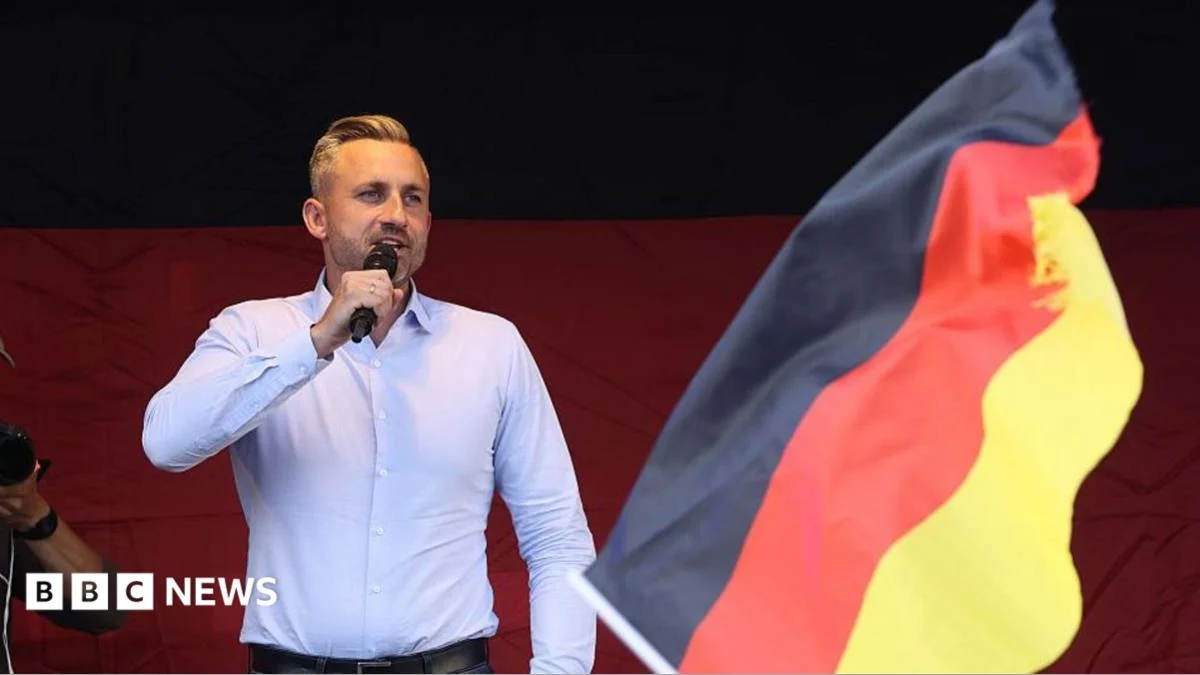
At the forefront of the AfD’s charge in Saxony-Anhalt is Ulrich Siegmund, the charismatic lead candidate whose media dominance and public persona have become central to the campaign. Dubbed "Germany’s Most Dangerous Man" by Der Spiegel magazine, the 35-year-old politician has masterfully cultivated an image that resonates with his base. He is frequently seen amidst adoring crowds or in his prolific social media posts, often pictured happily riding a retro East German scooter—a potent symbol of the "Ostalgie" that many voters in the region harbor. This blend of approachable localism with a defiant political stance has allowed Siegmund to capture significant attention, often overshadowing his political rivals.
Siegmund has, however, faced considerable scrutiny regarding the composition of his inner circle. Reports have emerged suggesting that individuals with past connections to the neo-Nazi scene hold influential roles around him. While Siegmund has consistently brushed off these allegations, dismissing them as politically motivated attacks, the accusations underscore the persistent concerns about the AfD’s proximity to extremist elements. Critics argue that such associations are not merely coincidental but reflective of a deliberate strategy to attract and normalize support from the far-right fringes, even as the party publicly distances itself from National Socialism.
AfD’s Controversial Policy Platform: A Challenge to Liberal Norms
The AfD’s manifesto for Saxony-Anhalt outlines a series of policy proposals that challenge established liberal democratic norms and constitutional principles. On immigration, the party advocates for the creation of a specialized task force dedicated to the detention and deportation of migrants who no longer possess the legal right to remain in the state. Furthermore, it calls for an end to what it terms "illegal, culturally alien" mass migration, echoing nativist rhetoric that has become a hallmark of far-right movements across Europe. The party also proposes segregating child refugees into special classes, explicitly stating that "The refugee children should be given the message that their stay in Germany is only temporary," a stance that has drawn sharp criticism from human rights organizations and educational bodies who argue it violates principles of integration and child welfare.
In the realm of education and social policy, the AfD’s platform is equally provocative. Its manifesto claims that "sexual deviations and non-reproductive lifestyles" have been "aggressively promoted" over "normal family" structures, reflecting a conservative, often regressive, view of societal norms. The party argues for banning LGBT rainbow flags from being flown at schools, asserting that such symbols represent a political agenda rather than inclusivity. Furthermore, it advocates for a revision of history curricula, suggesting that children should be taught less about the atrocities of the Nazi era and more about "positive aspects of German history." This proposal has ignited widespread condemnation from historians, educators, and political figures, who warn against any attempt to downplay the unique responsibility Germany bears for its past. Critics contend that such a revisionist approach risks whitewashing historical facts and undermining crucial lessons learned from the darkest chapter of German history.
The Shadow of Geopolitics: Russia and Disinformation Campaigns
Adding another layer of complexity to the election is the AfD’s overt pro-Russia sympathies, which have raised serious concerns about its trustworthiness regarding sensitive intelligence and its potential to compromise national security. A notable incident involved Hans-Thomas Tillschneider, a leading AfD figure in Saxony-Anhalt, whose office was found to contain a Russian army mug. Tillschneider dismissed it as a mere souvenir, famously stating, "it’s not our war," in reference to the conflict in Ukraine. This sentiment aligns with the AfD’s broader narrative, which frequently questions Germany’s support for Ukraine and advocates for closer ties with Moscow.
These sympathies take on heightened significance given recent geopolitical events. Just this week, Berlin publicly blamed Moscow for a failed drone attack on Leipzig/Halle Airport, a claim that the Kremlin vehemently denied, dismissing it as "anti-Russian hysteria." German security sources have concurrently warned of an escalation in Russian-backed disinformation campaigns, often targeting AfD rivals and seeking to sow discord within the political landscape. These campaigns, which Moscow consistently refutes, are a stark reminder of the broader hybrid warfare tactics employed by Russia and their potential impact on democratic processes, particularly in regions where pro-Russian sentiment is more pronounced. The BfV, Germany’s domestic intelligence agency, has been particularly vigilant about foreign interference, underscoring the delicate balance between protecting democratic integrity and avoiding accusations of political meddling.
The "Brandmauer" Under Threat: German Democracy at a Crossroads
A defining characteristic of post-war German politics has been the "Brandmauer," or firewall, a consensus among established democratic parties to refuse any form of coalition or cooperation with the far right. This firewall, erected to prevent a resurgence of extremist ideologies, has historically kept parties like the AfD out of government at both federal and state levels. In Saxony-Anhalt, however, the AfD’s strategy is not merely to crack this firewall but to bypass it altogether by securing an absolute parliamentary majority.
The German electoral system, a mixed-member proportional representation, typically leads to coalition governments. For the AfD to govern alone, it would need to win over 50% of the seats, a formidable challenge but one that recent polling suggests is within reach. Latest polls indicate the AfD could garner between 30-35% of the vote, making them the strongest single party, but still short of an outright majority. The outcome will heavily depend on whether other, smaller parties manage to clear the 5% threshold required to enter parliament. If many smaller parties fail to meet this threshold, their votes are effectively lost, disproportionately benefiting larger parties like the AfD. This mathematical quirk could inadvertently hand the AfD a parliamentary majority even if their popular vote share remains below 50%. This intricate political arithmetic transforms the election into a high-stakes gamble for all involved, with the very structure of German governance hanging in the balance.
Chancellor Merz and the CDU’s Struggle for Relevance
The potential triumph of the AfD in Saxony-Anhalt would represent a crushing blow to Chancellor Friedrich Merz and the CDU. Merz, who assumed the party leadership with a mandate to modernize the CDU and stem the tide of the far-right, has struggled to articulate a compelling counter-narrative. His conservative stance, intended to appeal to disaffected voters on the right, has often been criticized for inadvertently legitimizing some of the AfD’s themes, without offering a distinct alternative. The CDU’s performance in Saxony-Anhalt, a state where it has historically been a dominant force, will be closely watched as a barometer of Merz’s leadership and the party’s broader strategy. A poor showing could trigger renewed leadership challenges within the CDU, further destabilizing the already fragmented political landscape.
The CDU’s dilemma is profound: how to reclaim conservative voters without drifting too far to the right, alienating its more centrist base, and how to effectively counter the AfD’s populist appeal without resorting to similar rhetoric. The current government’s struggles with inflation, energy prices, and immigration policy have provided ample ammunition for the AfD, making the CDU’s task all the more difficult.
Saxony-Anhalt: A Microcosm of National Discontent
Saxony-Anhalt, though relatively small in terms of population (approximately 2.1 million residents), holds immense symbolic weight. Its historical context as part of the former GDR, its ongoing demographic shifts, and its economic challenges make it a microcosm of the broader discontent simmering across eastern Germany. The issues voiced by voters in Saxony-Anhalt—frustration with immigration, public safety concerns, economic anxieties, and skepticism towards federal policies—mirror national trends that the AfD has expertly capitalized on.
A victory here would not only grant the AfD direct influence over local education, policing, and cultural policies but would also provide its delegates with a louder, more legitimate voice in the Bundesrat, the federal government’s second chamber. This increased presence in a key legislative body would allow the AfD to exert greater influence on national legislation and policy debates, extending its reach beyond its current role as an opposition party in the Bundestag.
The Road Ahead: Implications for German Governance and Society
Should the AfD secure a decisive victory in Saxony-Anhalt, the party will face a test it has never encountered: the challenges of governance. While the AfD has thrived on anti-establishment rhetoric, railing against the federal government in Berlin and those in power, a win would place it squarely in an executive role. The grievances that the party currently lays at the door of others would then become its own responsibility to address. This transition from protest party to governing party could expose internal divisions, highlight the practical limitations of its radical proposals, and potentially temper its populist appeal as it navigates the complexities of administration.
The implications for Germany’s democratic institutions are profound. An AfD government in Saxony-Anhalt would inevitably spark debates about the erosion of democratic norms, the protection of minority rights, and the future of constitutional principles. Internationally, such a development would likely send shockwaves, impacting Germany’s image as a stable, liberal democracy and potentially affecting its standing within the European Union. For the citizens of Saxony-Anhalt, the election presents a stark choice: to maintain the established political order, albeit with its current challenges, or to embark on an uncharted path under a far-right government.
Ultimately, the election in Saxony-Anhalt is more than just a regional contest; it is a critical juncture for German politics, testing the resilience of its democratic firewall and signaling the potential for a new, uncertain chapter in the nation’s history. The outcome will be watched with bated breath, not just in Germany, but across Europe and beyond.