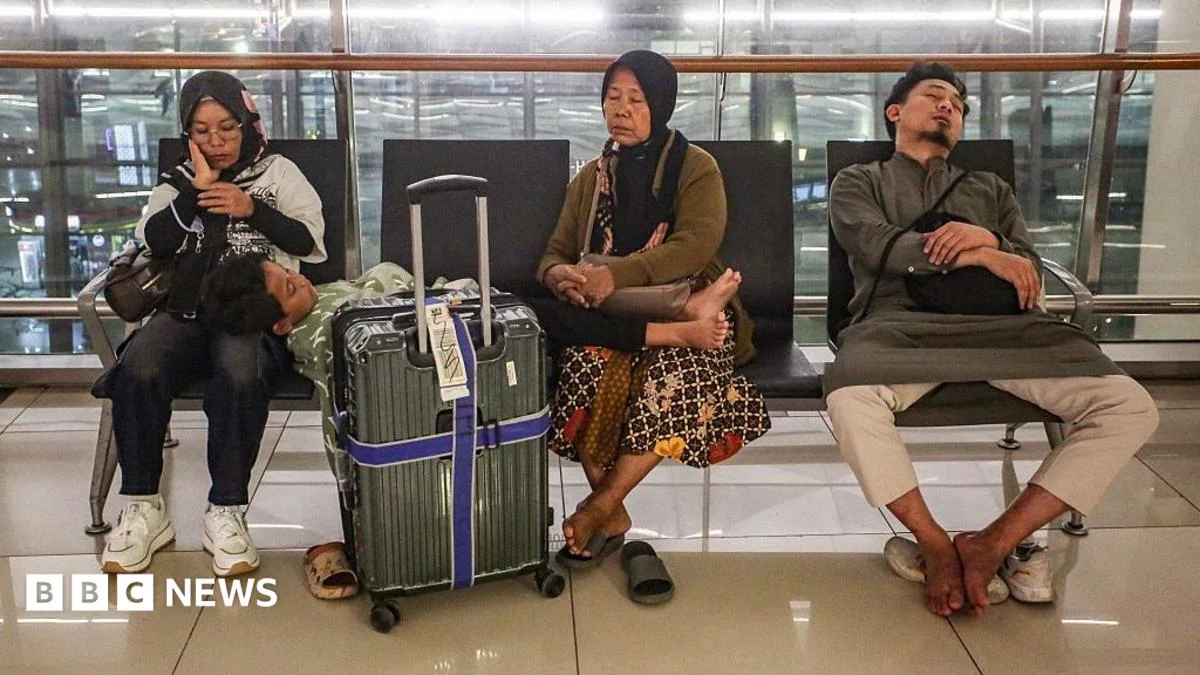
A significant volcanic eruption from Mount Anak Krakatoa in Indonesia has led to the suspension of 209 flights at Jakarta’s Soekarno-Hatta International Airport (CGK), the nation’s primary international gateway, effectively stranding over 22,000 passengers. The disruption, initiated on Sunday morning, follows the detection of volcanic ash in the airspace near the bustling capital, prompting immediate and stringent aviation safety measures. The transport ministry confirmed the initial suspension was extended until 13:30 local time (0630 GMT), impacting critical international routes, notably those connecting to Singapore, Doha, Sydney, and Kuala Lumpur, causing a ripple effect throughout the regional and global air travel network.
Chronology of the Eruption and Its Immediate Aftermath
The seismic awakening of Mount Anak Krakatoa commenced late on Friday night, marking the beginning of a period of heightened activity. Witnesses and monitoring stations reported continuous seismic tremors, spectacular lava fountains, and resonant booming sounds that reverberated across the surrounding regions of the Sunda Strait, the narrow waterway separating the islands of Java and Sumatra. This initial phase of eruption set the stage for subsequent, more impactful events.
Early on Sunday morning, the volcano experienced two more significant eruptions, ejecting a plume of ash and gas high into the atmosphere. It was the detection of this ash cloud, carried by prevailing winds, within the critical flight paths and airspace surrounding Jakarta that triggered the unprecedented response from aviation authorities. The decision to suspend flights was made swiftly to safeguard aircraft and passengers from the known dangers of volcanic ash. AirNav Indonesia, the national air navigation service provider, in coordination with the Center for Volcanology and Geological Hazard Mitigation (PVMBG) and the Meteorology, Climatology, and Geophysics Agency (BMKG), issued warnings and implemented rerouting and ground stop procedures.
The immediate consequence was the grounding of 209 scheduled flights, both inbound and outbound from Soekarno-Hatta International Airport. This figure represents a substantial portion of the airport’s daily operations, especially considering its status as one of the busiest airports in the Southern Hemisphere. The initial estimated number of affected passengers, exceeding 22,000, underscores the significant logistical challenge faced by airlines, airport management, and travelers alike. As the situation evolved, the extended suspension necessitated further adjustments to flight schedules and passenger management strategies.
Understanding the Peril: Volcanic Ash and Aviation Safety
Volcanic ash, though seemingly innocuous, poses a severe and multifaceted threat to aviation. Unlike smoke, volcanic ash consists of pulverized rock and glass particles, which are highly abrasive and can cause catastrophic damage to aircraft engines, airframes, and critical flight instruments. When ingested into jet engines, the high operating temperatures can melt these silicate particles, forming a glass-like coating on turbine blades and fuel nozzles, leading to engine malfunction, flame-out, and potentially complete power loss. This phenomenon has been documented in several historical incidents, underscoring the extreme caution exercised by aviation authorities.
Beyond engine damage, ash particles can abrade the outer surfaces of an aircraft, compromising aerodynamic integrity and visibility through cockpit windows. Static electricity generated by ash particles can also interfere with avionics and communication systems. Consequently, international aviation bodies, including the International Civil Aviation Organization (ICAO), have established stringent protocols for managing flights in areas affected by volcanic ash. Volcanic Ash Advisory Centers (VAACs), such as the Darwin VAAC which monitors the Indonesian region, play a crucial role in disseminating real-time information on ash cloud location, altitude, and trajectory to airlines and air traffic control. The issuance of a NOTAM (Notice to Airmen) regarding the presence of ash effectively closes airspace or reroutes flights to ensure safety.
Indonesia’s Volcanic Landscape: A Geological Context
Indonesia is geographically situated on the notorious "Pacific Ring of Fire," an arc of intense seismic activity and volcanic eruptions that encircles the Pacific Ocean. This geological setting is a result of the collision of several major tectonic plates, leading to the subduction of oceanic crust beneath continental crust. This process generates magma chambers that feed Indonesia’s more than 130 active volcanoes, making it the country with the largest number of active volcanoes globally. The frequent seismic and volcanic activity is a constant backdrop to life in the archipelago, necessitating robust disaster preparedness and mitigation strategies.
Mount Anak Krakatoa, which translates to "Child of Krakatoa," holds particular historical significance. It emerged from the sea at the beginning of the 20th century, specifically in 1927, within the caldera formed by the cataclysmic 1883 eruption of its parent volcano, Mount Krakatoa. The 1883 eruption was one of the deadliest and most powerful volcanic events in recorded history, generating tsunamis that killed tens of thousands and altering global weather patterns for years. Anak Krakatoa has been sporadically active since its birth, characterized by effusive eruptions and occasional explosive events. Its most recent major event occurred in December 2018, when a flank collapse of the volcano triggered an underwater landslide, generating a devastating tsunami that struck the coasts of Java and Sumatra, killing over 400 people. This recent history underscores the potential for sudden and severe impacts from Anak Krakatoa’s activity.
Impact on International Travel and Commerce
The flight suspensions at Soekarno-Hatta International Airport have far-reaching implications beyond the immediate inconvenience to passengers. As Indonesia’s busiest airport, CGK serves as a critical hub for both domestic and international travel, connecting millions of passengers annually to destinations across Asia, Australia, the Middle East, and beyond. In 2023, CGK handled over 50 million passengers, highlighting its pivotal role in the region’s air transport infrastructure.
The affected routes, including those to Singapore, Doha, Sydney, and Kuala Lumpur, are among the most heavily trafficked international corridors for Indonesia. Singapore Changi Airport, for instance, is a major regional connecting hub, and disruptions to flights between Jakarta and Singapore inevitably create a domino effect on onward connections. Similarly, routes to Doha (a hub for Qatar Airways), Sydney (a major gateway to Australia), and Kuala Lumpur (another key Southeast Asian hub) are vital for business, tourism, and diaspora communities.
Economically, the flight cancellations translate into direct losses for airlines through canceled bookings, compensation for stranded passengers, and operational inefficiencies. For the broader Indonesian economy, particularly the tourism sector, such disruptions can lead to a decline in inbound visitors, affecting hotels, tour operators, and related service industries. Business travelers face delays that can impact crucial meetings and supply chain logistics, as air cargo operations are also halted or rerouted. The extended nature of the suspension, even for a single day, can accumulate significant financial costs for all stakeholders involved.
Official Responses and Public Health Advisories
In response to the unfolding situation, Indonesian authorities have activated a coordinated emergency response. The Ministry of Transportation has been at the forefront, issuing directives to airlines and airport operators, and closely monitoring the atmospheric conditions in collaboration with meteorological agencies. They emphasized that the pause in operations was a necessary safety precaution, with regular updates provided on the status of the airspace.
PT Angkasa Pura II, the state-owned airport operator managing Soekarno-Hatta, has initiated protocols to assist stranded passengers. This includes setting up information desks, coordinating with airlines for rebooking options, and facilitating temporary accommodation where feasible. Passengers have been urged to contact their respective airlines for the latest flight information and rebooking procedures.
Crucially, the National Disaster Management Agency (BNPB) and the PVMBG have continuously monitored Mount Anak Krakatoa’s activity. They have confirmed that, despite the significant eruptions and ashfall, there is currently no tsunami warning linked to the volcano’s recent activity. This is a critical distinction, especially given the tragic events of 2018, and provides a measure of reassurance to coastal communities in the Sunda Strait. PVMBG has maintained the volcano’s alert level, advising caution in proximity to the crater.
Furthermore, the Minister of Health has issued urgent advisories to residents in affected areas, particularly those experiencing ashfall. The recommendations include staying indoors as much as possible and wearing face masks when venturing outside. Volcanic ash can pose several health risks, including respiratory problems (irritation of the lungs, exacerbation of asthma), eye irritation (conjunctivitis, corneal abrasions), and skin irritation. The fine particulate matter can penetrate deep into the respiratory system, and prolonged exposure can lead to chronic health issues. The emphasis on N95 or similar masks is crucial for effective protection against these fine particles.
Broader Implications and Future Outlook
The current situation highlights the inherent challenges of operating a major international airport in a volcanically active region. While Indonesia has developed sophisticated monitoring systems and emergency protocols, the unpredictable nature of volcanic eruptions means that disruptions are an ongoing possibility. This event serves as a critical reminder for airlines to maintain robust contingency plans and for travelers to be aware of the geological risks when planning trips to the region.
Looking ahead, the duration of the flight suspensions will depend on the continued activity of Anak Krakatoa and the dissipation of the ash cloud. Authorities will rely on continuous monitoring by VAACs and meteorological agencies to determine when the airspace can be safely reopened. Airlines will face the complex task of clearing the backlog of stranded passengers, rerouting aircraft, and rescheduling hundreds of flights, a process that can take several days even after the immediate threat subsides.
For the international community, this event underscores the interconnectedness of global air travel and the ripple effects that a localized natural disaster can have on a worldwide scale. It also reinforces the importance of international cooperation in aviation safety, disaster preparedness, and scientific research into volcanic phenomena to mitigate future risks. As Indonesia navigates this latest challenge, the focus remains firmly on public safety, efficient crisis management, and minimizing the disruption to its vital air transport infrastructure.