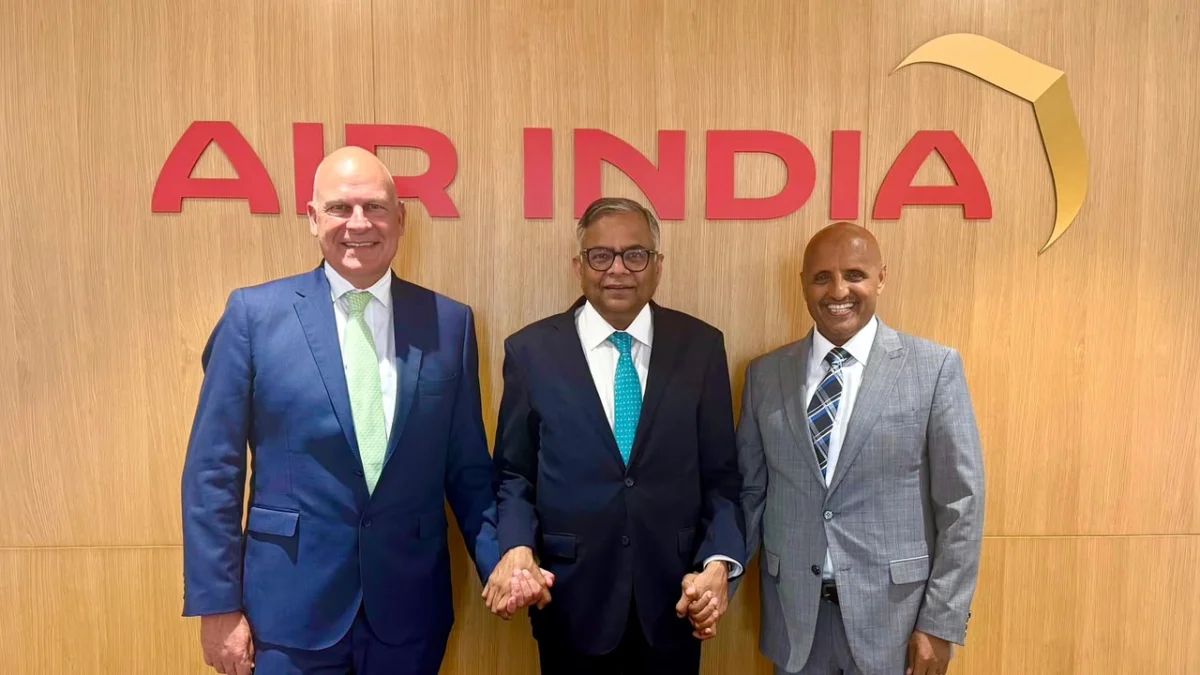
Air India Chairman N. Chandrasekaran officially signaled a new era for the national carrier during a comprehensive employee town hall on Monday, emphasizing that the airline’s future success will be defined by four critical metrics: safety, customer trust, reliable operations, and rigorous cost management. The meeting served as a formal transition of leadership from outgoing CEO Campbell Wilson to the incoming chief, Tewolde Gebremariam, marking a pivotal moment in the Tata Group’s multi-year effort to restore the airline to its former status as a premier global carrier.
The transition comes at a juncture where Air India has moved past its initial "rescue and stabilization" phase and is now entering a period of operational refinement. Addressing a global workforce of thousands, Chandrasekaran acknowledged the immense challenges the airline has faced since its privatization in 2022, describing the recent period as one of the most difficult stretches in the carrier’s storied history. However, he maintained that the foundational work laid over the past four years has prepared the airline for a more disciplined and performance-driven future.
The Legacy of the Rebuild Phase
When the Tata Group officially took control of Air India in January 2022, the airline was struggling with a dilapidated fleet, low employee morale, and a fragmented service culture. Campbell Wilson, who was brought in from Singapore Airlines’ low-cost subsidiary Scoot, was tasked with the "Vihaan.AI" transformation plan—a five-year roadmap designed to claim a 30% share of both domestic and international markets.
Under Wilson’s tenure, Air India underwent a massive structural overhaul. This included the historic order of 470 aircraft from Boeing and Airbus, a deal valued at over $70 billion at list prices. The airline also committed $400 million to completely refurbish the interiors of its legacy wide-body fleet, which had long been a point of contention for international travelers. Furthermore, Wilson oversaw the complex legal and operational merger with Vistara—a joint venture between Tata and Singapore Airlines—and the consolidation of Air India Express and AIX Connect (formerly AirAsia India) into a single low-cost entity.
As Wilson prepares to depart, the airline Gebremariam inherits is vastly different from the one that existed in 2022. It is now a consolidated group with modern technology stacks, a growing fleet of Airbus A350s, and a centralized training academy in Gurugram capable of training thousands of pilots and cabin crew annually.
The Four Pillars of the Next Phase
Chairman Chandrasekaran’s address was clear in its shift of tone. While the first phase was defined by massive capital expenditure and expansion, the next phase will be defined by operational excellence. The "Four Pillars" outlined by the Chairman provide a roadmap for the incoming leadership:
- Safety as a Non-Negotiable Core: Following a series of highly publicized operational lapses and technical snags over the last year, Chandrasekaran emphasized that safety must be the bedrock of the airline’s culture. This involves not only flight safety but also ground safety and adherence to international regulatory standards.
- Restoring Customer Trust: Air India has faced significant criticism regarding its ground services and cabin maintenance. The Chairman noted that rebuilding the "Maharajah" brand requires a consistent, world-class experience that competes with Gulf carriers and other premium international airlines.
- Reliability and On-Time Performance (OTP): Reliability has been a pain point for Air India, particularly on long-haul routes. The focus will now shift toward ensuring that the expanded fleet operates with a high degree of punctuality, minimizing cancellations and delays that have historically eroded passenger loyalty.
- Tighter Control of Costs: After years of heavy investment in aircraft and infrastructure, the airline must now turn its attention to the bottom line. Chandrasekaran signaled that the era of "rebuilding at any cost" is transitioning into a phase where fiscal discipline and operational efficiency are paramount to achieving long-term profitability.
Incoming Leadership: The Tewolde Gebremariam Era
The appointment of Tewolde Gebremariam as the incoming CEO is seen by industry analysts as a strategic move to leverage his experience in turning around a major flag carrier. During his tenure at Ethiopian Airlines, Gebremariam was credited with transforming the carrier into the largest and most profitable airline in Africa, primarily by building a robust hub-and-spoke model in Addis Ababa and diversifying revenue streams.
His expertise in managing a global network from a developing market is expected to be instrumental as Air India seeks to turn New Delhi and Mumbai into global transit hubs that can rival Dubai, Doha, and Singapore. Gebremariam’s track record of maintaining high operational standards while keeping costs low aligns directly with the "Four Pillars" outlined by the Chairman.
Chronology of the Tata-Air India Transformation
To understand the weight of the current transition, it is essential to look at the timeline of the airline’s evolution since its return to the Tata fold:
- January 2022: Tata Group officially takes over Air India from the Government of India, ending decades of state ownership.
- May 2022: Campbell Wilson is appointed as CEO and Managing Director.
- September 2022: The "Vihaan.AI" transformation plan is launched, setting a five-year target for market dominance.
- February 2023: Air India signs a record-breaking order for 470 aircraft, including 250 from Airbus and 220 from Boeing.
- August 2023: The airline reveals a new brand identity and livery, signaling a departure from its traditional aesthetic toward a more modern, global look.
- January 2024: The first Airbus A350-900 enters commercial service, marking the beginning of the fleet renewal program.
- November 2024: The merger between Air India and Vistara is finalized, creating a unified full-service carrier.
- Current (Late 2024): Transition of leadership to Tewolde Gebremariam begins, focusing on the "Next Phase" of operational stability.
Supporting Data and Market Context
The scale of the task ahead is reflected in the current market data. According to recent figures from the Directorate General of Civil Aviation (DGCA), the Indian aviation market is the third largest in the world and is growing at an annual rate of nearly 15%. However, Air India faces stiff competition domestically from IndiGo, which holds over 60% of the market share.
Internationally, Air India carries the highest number of passengers to and from India among domestic carriers, but it still trails behind foreign airlines like Emirates and Qatar Airways in terms of premium market share. The airline’s current fleet consists of approximately 140 aircraft, with hundreds more scheduled for delivery over the next decade. The challenge for the new leadership will be to integrate these new planes while retiring aging Boeing 777s and 787s that have been prone to technical issues.
Furthermore, the financial stakes are high. While the Tata Group has not publicly disclosed the exact losses of the airline since the takeover, industry estimates suggest that the carrier continues to face significant daily operational losses as it writes off legacy debts and invests in new systems. The "Cost Control" pillar is a direct response to the need for the airline to eventually become self-sustaining without constant capital infusions from the parent company.
Industry Reactions and Implications
The aviation industry has reacted to the leadership change with cautious optimism. Analysts suggest that while Campbell Wilson successfully navigated the "hard engineering" of the merger and fleet orders, Gebremariam is the "soft skills and efficiency" specialist needed for the next leg of the journey.
"The first phase was about getting the hardware right—the planes, the seats, the IT systems," said one senior aviation consultant. "The second phase is about the software—the people, the culture, and the consistency of service. Gebremariam has a history of building an airline culture that is both disciplined and highly competitive on a global scale."
The implications of this leadership transition extend beyond Air India. A successful turnaround of the flag carrier is seen as a matter of national prestige and a vital component of India’s goal to become a $5 trillion economy. By establishing a world-class international airline, India aims to capture a larger share of the global tourism and cargo markets, reducing its reliance on foreign carriers for international connectivity.
Conclusion: A High-Stakes Horizon
As the town hall concluded, the message to the employees was one of both gratitude and high expectations. The "Changing of the Guard" represents more than just a new name in the CEO’s office; it represents a shift in the very philosophy of the airline’s management.
Air India’s journey from a neglected state asset to a global contender is far from over. With the integration of Vistara complete and a massive fleet on the horizon, the pressure now rests on Tewolde Gebremariam to execute the Chairman’s vision. The coming months will be a test of whether the airline can translate its newfound resources into the "reliable operations" and "customer trust" that have been elusive for so long. For the Tata Group, the success of Air India is not just a business objective—it is a commitment to reclaiming a legacy that began with J.R.D. Tata nearly a century ago.