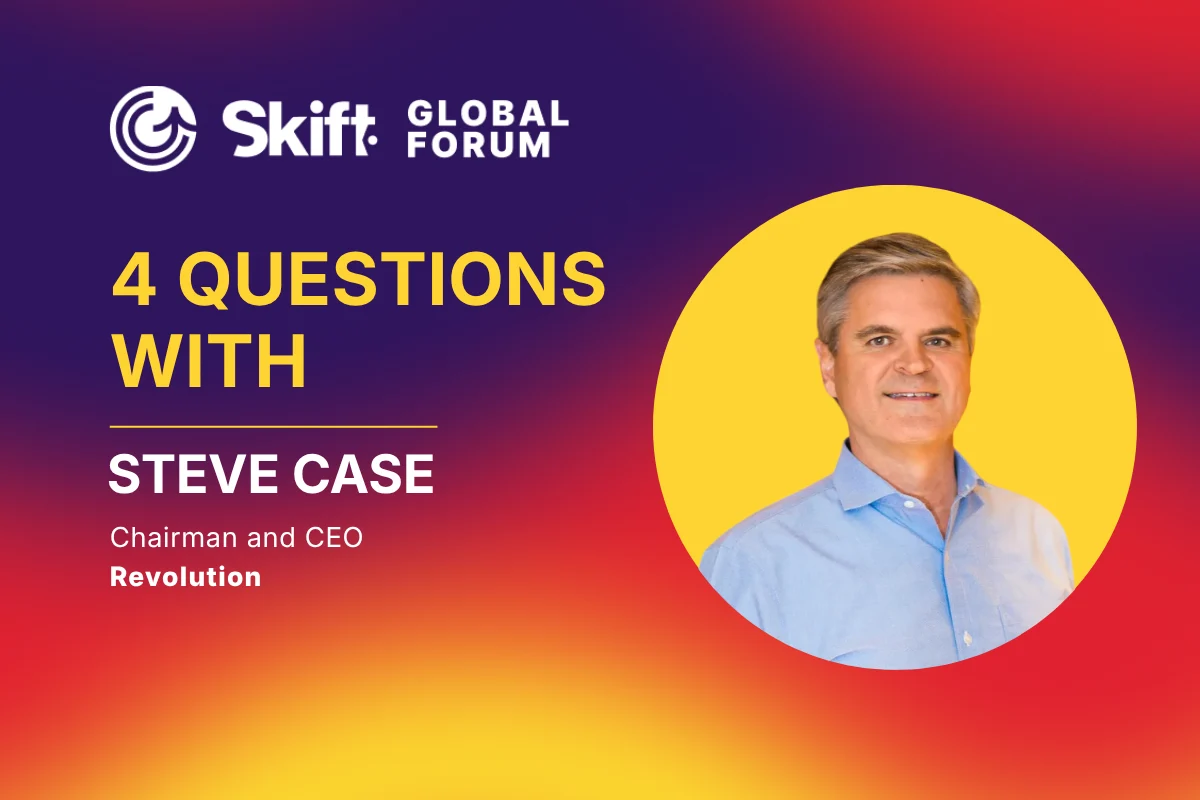
Steve Case, the co-founder of AOL and current chairman and CEO of Revolution, is set to headline the Skift Global Forum in New York City from September 22–24, 2026, where he will detail a contrarian investment philosophy designed for the era of generative artificial intelligence. Central to Case’s strategy is a conceptual framework he calls the "Scarcity Shift," a decision-making rule that dictates capital should be deployed into assets that AI cannot replicate, while AI itself should be used to commoditize and scale administrative and digital functions. This approach has guided Case’s recent high-profile moves in the travel and hospitality sectors, including the development of the Punta Cacique peninsula in Costa Rica and the strategic consolidation of luxury travel brands under "The Exclusive Collective."
The core of Case’s thesis rests on a single binary question: will AI make a specific asset more abundant, or will that asset remain scarce? As AI continues to lower the barriers to content creation, travel planning, and logistics management, these digital services are moving toward a state of hyper-abundance. Case argues that in such an environment, the relative value of physical, irreplaceable assets—such as unique geographic locations, multi-decade community trust, and human-led curation—will experience a significant premium. This philosophy marks a departure from the "move fast and break things" ethos of the early internet era, suggesting that the next decade of travel innovation will be defined by the protection of "good friction" and the deepening of compounding human relationships.
A Chronology of Strategic Evolution: From AOL to The Exclusive Collective
The trajectory of Steve Case’s investment career provides a historical context for his current focus on scarcity. After departing AOL, Case founded Revolution in 2005 with the intent of investing in "people and ideas that can change the world." His foray into luxury travel began over twenty years ago with an early investment in Exclusive Resorts, a pioneer in the destination club model. At the time, the investment was viewed primarily as a real estate play. However, over the subsequent two decades, Case’s perspective shifted from valuing the physical structures to valuing the membership network and the data-driven understanding of family travel patterns.
In recent years, this strategy has accelerated through a series of tactical acquisitions and developments. The timeline of these moves illustrates a concerted effort to dominate the high-end, trust-based travel market:
- Early 2000s: Initial investment in Exclusive Resorts, establishing the foundation for a membership-based hospitality model.
- 2010s–2020s: Strategic land acquisitions in Hawaii and the commencement of the Punta Cacique project in Costa Rica, focusing on ecologically unique and geographically finite locations.
- 2024–2025: The acquisition of Inspirato and onefinestay, effectively consolidating three of the most prominent names in luxury residential travel.
- 2026: The formalization of "The Exclusive Collective," a platform designed to provide a lifetime of curated travel experiences for affluent families, moving away from transactional bookings toward a compounding relationship model.
This chronology demonstrates Case’s long-term bet that the "third wave" of the internet—where technology integrates into the physical fabric of our lives—requires a focus on real-world community rather than just digital disruption.
Supporting Data: The Paradox of Abundance and the Return of the Advisor
The necessity of Case’s "Scarcity Shift" is supported by emerging consumer data that highlights a growing fatigue with digital-only travel solutions. Despite the proliferation of AI-driven booking engines and itinerary planners, modern travelers are increasingly seeking human intervention. A recent Chase Travel survey of more than 4,000 travelers revealed a surprising trend: 60 percent of Gen Z and Millennial respondents expressed a desire to use a travel advisor.
This data suggests that for the most digitally fluent generations, the abundance of choice has become a liability rather than an asset. While AI can generate an infinite number of travel itineraries in seconds, it cannot provide the "confidence" that comes from human judgment and accountability. Case’s strategy leverages this "paradox of choice" by positioning curation not as a secondary service, but as the primary product. By narrowing options through a trusted human lens, companies like those within The Exclusive Collective aim to solve the "decision fatigue" that AI-driven abundance inadvertently creates.
Market analysis of the luxury sector further reinforces this. According to industry reports, the global luxury travel market is projected to reach $1.65 trillion by 2031, with a significant portion of that growth driven by "experiential" and "transformative" travel. These categories rely heavily on unique locations and high-touch service—elements that fall squarely into the "staying scarce" category of Case’s investment matrix.
Official Responses and Industry Implications
The travel industry’s reaction to the rise of AI has been polarized, with some leaders focusing on full automation and others, like Case, advocating for a hybrid approach. At the upcoming Skift Global Forum, Case will be joined by other industry titans, including Airbnb’s Brian Chesky and Booking Holdings’ Glenn Fogel. While Airbnb has experimented with AI to enhance guest-host matching, and Booking.com has integrated AI "trip planners," Case’s focus on "protecting friction" offers a distinct alternative to the industry-wide push for seamlessness.
Industry analysts suggest that Case’s philosophy of "good friction" could redefine service design in hospitality. "Bad friction"—such as long queues at check-in or complex refund processes—is a target for AI elimination. However, "good friction"—the serendipitous moments of discovery, the effort required to learn a new culture, or the unexpected conversation with a local—is what creates lasting memories. The implication for the broader industry is that over-optimization may lead to a sanitized, forgettable product. Case’s argument is that the most successful travel brands of the future will be those that intentionally design moments of human vulnerability and curiosity into their guest journeys.
The Membership Model: Moving from Transactions to Compounding Trust
A significant pillar of Case’s strategy is the shift from transactional business models to membership-based ones. In a traditional hotel or OTA (Online Travel Agency) model, the relationship with the customer often resets to zero after each stay. Case argues that this is an inefficient use of capital in an AI-dominated world. Instead, he advocates for models where the relationship "compounds" over time.
By utilizing membership structures in Exclusive Resorts and Inspirato, Case’s companies gather deep, longitudinal data on member preferences that go far beyond what an algorithm can glean from a single search query. This allows the service team to anticipate needs—knowing, for example, how a family celebrates a specific milestone or which property features are essential for a child’s specific needs—before the member even asks. This "head start" is viewed as a competitive moat that AI cannot easily bridge, as it is built on years of real-world interactions and emotional intelligence.
Impact and Implications: The Future of Irreplaceable Places
The "Scarcity Shift" also has profound implications for environmental and land-use policy in travel. By investing in projects like Punta Cacique—a peninsula that cannot be "manufactured" or "scaled"—Case is highlighting the intrinsic value of conservation and thoughtful development. In Hawaii and Costa Rica, the focus is on "base camp" hospitality: providing a luxury experience that encourages guests to explore off-the-beaten-path locations, thereby supporting local economies and preserving the "serendipity value" of the destination.
As the travel industry moves toward 2030, the tension between AI-driven efficiency and human-driven experience will likely intensify. Steve Case’s participation in the Skift Global Forum 2026 serves as a pivotal moment for the sector to evaluate whether it is "sanding away" the very qualities that make travel meaningful. By aggressively adopting AI for administrative abundance while doubling down on physical and emotional scarcity, Case is providing a blueprint for a future where technology serves humanity, rather than replacing the human elements of hospitality.
The ultimate takeaway for the global travel market is clear: while AI will inevitably handle the mechanics of travel, the "product" itself remains rooted in the physical world. The winners in the next era of global tourism will not necessarily be the companies with the best algorithms, but those that own the most irreplaceable places and the deepest levels of human trust. As Case prepares to take the stage in New York, his message to the industry is a reminder that in an increasingly digital world, the most valuable assets are the ones that can never be digitized.