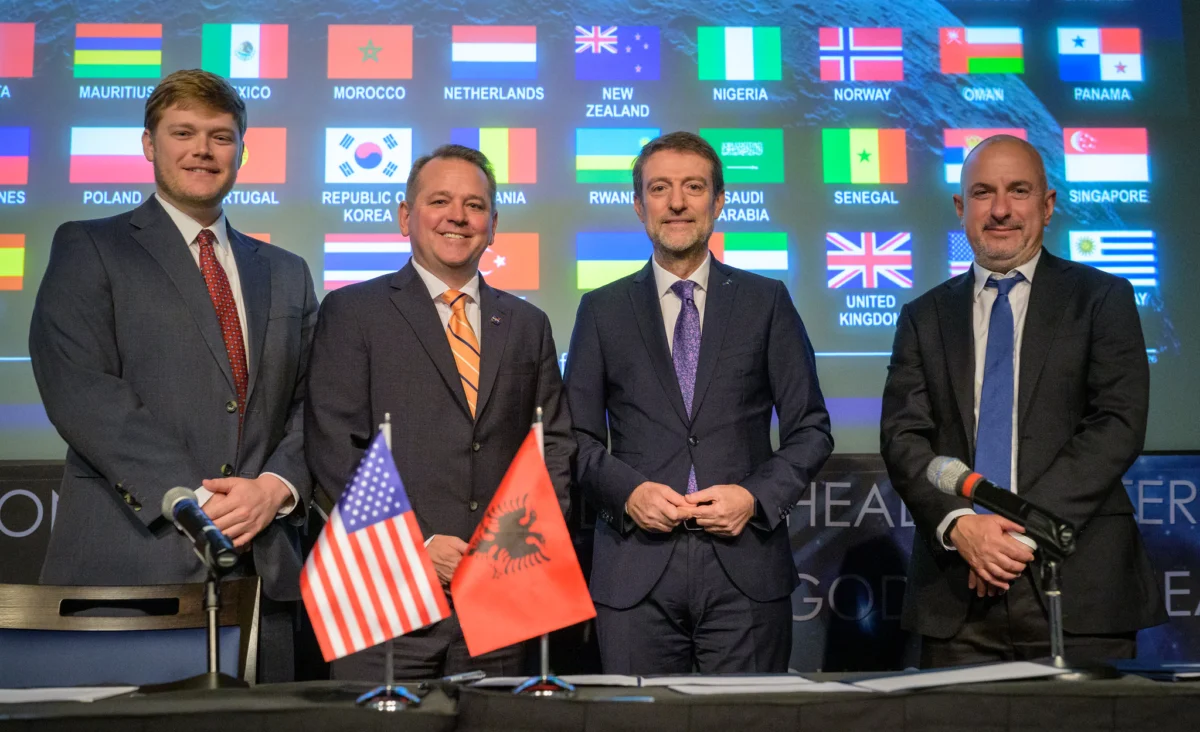
The Republic of Albania officially joined the growing international coalition committed to the principles of responsible and transparent space exploration on Monday, signing the Artemis Accords during a ceremony hosted by NASA at its headquarters in Washington D.C. This significant step marks Albania’s formal embrace of a shared vision for peaceful and sustainable activities in outer space, becoming the 73rd nation to endorse the framework. The signing ceremony brought together high-ranking officials from both nations, underscoring the strategic importance of this expanded partnership.
NASA Deputy Administrator Matt Anderson extended a warm welcome to the newest signatory, emphasizing the historical depth of the relationship between the two countries. "It is my privilege to welcome the Republic of Albania as the 73rd signatory of the Artemis Accords," Anderson stated. "The relationship between our nations goes back more than a century. Today, we extend that partnership into space, forging new frontiers of cooperation." This sentiment highlights a continuation of diplomatic and strategic alignment that now encompasses the burgeoning domain of space.
Representing the Republic of Albania, Minister for Europe and Foreign Affairs Ferit Hoxha formally appended his signature to the Accords. He was joined by Ervin Bushati, Ambassador of the Republic of Albania to the United States, and Connor Tomlinson, U.S. Deputy Assistant Secretary of State for Space and Environment, further signifying the diplomatic weight and mutual commitment behind the event. The atmosphere was one of shared purpose and optimism for future collaborative endeavors.
A Milestone for Global Space Governance
The Artemis Accords, established in 2020 by NASA and the U.S. Department of State in conjunction with seven other founding nations, represent a critical international framework designed to govern the conduct of civil space exploration. They emerged in response to increasing global interest in lunar activities, driven by both governmental space agencies and burgeoning private enterprises. The Accords introduce a foundational set of practical principles intended to enhance the safety, predictability, and coordination among nations as they embark on exploration missions to the Moon, Mars, and beyond.
At their core, the Artemis Accords are built upon the 1967 Outer Space Treaty, reinforcing its tenets while addressing the specific challenges and opportunities presented by modern space exploration. The ten key principles enshrined within the Accords commit signatory nations to:
- Peaceful Exploration: All activities under the Artemis program must be exclusively for peaceful purposes, in accordance with international law. This principle underscores the non-militarization of space and the commitment to scientific and cooperative endeavors.
- Transparency: Signatories agree to conduct their activities in a transparent manner, sharing information about their policies and plans to minimize misunderstandings and promote trust.
- Interoperability: Nations are encouraged to use common standards and protocols where possible, facilitating collaboration and ensuring the long-term sustainability and safety of operations in space, particularly around the Moon.
- Emergency Assistance: A commitment to provide assistance to personnel in distress in outer space, in line with the Agreement on the Rescue of Astronauts, the Return of Astronauts and the Return of Objects Launched into Outer Space.
- Registration of Space Objects: Signatories commit to registering their space objects in accordance with the 1975 Convention on Registration of Objects Launched into Outer Space, contributing to a comprehensive and transparent record of activities.
- Release of Scientific Data: A pledge to publicly release scientific data derived from Artemis activities, ensuring that the benefits of space exploration are shared globally for the advancement of human knowledge.
- Protecting Heritage Sites: Commitment to preserving outer space heritage, including historic landing sites and artifacts on the Moon, Mars, and other celestial bodies.
- Space Resources: The Accords affirm that the extraction and utilization of space resources should be conducted in a manner that is consistent with the Outer Space Treaty, supporting sustainable and safe operations. This principle is particularly significant for future lunar and Martian settlements.
- Deconfliction of Activities: Signatories commit to preventing harmful interference, providing appropriate notification of activities, and coordinating operations to ensure safety and avoid conflicts in increasingly crowded orbital and celestial environments.
- Orbital Debris: A commitment to mitigate the generation of harmful orbital debris and to dispose of spacecraft safely at the end of their missions, promoting the long-term sustainability of the space environment.
By endorsing these principles, Albania aligns itself with a growing consensus on best practices for space activities, signaling its intent to be a responsible actor in humanity’s ongoing expansion into the cosmos.
Albania’s Evolving Space Ambitions
Albania’s decision to sign the Artemis Accords is not an isolated event but rather a logical progression in its nascent yet ambitious journey into space. A notable recent milestone occurred in January 2023, when Albania launched its first two dedicated Earth-observation satellites, Albania-1 and Albania-2. These satellites were deployed aboard a SpaceX Falcon 9 rocket from NASA’s Kennedy Space Center in Florida, demonstrating a practical example of the United States’ support for Albania’s burgeoning capabilities in space.
The launch of Albania-1 and Albania-2, managed through a partnership with the U.S.-based company Satellogic, marked a significant leap forward for the Balkan nation. These high-resolution imaging satellites are designed to provide crucial data for a variety of national priorities, including agricultural monitoring, environmental protection, urban planning, border surveillance, and disaster management. The ability to collect and analyze its own space-based data empowers Albania with enhanced decision-making capabilities and greater self-reliance in critical sectors. This initiative underscores a clear strategic intent to leverage space technology for national development and security, moving beyond being merely a recipient of such data to an active participant in its generation.
Ferit Hoxha articulated Albania’s commitment to these values during the signing ceremony. "It is a great honor for Albania to join the growing community of nations that have signed these important Artemis Accords," Hoxha remarked. "By taking this step, Albania affirms its commitment to peaceful, transparent, sustainable, and cooperative exploration of space. We do so as a country deeply committed to international law, multilateral cooperation, and the belief that humanity’s greatest achievements are realized not in isolation, but through partnerships." His statement encapsulates the nation’s ethos of international cooperation and adherence to a rules-based order, both on Earth and in space.
A Century of Partnership Extended to the Cosmos
The relationship between the United States and Albania is robust and multifaceted, rooted in shared democratic values and strategic interests. Albania has been a steadfast ally of the United States, particularly since the fall of communism, and a committed member of NATO since 2009. This long-standing partnership has seen cooperation across various domains, including defense, economic development, and cultural exchange. The signing of the Artemis Accords represents a natural extension of this deep bilateral relationship into the rapidly evolving frontier of space.
For the United States, welcoming Albania into the Artemis Accords further strengthens the coalition of like-minded nations dedicated to a particular vision of space exploration – one that prioritizes transparency, sustainability, and peaceful collaboration. As the global space landscape becomes increasingly crowded and competitive, frameworks like the Accords are vital for establishing norms of behavior and preventing potential conflicts. Albania’s accession adds another voice to this collective effort, reinforcing the principles championed by the U.S. and its partners.
Fostering Innovation Through Collaboration
Beyond satellite launches, Albania has also demonstrated a proactive engagement with the international space community through initiatives such as NASA’s Space Apps Challenge. Albania has played an active role in this global hackathon, hosting local events that successfully connect students, technologists, and innovators with NASA’s openly available Earth and space science data. This involvement highlights Albania’s commitment to fostering a culture of innovation and scientific inquiry among its youth and technical communities.
NASA Space Apps is recognized as the world’s largest annual global hackathon, mobilizing participants in more than 150 countries to develop creative solutions to real-world challenges. By utilizing open data from NASA and partner space agencies, participants contribute to advancing exploration for the benefit of all humanity. Albania’s enthusiastic participation in this program demonstrates its dedication to capacity building and nurturing a new generation of space enthusiasts and professionals, who will be crucial for the nation’s continued growth in the space sector. Such grassroots engagement complements the high-level diplomatic commitments, ensuring a holistic approach to space development.
The Broader Implications for Space Exploration
Albania’s accession to the Artemis Accords carries broader implications for the future of international space exploration and governance. In an era marked by increasing geopolitical competition, the Accords provide a counter-narrative to alternative models of space conduct proposed by other major spacefaring nations. They advocate for a predictable, transparent, and cooperative environment, essential for the long-term sustainability and safety of operations beyond Earth orbit.
The Accords are intrinsically linked to NASA’s ambitious Artemis program, which aims to return humans to the Moon, establish a sustainable lunar presence, and eventually pave the way for human missions to Mars. By signing the Accords, nations open the door to potential opportunities for future lunar exploration with NASA, contributing to humanity’s return to the Moon and actively shaping what is often referred to as a "Golden Age" of space exploration and innovation. This could involve participation in scientific experiments, technology demonstrations, or even eventual contributions to lunar infrastructure.
For Albania, this signing is not just symbolic; it potentially unlocks avenues for enhanced scientific exchange, technological transfer, and even commercial partnerships in the burgeoning space economy. While Albania may not be sending astronauts to the Moon in the immediate future, its commitment to the Accords signals its readiness to participate in the scientific, economic, and normative aspects of this new era of deep space exploration. It positions Albania as a reliable partner in the global effort to ensure that humanity’s expansion into space is conducted responsibly and for the benefit of all.
Looking Ahead: Opportunities and Challenges
As the 73rd signatory, Albania joins a diverse group of nations, ranging from established space powers like the United States, Japan, and Canada, to emerging space nations across Europe, Asia, Africa, and South America. This growing consensus around the Artemis Accords principles underscores a global desire for a common framework governing space activities, especially as lunar and Martian exploration becomes more feasible.
The challenges ahead involve not only adhering to these principles but also actively contributing to their evolution and implementation. For Albania, this means continuing to invest in its space capabilities, fostering its scientific and technological talent, and engaging actively in international dialogues on space policy. Its recent satellite launches and participation in initiatives like the Space Apps Challenge demonstrate a clear trajectory toward becoming a more integrated and contributing member of the global space community.
The signing ceremony on Monday was more than a formal diplomatic act; it was a reaffirmation of shared values and a commitment to extending a rules-based international order into the vast expanse of outer space. As humanity sets its sights on returning to the Moon and venturing further into the solar system, the collective effort of nations like Albania, united under the banner of the Artemis Accords, will be paramount in ensuring that this new chapter of exploration is characterized by peace, cooperation, and mutual benefit. The Republic of Albania has now officially taken its place among the nations shaping this exciting future.
For more information on the Artemis Accords, please visit: https://www.nasa.gov/artemis-accords