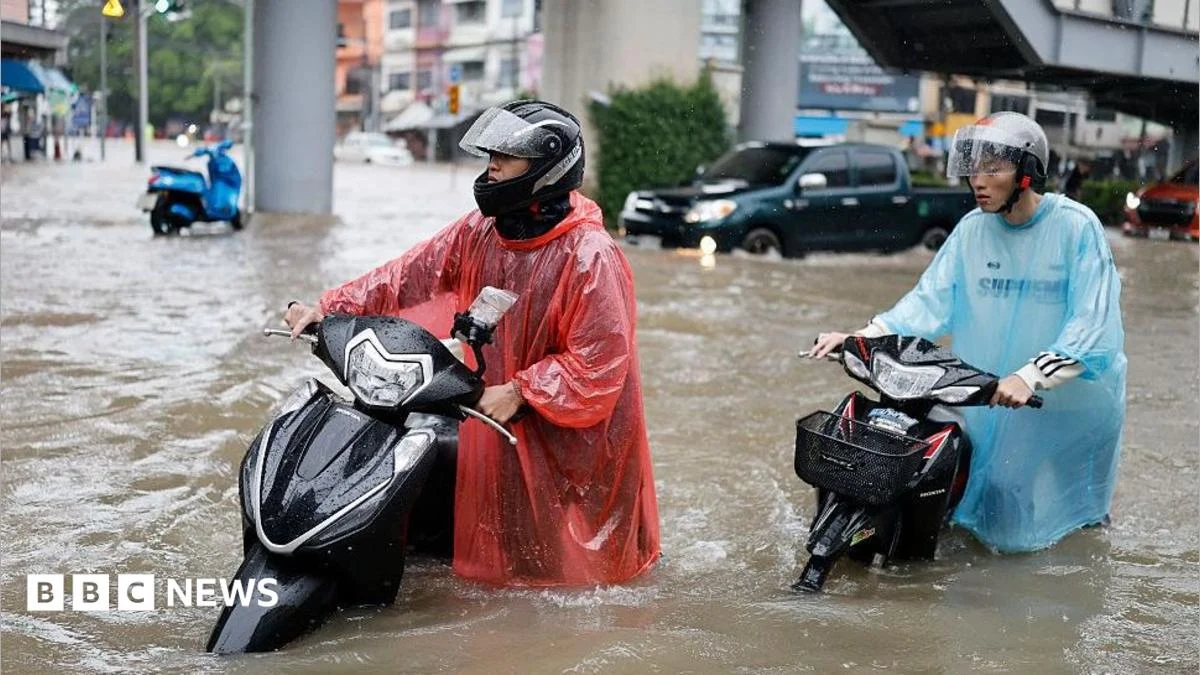
Bangkok, Thailand – A state of emergency has been declared across all 50 districts of Bangkok following an extraordinary deluge that has submerged vast swathes of the Thai capital, disrupting daily life and raising concerns about the city’s long-term resilience to extreme weather. Since Thursday, the sprawling metropolis has been inundated by over 300mm (12 inches) of rainfall, a volume that has overwhelmed its extensive, yet often challenged, drainage infrastructure, turning major thoroughfares into canals and forcing thousands to contend with waist-deep waters. As of Sunday, while the immediate intensity of the downpours had subsided, the Bangkok Metropolitan Authority (BMA) cautioned that canal water levels remained critically high, with city governor Chadchart Sittipunt warning residents that the flood crisis was far from over.
A City Under Water: The Immediate Impact
The declaration of a disaster emergency underscores the severity of the situation. Images from across the city depict a landscape transformed: cars abandoned in submerged streets, residents wading through murky waters, and makeshift barriers erected to protect homes and businesses. The usually bustling arteries of the capital, already notorious for their congestion, have been rendered impassable in many areas, creating traffic chaos and bringing daily commutes to a standstill. Public transportation, including parts of the city’s elevated train systems and underground metro, has faced significant disruptions, exacerbating the challenges for the city’s approximately 11 million residents.
Authorities have issued urgent directives, urging citizens to remain at home unless absolutely necessary. Those residing in close proximity to Bangkok’s intricate network of canals, which crisscross the city and typically serve as vital waterways, have been advised to relocate their valuable belongings and personal effects to higher floors, anticipating further rises in water levels. The advisory highlights the ongoing risk posed by the saturated canal systems, which are struggling to discharge the massive influx of rainwater.
Chronology of a Deluge: From Thursday to Sunday
The crisis escalated rapidly, beginning with intense and unseasonably heavy rainfall that commenced on Thursday. While thunderstorms are a common feature of Thailand’s annual monsoon season, the sheer volume and persistence of the recent downpours far exceeded typical patterns.
- Thursday: Initial heavy rains began, gradually accumulating, and causing localized flooding in vulnerable areas. The city’s drainage systems, including its network of pumps and underground tunnels, began to show signs of strain.
- Friday: Rainfall intensified, leading to widespread inundation. Reports of submerged roads and traffic gridlock became common across various districts. Emergency services initiated preliminary response efforts.
- Saturday: The situation deteriorated significantly. With continuous rainfall, many areas experienced rapidly rising water levels. Governor Chadchart Sittipunt acknowledged the severity, stating that the east of the city had been particularly hard-hit. He underscored the relentless nature of the rain and the challenge of pumping water out when canals were already at capacity. It was on this day that all 50 districts were officially declared emergency zones, signifying the extensive reach of the disaster.
- Sunday: While the rains momentarily abated, providing a brief respite, the BMA confirmed that canal levels remained dangerously high. The governor reiterated warnings of continued flooding, urging vigilance and caution. The focus shifted from managing active downpours to draining accumulated water and preventing further escalation from residual water in the system.
Echoes of 2011: A Lingering Fear

For many long-term residents, the current flooding evokes unsettling memories of the devastating nationwide floods of 2011. Somkid Pheuk-ngam, a 67-year-old resident living near a canal just north of central Bangkok, shared her harrowing experience with the AFP news agency. "The water keeps coming in. It’s hard to go out now. It’s like at my waist level now," she recounted, describing how her shop had been closed for two days. She observed that current water levels appeared to be worse than those experienced in 2011, a stark comparison that highlights the gravity of the present situation.
The 2011 floods were one of Thailand’s most severe natural disasters in decades, affecting millions across the country and claiming hundreds of lives over a three-month period. The economic impact was colossal, estimated at over $40 billion, with significant damage to industrial estates, agricultural lands, and infrastructure. While the current flooding in Bangkok has, thankfully, not yet resulted in reported casualties, the comparison to 2011 serves as a grim reminder of the potential for widespread destruction and the psychological toll such events inflict on a populace. The city’s preparedness and response mechanisms have undoubtedly evolved since then, but the sheer force of nature remains a formidable adversary.
Bangkok’s Unique Vulnerability: Geography and Urbanization
Bangkok’s susceptibility to flooding is a complex interplay of geography, rapid urbanization, and meteorological patterns. Situated on the Chao Phraya River delta, merely two meters above sea level on average, the city is inherently low-lying and built on soft, alluvial soil. This geographical characteristic makes it prone to inundation from both river overflows and tidal surges, compounded by heavy rainfall.
Moreover, decades of rapid, often unplanned, urban development have exacerbated the problem. The expansion of concrete infrastructure has paved over natural floodplains and permeable surfaces, reducing the ground’s ability to absorb rainwater. The construction of buildings and roads has also placed immense pressure on the city’s underground water sources, leading to land subsidence—a gradual sinking of the ground level. Studies have indicated that parts of Bangkok are sinking by several centimeters annually, making the city even more vulnerable to rising sea levels and intensified rainfall.
The city’s elaborate network of canals, or khlongs, historically served as both transportation arteries and crucial drainage channels. However, many khlongs have been filled in for development or become clogged with waste and sediment, significantly diminishing their capacity to manage floodwaters. While the BMA has invested in large-scale drainage projects, including giant underground tunnels and numerous pumping stations, these systems have a finite capacity. The recent rainfall, exceeding 300mm in a short span, clearly pushed these critical infrastructures beyond their design limits.
Official Response and Mitigation Efforts
In response to the emergency, the BMA, under Governor Chadchart Sittipunt, has mobilised extensive resources. Pumping stations across the city are operating at maximum capacity, working tirelessly to divert water from residential areas and major roads into the river and out to sea. Emergency crews have been deployed to clear blocked drains and distribute sandbags in critical areas, particularly those adjacent to overflowing canals.

Governor Sittipunt, who has been actively involved in overseeing the response, has maintained a visible presence, providing regular updates to the public and coordinating efforts. His emphasis on the challenges posed by full canals highlights the core issue: even with powerful pumps, if the receiving waterways are at their limit, the discharge capacity is severely hampered. The focus remains on strategic water management, prioritising the safety of residents and critical infrastructure.
Beyond immediate relief, the BMA has long-term plans to enhance Bangkok’s flood resilience. These include expanding the network of drainage tunnels, developing more water retention areas (monkey cheeks), and strengthening river embankments. However, the scale of the challenge, compounded by climate change projections, necessitates continuous investment and adaptive strategies.
Economic and Social Implications
The current flooding is expected to have significant economic repercussions, even if short-lived. Businesses, particularly small and medium-sized enterprises like Somkid Pheuk-ngam’s shop, face immediate losses due to closures, damaged inventory, and reduced customer traffic. The disruption to logistics and supply chains will impact larger industries, while the tourism sector, a cornerstone of Bangkok’s economy, could see a temporary downturn as visitors navigate the challenging conditions.
Socially, the floods impose immense hardship. Beyond the immediate inconvenience and potential property damage, there are public health concerns related to stagnant water, which can become breeding grounds for disease-carrying insects and contaminate water sources. The psychological stress on residents, especially those who have experienced previous floods, can be profound. The emergency also diverts public resources that could otherwise be allocated to development projects.
Meteorological Outlook and Future Preparedness
The Thai Meteorological Service has issued further warnings, forecasting more heavy rain throughout the coming week. While the low-pressure area responsible for the recent intense downpours is anticipated to shift towards central Thailand, this does not guarantee an immediate reprieve for Bangkok. The saturated ground, overflowing canals, and weakened infrastructure mean that even moderate rainfall could exacerbate existing conditions or trigger new flooding in other vulnerable areas.
The recurrence of extreme weather events like this underscores the urgent need for comprehensive, long-term strategies for urban resilience in Bangkok. This includes not only enhancing physical infrastructure but also improving early warning systems, fostering community preparedness, and integrating climate change adaptation into all facets of urban planning. As Bangkok continues to grow and face the realities of a changing climate, its ability to manage water, both in abundance and scarcity, will define its future. The current emergency serves as a stark reminder of this critical imperative, demanding continued vigilance and sustained efforts from both authorities and citizens alike.