

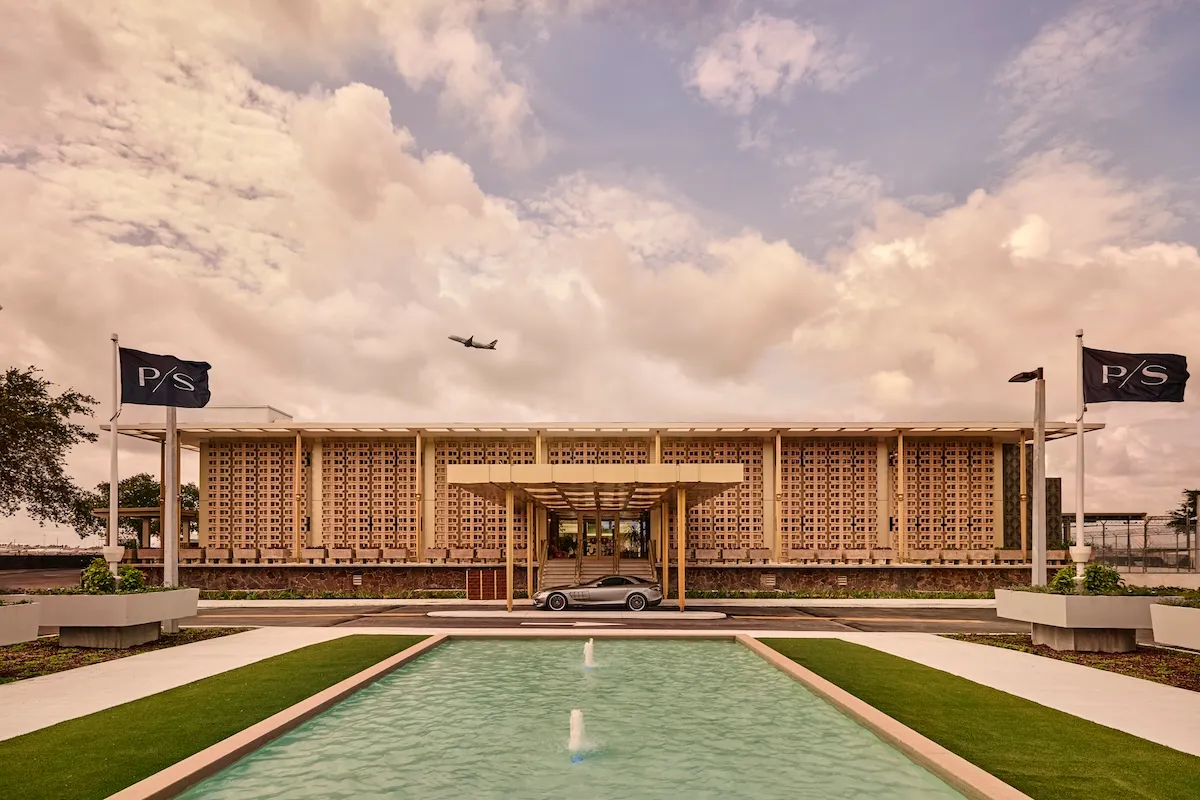
The landscape of commercial aviation is undergoing a significant structural shift as the boundaries between private and commercial travel continue to blur. At the forefront of this transformation is PS, formerly known as The Private Suite, a luxury terminal operator that allows commercial passengers to bypass the traditional airport experience entirely. Since its inception at Los Angeles International Airport (LAX) in 2017, the company has transitioned from a niche luxury offering to a critical piece of infrastructure for high-net-worth individuals and corporate travelers seeking efficiency, privacy, and personalized service. Under the leadership of CEO Amina Belouizdad Porter, PS has recently accelerated its expansion, doubling its footprint in 2024 with new locations at Dallas-Fort Worth (DFW) and Miami International Airport (MIA), following its 2023 debut at Hartsfield-Jackson Atlanta International Airport (ATL).
The Evolution of the Private Terminal Model
The concept of a private terminal for commercial flyers was born out of a specific pain point in the American aviation market. While European and Middle Eastern hubs have long offered "VIP" or "First Class" terminals—such as the Lufthansa First Class Terminal in Frankfurt or the Windsor Suite at London Heathrow—the United States infrastructure remained largely egalitarian and, consequently, often congested. PS identified a gap in the market: travelers who fly on commercial carriers like Delta, United, or American but are willing to pay a premium to avoid the crowds, security lines, and logistical hurdles of the main terminal.
The service model is built on three pillars: privacy, security, and seamless transit. Upon arrival at a PS facility, which is located in a dedicated building separate from the main airport gates, guests are greeted by a specialized team. The facility manages all aspects of the travel process, including luggage handling, TSA screening via a private checkpoint, and, for arriving international passengers, dedicated Customs and Border Protection (CBP) processing. The most distinct feature of the service is the tarmac transfer; when it is time to board, guests are driven across the airfield in a luxury vehicle directly to the aircraft door, ascending via stairs or a jet bridge elevator.
Strategic Leadership and Institutional Discipline
The current trajectory of PS is heavily influenced by the background of its CEO, Amina Belouizdad Porter. Bringing a background in private equity and hotel development, Belouizdad Porter has infused the company with a dual focus on operational excellence and capital efficiency. Her approach treats the terminal not just as a hospitality venue, but as a complex logistical hub that must operate with the precision of a Swiss watch.
In recent industry briefings, Belouizdad Porter has emphasized the importance of "recall" in the luxury sector. The ability of the staff to remember a guest’s specific preferences—ranging from their preferred beverage to their seating habits—is a hallmark of the brand’s service culture. This level of personalization is often cited as a differentiator against traditional five-star hotels and exclusive members’ clubs, which have struggled to maintain consistent service standards amid post-pandemic labor shortages. For PS, the business model relies on super-serving a "difficult" or high-stakes clientele whose primary currency is time. By applying an investor’s discipline to hospitality, the company has managed to scale while maintaining the high-touch environment required by its membership base.
A Chronology of Expansion: From LAX to the National Stage
The growth of PS reflects a broader trend in the "premiumization" of the travel industry. The timeline of the company’s expansion illustrates a strategic selection of the most heavily trafficked and economically significant hubs in the United States:
- 2017: The Launch at LAX. The Private Suite opened at Los Angeles International Airport, serving as the proof-of-concept for the US market. It catered largely to the entertainment industry and international business travelers.
- 2023: Entry into Atlanta (ATL). Recognizing the importance of the world’s busiest airport, PS opened its second location in Atlanta. This move signaled the brand’s intent to move beyond the "celebrity" market of Los Angeles and into the heart of corporate and connecting travel.
- Summer 2024: The Double Expansion (DFW and MIA). In a significant scaling effort, PS opened facilities at Dallas-Fort Worth and Miami. These locations were chosen for their high volume of international connections and the presence of a large concentration of high-net-worth residents and corporate headquarters.
The choice of Dallas and Miami is particularly telling of the current economic climate. Dallas serves as a central hub for North American domestic traffic and a burgeoning tech and finance sector, while Miami has seen an unprecedented influx of wealth and corporate relocation over the last four years. By securing footprints in these airports, PS has positioned itself at the nodes of the most lucrative travel corridors in the country.
Operational Data and the Economic Impact
The demand for these services is supported by data indicating a K-shaped recovery in the travel sector. While budget and mid-tier travel have faced fluctuations due to inflation and rising fuel costs, the ultra-premium segment has remained resilient. According to market research, the luxury travel market is projected to grow at a compound annual growth rate (CAGR) of over 7% through 2030.
A single PS terminal represents a significant capital investment, often involving complex lease agreements with airport authorities and coordination with federal agencies like the TSA and CBP. For the airports, these private terminals provide a lucrative revenue stream without adding to the congestion of the main terminal. At DFW, for example, the introduction of PS provides an alternative for the airport’s most affluent passengers, potentially freeing up capacity in the main terminal’s premium lounges.
The pricing structure of PS further highlights its exclusivity. With annual memberships often costing several thousand dollars and per-use fees for "The Salon" (a shared lounge) or "Private Suites" (individual rooms) ranging from $1,000 to $4,500, the service is positioned at the very top of the travel expenditure pyramid. Despite these costs, the value proposition—saving approximately 90 minutes of "friction time" per trip—continues to drive high utilization rates among frequent flyers.
Industry Implications and Future Outlook
The expansion of PS has broader implications for the future of airport design and airline partnerships. As these private terminals become more common, major airlines are looking for ways to integrate their own top-tier services with these off-terminal providers. We are seeing a shift where the "ground experience" is no longer the responsibility of the airline alone, but a collaborative effort between the carrier, the airport, and third-party luxury operators.
Industry analysts suggest that the success of PS may trigger a wave of competitors or lead to airports developing their own in-house private terminal brands. However, the barrier to entry remains high due to the required security clearances, tarmac access rights, and the logistical complexity of coordinating with air traffic control for vehicle movements on the airfield.
Looking ahead, the focus for PS will likely turn to other major international gateways such as New York (JFK), Chicago (ORD), or San Francisco (SFO). There is also the potential for international expansion, as the brand looks to export its Americanized version of the VIP terminal to global markets where the demand for privacy and efficiency is universal.
Conclusion: The New Standard for High-Stakes Travel
The growth of PS from a single-location experiment in Los Angeles to a multi-city network represents a maturing of the luxury travel infrastructure in the United States. By combining the discipline of private equity with the high-touch service of luxury hospitality, Amina Belouizdad Porter and her team have redefined what it means to fly commercial.
As the company continues to integrate into the fabric of major US airports, the traditional "airport terminal" is being bifurcated. For the general public, the focus remains on throughput and digital efficiency. For the segment served by PS, the focus is on the total removal of the airport as a source of stress. In an era where travel is often characterized by delays and density, PS has successfully commodified the one thing money usually cannot buy at an airport: total seclusion and the gift of time. The successful launches in Dallas and Miami suggest that the appetite for this level of service is not only sustained but is becoming a standard expectation for the world’s most frequent and influential travelers.