


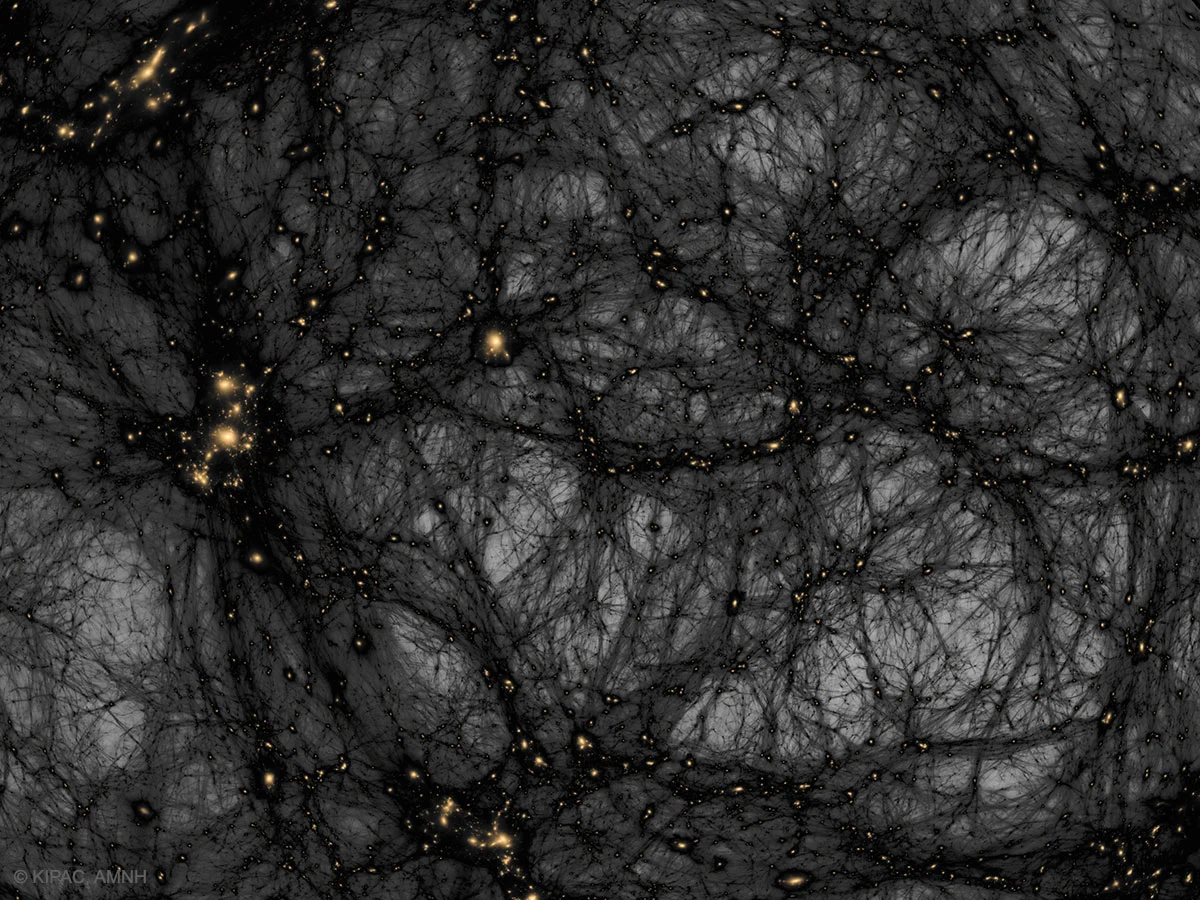
The Astronomy Picture of the Day (APOD), a daily initiative by NASA, recently featured a striking computer simulation of the universe’s matter distribution, casting light on the profound mysteries of dark matter and dark energy. This particular image, originating from the American Museum of Natural History’s Hayden Planetarium Space Show, "Dark Universe," visually represents the intricate, unseen scaffolding that dictates the cosmos’s structure and evolution. Far from being empty, the universe is dominated by these enigmatic components, which, despite their invisibility, exert immense gravitational influence, shaping everything from individual galaxies to the colossal cosmic web.
The featured simulation, depicting dark matter as complex, dark filaments akin to "spider webs" and ordinary baryonic matter as comparatively rare orange clumps, underscores a fundamental truth of modern cosmology: the universe we perceive with our senses and instruments—stars, planets, gas, and dust—constitutes merely a fraction of its total mass-energy content. The vast majority remains elusive, known only through its gravitational effects. This APOD entry serves as a potent reminder that our understanding of the cosmos is continually evolving, driven by observations that challenge and expand the boundaries of known physics.
The Enigma of Dark Matter: Unveiling the Invisible Architect
The concept of dark matter arose from persistent observational anomalies that could not be explained by the visible matter alone. The journey to its theoretical postulation began nearly a century ago, with early hints suggesting a significant "missing mass" in the universe.
Historical Context and Early Evidence:
The first compelling evidence for unseen mass emerged in the 1930s when Swiss astronomer Fritz Zwicky studied the Coma Cluster of galaxies. He observed that galaxies within the cluster were moving too rapidly to be held together by the gravitational pull of their visible mass. Zwicky calculated that the cluster must contain far more mass than could be accounted for by the luminous galaxies, coining the term "dunkle Materie" (dark matter). His findings, initially met with skepticism, laid the groundwork for future investigations.
Decades later, in the 1970s, American astronomer Vera Rubin, along with Kent Ford, provided crucial additional evidence by studying the rotation curves of spiral galaxies. They found that stars at the outer edges of galaxies orbited at unexpectedly high velocities, nearly as fast as those closer to the galactic centers. According to classical Newtonian gravity, if visible matter were the sole determinant of mass, stellar velocities should decrease with increasing distance from the galactic core, much like planets orbiting the Sun. The flat rotation curves observed by Rubin and Ford strongly implied the presence of a vast, invisible halo of matter extending far beyond the visible boundaries of galaxies, providing the necessary gravitational pull to keep the outer stars in orbit.
More recently, observations of galaxy clusters like the Bullet Cluster (1E 0657-56) have offered what many consider the most direct evidence for dark matter. This cluster collision revealed a clear separation between the hot, X-ray-emitting gas (baryonic matter) and the gravitational potential (inferred from gravitational lensing). The gas, which constitutes most of the visible mass, was slowed by drag during the collision, while the dominant mass—the dark matter—passed through relatively unimpeded, demonstrating that it interacts very weakly, if at all, with itself or with baryonic matter, save for gravity.
What is Dark Matter? A Cosmic Composition:
Dark matter is currently understood to be a hypothetical form of matter that does not emit, absorb, or reflect light or any other form of electromagnetic radiation. Its only known interaction is through gravity. This non-baryonic nature distinguishes it from ordinary matter (protons, neutrons, electrons), which makes up everything we can see and touch. According to the prevailing Lambda-CDM (Lambda-Cold Dark Matter) model, dark matter accounts for approximately 27% of the universe’s total mass-energy density, dwarfing the mere 5% attributed to baryonic matter.
The precise composition of dark matter remains one of the most significant unsolved puzzles in physics. Leading candidates for dark matter particles include:
- Weakly Interacting Massive Particles (WIMPs): Hypothetical particles with masses significantly greater than protons, interacting only through gravity and the weak nuclear force. This class of particles has been the focus of numerous direct detection experiments.
- Axions: Extremely light, hypothetical particles proposed to solve certain problems in quantum chromodynamics (QCD).
- Sterile Neutrinos: A theoretical type of neutrino that does not interact via the weak force, unlike the known "active" neutrinos.
- Primordial Black Holes: While once considered, current constraints suggest they would need to be of specific mass ranges, making them less favored as the primary component of dark matter.
Observational Pillars: Evidence for the Unseen:
Beyond galaxy rotation curves and cluster dynamics, several other cosmological observations unequivocally point to the existence of dark matter:
- Gravitational Lensing: The bending of light by massive objects, predicted by Einstein’s theory of general relativity, provides a powerful tool for mapping the distribution of total mass, including dark matter. Strong lensing, where distant galaxies are dramatically distorted into arcs or multiple images by foreground galaxy clusters, allows astronomers to infer the mass of the lensing object. Weak lensing, a more subtle distortion of many background galaxies, can map the distribution of dark matter across vast cosmic scales. These observations consistently reveal mass distributions that far exceed what can be accounted for by visible matter alone.
- Cosmic Microwave Background (CMB) Anisotropies: The CMB, the relic radiation from the Big Bang, provides a snapshot of the universe when it was only about 380,000 years old. Tiny temperature fluctuations (anisotropies) in the CMB reveal the initial density variations that eventually grew into galaxies and clusters. The pattern and amplitude of these fluctuations are exquisitely sensitive to the universe’s composition. Models that include dark matter accurately predict the observed CMB power spectrum, while models without it fail to match the data. Dark matter provided the necessary gravitational "seeds" for structure formation without interfering with the light and baryonic matter interactions of the early universe.
- Large-Scale Structure Formation: The universe is not uniformly distributed; it exhibits a "cosmic web" of galaxies and clusters connected by filaments, interspersed with vast voids. Computer simulations, such as the one featured by APOD, demonstrate that this large-scale structure can only form and evolve as observed if dark matter is the dominant gravitational component. Baryonic matter, due to its interaction with radiation in the early universe, would have been too smooth to form such structures on its own. Dark matter, being immune to electromagnetic forces, could begin clumping earlier, creating gravitational potential wells into which baryonic matter later fell.
The Cosmic Web: Simulating the Invisible Universe
The APOD image is a prime example of how sophisticated computer simulations have become indispensable tools in modern astrophysics. Since dark matter cannot be directly observed, these simulations allow scientists to model its gravitational behavior and its influence on the distribution of ordinary matter over billions of years.
Simulation Techniques and Insights:
Cosmological simulations like Illustris, Millennium, and Bolshoi—mentioned in links related to the original APOD explanation—start with initial conditions mimicking the early universe (based on CMB data). They then apply the laws of gravity and hydrodynamics to track the evolution of billions of particles representing dark matter and baryonic gas. The results are then compared with actual astronomical observations, such as the distribution of galaxies, the properties of galaxy clusters, and the statistics of gravitational lensing, to refine and validate the models.
The "Dark Universe" simulation vividly portrays the cosmic web, a vast, filamentary network of dark matter that pervades the universe. This network acts as the underlying skeleton of the cosmos. Galaxies and galaxy clusters are preferentially found at the intersections and along the filaments of this dark matter web, where the gravitational pull is strongest. The orange clumps representing baryonic matter in the simulation highlight this phenomenon: ordinary matter coalesces in the gravitational potential wells created by the invisible dark matter. Voids, vast regions with very few galaxies, are the spaces between these filaments, where dark matter density is lowest.
These simulations are not merely illustrative; they are powerful predictive tools. They allow cosmologists to test different dark matter candidates and their properties, providing insights into how the universe’s structure originated and evolved from a relatively smooth early state to the complex, hierarchical arrangement we observe today. The statistical matches between these simulations and astronomical observations are remarkably good, reinforcing the current understanding of dark matter’s pivotal role.
The Rise of Dark Energy: A Repulsive Force
While dark matter addresses the "missing mass" problem, an even more profound mystery emerged in the late 1990s: the accelerating expansion of the universe, driven by what is now termed dark energy.
The Discovery of Cosmic Acceleration:
Prior to 1998, the prevailing cosmological view held that the universe’s expansion, set in motion by the Big Bang, must be gradually slowing down due to the collective gravitational pull of all matter within it. The key question was whether the universe would eventually halt its expansion and recollapse (a "Big Crunch") or continue expanding indefinitely, albeit at a decelerating rate.
The answer came from independent teams of astronomers—the Supernova Cosmology Project, led by Saul Perlmutter, and the High-Z Supernova Search Team, led by Brian Schmidt and Adam Riess. They were studying Type Ia supernovae, a specific type of exploding star known as "standard candles" because they have a consistent peak luminosity. By measuring their apparent brightness, astronomers can accurately determine their distance. By also measuring their redshift, they can determine the rate at which the universe expanded in the past.

The groundbreaking discovery, for which Perlmutter, Schmidt, and Riess were awarded the Nobel Prize in Physics in 2011, was that distant Type Ia supernovae were fainter than expected. This implied they were farther away than predicted by a decelerating universe. The only logical conclusion was that the universe’s expansion was not slowing down but was, in fact, accelerating.
What is Dark Energy? A Cosmic Enigma:
Dark energy is an even more mysterious component than dark matter. It is characterized as a uniform, pervasive form of energy that exerts a repulsive gravitational force, effectively pushing space apart. Unlike dark matter, which clumps gravitationally and helps form structures, dark energy is thought to be smoothly distributed throughout the cosmos, acting as a constant pressure.
The dominant hypothesis for dark energy is the cosmological constant (Lambda), first introduced by Albert Einstein but later discarded as his "biggest blunder." In this view, dark energy is an intrinsic property of space itself—the energy of the vacuum. As space expands, more space is created, leading to more dark energy, which in turn drives further expansion. Other theoretical models include quintessence, a dynamic field whose energy density can change over time.
Dark energy is estimated to constitute a staggering 68% of the universe’s total mass-energy density, making it the dominant component of our cosmos. Its influence became significant relatively recently in cosmic history, around 5-6 billion years ago, as the universe expanded and its density of matter (both baryonic and dark) diluted, allowing the constant energy density of dark energy to take over.
Implications for the Universe’s Fate:
The discovery of dark energy fundamentally altered our understanding of the universe’s ultimate destiny. Instead of a potential "Big Crunch" or a perpetually decelerating expansion, the accelerating expansion driven by dark energy points towards a "Big Freeze" or "Heat Death." In this scenario, galaxies will continue to recede from each other at an ever-increasing rate, eventually disappearing beyond our observable horizon. The universe will become increasingly cold, dilute, and empty, with individual galaxies and stars slowly dying out as their energy is dispersed. While the extreme "Big Rip" scenario, where dark energy becomes so potent it tears apart even atoms, is less favored by current data, the future of the cosmos appears to be one of cold, lonely expansion.
The Standard Model of Cosmology: Lambda-CDM
The insights gained from the study of dark matter and dark energy have coalesced into the prevailing theoretical framework for understanding the universe: the Lambda-Cold Dark Matter (Lambda-CDM) model. This model, considered the standard model of cosmology, posits a universe composed of approximately 5% baryonic matter, 27% cold dark matter, and 68% dark energy (represented by the cosmological constant, Lambda).
Integration and Successes:
The Lambda-CDM model successfully explains a vast array of cosmological observations, including:
- The large-scale structure of the universe (the cosmic web).
- The anisotropies in the Cosmic Microwave Background radiation.
- The abundance of light elements formed during Big Bang nucleosynthesis.
- The expansion history of the universe, including its current acceleration.
- The statistics of galaxy clusters and gravitational lensing.
It provides a coherent narrative for the evolution of the universe from the Big Bang to its present state, describing how initial quantum fluctuations grew into the complex cosmic structures we observe today, guided by the gravitational hand of dark matter and accelerated by the repulsive force of dark energy.
Limitations and Unanswered Questions:
Despite its remarkable successes, the Lambda-CDM model is fundamentally phenomenological. It describes what dark matter and dark energy do, but not what they are. This represents a significant gap in our understanding of fundamental physics. The nature of these dominant cosmic constituents remains unknown, prompting intense theoretical and experimental efforts worldwide. Are they new particles? New forces? Or do they hint at modifications to Einstein’s theory of gravity itself on cosmic scales? These are the questions that define the cutting edge of modern cosmology.
Challenges and Future Directions: Probing the Cosmic Unknowns
The quest to unravel the mysteries of dark matter and dark energy is a global scientific endeavor, employing a diverse array of experimental and observational techniques.
Experimental Efforts for Dark Matter:
Scientists are pursuing multiple avenues to directly or indirectly detect dark matter particles:
- Direct Detection Experiments: Laboratories deep underground, shielded from cosmic rays, host sensitive detectors designed to observe the faint recoil of an atomic nucleus if a WIMP were to collide with it. Projects like LUX-ZEPLIN (LZ), XENONnT, and PandaX, located in former mines or mountain tunnels, are pushing the limits of sensitivity, though a definitive detection remains elusive.
- Indirect Detection Experiments: These experiments search for the annihilation or decay products of dark matter particles in space. If dark matter particles collide with each other, they might produce observable particles like gamma rays, neutrinos, or antimatter. Space telescopes like the Fermi Gamma-ray Space Telescope and the Alpha Magnetic Spectrometer (AMS-02) on the International Space Station are searching for these signatures.
- Collider Searches: Particle accelerators like the Large Hadron Collider (LHC) at CERN attempt to produce dark matter particles in high-energy collisions. If dark matter particles are created, they would escape the detectors unseen, leaving behind a characteristic "missing energy" signature.
Observational Missions for Dark Energy:
Understanding dark energy requires even more precise measurements of the universe’s expansion history and large-scale structure:
- Space Telescopes: Upcoming missions like the European Space Agency’s Euclid mission and NASA’s Nancy Grace Roman Space Telescope (formerly WFIRST) are specifically designed to map billions of galaxies across vast cosmic distances, precisely measuring their positions and redshifts. By studying gravitational lensing and the distribution of galaxies, these telescopes will provide unprecedented data to constrain the properties of dark energy.
- Ground-Based Surveys: Projects such as the Vera C. Rubin Observatory (formerly LSST) will conduct deep and wide-field surveys of the sky, cataloging billions of celestial objects and enabling detailed studies of weak gravitational lensing and Type Ia supernovae.
- Cosmic Microwave Background (CMB) Experiments: Next-generation CMB experiments like the Simons Observatory and CMB-S4 aim to measure the CMB with even greater precision, providing crucial insights into the early universe and its dark components.
Theoretical Frameworks:
Alongside experimental and observational efforts, theoretical physicists continue to explore alternative explanations. These include modifications to Einstein’s theory of general relativity on cosmological scales (e.g., f(R) gravity), models involving extra dimensions, or connections to quantum gravity theories. The interplay between theory, observation, and experiment is vital in advancing our knowledge.
Broader Impact and Implications
The existence of dark matter and dark energy represents one of the most significant revolutions in fundamental physics and cosmology in decades. It underscores that our current Standard Model of Particle Physics, which successfully describes all known forces and particles except gravity, is incomplete. The universe is far more complex and mysterious than once imagined, with the familiar baryonic matter being a mere afterthought in the grand cosmic scheme.
Understanding these hidden components is not just an academic exercise; it is crucial for comprehending the entire narrative of cosmic evolution. From the initial moments after the Big Bang, through the formation of the first stars and galaxies, to the accelerating expansion that will dictate the universe’s ultimate fate, dark matter and dark energy have played, and continue to play, the dominant roles. Their elucidation promises to unlock new physics, potentially leading to a more unified theory of everything.
For humanity, these discoveries reinforce our position within a vast and largely unknown cosmos. Initiatives like NASA’s APOD are vital bridges, bringing these profound scientific frontiers to the public, inspiring curiosity, and fostering a deeper appreciation for the ongoing quest to understand the universe we inhabit. The "haunting" presence of dark matter and the pervasive influence of dark energy serve as a testament to the boundless mysteries that still await discovery, propelling astronomers and physicists toward the next era of cosmic revelation.