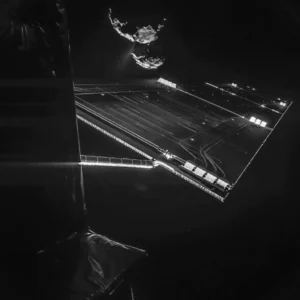



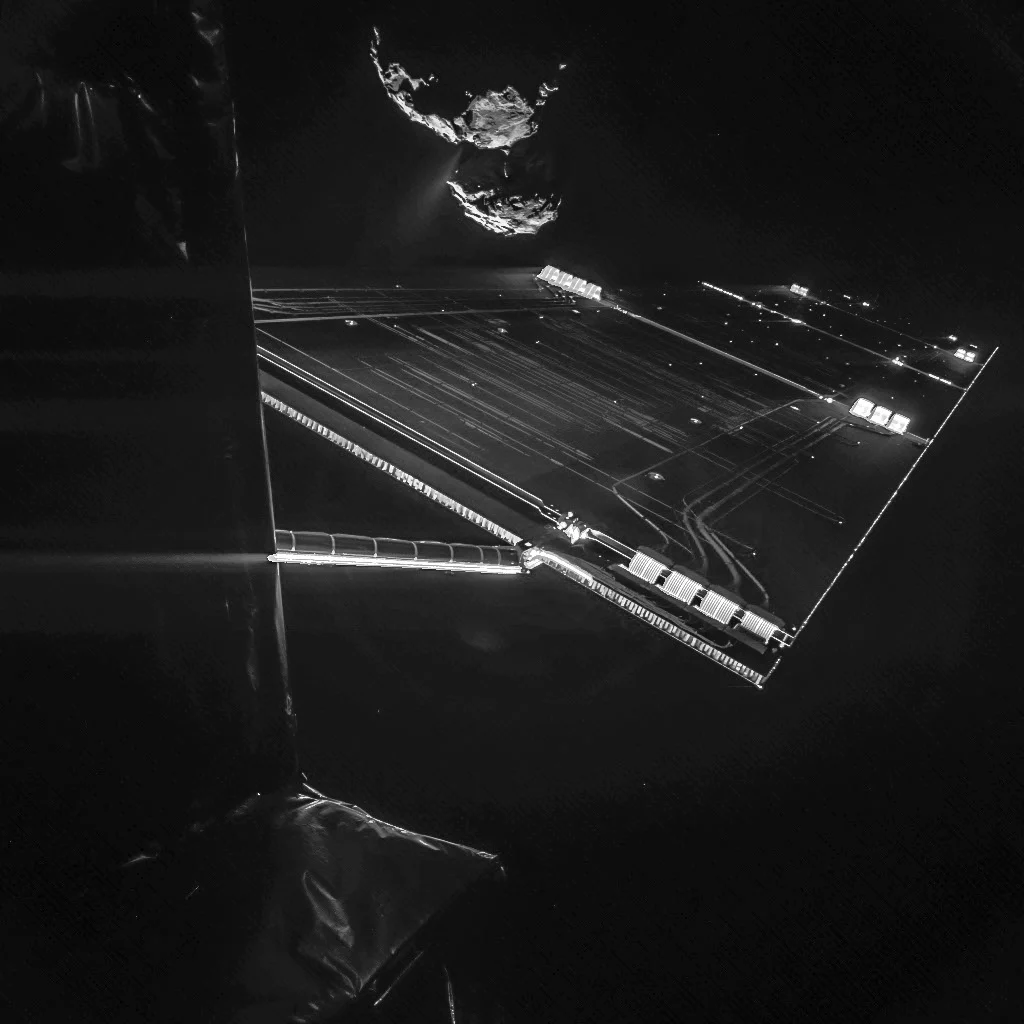
On October 7, 2014, a unique and iconic "selfie" was captured by the European Space Agency’s (ESA) Rosetta spacecraft, providing an unprecedented view of humanity’s ambitious endeavor to explore the primordial depths of our solar system. This remarkable image, featuring one of Rosetta’s colossal solar arrays starkly contrasted against the enigmatic nucleus of Comet 67P/Churyumov-Gerasimenko, was taken while the spacecraft was a staggering 472 million kilometers from Earth, yet an astonishingly close 16 kilometers from its celestial target. The photograph, a testament to intricate engineering and scientific curiosity, was snapped by the CIVA camera system mounted on the Philae lander, which was still attached to its mothership just weeks before its historic separation and descent.
The Genesis of a Grand Mission: Unveiling Cosmic Origins
The Rosetta mission, a cornerstone of ESA’s scientific program, represented a monumental leap in cometary exploration. Launched on March 2, 2004, from Kourou, French Guiana, aboard an Ariane 5 rocket, Rosetta embarked on a decade-long journey through the inner solar system, utilizing gravity assists from Earth and Mars to gain momentum and set its course for Comet 67P. The primary objectives of the mission were multifaceted: to study the comet’s nucleus and environment for an extended period, observe its evolution as it approached the Sun, and, crucially, to deploy a lander (Philae) onto its surface for in-situ analysis. Scientists believed that comets, pristine remnants from the formation of our solar system 4.5 billion years ago, hold vital clues about the conditions prevalent in the early protoplanetary disk, including the origin of Earth’s water and the building blocks of life.
Rosetta’s journey was not without its challenges. After its launch, the spacecraft performed three Earth flybys (2005, 2007, 2009) and one Mars flyby (2007) to gain the necessary velocity. In June 2011, Rosetta entered a deep-space hibernation to conserve power during the coldest, most distant leg of its voyage, awakening dramatically in January 2014, signaling its readiness for the final approach to Comet 67P. This meticulous navigation and precise orbital mechanics demonstrated the peak of European space engineering capabilities, setting the stage for the unprecedented rendezvous.
The Rendezvous: A Comet Revealed
Rosetta successfully achieved rendezvous with Comet 67P/Churyumov-Gerasimenko in August 2014, becoming the first spacecraft in history to orbit a comet. This achievement marked the culmination of years of planning and execution, ushering in a new era of cometary science. Immediately, the spacecraft began to send back breathtaking images of 67P’s peculiar double-lobed nucleus, which quickly earned it the affectionate moniker of "rubber ducky" due to its distinctive shape. This unusual morphology suggested a violent past, possibly the gentle merger of two separate cometesimals in the early solar system, or the result of intense erosion.
The initial close-up observations from Rosetta’s suite of 11 instruments began to unravel the comet’s secrets. Scientists mapped its surface, analyzed its tenuous atmosphere (coma) and dust trails, and measured its temperature and composition. The findings were immediate and profound, revealing a dark, dusty surface covered in primordial ice and organic compounds. The data gathered during this orbital phase was critical, not only for understanding the comet itself but also for selecting a suitable landing site for the Philae probe. The comet, roughly 4.3 kilometers at its longest dimension, presented a formidable challenge with its rugged terrain, varying gravity fields, and active outgassing.
The Iconic Selfie: A Moment of Proximity and Precision
The photograph taken on October 7, 2014, quickly transcended its technical origins to become one of the most memorable images in space exploration history. Dubbed a "selfie," it was far from a casual snapshot. The image was meticulously planned and executed using the Comet Infrared and Visible Analyser (CIVA) camera system, part of the scientific payload on the Philae lander. Philae, still firmly attached to Rosetta, extended a boom arm with the CIVA camera, carefully positioning it to capture a wide-angle view that included a portion of Rosetta’s massive 14-meter-long solar array in the foreground, with the comet’s nucleus dramatically filling the background.
The technical challenge of capturing such a scene cannot be overstated. The immense contrast between the brightly sunlit solar array and the much dimmer, distant comet nucleus required advanced imaging techniques. To overcome this, the CIVA system captured two exposures – one short and one long – which were then expertly combined to create a single, high-dynamic-range image. This composite perfectly rendered both the dazzling glint off Rosetta’s metallic surface and the subtle details of the comet’s rough, active surface, where dust and gas were visibly streaming away as it began its approach towards the Sun.

Officials at the European Space Agency hailed the image as a powerful symbol of the mission’s success and the incredible proximity achieved. "This ‘selfie’ was more than just a picture; it was a testament to the precision engineering and navigation that brought Rosetta so close to its target," stated a mission spokesperson at the time, underscoring the unprecedented nature of orbiting and preparing to land on such a dynamic celestial body. The image conveyed both the scale of the spacecraft and the alien beauty of its destination, captivating audiences worldwide and generating immense public interest in the mission’s next critical phase.
Philae’s Bold Descent: A Pioneering Landing Attempt
The selfie served as a poignant visual prelude to one of the most audacious maneuvers in space history: the deployment of the Philae lander. On November 12, 2014, just over a month after the iconic photograph was taken, Philae separated from Rosetta at 08:35 UTC, embarking on a seven-hour, nerve-wracking descent to the surface of Comet 67P. Its chosen primary landing site, named Agilkia, was located on the smaller lobe of the double-lobed nucleus, a region carefully selected for its scientific potential and perceived safety. The selfie provided a final, close-up perspective from Philae’s camera looking back towards the orbiter before it began its independent journey towards the comet.
Philae’s mission was to anchor itself to the comet’s surface using harpoons and drills, then conduct a battery of scientific experiments, including drilling into the subsurface to analyze its composition, measuring temperature and electrical properties, and studying the comet’s internal structure. However, the landing proved to be far more complex than anticipated. Due to an unforeseen malfunction, Philae’s harpoons failed to fire upon first contact, causing the lander to bounce twice before finally coming to rest in a shadowed, irregular terrain far from its intended target.
Despite the challenging landing, Philae managed to operate for approximately 60 hours, collecting and transmitting an extraordinary amount of data before its primary battery depleted and it entered a silent state. The data gathered during this brief operational period provided invaluable insights into the comet’s surface properties, confirming the presence of organic molecules and revealing a surprisingly hard, icy interior beneath a layer of dust. The mission control teams, though disappointed by the imperfect landing, expressed immense satisfaction with the scientific bounty achieved under such extreme circumstances.
Scientific Legacy and Broader Implications
The Rosetta mission, encompassing both the orbiter and the Philae lander, profoundly reshaped our understanding of comets and, by extension, the early solar system. Among its most significant discoveries were:
- Comet Water Composition: Rosetta’s ROSINA instrument found that the ratio of deuterium to hydrogen (D/H) in Comet 67P’s water vapor was significantly different from Earth’s oceans. This finding challenged the prevailing theory that comets were the primary source of Earth’s water, suggesting instead that a combination of sources, including asteroids, played a more dominant role.
- Organic Molecules: Both Rosetta and Philae detected a wide array of complex organic molecules, including several never before found on a comet, such as amino acid precursors. This strengthened the hypothesis that comets could have delivered the chemical building blocks necessary for life to early Earth.
- Comet Activity Mechanisms: Rosetta provided unprecedented detail on how comets become active as they approach the Sun, observing jets of gas and dust erupting from specific regions, driven by subsurface ice sublimation. It revealed that the activity was localized and driven by specific geomorphological features.
- Comet Formation: The double-lobed shape of 67P and its physical characteristics provided strong evidence for the gentle accretion of two distinct bodies in the early solar system, offering clues about the conditions and processes that led to the formation of planets.
- Long-Term Evolution: Rosetta observed 67P for over two years, witnessing its evolution from a relatively dormant body far from the Sun to an active, outgassing object at perihelion (closest approach to the Sun) and back again. This long-term monitoring yielded critical data on cometary evolution.
The mission concluded on September 30, 2016, with a controlled descent of the Rosetta orbiter onto the surface of Comet 67P, ensuring that its instruments could gather final, ultra-close-up data before its operational life ended. This bold finale, much like the entire mission, pushed the boundaries of space exploration.
The Rosetta mission stands as a monumental triumph of international collaboration and scientific ambition. It demonstrated humanity’s capability to intercept, orbit, and even attempt to land on a cometary nucleus, millions of kilometers away. The data gathered continues to be analyzed by scientists worldwide, yielding new insights into our cosmic heritage. The iconic selfie of October 7, 2014, remains a powerful visual reminder of this extraordinary journey, a symbol of human ingenuity reaching out to touch the ancient fragments of our solar system and unravel its deepest secrets. It etched into public consciousness the image of a robotic explorer, a surrogate for humanity, poised on the brink of unprecedented discovery, forever changing our perspective on these enigmatic celestial wanderers.