


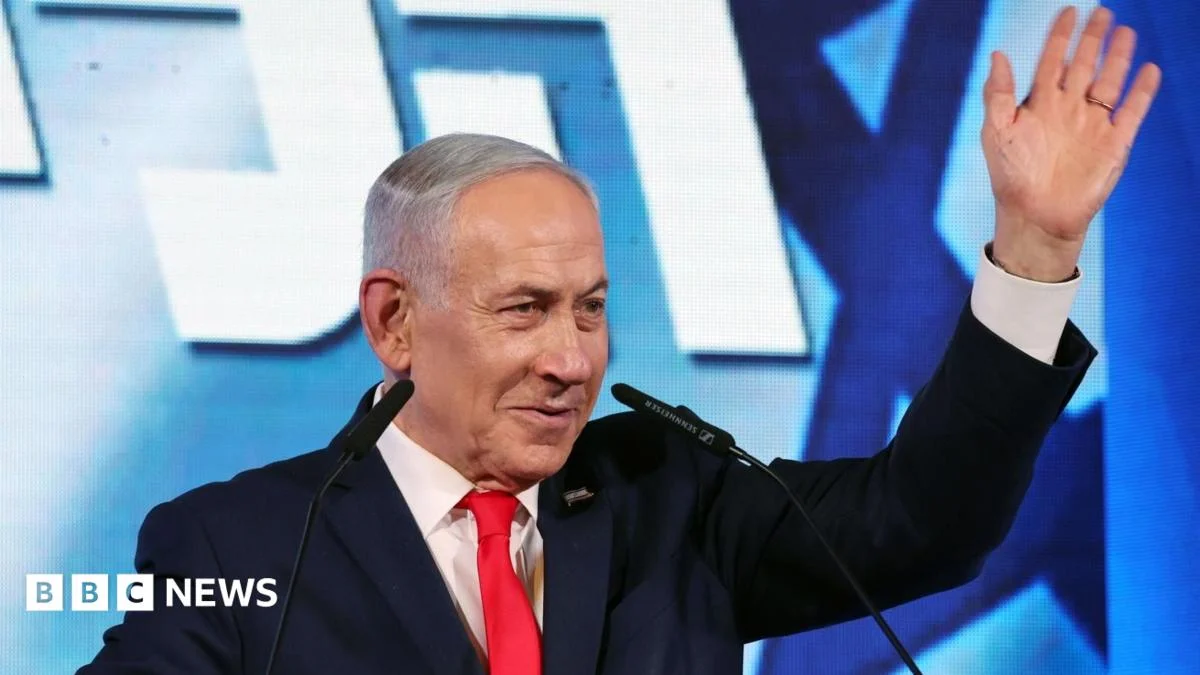
Partial results from Israel’s general election indicate that veteran Prime Minister Benjamin Netanyahu is leading his rival, former military chief Gadi Eisenkot, yet remains short of a clear majority in the 120-seat Knesset, setting the stage for potentially protracted and complex coalition negotiations. With approximately 85% of ballots tallied, Netanyahu’s Likud party, aligned with its traditional far-right and ultra-Orthodox Jewish partners, appeared poised to secure 53 seats. In contrast, Eisenkot’s centrist Yashar party and its bloc of three other Jewish opposition parties were projected to win 48 seats. Both prominent leaders have publicly declared their intent to undertake the challenging task of forming a governing coalition, underscoring the fragmented political landscape. A crucial and unprecedented development in this election is the projected performance of Arab-led parties, which are on track to secure 19 seats, potentially positioning them as indispensable kingmakers. However, this prospect is fraught with tension, as nearly all Jewish parties across the political spectrum have explicitly ruled out forming a government that relies on their support. The final outcome remains uncertain, with between 430,000 and 480,000 absentee ballots—including those from soldiers, diplomats, and hospital patients—still awaiting tabulation. This substantial number of uncounted votes means that definitive election results could take another day or two to materialize. Once the final figures are confirmed, President Isaac Herzog will initiate consultations with all elected political factions, a customary procedure designed to identify the leader with the most viable path to assembling a stable government. This intricate process could extend over several weeks, and if it ultimately fails, Israel could face the prospect of yet another snap election, continuing a cycle of political instability that has characterized the nation’s recent history.
A Nation at a Crossroads: The Post-October 7 Landscape
This election, held on Tuesday, marks a pivotal moment for Israel, being the first national vote since the devastating Hamas-led attacks on October 7, 2023, and the subsequent protracted conflicts in Gaza, Lebanon, and the broader regional repercussions involving Iran. The gravity of the election was palpable across the country, with many Israelis viewing it as one of the most consequential in the nation’s history. Beyond merely deciding who would lead the country, the vote was seen as a referendum on Israel’s future trajectory, particularly concerning its increasingly hard-line, religious-nationalist direction.
Key campaign issues dominated public discourse and voter sentiment. Foremost among these was accountability for the profound security failures that allowed the October 7 attacks to occur, which resulted in the deaths of approximately 1,200 people and the abduction of 251 others. The conduct and strategic objectives of the ongoing regional wars, particularly in Gaza, also weighed heavily on voters’ minds. Domestic issues such as the contentious debate over conscripting ultra-Orthodox Jewish men into the military—a long-standing point of contention between secular and religious factions—and proposed judicial reforms that have sparked widespread protests in previous years, were also central. Furthermore, Israel’s international standing, which has been significantly impacted by the recent conflicts and its evolving diplomatic relations, was a major concern for many citizens.
The election results and the subsequent coalition negotiations will profoundly shape how these critical issues are addressed, potentially altering Israel’s internal cohesion and its geopolitical posture.
Chronology of a Tense Election Night
The night of the election was marked by shifting narratives and palpable tension, reflecting the deep divisions within Israeli society. Initial exit polls, released immediately after polling stations closed by three major Israeli broadcasters, presented a picture initially favoring Gadi Eisenkot’s "Change Bloc." These early projections suggested Eisenkot’s bloc would secure between 52 and 53 seats in the Knesset, narrowly outperforming Netanyahu’s bloc, which was predicted to win around 50 seats.
Buoyed by these initial projections, Eisenkot swiftly declared victory, telling supporters at Yashar’s election headquarters in Tel Aviv that the public had "spoken in favour of change." He asserted, "The coalition of failure has lost the people’s trust," and pledged to "work with my partners to ensure that the people’s decision is translated into a Zionist government." This early declaration set an optimistic tone for his camp.
However, the political drama quickly intensified as broadcasters began to update their exit polls later in the evening. Two of the three major channels revised their projections, indicating a tie between the rival blocs, each estimated to secure 51 seats. The third broadcaster, in a significant shift, then projected a narrow three-seat lead for Netanyahu’s bloc.
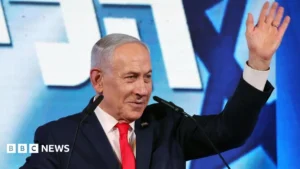
Seizing on this revised outlook, Benjamin Netanyahu made a triumphant appearance at Likud’s headquarters in Jerusalem. He declared that his right-wing bloc had won a "great majority," a statement met with fervent applause from his supporters. Netanyahu underscored his vision for the country, stating, "We must put in place a strong right-wing national government. It is forbidden, simply forbidden, to endanger Israel by forming a government that relies on anti-Zionist Arab parties." This statement immediately signaled the deep ideological chasm that would complicate any potential cross-bloc negotiations.
As the actual vote count progressed throughout Wednesday, it became clear that Netanyahu’s bloc had performed even better than the updated exit polls had suggested. The current projection of 53 seats represents a significant improvement on the initial exit poll figures, though it is still 15 seats fewer than his bloc controlled in the previous Knesset, highlighting a degree of erosion in his traditional support base despite the lead. This shifting landscape from exit polls to actual results underscored the volatility and uncertainty inherent in Israel’s complex electoral system.
The Contenders: Ideological Divides and Coalition Prospects
The election has once again exposed the profound ideological fissures that define Israeli politics, primarily between Benjamin Netanyahu’s right-wing, religious-nationalist bloc and the more centrist-left opposition led by Gadi Eisenkot.
Netanyahu’s Bloc: The Hardline Right
Benjamin Netanyahu’s enduring political career is inextricably linked to the Likud party, which he has led for decades. His bloc comprises Likud, a dominant force in right-wing Israeli politics, alongside several far-right and ultra-Orthodox Jewish parties. These allies typically advocate for a hawkish security stance, expanded Jewish settlement in the West Bank, and a strong emphasis on Jewish religious law in public life. Their core platform often includes resistance to a two-state solution and a robust defense of Israel’s national security interests, particularly in the face of perceived threats from its Arab neighbors and Iran. Netanyahu’s strong rhetoric against relying on Arab parties for governance reflects a long-held political strategy aimed at solidifying his right-wing base and preventing any perceived concessions to Palestinian interests. The 53 seats projected for his bloc, while a leading number, fall short of the 61-seat majority required to form a government independently, forcing him into a delicate dance of negotiation.
Eisenkot’s Bloc: The Quest for Change
Gadi Eisenkot, a former military chief of staff, entered the political arena on a platform centered on "change," accountability, and a more moderate approach to governance. His Yashar party, along with other Jewish opposition parties in his bloc, represents a more diverse ideological spectrum, ranging from centrist to left-leaning. Their campaign focused heavily on addressing the failures leading to October 7, restoring national unity, and potentially re-evaluating some of the previous government’s policies, particularly judicial reforms. Eisenkot has previously articulated conditions for any alliance, including explicit recognition of Israel as both Jewish and democratic, and a clear stance against Hamas as a terrorist organization that must be dismantled. These conditions, while seemingly fundamental, can become points of contention in the intricate process of coalition building, especially when considering alliances with Arab parties or even some elements within his own diverse bloc. The challenge for Eisenkot lies in uniting these disparate elements to present a coherent alternative to Netanyahu’s long-standing dominance.
The Arab Parties: From Margins to Potential Kingmakers
One of the most significant and potentially transformative outcomes of this election is the unprecedented surge in representation for Arab-led parties. Currently projected to win 19 seats, nearly doubling their previous presence, these parties could emerge as a powerful and indispensable bloc in the formation of the next government. This surge is largely attributed to a remarkable increase in turnout among Arab Israelis, who constitute approximately a fifth of the country’s population and often identify themselves as Palestinian citizens of Israel.
Mahdi Kabaha, a prominent activist from the Arab-majority city of Umm al-Fahm who spearheaded efforts to mobilize the Arab vote, described the result as "historic." He emphasized the clear message from Arab citizens: "Arab citizens came out and said clearly: we want a real say in this country." This sentiment underscores a growing desire within the Arab community to influence national policy and challenge their historical marginalization.
Yousef Jabareen, the head of the Joint List—one of the leading Arab parties—told the BBC that a significant motivator for Arab voters was the opportunity to oust far-right National Security Minister Itamar Ben-Gvir from office. Jabareen vehemently accused Ben-Gvir of racism and "provocation against our community," highlighting the deep animosity felt towards his policies.
Itamar Ben-Gvir, the leader of the Jewish Power party and a key ally of Netanyahu, is a highly controversial figure whose platform includes the annexation of the occupied West Bank, the promotion of Jewish settlement in Gaza, and the "voluntary emigration" of Palestinians. His extreme views have led several Western countries to impose sanctions on him for incitement against Palestinians, making him a divisive figure both domestically and internationally.
The prospect of Arab parties playing a decisive role has opened a complex debate within the opposition. Mansour Abbas, leader of the United Arab List (UAL), who notably served in a short-lived governing coalition after the 2021 elections—a groundbreaking moment in Israeli politics—expressed optimism on election night. He stated his hope that "the numbers will work out and we, the Change Bloc and the UAL, can ensure that there are 61 Knesset seats." This indicates a clear willingness from the UAL to engage in coalition talks.
Yair Golan, leader of the left-wing Democrats party and a member of Eisenkot’s bloc, publicly appealed to his partners, recognizing an "opportunity to form a change government in partnership" with the Arab parties to replace Netanyahu’s coalition. Writing on X (formerly Twitter), Golan stressed the imperative to overcome historical prejudices: "We have no future here if we don’t stop being afraid. And if we don’t put an end to racism."
However, the path to such an alliance is fraught with obstacles. Eisenkot himself has previously raised objections or attached stringent conditions to any alliance with Arab parties, including the explicit recognition of Israel as a Jewish and democratic state and the unequivocal declaration of Hamas as a terrorist organization. Furthermore, the right-wing parties within his own bloc have flatly rejected the idea of partnering with Arab parties, creating internal friction.
Jabareen, from the Joint List, remained firm on the Arab parties’ position, stating, "The opposition parties cannot dictate any conditions. If the opposition in Israel are willing to afford real and substantive change, and an alternative for the dangerous, extreme-right-wing government… they will have to negotiate with us." This stance sets the stage for potentially tough negotiations, as Arab parties demand a seat at the table on equal terms, challenging long-held political taboos.
Voices from the Electorate: Frustration and Fear
The election results have resonated deeply across Israeli society, eliciting a range of emotions from hope and relief to disappointment and fear, often reflecting personal experiences and ideological convictions.
Avigail Levine, a resident of Kfar Saba who voted for former prime minister Naftali Bennett’s opposition Beyachad party, expressed profound disappointment with the preliminary election results. "I was hoping for new leadership. I feel we need it as a nation," she told the BBC, articulating a widespread desire for a fresh start. Her sentiment was particularly acute regarding accountability for the October 7 attacks. "The people in power on 7 October should not be in power now," she asserted, echoing a common frustration that Benjamin Netanyahu had not shouldered direct responsibility for the catastrophic security failures that day. For Levine, the issue was deeply personal; her husband’s grandmother was among the victims who tragically died in Kibbutz Be’eri, one of the communities devastated by the Hamas onslaught.
Conversely, Gal from Ramat Gan articulated the security concerns that drove many to support Netanyahu. He stated that he voted for the incumbent prime minister because Israelis "cannot relax and live in peace with neighbours when all they want is to erase us from the map." This perspective reflects a prevalent belief among many right-wing voters that only a strong, uncompromising leadership can guarantee Israel’s survival in a hostile region. Gal also voiced apprehension regarding the growing influence of Arab political parties, stating he was "afraid of the strengthening of the Arab political parties," a sentiment that underlines the deep-seated mistrust and communal divisions within the country. These contrasting views highlight the profound ideological and security-based anxieties that shaped the voting behavior of a deeply polarized electorate.
Allegations of Electoral Misconduct
Adding a layer of controversy to an already fraught election, Netanyahu’s Likud party made unsubstantiated claims on Wednesday, alleging that the election had been "stolen." The party specifically accused Arab parties of resorting to "bribery, threats, violence, fraud and the use of prohibited software to encourage voters," without providing any concrete evidence to support these serious allegations. The Central Elections Committee, the independent body responsible for overseeing the integrity of the electoral process, promptly announced that it would examine the claims as part of its standard post-election review. Such allegations, even without immediate substantiation, can further erode public trust in democratic institutions and exacerbate existing political tensions, particularly in a climate of intense polarization.
Implications and the Road Ahead
The path to forming a stable government in Israel is rarely straightforward, and this election, with its fragmented results and deep ideological divides, promises to be particularly challenging. The 120-seat Knesset requires a minimum of 61 seats for a governing coalition. With neither of the two major blocs currently achieving this threshold, the political future hinges on intricate negotiations and the potential for unprecedented alliances.
Presidential Consultations and Coalition Building:
Once the final, official results are confirmed, President Isaac Herzog will embark on the constitutional process of holding consultations with the leaders of all elected political factions. During these meetings, each party leader will recommend to the President the candidate they believe has the best chance of forming a viable government. Based on these recommendations and his own assessment of the political landscape, the President will then task a designated leader—most likely Netanyahu or Eisenkot—with the mandate to assemble a coalition. This process typically takes several weeks, during which intense horse-trading, concessions, and ideological compromises are negotiated behind closed doors.
Potential for Instability and Another Election:
Israel has a history of political instability, marked by frequent elections and short-lived governments. The current scenario, where Arab parties hold significant leverage but are largely shunned by Jewish parties, could lead to a protracted stalemate. If the initial designated leader fails to form a government within the allotted timeframe (typically 28 days, with a possible 14-day extension), the mandate can be passed to another leader, or even back to the Knesset. Should all attempts fail, the country would ultimately be forced to hold another election, perpetuating a cycle that has seen five elections in less than five years prior to this one.
Policy Implications:
The composition of the next government will have profound implications for Israel’s domestic and foreign policies. A Netanyahu-led government, reliant on far-right and ultra-Orthodox parties, would likely continue its hardline stance on security, potentially pursuing further judicial reforms that could challenge the Supreme Court’s authority, and maintaining existing policies regarding West Bank settlements. This could further strain relations with key international allies and escalate tensions with Palestinians. Conversely, a government led by Eisenkot, potentially with the support of Arab parties, could seek a more moderate approach, focusing on national unity, internal reforms, and a potentially more flexible diplomatic strategy, though its ability to enact significant shifts would depend on the ideological diversity of its coalition partners.
Regional and International Standing:
The global community will be closely watching Israel’s political developments. In the aftermath of the October 7 attacks and the ongoing Gaza conflict, Israel’s international standing is under intense scrutiny. A government perceived as extreme or unwilling to engage in peace efforts could face increased diplomatic isolation and pressure. Conversely, a more inclusive and moderate government might find greater international support. The implications for the broader Middle East, particularly regarding relations with Arab states that have normalized ties with Israel, and the ongoing tensions with Iran, are substantial.
This election, held at a critical juncture in Israel’s history, has not delivered a clear mandate, instead ushering in a period of complex political maneuvering. The ultimate outcome will not only determine who leads Israel but will also shape its identity, its internal dynamics, and its role on the global stage for years to come.