Venezuelan opposition leader María Corina Machado has made a dramatic return to her homeland, ending a more than ten-month period of exile and immediately re-entering a deeply polarized and fraught political landscape. Her arrival on Sunday, confirmed via social media and by her close allies, marks a significant moment in Venezuela’s protracted struggle for democratic transition, raising both hopes and uncertainties for the nation’s future.
"I am here. With you," Machado declared on X (formerly Twitter) on Sunday, her message resonating with a base of supporters who have long championed her as a symbol of resistance against the ruling government. Her return follows numerous prior attempts to re-enter the country, each met with official obstruction and denial, underscoring the precarious nature of political dissent in Venezuela.
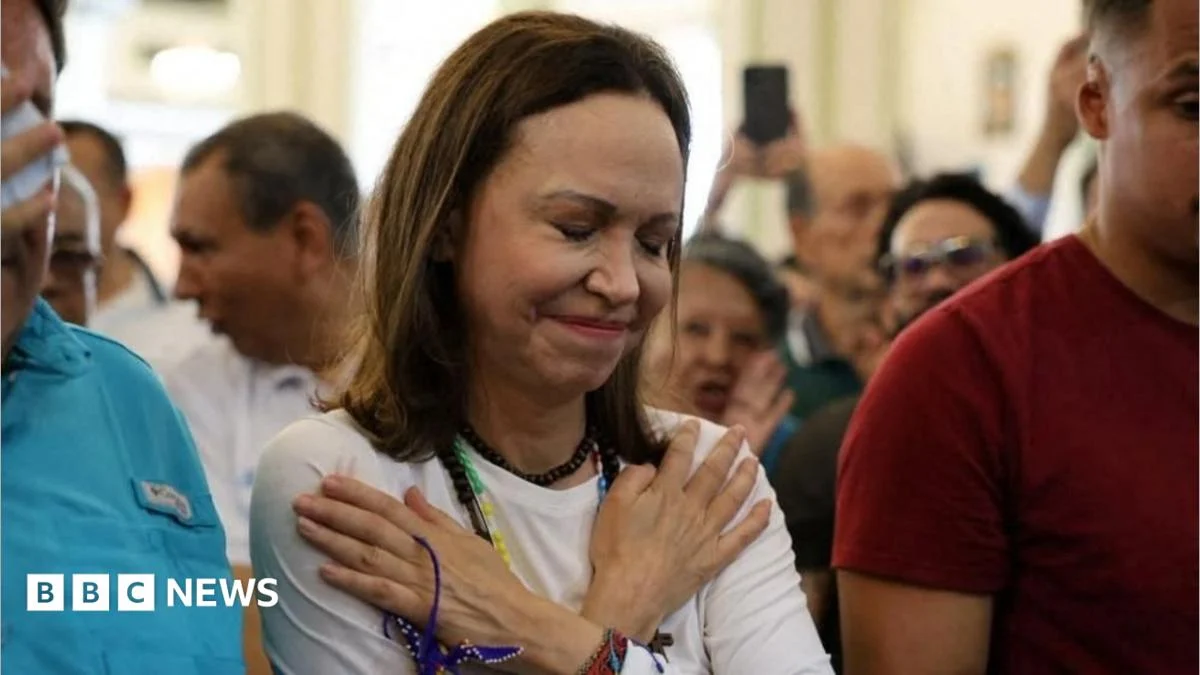
Machado was photographed attending Mass at a church in the Venezuelan state of Lara, visibly moved as she was embraced by a crowd of fervent supporters. From Lara, she embarked on a journey towards the capital, Caracas, in a caravan that rapidly grew in size, with more supporters lining the route, eager to catch a glimpse of the returning figurehead. Her ally, former presidential candidate Edmundo González, was among the first to officially confirm her presence on Venezuelan soil. "I am thrilled to announce to you that our leader, my dear María Corina, is on Venezuelan soil," González stated, emphasizing the profound symbolic weight of her return. "Today is a very important day for Venezuelans. Our sovereign voice returns with her to lead and guide this process!" He further added his intention to soon join Machado to advance the country "toward freedom."
A Chronology of Exile and Political Turmoil
Machado’s return is the latest chapter in a turbulent political narrative that has seen Venezuela grapple with an acute economic crisis, widespread social unrest, and a deepening authoritarian shift under President Nicolás Maduro. Her exile began in January, when she departed Venezuela on a speedboat under cover of darkness. Her destination was Norway, where she was slated to accept the Nobel Peace Prize, an award that underscored her international recognition as a leading voice for human rights and democracy.
The period immediately following her departure was marked by seismic shifts in the Venezuelan political landscape. In January of the same year, the United States took decisive action, seizing President Nicolás Maduro. This move by the US, which had long recognized Maduro’s presidency as illegitimate following a disputed 2018 election, precipitated a rapid realignment of power. The Trump administration subsequently backed Maduro’s deputy, Delcy Rodríguez, who was then sworn in as interim president. Rodríguez’s ascendancy was quickly followed by the signing of an oil deal that granted highly favourable terms to the United States, highlighting the geopolitical stakes intertwined with Venezuela’s vast energy reserves.
During her time in exile, Machado’s efforts to return were consistently thwarted. An advisor confirmed in September that over the preceding weeks, Machado had attempted seven times to re-enter Venezuela, only to be denied each time. Reports of US involvement in delaying her return had circulated, though these allegations were denied by Washington. Her ability to finally return to her country was contingent on approval from the Trump administration, which appears to have now been granted, signaling a potential shift in diplomatic strategy or a new understanding between key actors.
The Disputed 2023 Primary and Persistent Disqualification
María Corina Machado has long been a staunch advocate for democratic principles in Venezuela, often clashing directly with the government’s increasingly restrictive policies. Her political mandate was significantly bolstered in 2023 when she overwhelmingly won an independent presidential primary election, organized outside the Maduro government’s official electoral authority. Despite facing considerable obstacles and a hostile political environment, Machado garnered more than 90% of the vote, a resounding affirmation of her popular support among opposition factions.
However, this electoral victory was immediately challenged by the Maduro government, which swiftly moved to bar Machado from running for office. She was accused of fraud and various tax violations, charges that Machado vehemently denied, dismissing them as politically motivated attempts to sideline a formidable opponent. This disqualification, a tactic frequently employed by the Venezuelan government against prominent opposition figures, forced Machado into a precarious existence within the country. Before her eventual flight to Norway, she spent her final days hiding in safehouses, a testament to the risks faced by those challenging the established power structure.
The government’s actions against Machado are part of a broader pattern of suppressing political opposition. Since the early 2010s, Venezuela has seen numerous opposition leaders jailed, exiled, or disqualified from holding public office. The government has incrementally consolidated power, eroding democratic institutions and tightening its grip on the electoral process, often through a Supreme Court closely aligned with the executive. This systematic suppression has contributed to the exodus of millions of Venezuelans, fleeing political persecution, economic hardship, and a humanitarian crisis characterized by hyperinflation, food shortages, and collapsing public services. The United Nations Refugee Agency (UNHCR) estimates that over 7.7 million Venezuelans have left the country, constituting one of the largest displacement crises in the world.
The 2024 Election and Maduro’s Downfall
In the wake of Machado’s disqualification, her ally Edmundo González stepped forward to run in her place against Maduro in the contested 2024 election. The electoral authority, which opposition groups and international observers widely regard as closely aligned with the government, declared Maduro the winner of this election without making detailed voting tallies public. This lack of transparency fueled immediate allegations of electoral fraud from the opposition, who presented copies of voting tallies as evidence to argue that González, not Maduro, had won the election.
The disputed election was swiftly followed by a dramatic turn of events concerning Maduro himself. In January 2024, Maduro was removed from the country by US forces and is currently jailed in New York. He faces serious charges, including drug trafficking, weapons offenses, and torture. Maduro has pleaded not guilty to all charges, maintaining his innocence and asserting the political motivation behind his arrest. His removal and subsequent detention mark an unprecedented intervention by the United States into Venezuela’s political leadership, further complicating the country’s already intricate power dynamics.
The Role of International Diplomacy and US Involvement
María Corina Machado’s return is intrinsically linked to ongoing international diplomatic efforts and the direct involvement of the United States. David Smolansky, a spokesperson for Machado, lauded her return as "a major step toward a democratic transition and free, fair, and verifiable presidential elections in the near future." Smolansky explicitly thanked "President Donald Trump, Secretary of State Marco Rubio, the US Government, Congress, and allied governments for their continued leadership and support," underscoring the perceived pivotal role of US foreign policy in facilitating her re-entry.
The unique circumstances surrounding her Nobel Peace Prize also became a point of international discussion. In January, Machado visited the White House and, controversially, gifted her Nobel Prize award to then-President Donald Trump. This act drew attention to the Nobel Committee’s firm stance that the prize "cannot be revoked, shared, or transferred to others," highlighting the symbolic nature of her gesture rather than a formal transfer of the award. Trump, when asked about Machado’s return on Sunday, stated, "I don’t know anything about" her return, adding that he hoped she was "safe." He further commented, "I think she’s a very nice woman. She gave me her Nobel Prize, so how can I say anything else? And I hope she’s safe."
US Secretary of State Marco Rubio publicly praised his country’s role in securing Machado’s return, attributing it to the success of political reconciliation talks. Rubio posted on X, "The conditions allowing for the safe return of Ms Machado to Venezuela is the direct result of the US supported reconciliation talks which has already seen hundreds of political prisoners freed and hundreds of political opposition figures return from exile." He emphasized the broader goals of these diplomatic efforts, adding, "We expect all political actors to support these talks which represent the best chance Venezuela has had in thirty years to peacefully achieve not just a free and fair election but an enduring democracy."
These statements from US officials highlight a consistent US policy objective: to foster a democratic transition in Venezuela, often through a combination of sanctions, diplomatic pressure, and support for opposition figures. The US has maintained an extensive sanctions regime against Venezuela’s state-owned oil company, PDVSA, and various government officials, aiming to pressure the Maduro government to hold free and fair elections. These sanctions have significantly impacted Venezuela’s economy, further exacerbating the humanitarian crisis, a point of contention among international observers regarding their efficacy and ethical implications.
Reactions and Future Implications
María Corina Machado’s return injects a powerful new dynamic into Venezuela’s already volatile political landscape. Her presence on the ground is likely to galvanize the opposition, which has often struggled with internal divisions and a sense of disenfranchisement. Her strong mandate from the 2023 primary election positions her as a unifying figure, potentially capable of mobilizing widespread popular support.
However, her return also presents significant challenges. It remains unclear what Machado’s immediate plans are now that she is back in Venezuela, though she has previously stated her intention to run for president if an election were held. The crucial question is whether the US-backed interim government, now led by Delcy Rodríguez, will recognize her political legitimacy or continue the Maduro government’s policy of disqualification. The legal and political ramifications of her return, especially concerning her ability to participate in any future electoral processes, are yet to be fully determined.
The implications for Venezuela’s democratic trajectory are profound. Machado’s presence could reignite street protests and large-scale political mobilization, potentially leading to confrontations with state security forces. Her leadership could also pressure the interim government to adhere more strictly to democratic norms and accelerate the path toward genuinely free and fair elections. Conversely, if her political activities are again suppressed, it could deepen the sense of despair among the opposition and further entrench the country’s authoritarian tendencies.
Internationally, Machado’s return will be closely watched by regional and global powers. The European Union, the United Nations, and various Latin American nations have consistently called for a peaceful resolution to Venezuela’s crisis, emphasizing human rights and democratic principles. Her ability to operate freely and safely within Venezuela will serve as a key indicator of the political climate and the effectiveness of international diplomatic pressure.
In conclusion, María Corina Machado’s return to Venezuela is far more than a personal journey; it is a critical juncture in the nation’s ongoing struggle for democracy. It represents a renewed hope for millions of Venezuelans yearning for change, while simultaneously posing complex questions about the future of political engagement, the role of international intervention, and the enduring resilience of a deeply divided nation. The coming weeks and months will undoubtedly reveal whether this dramatic homecoming heralds a true turning point toward freedom and democratic transition, or if it will merely be another chapter in Venezuela’s long and arduous quest for stability and self-determination.