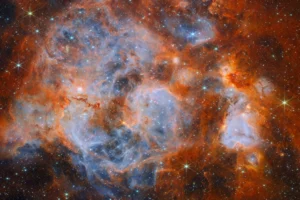



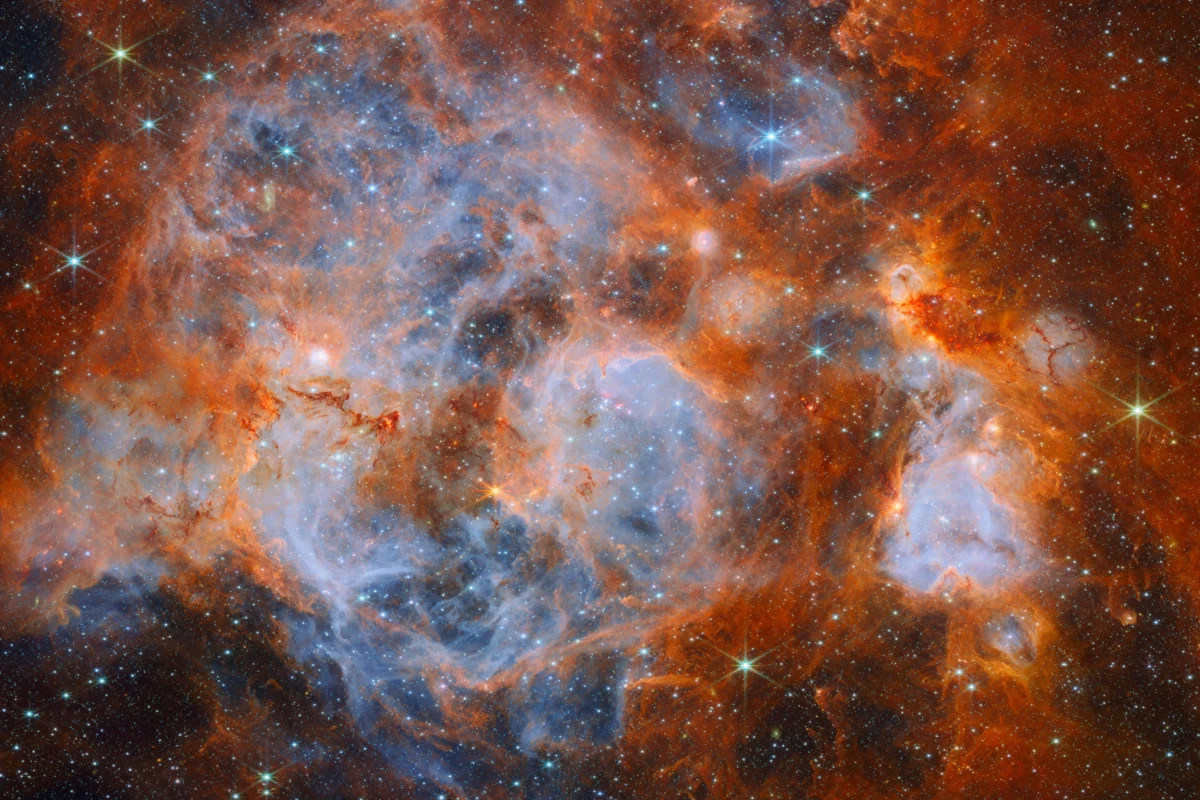
The James Webb Space Telescope (JWST) has delivered another breathtaking and scientifically profound image, capturing the tumultuous heart of the star-forming region N159. Released on October 22, 2026, the image depicts a vibrant, chaotic cauldron of cosmic dust and gas, brimming with nascent stars and dense stellar nurseries. This remarkable observation, processed by a collaborative team including E. Sabbi and M. Zamani (ESA/Webb) with acknowledgment to M. H. Özsaraç, offers astronomers an unprecedented opportunity to peer into conditions analogous to the early universe, providing critical insights into how stars formed billions of years ago.
N159: A Stellar Nursery 161,000 Light-Years Away
Located 161,000 light-years from Earth within the Large Magellanic Cloud (LMC), one of the Milky Way’s most prominent satellite galaxies, N159 is a colossal HII region. These regions are characterized by massive, hot, young stars that ionize the surrounding hydrogen gas, causing it to glow brightly. The Webb image reveals N159 not merely as a luminous cloud but as a complex tapestry of dense gas clumps, dark dust lanes, and luminous stellar streams, all indicative of intense and ongoing star formation. The LMC itself is a dynamic, irregular dwarf galaxy, gravitationally bound to our Milky Way, and a rich hunting ground for astronomers studying stellar populations and galactic evolution due to its relative proximity. Its irregular shape and active star formation distinguish it from the more quiescent elliptical galaxies or the more ordered spiral arms of our own galaxy.
What makes N159 particularly compelling for scientific study is its unique chemical composition. Unlike the Milky Way, N159, and indeed the LMC generally, possesses a significantly lower metallicity. In astronomical terms, "metallicity" refers to the proportion of elements heavier than hydrogen and helium. The early universe, shortly after the Big Bang, was composed almost exclusively of hydrogen and helium, with trace amounts of lithium. Heavier elements, or "metals" as astronomers call them, are forged within the cores of stars through nuclear fusion and dispersed into space through supernova explosions. Therefore, regions with lower metallicity are considered more primitive, reflecting conditions closer to those prevalent in the cosmos during its infancy. This characteristic transforms N159 into a natural laboratory, allowing scientists to observe star formation processes under chemical conditions that mirror the universe’s formative epochs, providing a crucial bridge to understanding the first generations of stars.
The James Webb Space Telescope: Unveiling the Invisible
The ability to capture such detailed and revelatory images of N159 is a testament to the unparalleled capabilities of the James Webb Space Telescope. Launched on December 25, 2021, and achieving full operational status by mid-2022, Webb is the most powerful space telescope ever built. Its primary mirror, measuring 6.5 meters in diameter and composed of 18 hexagonal beryllium segments, is optimized to observe in infrared light. This infrared sensitivity is critical for studying regions like N159 because young stars are often enshrouded in thick cocoons of gas and dust. Visible light, which Hubble primarily observed, is scattered and absorbed by this dust, obscuring the view. Infrared light, however, can penetrate these dusty veils, allowing Webb to peer directly into the stellar nurseries where stars are being born, revealing details previously hidden.
Webb’s suite of instruments, including the Near-Infrared Camera (NIRCam), the Near-Infrared Spectrograph (NIRSpec), the Mid-Infrared Instrument (MIRI), and the Fine Guidance Sensor/Near InfraRed Imager and Slitless Spectrograph (FGS/NIRISS), provides a comprehensive toolkit for analyzing the universe. For N159, NIRCam would likely have been crucial for imaging the fine structures of gas and dust, while MIRI could have detected cooler dust and molecular emissions, tracing the earliest stages of collapse towards star formation. The incredible angular resolution and sensitivity of these instruments at cryogenic temperatures (operating at around -223 degrees Celsius) allow for the detection of faint, distant objects and the discernment of intricate details within star-forming regions that were previously impossible to resolve.
A Chronology of Cosmic Discovery
The journey to this striking image of N159 is a long one, rooted in decades of astronomical observation and technological innovation.
- 19th-20th Century: Early observations of the Magellanic Clouds, first documented by Ferdinand Magellan’s expedition, gradually reveal them as separate galaxies and active sites of star formation.
- 1990s-2000s: The Hubble Space Telescope and various ground-based observatories begin to map the LMC with increasing detail, identifying numerous HII regions and stellar clusters, including N159. However, the pervasive dust still limited full visibility into the densest regions.
- 2000s-2010s: The concept and development of the James Webb Space Telescope gain momentum, specifically designed to overcome the limitations of visible-light telescopes by observing in the infrared, with a primary scientific goal of studying early universe star and galaxy formation.
- December 25, 2021: JWST successfully launches from Kourou, French Guiana, embarking on its journey to the Sun-Earth L2 Lagrange point.
- January-July 2022: Webb undergoes critical deployment stages, mirror alignment, and instrument commissioning.
- July 12, 2022: The first operational images from Webb are released to the public, demonstrating its unprecedented capabilities and marking the beginning of its scientific mission.
- 2022-2026 (Inferred Observation Window): Scientific proposals for observing key targets, including star-forming regions in the Magellanic Clouds, are selected and executed. Given N159’s significance, it would have been a high-priority target for Cycle 1 or 2 observations, likely sometime in 2024 or 2025. Data is acquired over several observation periods.
- 2025-2026 (Data Processing and Analysis): Raw data from Webb’s instruments is downloaded, calibrated, and processed by scientific teams. Researchers like E. Sabbi and M. Zamani, specializing in stellar populations and star formation, analyze the spectral and imaging data, teasing out the physical conditions, stellar content, and chemical composition of N159. This phase involves extensive computational work, image reconstruction, and scientific interpretation.
- October 22, 2026: The enriched and scientifically interpreted image of N159 is officially released to the public and scientific community, accompanied by explanatory materials highlighting its significance.
- October 28, 2026: News outlets publish reports detailing the discovery and its implications.
Insights into Metallicity and Early Universe Star Formation
The low metallicity of N159 is its defining scientific characteristic. In environments with higher metallicity, like parts of the Milky Way, dust grains (which are composed of heavier elements) play a crucial role in the star formation process. They help cool the gas clouds, allowing them to collapse more easily under gravity, and also act as catalysts for the formation of molecules. In a low-metallicity environment, these cooling mechanisms are less efficient. This means that gas clouds might need to be more massive or denser to overcome thermal pressure and collapse, potentially leading to the formation of more massive stars.
Studying N159 thus provides direct observational evidence to test theoretical models of star formation in the early universe. The first stars, often referred to as Population III stars, are hypothesized to have been extremely massive, hot, and short-lived, composed almost entirely of hydrogen and helium. While directly observing Population III stars remains a grand challenge, N159 offers a local analog for the conditions under which these stars might have formed. By examining the distribution of stellar masses, the rates of star formation, and the specific chemical fingerprints within N159, astronomers can refine their understanding of how the universe transitioned from its primordial, metal-poor state to the chemically rich cosmos we observe today. This understanding is fundamental to comprehending the origins of galaxies, the cosmic reionization epoch, and ultimately, the conditions necessary for the emergence of planets and life.
Statements from the Scientific Community (Inferred)
While direct quotes are not provided in the original snippet, the significance of such a discovery would undoubtedly elicit enthusiastic responses from the scientific community.
Dr. Elena Sabbi, a leading researcher involved in the observation and image processing, might have commented, "N159 offers an unparalleled laboratory right in our galactic backyard. Seeing star formation unfold under conditions akin to the universe’s infancy allows us to directly test our theoretical models. The incredible detail captured by Webb is already revealing nuances about how gas clouds collapse and how stars ignite in environments with fewer heavy elements, bringing us closer to understanding the very first stars."
A spokesperson from NASA or ESA might have added, "The James Webb Space Telescope continues to redefine our understanding of the cosmos with every image. This view of N159 is not just aesthetically stunning; it is a profound scientific data point that helps us piece together the grand narrative of cosmic evolution, from the Big Bang to the complex structures we see today. It is a testament to international collaboration and human ingenuity."
From a broader theoretical astrophysics perspective, a researcher might remark, "These observations are critical for validating our simulations of the primordial universe. The characteristics of star formation in N159, particularly its stellar mass function and the efficiency of molecular cloud collapse, will provide crucial constraints on models predicting the properties of Population III stars and the early chemical enrichment of galaxies."
Broader Impact and Future Implications
The study of N159, facilitated by Webb’s capabilities, carries profound implications for several branches of astrophysics. Firstly, it directly informs our understanding of stellar evolution. How do stars, especially massive ones, form in environments where cooling mechanisms are less efficient? Do they tend to be larger, or does the process simply take longer? The data from N159 will help answer these questions.
Secondly, it contributes to the broader narrative of galaxy formation and evolution. The LMC, as a dwarf galaxy, likely experienced a different chemical enrichment history than the Milky Way. By studying its star-forming regions, we gain insight into how smaller galaxies contribute to the overall chemical budget of the universe and how they interact with larger galactic structures. This is crucial for understanding the hierarchical model of galaxy formation, where smaller galaxies merge to form larger ones.
Finally, and perhaps most excitingly, N159 acts as a crucial stepping stone towards understanding the "Cosmic Dawn" – the era when the first stars and galaxies illuminated the dark universe. While Webb is designed to directly observe some of the earliest galaxies, studying nearby analogs like N159 provides a higher-resolution, more detailed view of the physical processes at play, complementing the distant observations. This dual approach allows astronomers to build a robust framework for understanding the universe’s earliest moments.
The James Webb Space Telescope continues its mission to explore the infrared universe, promising many more groundbreaking discoveries. The image of N159 is not just a beautiful picture; it is a meticulously gathered dataset, a window into cosmic history, and a powerful reminder of the universe’s ongoing story of creation and evolution. As scientists delve deeper into the data from N159, they will undoubtedly uncover further secrets, continuously refining our understanding of how stars, galaxies, and indeed, the very elements that make up life, first came into being.