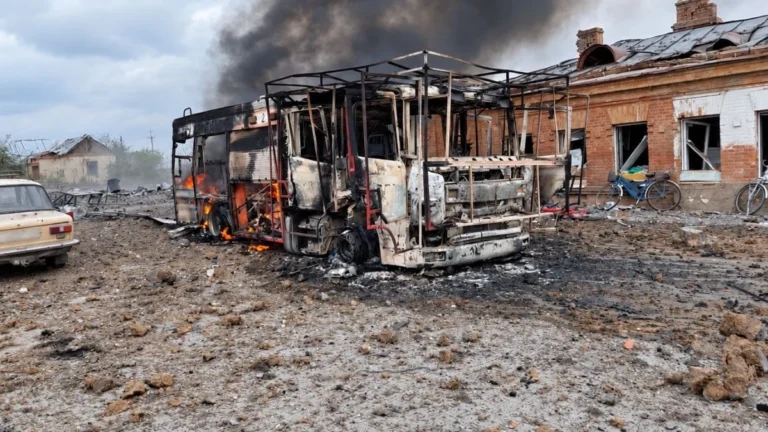




Investigators probing the catastrophic crash of a private Learjet 60 in Palm Beach, Florida, that claimed the lives of all nine individuals on board, are focusing on strong evidence suggesting the aircraft began to break apart while still in the air. The jet, which was en route from Austin, Texas, to the Bahamas, plunged into a busy multi-lane highway, Military Trail, on Sunday, resulting in a devastating explosion and a deep impact crater that has complicated recovery efforts. The National Transportation Safety Board (NTSB) has identified severe weather conditions, including heavy rainfall, thunderstorms, and reported turbulence and icing, as a major investigative focal point.
The tragic incident, occurring around 12:50 local time (17:50 GMT), saw the Learjet nosedive into the six-lane thoroughfare, which is lined with businesses and residential areas, including a mobile home park. The force of the impact was so immense that it created a significant crater in the roadway, scattering debris across a wide area encompassing sports fields, commercial establishments, and private residences. One individual in a car on the ground sustained a leg injury, a testament to the sheer destructive power of the crash.
Catastrophic Descent: A Flight’s Final Moments
The flight, carrying a tech entrepreneur, his young family, and friends, along with the pilot and co-pilot, began its journey from Austin, Texas, with a planned destination in the Bahamas. However, as the Learjet 60 approached the Florida coast, it encountered perilous weather conditions that would ultimately lead to its demise.
Air traffic control (ATC) audio recordings from the ill-fated flight paint a harrowing picture of the aircraft’s final moments. A voice from the cockpit is heard calmly, then with increasing urgency, reporting "moderate turbulence" and stating that the crew was "managing the ice." These conditions are known hazards, capable of severely impacting an aircraft’s aerodynamics and control. Ice accumulation, even in small amounts, can disrupt airflow over wings and control surfaces, drastically reducing lift and increasing drag. Moderate turbulence, while generally not structurally damaging to commercial aircraft, can cause significant discomfort and, in severe cases, temporary loss of control, especially when combined with other adverse factors.
Moments later, the crew reported "picking up precipitation" and the critical need to "climb," suggesting an attempt to ascend out of the challenging weather layer. However, the situation rapidly deteriorated. The same voice then declared the plane was "descending at a rate of 10,000ft (3,048m) per minute." This rate of descent is exceptionally high and indicative of a severe loss of control or propulsion. An emergency was declared, and the final chilling transmissions included desperate yells of "we are in an overspeed condition descending 20,000ft per minute," followed by the grim realization, "we are going to crash into the ground." An overspeed condition occurs when an aircraft exceeds its maximum operating speed, which can lead to structural damage or even failure, especially in turbulent air. The staggering descent rate of 20,000 feet per minute is equivalent to plummeting approximately 227 miles per hour vertically, leaving virtually no time for recovery. Flight analysis has corroborated these reports, indicating the jet was indeed plummeting hundreds of feet per second before impact.
The Scene of Devastation: Palm Beach’s Military Trail
The impact zone on Military Trail, a major north-south artery in Palm Beach County, was described by first responders and investigators as a scene of utter devastation. The multi-lane road, typically bustling with commuter traffic and commercial activity, was transformed into a hazardous expanse of wreckage and emergency personnel. The crater formed by the nosedive was reportedly deep, initially estimated to be several meters, and became partially filled with water due to the intense rainfall from the severe storms affecting the area at the time. This water infiltration further complicated the already arduous task of recovering the aircraft’s main wreckage.
Lead NTSB investigator Tim Monville emphasized the unprecedented challenge this presented: "The biggest obstacle that we’re going to have is recovering the major wreckage from the impacted crater on the roadway." The fragmented nature of the debris, scattered widely across adjacent sports fields, businesses, and homes, underscored the violence of the crash. This wide dispersal of parts is consistent with the preliminary findings of an in-flight breakup, requiring investigators to meticulously map and collect every piece of evidence, no matter how small or distant from the main impact site. Tom Chapman of the NTSB confirmed this, stating, "We do have some evidence that there was some breakup of the aircraft before impact," adding, "We may find parts of the aircraft some distance away from the actual impact site."
Investigative Focus: Weather and Structural Integrity
The NTSB’s investigation is multi-faceted, focusing on both the environmental factors and the mechanical integrity of the aircraft. Weather conditions are a primary concern, given the crew’s reported struggles with turbulence, icing, and precipitation. Aviation experts note that even "moderate" turbulence, especially when sustained or encountered in specific atmospheric conditions, can exert considerable stress on an aircraft’s airframe. Icing, particularly clear ice, which is difficult to see, can accumulate rapidly on wings, propellers, and control surfaces, altering aerodynamics and significantly degrading performance. The combination of these factors, especially within a strong thunderstorm environment, can create a rapidly escalating emergency for pilots.
The evidence of an in-flight breakup is particularly critical. This could suggest several scenarios: a catastrophic structural failure due to extreme aerodynamic stress (perhaps exacerbated by severe weather or an overspeed condition), a pre-existing structural flaw, or an inflight explosion or fire. Investigators will analyze the fracture patterns on recovered debris to determine if the breakup was a result of upward or downward forces, twisting, or other stresses. The location and type of parts found away from the main crater will be crucial in piecing together the sequence of events leading to the aircraft’s final plunge.
A paramount objective for investigators is the recovery of the aircraft’s cockpit voice recorder (CVR) and flight data recorder (FDR). These "black boxes" are designed to withstand extreme impact and fire, storing vital information about the flight’s parameters (speed, altitude, engine performance, control inputs) and the last 30 minutes of cockpit audio. If recovered and data is extractable, they will provide an invaluable, objective record of the crew’s actions, the aircraft’s performance, and any alarms or warnings that may have sounded, offering definitive insights into the moments leading up to the crash. The NTSB is actively searching for these devices, understanding their critical role in unraveling the mystery.
The Aircraft: Learjet 60 Profile
The crashed aircraft was a Learjet 60, a popular mid-size business jet known for its speed, range, and operational efficiency. Manufactured by Bombardier Aerospace, the Learjet 60 typically carries 7 to 8 passengers and has a cruising speed of approximately 525 miles per hour (845 km/h) and a service ceiling of 51,000 feet (15,545 meters). It is equipped with two Pratt & Whitney Canada PW305A turbofan engines. The Learjet 60 is generally considered a reliable aircraft, with a good safety record over its decades of operation. However, like all complex machines, it is susceptible to mechanical failures, and its performance can be severely challenged by extreme weather conditions, particularly rapid changes in air density, wind shear, and icing at higher altitudes. Understanding the specific model’s design characteristics, maintenance history, and any known operational advisories will be part of the NTSB’s comprehensive review.
The Victims: Lives Lost in the Tragedy
The devastating crash claimed the lives of nine individuals, leaving families and communities in mourning. Among the victims were tech entrepreneur Adam Robinson, his wife Helen Sharp, and their two young children, Emma, aged four, and Charlie, aged two. They were joined by family friends Rachael Reed and Charmi Fehr, and the family’s nanny, Anita Maria Cetina. The loss of an entire family and their companions underscores the profound human tragedy of the accident.
The flight crew consisted of pilot Jeffrey Gregory, 55, and co-pilot Nathalia Filgueiras, a remarkable 20-year-old who had earned her pilot’s license at the tender age of 17. Media reports identified Gregory as an experienced pilot, married with two children, and formerly employed by East Coast Jets. A spokesperson for East Coast Jets expressed deep sadness, stating, "We are deeply saddened to learn that Capt Jeff Gregory was among those who lost their lives in yesterday’s tragic aviation accident in Palm Beach."
Nathalia Filgueiras’s story resonated deeply, highlighting her passion and dedication to aviation. Her mother, Camila Corteleti, confirmed her daughter’s death to US media, sharing Nathalia’s love for flying: "She loved the freedom. It was completely different seeing the world from the top." In a 2023 interview with a local CBS News affiliate, Filgueiras had spoken with pride about receiving her pilot’s license while still a senior in high school. "I like being different than everyone," she had said. "Some people think that it’s weird that I can fly planes but I can’t drive a car – I mean, I can, but a lot of people think it’s funny." Her aspirations and young life were tragically cut short, a poignant reminder of the inherent risks, even in highly regulated fields like aviation.
Challenges of Recovery and Analysis
The NTSB’s investigation is a methodical and exhaustive process that can often take months, if not years, to conclude. The unique challenges presented by this crash site—a deep, water-filled crater on a major roadway and a widely dispersed debris field—will undoubtedly extend the initial recovery phase. Specialized equipment, including heavy lifting gear and possibly dewatering pumps, will be required to access the main wreckage. Each recovered piece of the aircraft, no matter how small, is a puzzle piece that must be cataloged, photographed, and often transported to a secure facility for detailed examination. Metallurgists, engineers, and accident reconstruction specialists will painstakingly analyze fracture surfaces, material integrity, and component functionality to determine the exact sequence of events leading to the in-flight breakup and subsequent crash.
Beyond the physical evidence, investigators will review every aspect of the flight: the aircraft’s maintenance records, the pilots’ training and medical histories, air traffic control communications and radar data, meteorological reports, and eyewitness accounts. They will also look into the operational practices of the charter company or owner of the jet. The goal is not merely to determine what happened, but why it happened, to prevent similar tragedies in the future.
Broader Implications and Aviation Safety
The crash has had immediate and significant implications for the local community. Military Trail, a critical transportation artery, was closed for an extended period, disrupting traffic and local businesses. The sight of the massive crater and the ongoing recovery efforts served as a stark, unsettling reminder of the tragedy for residents and commuters. First responders, who dealt with the immediate aftermath of the fiery impact and the grim task of victim recovery, will undoubtedly carry the psychological toll of the event.
From a broader perspective, every aviation accident investigation contributes to the continuous evolution of aviation safety. While air travel remains one of the safest forms of transportation, each incident provides valuable lessons that can lead to improvements in aircraft design, operational procedures, pilot training, and air traffic management. Should the investigation reveal specific mechanical failures, structural weaknesses, or procedural shortcomings related to severe weather operations, it could lead to new safety recommendations or directives from regulatory bodies like the Federal Aviation Administration (FAA). The detailed findings will be crucial for the aviation industry globally to learn from this devastating event, reinforcing the vigilance required to ensure the highest standards of safety in the skies. The NTSB’s final report, when issued, will offer a comprehensive account, shedding light on the full sequence of events that led to the tragic end of this Learjet 60 flight.