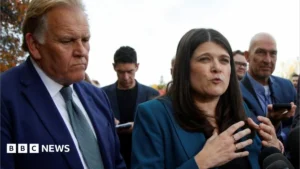



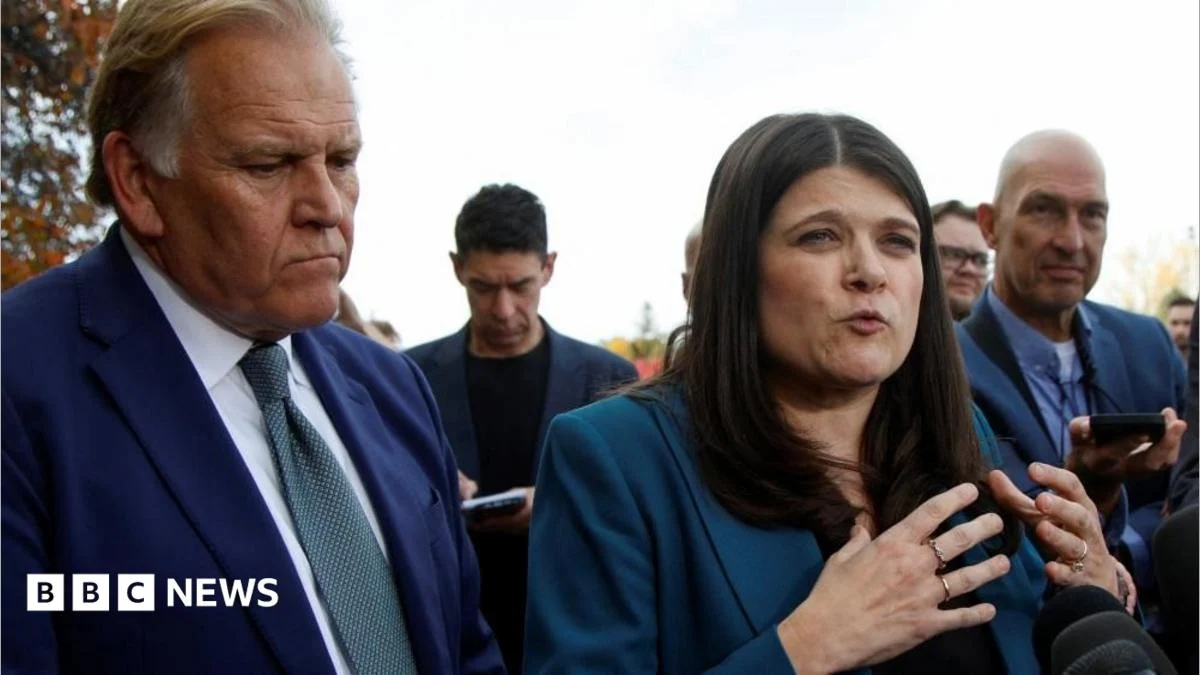
In a stunning political development just days before Michigan’s pivotal US Senate election, Congresswoman Haley Stevens, a sitting Democrat, publicly endorsed Republican candidate Mike Rogers. The unexpected move on Sunday, October 27, 2024, came as Stevens’ long-simmering feud with Abdul El-Sayed, her own party’s nominee, reached a critical boiling point, sending shockwaves through the Democratic Party and potentially reshaping the dynamics of a closely watched contest.
Stevens, who represents Michigan’s 11th Congressional District, appeared alongside Rogers at a church service, subsequently posting a video on X (formerly Twitter) to explain her decision. "I don’t belong in Abdul’s campaign," she stated emphatically. "Who we are as Michiganders is not hate and is not what we are getting out from our Democratic nominee right now. That’s why I am endorsing Mike Rogers." This unprecedented cross-party endorsement from a sitting member of Congress against her party’s standard-bearer in a high-stakes Senate race has ignited a firestorm of condemnation from Democrats, raising profound questions about party unity, ideological divides, and the integrity of electoral contests in an increasingly polarized political landscape.
The High Stakes of Michigan’s Senate Contest
The Michigan US Senate race is one of the most closely watched and expensive contests in the nation, carrying immense weight for control of the US Senate. The seat became open following the retirement announcement of long-serving Democratic Senator Debbie Stabenow, who has held the position since 2001. Her departure created a vacuum that both national parties have aggressively sought to fill, recognizing Michigan’s status as a perennial swing state that has proven decisive in recent presidential and statewide elections. With the current Senate balance precariously thin, every seat, especially in a battleground state like Michigan, is crucial for determining which party holds the majority.
Michigan’s diverse electorate, comprising urban progressive strongholds, suburban swing voters, and conservative rural areas, makes it a microcosm of national political trends. Its economic landscape, heavily reliant on the automotive industry, and its significant Arab American population, particularly in Dearborn, further add layers of complexity to its political fabric. The state’s voters have demonstrated a willingness to split tickets, electing Democrats to statewide offices while also backing Republicans in national contests, making predictions notoriously difficult. This inherent unpredictability has elevated the Stevens-El-Sayed-Rogers dynamic from a local spat to a national political flashpoint.
Profiles of the Key Players
Abdul El-Sayed, the Democratic nominee, is a former public health official and physician. The son of Egyptian immigrants, El-Sayed rose to prominence as Detroit’s Health Director and later launched an insurgent gubernatorial campaign in 2018, narrowly losing the Democratic primary. He represents the progressive wing of the Democratic Party, advocating for policies such as universal healthcare, aggressive climate action, and economic justice. His campaign has also been notably vocal on foreign policy issues, particularly regarding the Israeli-Palestinian conflict, often reflecting a more critical stance towards US foreign policy in the Middle East, which resonates with certain segments of the progressive base and the state’s significant Arab American community. His grassroots appeal and outsider status have been central to his political identity.
Haley Stevens is a two-term U.S. Representative for Michigan’s 11th Congressional District, encompassing parts of Oakland and Wayne counties. A centrist Democrat, she previously served as Chief of Staff to former Michigan Governor Jennifer Granholm. Stevens is known for her pragmatic approach and ability to appeal to suburban voters, a critical demographic in Michigan. She secured her congressional seat in 2018, flipping a traditionally Republican district, and has consistently emphasized bipartisan solutions and economic development. Her political style and policy positions align more closely with the Democratic establishment, and she enjoyed the support of prominent party figures, including Michigan Governor Gretchen Whitmer, during the primary race.
Mike Rogers, the Republican candidate, is a former U.S. Representative for Michigan’s 8th Congressional District and a former FBI agent. Known for his background in national security and intelligence, Rogers chaired the House Intelligence Committee during his tenure in Congress. He is considered a more moderate Republican compared to some of the party’s hardline conservatives, though his policy positions are firmly aligned with the Republican platform on issues such such as fiscal conservatism, border security, and a strong national defense. His name recognition and extensive political experience make him a formidable opponent, capable of drawing support from moderate Republicans and independent voters.
The Bruising Primary and Seeds of Discord
The roots of the Stevens-El-Sayed feud trace back to the Democratic primary earlier this year, a contest that was described by many as "bruising and sometimes bitter." El-Sayed, leveraging his progressive platform and grassroots organizing, managed to defeat Stevens, the establishment-backed congresswoman, to win the party’s nomination for the US Senate race. His victory was seen by many as a significant statement from the party’s left wing, highlighting a desire for more progressive leadership and a challenge to traditional Democratic power structures.
The primary illuminated a clear ideological chasm within the Michigan Democratic Party. Stevens, with her centrist appeal, focused on kitchen-table issues and bipartisan cooperation, appealing to voters who prioritize stability and incremental change. El-Sayed, on the other hand, energized a younger, more diverse, and politically active base with calls for systemic change, challenging corporate power, and re-evaluating long-held foreign policy positions. While both candidates ultimately aimed to represent Michigan Democrats, their fundamental approaches and political philosophies were often at odds, setting the stage for lingering tensions even after the primary concluded. Efforts to project party unity post-primary were often strained, with underlying disagreements occasionally surfacing.
Chronology of the Escalation: From Ad to Endorsement
The public feud between Stevens and El-Sayed escalated significantly in the days leading up to the election, culminating in Sunday’s endorsement.
The immediate catalyst for the most recent flare-up was a campaign advert from an outside liberal group. The controversial advert notably blamed Israel for high food prices, a highly contentious claim that drew immediate criticism. While El-Sayed’s campaign was not directly responsible for the ad, and he publicly criticized its contents and disavowed any connection to it, the incident served to reignite tensions. Stevens seized upon the ad, implicitly linking it to the broader political environment surrounding El-Sayed’s campaign and suggesting it reflected an unacceptable tone or ideology.
A planned "unity event" on Sunday, intended to showcase a united front between El-Sayed and Stevens, was reportedly canceled at El-Sayed’s behest. Stevens stated that El-Sayed had "made clear that I was not welcome in his campaign, that he didn’t need me there, that he didn’t want me there." Feeling rebuffed and unwelcome, Stevens chose a dramatically different path. Instead of attending the unity event, she made a surprise appearance alongside Republican candidate Mike Rogers at a church service.
It was immediately following this appearance that Stevens posted her video on X, officially endorsing Rogers. Her statements were unequivocal: "I don’t belong in Abdul’s campaign… Who we are as Michiganders is not hate and is not what we are getting out from our Democratic nominee right now. That’s why I am endorsing Mike Rogers." This public declaration was not merely a withdrawal of support but an active endorsement of her party’s rival, a move almost unheard of for a sitting member of Congress in a crucial election.
When reporters pressed El-Sayed for his reaction to Stevens’ endorsement, he maintained a dismissive posture, emphasizing his focus on the electorate. "At the end of the day, I don’t think about Haley Stevens," he told reporters on Sunday. "None of this matters." His statement aimed to project confidence and an unwavering focus on the issues, attempting to downplay the significance of Stevens’ defection. However, the political reality of a high-profile endorsement against a party’s nominee, particularly from one of its own elected officials, is rarely inconsequential.
Widespread Condemnation and Varied Reactions
The immediate aftermath of Stevens’ endorsement was a torrent of condemnation from within the Democratic Party.
Democratic Outrage:
Senator Chuck Schumer, the Senate Majority Leader, swiftly denounced Stevens’ decision, calling it a "despicable betrayal" of her political party. This strong language from such a senior party figure underscored the severity with which the Democratic establishment viewed Stevens’ actions. The Democratic Senatorial Campaign Committee (DSCC), the main campaign arm for Senate Democrats, also issued a statement reiterating its full support for El-Sayed and condemning any actions that undermine party unity, though refraining from directly naming Stevens.
The Michigan Democratic Party released a statement emphasizing the importance of electing Democrats up and down the ticket and expressing profound disappointment in any action that would jeopardize this goal. Numerous Michigan Democratic politicians, many of whom had previously encouraged Stevens to reconcile with El-Sayed and back the party’s ticket, publicly voiced their dismay. Some, speaking anonymously, described the move as "politically suicidal" for Stevens and "deeply damaging" to party cohesion.
Democratic voters in Detroit, interviewed by the BBC, echoed these sentiments. One voter stated, "I just genuinely don’t understand it. I do think it’s a betrayal of the party because the things she stands for are not the same things that he stands for as a Republican." Another, Matthew Barera, speculated, "Maybe she had frustrations with the party," acknowledging the internal tensions but still expressing surprise at the extent of her break.
Republican Response:
Mike Rogers’ campaign, predictably, welcomed Stevens’ endorsement, framing it as evidence of broad appeal and dissatisfaction with El-Sayed’s candidacy. They quickly amplified Stevens’ criticisms of El-Sayed, particularly her remarks about "hate" and the nominee’s perceived unsuitability for Michigan. The endorsement provided the Rogers campaign with valuable talking points and a potential boost in credibility among moderate voters who might be swayed by a Democrat breaking ranks.
However, some Republicans and Rogers supporters expressed skepticism about the endorsement’s tangible impact. Marissa Lee, a Rogers supporter, told the BBC, "People can see right through her actions, you know? She’s just angry. She is not going to make anybody change their mind." This perspective suggests that while the endorsement generates headlines, its ability to shift a significant number of votes might be limited, particularly among voters already firmly aligned with a party.
Analysis of Potential Impact and Broader Implications
The political ramifications of Haley Stevens’ endorsement are multifaceted and could extend beyond the immediate election outcome.
Impact on the Race:
The Michigan Senate race was already considered a toss-up, with recent polling data (where available, though not specified in the original article) indicating a very tight contest between El-Sayed and Rogers. In such a close election, even a marginal shift in voter sentiment or turnout could prove decisive. Stevens’ endorsement could theoretically influence several segments of the electorate:
- Moderate Democrats: Stevens’ base includes moderate, suburban voters who might feel alienated by El-Sayed’s progressive stances or the perceived negativity of the campaign. Her endorsement could give these voters "permission" to cross party lines, or at least consider Rogers.
- Independent Voters: Swing voters, particularly those in Michigan’s critical suburban corridors, often look for signals from credible, non-extremist voices. Stevens’ moderate Democratic credentials could lend an air of legitimacy to Rogers among these undecided voters.
- Republican Enthusiasm: The endorsement could energize Rogers’ base and moderate Republicans, presenting a narrative of a broad coalition against an "extreme" Democrat.
- Democratic Turnout: Conversely, the move could galvanize El-Sayed’s progressive base, inspiring them to turn out in force as a rebuke to Stevens and a show of loyalty to their nominee. However, it could also depress turnout among some Democrats who feel disillusioned by the internal party strife.
The quantitative impact remains uncertain. While high-profile endorsements can generate media attention, their direct translation into votes is often hard to measure. Michigan’s electoral history, with its significant split-ticket voting, suggests voters often make independent decisions based on a range of factors beyond party endorsements.
Democratic Party Unity and the 2028 Horizon:
As the original article notes, this feud "has underlined divisions over the party’s direction ahead of the 2028 presidential election." This internal strife is not unique to Michigan but reflects a broader national struggle within the Democratic Party between its progressive and centrist factions. Key policy areas like healthcare, climate change, and increasingly, foreign policy – particularly concerning Israel and Palestine – are points of contention. Progressive candidates like El-Sayed often appeal to a younger, more diverse, and activist base, while centrists like Stevens aim for broader appeal in swing districts and suburban areas. This ideological tension will undoubtedly continue to shape future primaries and the party’s platform in the lead-up to the next presidential cycle. The Michigan incident serves as a stark reminder of how these internal battles can spill into general elections, potentially jeopardizing party chances.
Implications for Political Careers:
For Haley Stevens, the endorsement of a Republican opponent is an extraordinary act with potentially severe consequences for her political future within the Democratic Party. It could lead to censure, loss of committee assignments, and primary challenges in future elections. Her standing with the Democratic Party apparatus is likely severely damaged. For Abdul El-Sayed, the incident tests his ability to unify disparate elements of the Democratic coalition and navigate intense internal criticism while maintaining focus on his general election opponent. His ability to rally his base and demonstrate resilience will be crucial. Mike Rogers, meanwhile, benefits from the optics of a Democrat validating his candidacy, potentially bolstering his image as a bipartisan-friendly choice.
Erosion of Party Discipline:
Such a high-profile defection raises questions about the strength of party discipline in modern American politics. While cross-party endorsements are not entirely unheard of, they are rare for a sitting member of Congress in a crucial Senate race. This incident could be viewed as a symptom of increasing political polarization, where ideological purity within a party sometimes takes precedence over party loyalty, or as an expression of deep personal and political disagreements that override traditional party allegiances.
The Role of Foreign Policy in Domestic Elections:
The contentious campaign advert blaming Israel for high food prices, and El-Sayed’s disavowal of it, highlights how foreign policy issues, particularly the Israeli-Palestinian conflict, are increasingly influencing domestic elections. In states with significant diaspora communities and a politically engaged electorate on these issues, candidates’ stances can become potent drivers of support or opposition, further complicating intra-party dynamics.
Conclusion
Haley Stevens’ endorsement of Mike Rogers is a dramatic and unexpected twist in Michigan’s already high-stakes US Senate race, just two days before voters head to the polls. It underscores the deep ideological fissures within the Democratic Party and the intense personal rivalries that can emerge from bruising primary contests. While the ultimate impact on the election remains to be seen, the move has ignited a fierce debate about party loyalty, political strategy, and the future direction of the Democratic Party. As Michigan voters prepare to cast their ballots, this unprecedented development ensures that the election will be remembered not only for its critical national implications but also for the extraordinary internal drama that preceded it. The outcome will undoubtedly be scrutinized for what it reveals about Michigan’s political landscape and the broader challenges facing American political parties.