


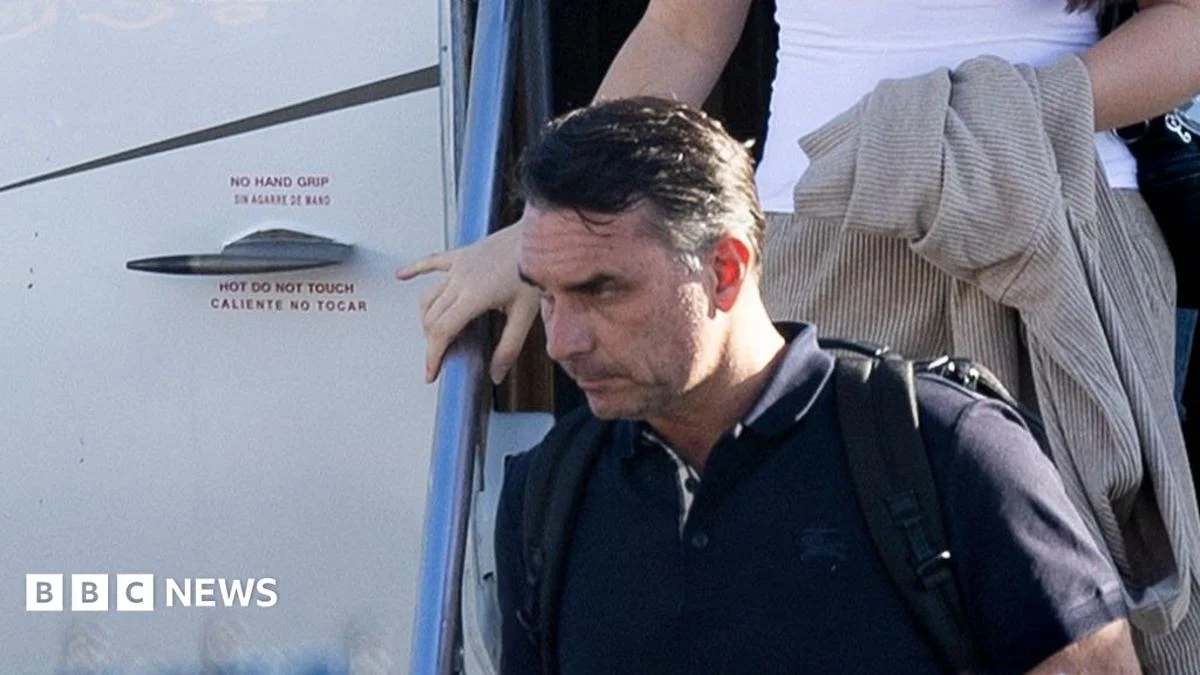
Flávio Bolsonaro, the eldest son of former Brazilian President Jair Bolsonaro and a sitting senator, has arrived in Florida, concluding days of intense speculation and conflicting reports regarding his whereabouts. His arrival at Miami-Opa Locka Executive Airport on Wednesday morning local time marked the end of a convoluted journey and ignited renewed scrutiny over his legal standing in Brazil and the broader political landscape involving his prominent family. The move places him, at least temporarily, in the same US state that served as a refuge for his father following Brazil’s contentious 2022 presidential election and for his brother, Eduardo Bolsonaro, amidst ongoing controversies.
The Unfolding Saga: Days of Uncertainty
The events leading to Flávio Bolsonaro’s confirmed arrival in the United States were characterized by a flurry of unsubstantiated reports, official denials, and ultimately, a verified itinerary that pointed to a deliberate, multi-leg transit. The confusion began with an initial report from an Argentine news outlet, which claimed Bolsonaro had crossed the land border from Brazil into Argentina before boarding a private plane bound for the US. This report quickly circulated, triggering a swift response from Brazilian authorities.
Initial Misdirection and Official Scrutiny
Early on Tuesday, Brazilian federal police, taking the rumors seriously, initiated checks at various border crossings. However, their efforts yielded no evidence that Bolsonaro had left the country. Concurrently, Argentine officials publicly stated they had no records of him crossing their border. For a brief period, it appeared that Bolsonaro might simply be maintaining an uncharacteristically low profile, following his unexpected defeat in Brazil’s recent presidential run-off vote and in light of a separate criminal investigation that had already led to judicial orders for his passports to be surrendered to authorities.
The situation escalated when Bolsonaro failed to comply with the 24-hour deadline to surrender his travel documents on Tuesday. In response, Brazilian authorities promptly cancelled his passports and issued directives for police to increase vigilance at all border posts. This official action intensified speculation about his departure, with his own lawyers publicly admitting they had no knowledge of his location, further deepening the mystery. The unfolding events painted a picture of a calculated, clandestine departure, raising questions about its timing and motivations, particularly as his parliamentary immunity was set to expire within weeks.
The Confirmed Route: From Argentina to Florida
The enigma surrounding Bolsonaro’s movements was eventually resolved through official confirmation from Argentine migration authorities. Late on Tuesday night local time, they posted on social media, verifying that Flávio Bolsonaro, accompanied by his wife and two daughters, had indeed crossed into Argentina over land. This revelation contradicted earlier official denials and underscored the deliberate nature of his initial movements.
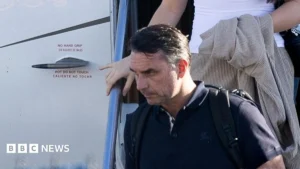
Subsequent flight tracking data, independently verified by the BBC, provided a detailed itinerary of their aerial journey. The Bolsonaros departed from Puerto Iguazú, Argentina, at 12:18 local time (03:18 GMT) on Wednesday. Their initial destination was Guayaquil, Ecuador, suggesting a conscious effort to obscure their final destination or to facilitate a logistical stopover. After a brief layover in Ecuador, the same private jet continued its flight, ultimately landing at Miami-Opa Locka Executive Airport. They were pictured disembarking just before 09:30 local time (13:30 GMT), finally bringing an end to the days of uncertainty. Awaiting photographers, who had gathered to capture the moment, swarmed Bolsonaro as he exited the airport, his team attempting to shield him with umbrellas amidst the media frenzy.
Bolsonaro’s Assertions and Allegations
Upon his arrival in Florida, Flávio Bolsonaro issued a statement that provided insight into his perspective on his departure and the political climate in Brazil. He extended gratitude to the presidents of both Argentina and the United States, as well as to the American public, whom he described as sharing "the same values as the good people of my own country." This framing aligns with a common narrative employed by right-wing populist leaders, seeking solidarity with perceived ideological allies abroad.
His statement then delved into more contentious claims. "It was never my intention to leave my homeland, but I know exactly where this is heading," he declared, hinting at a predetermined course of events he felt compelled to escape. He further asserted, "I departed from a regime of exception so that I could become the leader my people deserve." This phrase, "regime of exception," carries significant weight in a country with Brazil’s history, potentially referencing periods of authoritarian rule or perceived curtailment of democratic freedoms. It implicitly casts him as a figure acting against an oppressive system, a narrative frequently adopted by those facing legal or political pressure.
Echoes of a Contentious Election
Bolsonaro explicitly labeled himself a "victim of a coup d’état and political persecution," stating that his travel to the US was primarily to protect his family. This accusation of a coup and political persecution directly echoes the rhetoric frequently employed by his father, Jair Bolsonaro, following his electoral defeat. In his lengthy letter, Flávio Bolsonaro reiterated unsubstantiated allegations of "electoral fraud," claiming it allowed a "mathematical impossibility" to occur in the election results. These claims mirror those made by his father, who consistently questioned the integrity of Brazil’s electronic voting system without providing credible evidence, contributing to deep divisions within the country. The official results, confirmed by Brazil’s Superior Electoral Court (TSE), showed a clear victory for Luiz Inácio Lula da Silva, with a margin of over four million votes in the second round, largely attributed to significantly higher voter turnout and Lula’s success in swaying undecided voters. The president of the TSE, who confirmed the result, was himself appointed by Jair Bolsonaro, further undermining the fraud allegations.
The Political Landscape and Trump’s Response
Flávio Bolsonaro’s arrival and his subsequent statements are set against the backdrop of a deeply polarized Brazil, still grappling with the aftermath of the 2022 presidential election. The victory of Luiz Inácio Lula da Silva marked a significant shift back to the left after four years of Jair Bolsonaro’s conservative, populist administration. The transition of power was fraught with tension, exacerbated by Jair Bolsonaro’s refusal to explicitly concede the election and his consistent questioning of its legitimacy.
Brazil’s Divisive Political Aftermath
The political climate reached a boiling point on January 8th, when thousands of Jair Bolsonaro’s supporters stormed Brazil’s government buildings in Brasília – including the Congress, Supreme Court, and presidential palace – in an attempt to overturn the election results. This insurrection, which bore striking similarities to the January 6th Capitol attack in the United States, further highlighted the deep divisions and the fragility of democratic institutions in Brazil. Jair Bolsonaro, who was already in Florida at the time, later faced intense legal scrutiny and charges related to his alleged role in inciting these events, ultimately leading to his conviction and a 27-year sentence for attempted coup d’état.
Amidst Flávio Bolsonaro’s arrival and his renewed allegations, former US President Donald Trump offered a cautious, yet sympathetic, response. When asked about the allegations made in Bolsonaro’s letter, Trump declined to directly discuss them, stating, "I won’t get involved. It was a very strange election, that’s for sure." While avoiding an explicit endorsement of the fraud claims, his description of the election as "very strange" subtly echoed the skepticism often voiced by the Bolsonaro family and their allies. Trump went on to add that he thought Bolsonaro "and his family were treated very unfairly," a sentiment that aligns with the "political persecution" narrative espoused by Flávio Bolsonaro. This reaction from Trump underscores the ideological alignment between segments of the US and Brazilian right-wing political spectrums and provides a degree of implicit validation for the Bolsonaro family’s claims.
A Family Pattern: Bolsonaro’s US Connections and Legal Challenges
Flávio Bolsonaro’s decision to seek refuge in the United States, particularly Florida, is not an isolated incident but rather fits a discernible pattern established by other members of his influential family. The US, especially Florida, has become a favored destination for the Bolsonaro clan amidst their escalating legal and political troubles in Brazil, suggesting a deliberate strategy to leverage international connections or to temporarily evade domestic pressures.
Jair Bolsonaro’s Exile and Conviction
His father, Jair Bolsonaro, famously departed Brazil for Florida in December 2022, just days before his successor, Lula, was inaugurated. This pre-inauguration departure was widely seen as an attempt to avoid the symbolic handover of the presidential sash to his political rival and to distance himself from potential legal repercussions in Brazil. Jair Bolsonaro was still residing in the US when his supporters launched the violent assault on Brazil’s government buildings on January 8th, 2023. He later attempted to use his absence from Brazil during the riots as part of his defense in the ensuing coup trial, arguing he could not have directly incited the events while abroad. However, this defense ultimately failed to sway the courts. He was subsequently convicted of attempted coup d’état and sentenced to 27 years in prison, a landmark decision that underscored the gravity of the events and the judiciary’s commitment to upholding democratic norms. His time in Florida and his eventual legal fate set a significant precedent for the family.
Eduardo Bolsonaro’s Controversial Lobbying and Its Repercussions
Flávio’s brother, Eduardo Bolsonaro, also a federal congressman, has similarly established a presence in the United States, taking leave from Brazil’s Congress to reside in Texas. While in the US, Eduardo engaged in highly controversial activities, including lobbying officials in an attempt to influence the coup trial of his father. This lobbying effort, perceived as an unwarranted interference in Brazil’s sovereign judicial process, drew severe criticism and had significant diplomatic repercussions. The US, responding to these actions and potentially to the broader undermining of democratic institutions, imposed punitive tariffs on certain Brazilian goods and enacted sanctions on key Brazilian officials deemed to be involved in undermining democratic processes. Eduardo Bolsonaro was subsequently convicted in absentia by Brazil’s highest court earlier this year for these actions, further cementing the family’s track record of legal challenges stemming from their activities both within and outside Brazil. These familial precedents highlight the complex interplay between domestic Brazilian politics, international relations, and the personal legal entanglements of the Bolsonaro family.
Flávio Bolsonaro’s Impending Legal Crossroads
Flávio Bolsonaro’s arrival in the United States comes at a critical juncture regarding his legal standing in Brazil. He is currently the subject of two significant investigations pending before Brazil’s Supreme Federal Court (STF), which hold the potential for serious legal consequences. His imminent loss of parliamentary immunity adds another layer of complexity and urgency to his situation.
Looming Investigations and Loss of Immunity
One of the investigations pertains to alleged irregularities in the transfer of nearly $70 million (approximately £53 million) from the private bank Banco Master to the film "Dark Horse" – a biopic about his father. The nature of these alleged irregularities has not been fully disclosed, but such a substantial sum raises questions about the legitimacy of the transaction and potential illicit financial activities. The second investigation relates to broader allegations of money laundering. Both sets of allegations are serious and, if proven, could lead to severe penalties under Brazilian law. Bolsonaro has vehemently denied any wrongdoing in both cases.
A pivotal date for Flávio Bolsonaro’s legal vulnerability is January 31st, when his eight-year Senate term officially ends. With the conclusion of his term, he is set to lose his parliamentary immunity. In Brazil, parliamentary immunity protects elected officials from certain types of prosecution and detention while in office, primarily to safeguard their legislative duties from politically motivated legal attacks. Once this immunity is lifted, Flávio Bolsonaro will become significantly more susceptible to formal charges and potential arrest, as the investigations against him could then proceed more directly through the regular judicial system. This impending loss of immunity provides a strong circumstantial motive for his departure, suggesting a strategic move to preempt potential legal actions.
The Road Ahead: Legal and Political Implications
It remains unclear what Flávio Bolsonaro’s ultimate destination will be beyond Florida, or precisely how long he intends to stay in the US. His current legal status in Brazil, coupled with his statements claiming political persecution, could potentially lead to him seeking asylum or other forms of protected status in the United States. However, the US government typically assesses such claims based on international and domestic legal frameworks, and the existence of active investigations in his home country could complicate any such process. Brazil, for its part, could potentially seek his extradition if formal charges are brought against him and if an extradition treaty between the two nations is applicable to the specific allegations.
The intertwining of his legal troubles with his family’s history of US travel, lobbying efforts, and judicial convictions creates a complex web of implications. His presence in the US could strain diplomatic relations between Brasília and Washington, particularly if the Brazilian government perceives his stay as an evasion of justice or if he engages in activities that are seen as undermining Brazilian democratic institutions, as his brother Eduardo did. The coming weeks will likely reveal more about his intentions and the legal challenges that await him, both domestically and potentially internationally.
Broader Context and Geopolitical Undercurrents
Flávio Bolsonaro’s arrival in Florida, amidst a backdrop of legal challenges and political claims, serves as a stark illustration of the ongoing political turbulence in Brazil and its wider implications for international relations. The saga underscores the persistent polarization within Brazilian society, where a significant segment of the population, often aligned with the Bolsonaro family, continues to harbor distrust in democratic processes and institutions.
Implications for Brazilian Democracy and International Relations
The narrative of "electoral fraud" and "political persecution," frequently invoked by the Bolsonaro family, contributes to a climate of instability and challenges the legitimacy of the current government. This rhetoric, amplified by high-profile figures like Flávio Bolsonaro, risks further eroding public trust in democratic outcomes and potentially fueling future political unrest. For Brazilian democracy, these events represent a continued test of resilience and the rule of law, as the judiciary navigates complex cases involving powerful political figures while upholding constitutional principles.
Internationally, the repeated instances of high-profile Bolsonaro family members seeking refuge or engaging in political activities from the US could create diplomatic friction. While the US maintains a policy of non-interference in other nations’ internal affairs, it also has a vested interest in promoting democratic stability in key regional partners like Brazil. The actions of the Bolsonaro family, particularly those that have led to US sanctions or are perceived as attempts to undermine Brazilian judicial processes, could influence future bilateral relations. The situation also highlights the broader phenomenon of right-wing populist movements and their international networks, where figures facing domestic scrutiny often seek solidarity and support from like-minded groups abroad. Flávio Bolsonaro’s journey to Florida, therefore, is not merely a personal escape but a development with potential ramifications for Brazil’s political future, its democratic institutions, and its standing on the global stage.