


A devastating Russian aerial assault on a humanitarian aid distribution centre in Komyshuvakha, a village in Ukraine’s southern Zaporizhzhia region, has resulted in the deaths of at least 26 individuals and left many more injured and missing. Ukrainian President Volodymyr Zelensky condemned the attack as "utterly horrific," emphasizing the deliberate targeting of a facility known to provide essential assistance to civilians. The incident, which unfolded on Monday, involved multiple powerful 3,000kg aerial bombs, leaving a scene of widespread destruction and raising serious questions about the conduct of hostilities in the ongoing conflict.
Devastating Attack on Aid Centre
The relentless barrage on Komyshuvakha began with a primary strike targeting a local school, a building that had been repurposed to serve the community’s critical humanitarian needs. According to President Zelensky, following this initial strike, a second, equally destructive attack was launched against the very location where residents had sought shelter after the first blast. Regional head Mykhailo Semikin confirmed that at least nine 3,000kg aerial bombs were unleashed on the village. The sheer scale and destructive power of the ordnance created immense craters, some reportedly dozens of metres wide and several metres deep, tearing through buildings and infrastructure with catastrophic force.
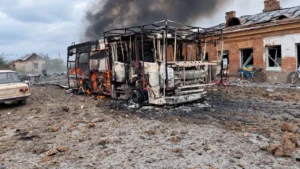
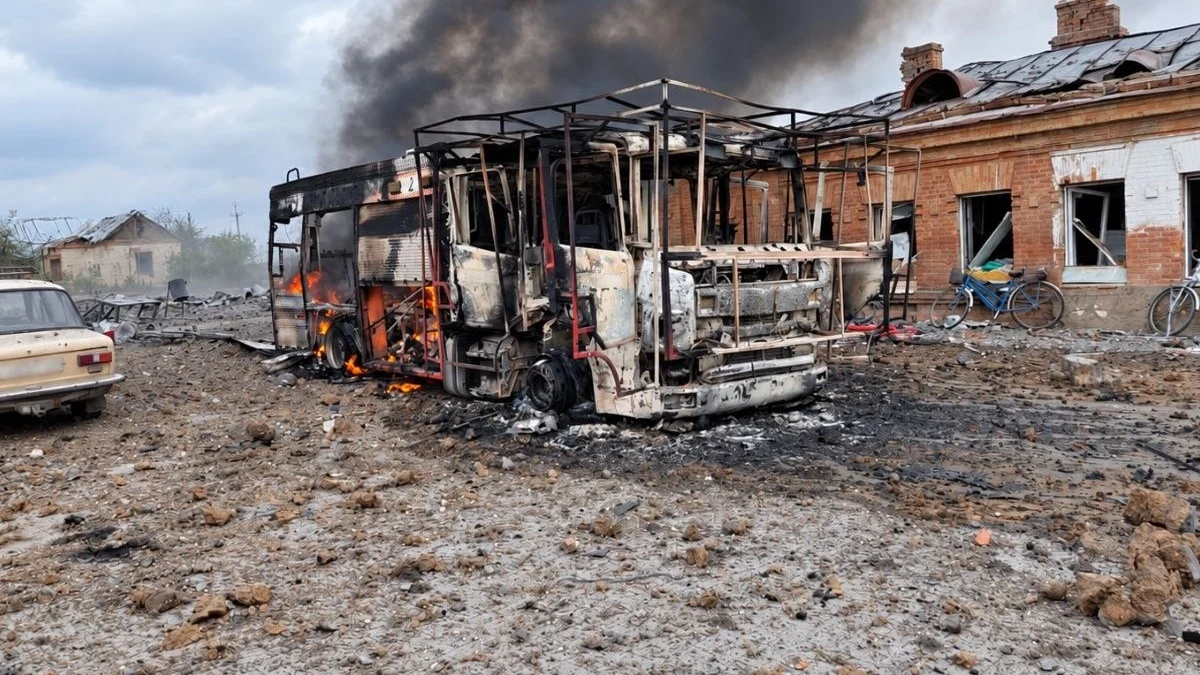
Visual evidence, including videos posted by President Zelensky and shared by Ukrainian emergency services, depicted immense craters, smoke billowing from destroyed structures, and desperate rescue teams sifting through piles of rubble in search of survivors. One image showed a burning bus engulfed in flames amidst the debris, illustrating the intensity of the assault. The widespread devastation suggested a concentrated and deliberate attack aimed at maximizing impact within the civilian area. Rescue efforts, crucial for finding those trapped beneath the rubble, were, however, severely hampered and repeatedly interrupted by persistent Russian drone attacks in the vicinity, exacerbating the already perilous conditions for emergency personnel and further endangering lives.
Escalating Casualty Count and Humanitarian Toll
The human toll of the Komyshuvakha tragedy is profound and continues to mount. Initial reports from Ukrainian officials placed the death toll at 18, a figure that steadily climbed throughout Monday. Ukraine’s state emergencies service (DSNS) later confirmed 24 fatalities, including at least two rescuers and four police officers, who were likely responding to the initial strike or involved in humanitarian efforts. By late Monday, President Zelensky confirmed the death toll had risen to 26 individuals. This highlights the extreme danger faced not only by civilians but also by those dedicated to saving lives and maintaining order in conflict zones.
Beyond the confirmed fatalities, five people were reported injured, and 27 individuals were initially listed as missing, prompting fears that the final death toll could yet increase as search operations continue. The majority of the victims were civilians who had congregated at the aid centre, a vital lifeline for many in the war-torn region, to receive essential supplies such as food, water, and medicine. Their presence at a known humanitarian distribution point underscores the acute vulnerability of non-combatants and the devastating impact of attacks on civilian infrastructure. The targeting of such a facility not only inflicts immediate casualties but also severely cripples the ability of aid organizations to deliver crucial assistance, deepening the humanitarian crisis for thousands. Regional head Mykhailo Semikin stated with gravity that "people are still under the rubble," underscoring the ongoing search for survivors and the grim expectation of further discoveries.
Ukrainian Leadership’s Vehement Condemnation
Ukrainian President Volodymyr Zelensky delivered a scathing rebuke of the Russian actions, stating unequivocally that "the Russians could not have been unaware that the local residents who remained in Komyshuvakha received humanitarian aid there every week." He framed the attack as "yet another proof that Russia does not want any de-escalation," suggesting a deliberate strategy to inflict terror and undermine any semblance of stability or peace. In his nightly video address, he escalated his condemnation, asserting that "with such killings, Russia is sending the exact opposite signal – Russia is counting on further killings."

Regional head Mykhailo Semikin echoed these sentiments, describing the incident as a "terrible tragedy" for the village and confirming the grim reality that rescue teams were forced to halt their operations multiple times due to continuous Russian drone attacks. In a somber acknowledgment of the immense loss and widespread grief, a day of mourning was officially declared for Tuesday across the entire Zaporizhzhia region, a testament to the community’s profound sorrow and solidarity in the face of such devastation. The declaration underscored the severity of the attack and its deep impact on the local populace.
Russia’s Silence Amidst Mounting Evidence
As of the time of reporting, the Russian military has refrained from publicly commenting on the Komyshuvakha attack. This pattern of silence or outright denial regarding accusations of targeting civilian infrastructure or humanitarian sites has been consistent throughout the full-scale invasion launched in February 2022. Moscow typically asserts that its strikes are aimed solely at military targets, a claim frequently contradicted by evidence on the ground, satellite imagery, and reports from international observers and human rights organizations. The lack of acknowledgment further complicates efforts to investigate and attribute responsibility for such incidents, often delaying justice for victims and their families. This strategic ambiguity forms a core part of Russia’s information warfare, seeking to sow doubt and deflect blame even in the face of overwhelming evidence.
The Dire Humanitarian Landscape of Zaporizhzhia
The Zaporizhzhia region, a critical battleground in southern Ukraine, has endured relentless shelling and aerial attacks since the outset of the full-scale invasion. Its strategic location, bordering occupied territories and serving as a gateway to the Azov Sea, has made it a focal point of intense fighting. Consequently, many communities within the region, including Komyshuvakha, face dire humanitarian conditions, with disrupted supply lines, damaged infrastructure, and a civilian population heavily reliant on external aid. Access to basic necessities such as food, clean water, medical care, and shelter has been severely compromised for months, if not years, in many areas.
Schools, community centres, and other civilian buildings have often been repurposed as humanitarian hubs, becoming essential nodes for the distribution of food, medicine, and other relief supplies provided by both Ukrainian authorities and international aid organizations. These centres are lifelines for thousands of vulnerable individuals, particularly the elderly, children, and those unable to evacuate. The targeting of such a facility not only inflicts immediate casualties but also severely cripples the ability of aid organizations to deliver crucial assistance, deepening the humanitarian crisis for thousands more who depend on these services. Previous reports from human rights groups and the United Nations have extensively documented numerous instances of civilian casualties and damage to non-military infrastructure across the region, painting a grim picture of the conflict’s devastating impact on everyday life and the pervasive humanitarian emergency. The Komyshuvakha attack serves as a stark reminder of the ongoing perils faced by civilians in these frontline territories.
Implications Under International Humanitarian Law
The attack on the Komyshuvakha aid centre raises profound concerns under international humanitarian law (IHL), also known as the laws of armed conflict. IHL explicitly prohibits direct attacks on civilians and civilian objects, including schools and humanitarian aid distribution points, unless they are being used for military purposes. Even if a civilian structure were to be used for military purposes, the principle of proportionality dictates that any attack must be designed to minimize harm to civilians and civilian objects, and the expected military advantage must outweigh the anticipated civilian harm. The deliberate targeting of a known humanitarian hub, particularly with powerful aerial bombs, could therefore constitute a war crime.
International bodies, such as the United Nations (UN) and the International Criminal Court (ICC), would likely view such an incident with grave concern. While no formal statements from these bodies have been issued specifically on Komyshuvakha yet, organizations like Human Rights Watch and Amnesty International have consistently called for thorough investigations into similar incidents in Ukraine, emphasizing the critical need for accountability for violations of international law. The involvement of rescuers and police officers among the casualties further underscores the indiscriminate nature of the attack, as these individuals, when performing their duties, are generally afforded special protection under IHL. Attacks on humanitarian personnel and facilities impede aid delivery and are considered severe breaches of international norms designed to protect the most vulnerable in conflict zones.
A Setback for Fragile Peace Prospects
President Zelensky’s remarks linking the Komyshuvakha attack to broader peace prospects are particularly salient. He highlighted a recent, successful joint Russian-Ukrainian operation to evacuate civilians from the Russia-occupied southern city of Oleshky, a temporary ceasefire reportedly brokered with the involvement of US First Lady Melania Trump. This limited success, Zelensky had suggested, offered a brief glimpse where "the next steps could show that peace is possible." The Komyshuvakha bombing, however, serves as a stark counterpoint, signaling Moscow’s continued reliance on military force and its apparent disinterest in genuine de-escalation.

The timing of this devastating attack is also critical, occurring just as teams from Ukraine, Russia, and potentially the US are reportedly preparing to resume peace talks in the coming days, possibly in Abu Dhabi, the United Arab Emirates. While expectations for a major breakthrough in these negotiations, which were suspended in February amidst escalating Russian offensives and dwindling Ukrainian air defenses, remain low, such violent acts only further erode trust and dim any prospects for constructive dialogue. The deliberate targeting of civilians and humanitarian infrastructure directly undermines the goodwill necessary for successful diplomatic engagement. It reinforces the perception that one side is not genuinely committed to finding a peaceful, diplomatic resolution, thereby making any future talks significantly more challenging and potentially fruitless.
The Broader Context of the Conflict
Russia’s full-scale invasion of Ukraine began in February 2022, marking a significant escalation of a conflict that had simmered since 2014 following the annexation of Crimea and the instigation of separatist movements in eastern Ukraine. The initial push towards Kyiv failed, leading to a strategic shift in focus towards eastern and southern Ukraine, including the Zaporizhzhia region. The conflict has since evolved into a grinding war of attrition, characterized by intense artillery duels, missile strikes, and drone warfare across vast front lines.
Ukraine, heavily reliant on Western military aid, has faced persistent challenges in maintaining its air defense capabilities against relentless Russian aerial assaults. Reports indicate that Kyiv has virtually run out of crucial Western-supplied interceptors to defend against the barrage of missiles and drones. This vulnerability has allowed Russia to step up its aerial bombardments in recent months, impacting both military positions and civilian areas with increased frequency and devastating effect. The Komyshuvakha attack exemplifies this heightened threat, showcasing the destructive power of Russian aerial ordnance and the tragic consequences for civilian populations caught in the crossfire. The lack of effective aerial defense leaves communities exposed to such devastating assaults, deepening the humanitarian crisis and complicating military efforts.
Calls for Accountability and Future Challenges
The Komyshuvakha tragedy adds another grim chapter to the ongoing conflict, underscoring the urgent need for international mechanisms to ensure accountability for alleged war crimes. The scale of the destruction and the apparent deliberate targeting of a humanitarian hub will undoubtedly intensify calls from international observers and human rights advocates for thorough and independent investigations. Documenting these incidents is crucial for future justice, whether through the International Criminal Court or other international tribunals.
For the people of Ukraine, and particularly those in frontline regions like Zaporizhzhia, the attack signifies a continued struggle for survival amidst relentless aggression. The incident casts a long shadow over any immediate prospects for peace, suggesting that the path to a lasting resolution remains fraught with significant challenges, as long as such devastating attacks on civilian life continue unabated. The international community faces renewed pressure to bolster humanitarian aid efforts, strengthen Ukraine’s defensive capabilities, and redouble diplomatic efforts, even as the immediate aftermath of Komyshuvakha highlights the profound obstacles to de-escalation and the enduring human cost of the conflict. The pursuit of peace must contend with the stark reality of ongoing violence and the imperative to protect civilian lives.