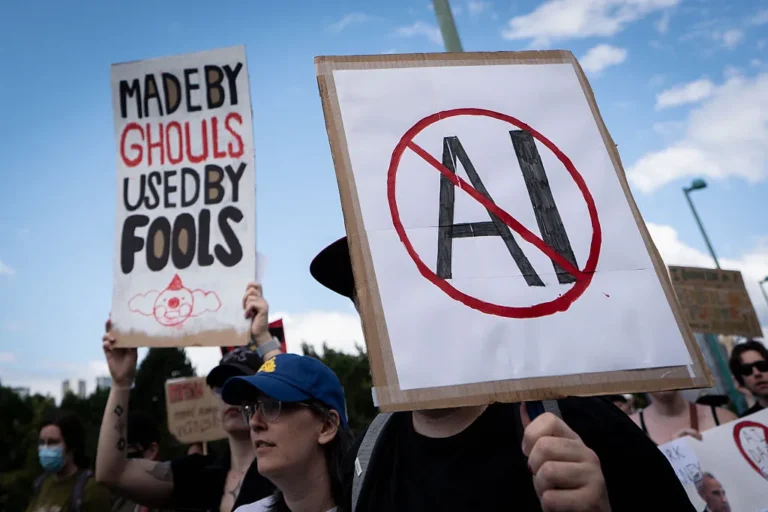



OpenAI’s chief global affairs officer, Chris Lehane, has posited that the 2028 United States presidential election could serve as a pivotal moment for artificial intelligence, urging political leaders to formulate comprehensive policies addressing public anxieties rather than merely echoing anti-AI sentiments or reacting to the burgeoning backlash against data center construction. His recent essay outlines a bold vision, likening AI’s transformative economic potential to President Franklin D. Roosevelt’s New Deal, a landmark series of federal programs and reforms enacted in the 1930s to rebuild an American economy shattered by industrialization and the Great Depression. Lehane’s call to action emphasizes the need for a "compelling third path" that ensures ordinary citizens can partake in AI’s benefits, addressing widespread concerns about economic control and future stability.
The "AI New Deal": A Vision for Economic Reordering
Lehane’s essay, published on OpenAI’s global affairs Substack, draws a direct parallel between the profound societal dislocations of the Great Depression era and the anxieties felt by Americans today regarding AI’s impact on their economic futures. The original New Deal fundamentally reshaped the relationship between government, business, and citizens, introducing social safety nets, worker protections, and regulatory frameworks to mitigate market failures and address rampant inequality. Lehane suggests that AI presents a similar inflection point, necessitating a proactive policy response to prevent economic disruption and ensure equitable distribution of wealth.
His proposals are structured around five key policy priorities designed to navigate this new economic landscape: robust worker protections and retraining initiatives, a renewed focus on education to equip the workforce for an AI-driven economy, stringent AI safety standards, responsible development of critical data center infrastructure, and mechanisms to foster shared prosperity. This comprehensive agenda signals a significant shift in the discourse around AI, moving beyond purely technological advancements to encompass broader societal and economic implications.
Contextualizing the Policy Shift: A Post-Midterm Landscape
The timing of Lehane’s essay is particularly noteworthy, following a stunning Democratic victory in the recent midterm elections, where the party flipped control of Congress. This electoral outcome was largely attributed to widespread voter frustration over the rising cost of living, inflation, and economic uncertainty. While AI itself was not a dominant campaign issue, the increasing public opposition to data center construction—driven by concerns over environmental impact, energy consumption, and local property values—emerged as a significant bipartisan concern in several races.
This political backdrop provides crucial context for Lehane’s intervention. For years, the conversation around AI policy, particularly from leading developers like OpenAI, has largely centered on accelerating innovation, reducing regulatory hurdles, and expanding infrastructure to support rapid growth. Indeed, OpenAI’s policy agenda from the previous year, as highlighted by Kate Brennan, who leads AI and corporate power policy at the AI Now Institute, primarily focused on these aspects. Brennan notes that Lehane’s rhetoric marks a "notable shift," suggesting a recognition by OpenAI of the need to address growing public skepticism and potential political headwinds. The shift indicates a strategic move to frame AI not just as a technological imperative but as a tool for national prosperity, albeit one that requires careful governance.
Expert Critique and Counterpoints: The Authenticity of the "New Deal" Analogy
Despite the ambitious framing, Lehane’s "AI New Deal" has attracted critical scrutiny, particularly regarding its potential to genuinely redistribute power and wealth. Kate Brennan argues that while "invoking a New Deal metaphor is to invoke state capacity to actually benefit the public," Lehane’s essay, penned by a private company, inherently advocates for policies that could ultimately serve its own commercial interests. She describes the comparison as "ahistorical at best and harmful at worst," suggesting that the original New Deal placed significant constraints on corporate power, a dimension largely absent from Lehane’s proposals for AI companies.
A central point of contention lies in the perceived imbalance between promoting AI adoption and ensuring accountability for its economic disruptions. Many of Lehane’s proposals, while seemingly public-spirited, implicitly encourage wider AI adoption and support the massive infrastructure expansion—particularly data centers—that companies like OpenAI require for continued growth. Critics question how these proposals would hold AI companies responsible for job displacement, skill obsolescence, or the concentration of economic gains that their technologies could create.
Brennan points out that the essay offers few concrete mechanisms to prevent AI’s benefits from becoming disproportionately concentrated. For instance, Lehane suggests tax incentives for workers to acquire AI skills, easier capital access for entrepreneurs, and new approaches to employee ownership and profit-sharing. While seemingly progressive, these are not equivalent to binding requirements that would mandate workers share in AI-generated wealth or that companies bear the costs of displacing workers. Brennan argues that a more authentic "New Deal" approach might involve revised corporate tax rates, tax incentives for hiring human employees over automation, or policies designed to prevent companies from amassing outsized market power. She views Lehane’s policy framework as largely "predicated on mass AI adoption and AI benefitting society, which we have yet to see," focusing almost exclusively on the "upside" of AI.
Deep Dive into Key Policy Areas
1. Economic Prosperity and Worker Protections:
Lehane’s emphasis on fostering economic opportunity for Americans willing to embrace AI is a recurring theme. He envisions AI as a path to greater prosperity, offering pathways for individuals to adapt and thrive. However, the concrete policy levers he proposes—such as incentives for AI skill acquisition and promoting employee ownership models—are seen by critics as insufficient to address the systemic challenges of wealth concentration. The historical New Deal introduced foundational worker protections like minimum wage, collective bargaining rights, and social security, which fundamentally altered the distribution of power between labor and capital. Lehane’s proposals, while encouraging, do not appear to establish similar structural safeguards to ensure that AI’s economic gains are broadly shared, nor do they detail how companies would be compelled to mitigate the socioeconomic costs of automation. The concern remains that without stronger regulatory mandates, the "middle class" success he champions could inadvertently tie individual agency to participation in an economy increasingly defined and controlled by powerful AI developers.
2. Data Centers and Infrastructure Development:
The expansion of data centers, the physical backbone of AI, has become a flashpoint in communities across the nation. Lehane acknowledges these concerns but pivots to emphasize the economic benefits: construction jobs, local tax revenue, and the critical role of these facilities in maintaining America’s technological lead over rivals like China. He goes so far as to draw a controversial comparison, warning that politicians supporting data center moratoriums could jeopardize national competitiveness, likening such a stance to the 2002 vote authorizing the Iraq War—a comparison that has been widely seen as an overreach.
This stance underscores the tension between immediate economic and national security arguments for infrastructure development and mounting local environmental and financial concerns. Data centers are notoriously energy-intensive, consuming vast amounts of electricity and water, leading to higher utility bills for residents and increased carbon footprints. Public sentiment in many regions has shifted from welcoming job creation to opposing the perceived burdens on local resources and quality of life. Lehane’s framing highlights the strategic importance of these facilities for AI dominance but offers limited concrete solutions to the community-level grievances.
3. AI Safety and Governance:
On AI safety, Lehane advocates for enforceable safety standards, independent evaluations, public oversight, and even the capability to restrict AI systems or deploy a "kill switch" in extreme scenarios. These proposals align with growing calls from policymakers and the public for greater control over advanced AI. However, critics, including Brennan, label these stances as "disingenuous" given OpenAI’s past actions. In 2024, OpenAI notably opposed California’s AI safety bill, SB 1047, which would have mandated catastrophic risk evaluations and shutdown capabilities for advanced AI models. Similarly, the company previously sought to limit state-level regulation, arguing it could stifle American innovation. While OpenAI has recently shown a willingness to shift some of these positions, backing certain state safety laws and expressing openness to independent evaluators embedded within the company, the historical record raises questions about the consistency and depth of its commitment to robust external oversight. Moreover, recent studies have indicated that major AI labs, including OpenAI, have yet to publish comprehensive, publicly accessible plans for containing a rogue or uncontrollable AI model, casting a shadow on the practical implementation of "kill switch" capabilities.
4. Child Safety and Education:
Lehane’s agenda also prioritizes child safety, stressing the need for age-appropriate protections and safeguards for AI companions used by minors. In the realm of education, he warns against excluding AI from classrooms, arguing that such a move could exacerbate inequality between wealthy students with access to advanced tools and "children in rural communities" who might be left behind. This argument, however, largely presumes that AI unequivocally improves learning outcomes—a claim that remains largely unproven and subject to ongoing pedagogical debate. Critics contend that a more rigorous examination of AI’s actual educational benefits, rather than simply more funding or integration, is needed. The potential for AI to displace the individualized attention and critical thinking fostered by human teachers also warrants careful consideration, a nuance not extensively explored in Lehane’s essay.
Broader Implications and the Road to 2028
Lehane’s essay serves as an early salvo in what promises to be an increasingly complex and contentious debate leading up to the 2028 presidential election. Affordability, already a key concern for American voters grappling with inflation and the rising cost of living, is likely to converge with AI-related anxieties. Voters are increasingly concerned about the tangible impacts of AI, from data centers driving up electricity bills to the specter of job displacement and the concentration of technology’s economic gains within a select few wealthy corporations.
The central tension of Lehane’s argument lies in his framing of AI as a technology that can restore agency and economic opportunity to Americans, while simultaneously tying their "middle class" success to their participation in an economy increasingly shaped by companies like OpenAI. The critical question remains whether his proposed policies will genuinely redistribute power and foster a more equitable society, or if they will subtly entrench the power of large AI developers under the guise of progress and national competitiveness.
The unfolding narrative of AI governance will likely be defined by this fundamental clash: between the industry’s push for innovation and adoption, often framed as essential for national prosperity, and the growing demand from public advocates and policymakers for robust accountability, equitable distribution of benefits, and stringent safeguards against potential harms. As the 2028 election cycle draws closer, the rhetoric and concrete policy proposals around AI are expected to intensify, making it a defining issue in the nation’s political discourse.
TechCrunch reached out to OpenAI for more specifics on Lehane’s proposals and the company’s current stances on these critical issues but did not receive a response by the time of publication.