


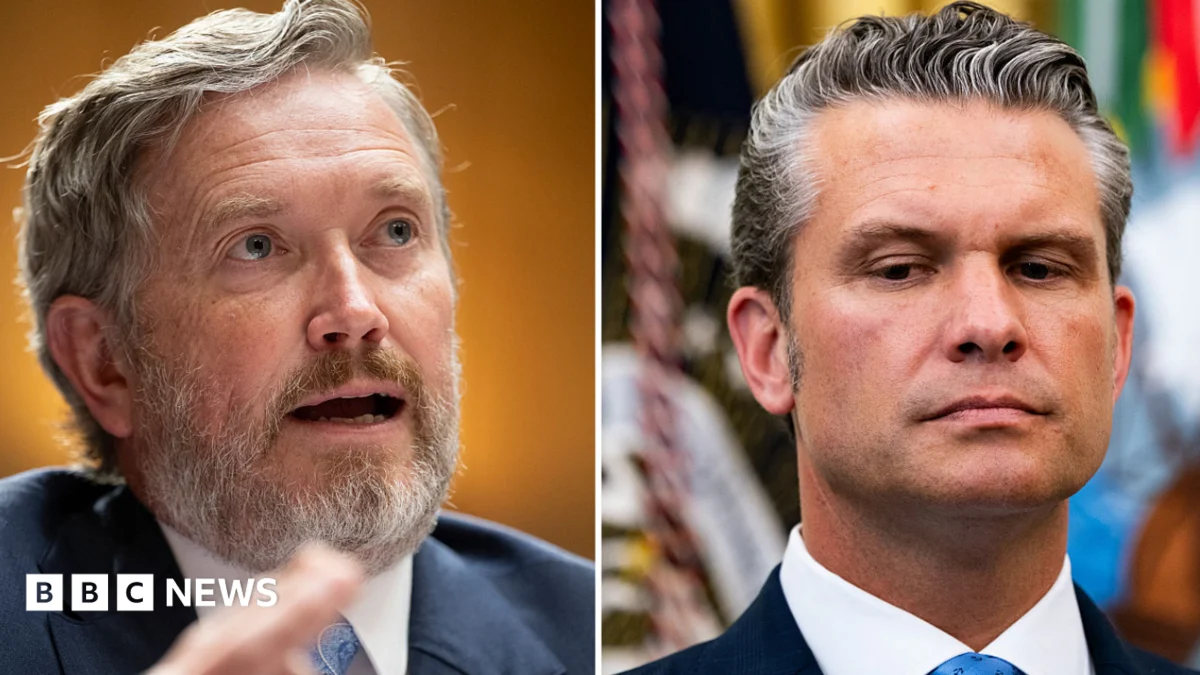
Washington D.C. — In a significant and rare move, Republican Representative Thomas Massie of Kentucky has initiated proceedings to force a vote in the House of Representatives this week on articles of impeachment against Secretary of Defense Pete Hegseth. Massie alleges that Secretary Hegseth has unconstitutionally engaged in military hostilities in Iran for over 90 days without explicit congressional authorization, thereby violating the US Constitution and demanding accountability. This aggressive push comes during a politically charged lame-duck session, following a midterm election that saw Republicans lose control of both chambers of Congress for the upcoming term.
"By engaging in hostilities in Iran for more than 90 days without congressional authorization, Secretary Hegseth is breaking the law and must be held accountable," Representative Massie declared, outlining the core of his accusation. While the immediate effort is widely expected to fail given the current Republican majority in the House, Massie’s motivation extends beyond the immediate outcome. He has openly stated his intent to pressure President Donald Trump into removing Hegseth from his post before Democrats, who are set to assume control of the House and Senate in January, can initiate their own, potentially more expansive, impeachment process. The Secretary of Defense, for his part, has dismissed the threat, stating he is "not worried about that" and announcing a news conference to address the matter directly on Tuesday.
The Genesis of the Challenge: War Powers and Congressional Authority
The controversy at the heart of Massie’s impeachment drive centers on the long-standing constitutional tension between presidential authority as Commander-in-Chief and Congress’s sole power to declare war. The War Powers Resolution of 1973, enacted in the wake of the Vietnam War, aimed to reassert congressional authority by requiring the President to consult with Congress before introducing U.S. armed forces into hostilities abroad and to obtain specific authorization within 60 days (with a 30-day withdrawal period) if forces are engaged in hostilities without a declaration of war. Massie’s articles of impeachment explicitly accuse Secretary Hegseth of flouting this critical legislative check on executive power by maintaining military engagements in Iran beyond the 90-day threshold without the requisite congressional approval.
The United States has maintained a complex and often volatile relationship with Iran for decades, marked by periods of diplomatic engagement, economic sanctions, and military posturing. While the precise nature and scale of the "hostilities in Iran" referred to by Massie have not been extensively detailed, the broader context involves regional security concerns, naval operations in strategic waterways, and the presence of U.S. forces in the Middle East. Over the past nine months, coinciding with the period of alleged unauthorized action, there have been reports of escalating tensions, including maritime incidents, proxy conflicts, and concerns over nuclear proliferation. Congress, reflecting bipartisan apprehension regarding potential unchecked military action, has previously attempted to constrain the administration. The House, with Massie’s support, has passed multiple War Powers resolutions this year specifically aimed at preventing further military action in Iran without congressional authorization. The Senate also passed a similar resolution over the summer, underscoring a legislative desire to reassert its constitutional prerogatives.
A Maverick’s Mission: Representative Thomas Massie’s Independent Streak
Representative Thomas Massie, representing Kentucky’s 4th congressional district, has earned a reputation as a libertarian-leaning Republican with a fiercely independent streak. A vocal critic of what he perceives as executive overreach and excessive government spending, Massie has frequently diverged from his own party’s leadership, including at times, President Trump. His opposition to the war in Iran began almost immediately after it commenced nearly nine months ago, reflecting a consistent non-interventionist stance.
Massie’s political trajectory has seen him challenge the establishment on various fronts. Beyond his critiques of the Iran conflict, he is also known for his persistent advocacy for the release of federal files related to the deceased sex offender Jeffrey Epstein, a cause that has garnered attention across the political spectrum. This latest impeachment effort is not his first; he initially introduced articles of impeachment against Hegseth in September. The timing of his reintroduction now, in the immediate aftermath of Republicans losing control of both the House and Senate in last week’s midterm elections, is highly strategic. Massie has framed his current push as a pre-emptive measure, a "much gentler version" of what he anticipates from Democrats once they assume control in January. "They will hold hearings and trials," Massie stated, indicating his belief that his action could encourage President Trump to replace Hegseth now, while a Republican-controlled Senate can still confirm a successor, thereby mitigating a potentially more damaging "Democrat spectacle" next year. Massie, who lost his own re-election bid earlier this year, faces no direct political repercussions from his constituents, which may afford him greater latitude to pursue principled, albeit unpopular, actions within his party.
Secretary Hegseth’s Stance and the Administration’s Response
Secretary of Defense Pete Hegseth, a prominent figure within the Trump administration, has largely projected an image of defiance in the face of Massie’s impeachment efforts. His dismissive "We’re not worried about that" response earlier on Monday indicates a confident posture, possibly reflecting the administration’s assessment of the resolution’s limited chances of success in the current Republican-controlled House. Hegseth’s scheduled news conference on Tuesday morning "on that very topic" suggests a deliberate intention to publicly address the allegations and potentially defend his actions and the administration’s foreign policy. His last major news conference was held in May, making this upcoming appearance a significant event, particularly given the political heat.
The administration has consistently defended its military actions abroad as necessary for national security interests and within the scope of presidential authority. It views such actions as responsive to evolving threats and crucial for protecting American personnel and allies. Any potential impeachment of a cabinet secretary, especially one as central as the Secretary of Defense, would be perceived by the White House as a direct challenge to its foreign policy prerogatives and an attempt to undermine executive authority. President Trump himself has been impeached by the House twice, and his administration has generally adopted an adversarial stance towards congressional oversight and challenges to its executive decisions.
The Impeachment Mechanism: A Rare but Increasingly Common Political Weapon
Impeaching a cabinet secretary is an exceptionally rare occurrence in U.S. history. The process mirrors that of presidential impeachment, requiring a majority vote in the House of Representatives to approve articles of impeachment (effectively, to formally charge the individual) and then a two-thirds majority vote in the Senate to convict and remove the individual from office. Historically, only two cabinet members have faced impeachment votes in the House: Secretary of War William Belknap in 1876, who resigned before his Senate trial but was still acquitted, and another instance that did not result in Senate conviction. This historical rarity underscores the gravity of Massie’s current initiative.
However, as observed by Paul Gowder, a law professor at Northwestern University in Chicago, the landscape of impeachment has shifted significantly in recent decades. "Impeachment has become much more common as the country has become more politically polarised," Gowder notes, tracing this trend back to the House’s impeachment of President Bill Clinton in 1998. With President Trump having faced House impeachment twice, the mechanism, once considered an extreme constitutional measure, has become a more frequent tool in partisan political warfare. Gowder predicts that several more of Trump’s cabinet members might face impeachment threats, reflecting the heightened polarization and the willingness of legislators to employ this ultimate check on executive power.
The Path Through Congress: Hurdles and Prospects
Upon the formal introduction of Massie’s articles of impeachment in a resolution on the House floor on Monday afternoon, House Speaker Mike Johnson is constitutionally obligated to schedule a time to consider it within two legislative days. Lawmakers have several options: they could vote on the resolution directly, vote to refer it to a relevant committee for further investigation, or vote to table it (set it aside indefinitely). Given the political climate and Massie’s intentions, a direct vote or referral to committee is more likely than simply tabling it, though the latter remains a possibility if leadership wishes to quickly dispense with the matter.
The prospects for the resolution’s passage in the House are complex. While Representative Massie, a Republican, is unlikely to secure broad support from his own party, he is expected to garner significant backing from House Democrats. House Minority Leader Hakeem Jeffries (D-NY) indicated on Sunday that he is a "hard yes" on impeachment, signaling that the Democratic caucus is largely aligned with the principle of holding the administration accountable for alleged constitutional breaches related to war powers. However, Massie himself acknowledged uncertainty regarding whether the measure has sufficient backing to pass the House.
Professor Peter Loge, a professor of public affairs at George Washington University, offers a nuanced perspective. He told the BBC that the impeachment measure is "likely to pass the House because the Republican majority is so slim." Loge elaborated, suggesting that "there are enough angry Republicans that more than enough Republicans are gonna simply not show up to vote." The current composition of the House stands at 218 Republicans and 214 Democrats. If a sufficient number of Republicans either vote in favor of impeachment or abstain from voting, thereby effectively lowering the threshold for passage, the resolution could indeed pass the House, despite the nominal Republican majority. This scenario highlights the precarious position of the outgoing Republican leadership in a lame-duck session, especially after significant electoral losses.
Even if the resolution successfully passes the House, its fate in the Senate is almost certainly doomed. The Senate requires a two-thirds majority vote (67 votes) to convict and remove an impeached official from office. This is an exceptionally high threshold that is notoriously difficult to meet, particularly in the current congressional term. Even when Democrats assume control of the Senate in January, they are not projected to hold enough seats to reach the two-thirds majority without substantial bipartisan support from Republicans, which is highly improbable for an impeachment of a cabinet secretary from a departing administration.
Broader Implications and Secretary Hegseth’s Future
Regardless of the immediate legislative outcome, Massie’s impeachment drive carries significant political implications. For President Trump, it represents another challenge to his executive authority and a potential distraction during a transitional period. For Secretary Hegseth, it underscores the intense scrutiny faced by high-ranking officials in a polarized political environment.
Professor Gowder noted that if Secretary Hegseth were to resign or be fired today, the current Republican-led Senate would likely be able to approve a replacement before the new term begins in January. He suggested that Democrats, likely prioritizing specific legislative battles, might approve "somebody reasonable" if a qualified candidate were put forth. However, Gowder questioned whether President Trump would select a "qualified candidate" who is "minimally acceptable to Democrats," suggesting that the administration might prioritize loyalty over bipartisan appeal in its final weeks.
Professor Loge further speculated on Secretary Hegseth’s long-term job security within the administration. He suggested that the chances of Hegseth surviving until the end of Trump’s term are "pretty slim," but he anticipated that Hegseth would more likely be ousted by the President than formally impeached by Congress. Loge observed, "Secretary Hegseth is a big personality, and I’m not sure I’d want to be a big personality that’s drawing attention from President Trump these days. That’s not a way to guarantee job security." This assessment points to the internal dynamics of the Trump administration, where the President has often shown a willingness to replace cabinet members who either draw too much negative attention or are perceived as not sufficiently aligned with his agenda.
Massie’s articles of impeachment, beyond the War Powers allegations, also accuse Hegseth of more expansive wrongdoing, including intimidating critics of the Trump administration and kidnapping foreign leaders. While these additional charges broaden the scope of the allegations, the core of the constitutional challenge remains the unauthorized use of military force. This effort, coming from within the President’s own party, serves as a powerful reminder of the enduring constitutional checks and balances and the fierce political battles that continue to define the current era in Washington. As the House prepares for a vote, the outcome will not only determine the immediate fate of Secretary Hegseth but also offer a glimpse into the complex political maneuvering and deep divisions that will characterize the transition of power in the coming weeks.