

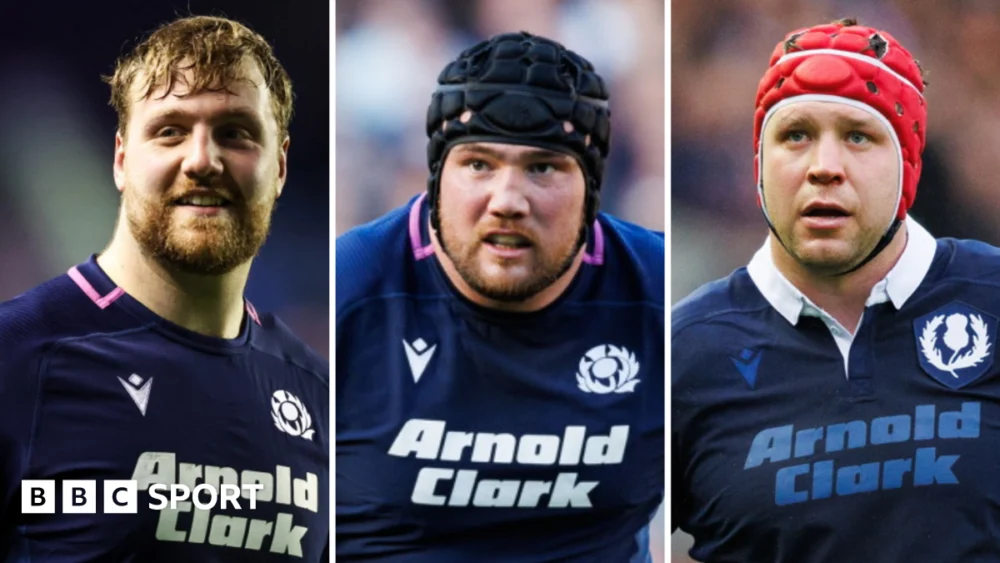
Scotland’s quest for a first Six Nations title since 1999 is poised on a knife-edge as they prepare for a pivotal clash away to Ireland. Head coach Gregor Townsend has unveiled a significantly reshaped second row, featuring Max Williamson and the seasoned Grant Gilchrist, while Zander Fagerson returns to the starting XV, signaling Scotland’s intent to challenge the reigning champions on their home turf. This crucial encounter follows Scotland’s electrifying 50-40 victory over France at Murrayfield, a result that has propelled them into genuine championship contention.
A Title Dream on the Line
The monumental win against France at home has ignited hopes of a championship, a feat Scotland has not achieved since their triumph in the Five Nations era of 1999. However, the path to glory is fraught with historical adversity. Scotland’s record against Ireland in recent times has been bleak, with a losing streak stretching to 11 matches. Their last victory in Dublin dates back to 2010, and they have never managed to secure four wins within a single Six Nations campaign. Adding another layer of complexity, Scotland’s championship aspirations also hinge on defending champions France faltering at home against England.
Strategic Selections Amidst Injury Concerns
The lineup against Ireland reflects a blend of strategic adaptation and response to mounting injury concerns. The formidable lock partnership of Gregor Brown and Scott Cummings, instrumental in the wins against England and France, are sidelined due to injury. This opens the door for a new-look second row. Grant Gilchrist, set to earn his 88th cap, will become Scotland’s all-time second-row appearance record holder, a testament to his enduring presence and leadership in the pack. Partnering him will be Max Williamson, who receives a significant vote of confidence from head coach Gregor Townsend. Williamson’s inclusion marks a second opportunity after an early substitution in the comeback victory against Wales.
Zander Fagerson’s return to the starting XV, reclaiming his spot from D’Arcy Rae, suggests a tactical adjustment aimed at bolstering the scrum and defensive capabilities from the outset. Fagerson’s powerful presence is a valuable asset, particularly in the physically demanding encounters Scotland has historically struggled with against Ireland. Winger Kyle Steyn, who has been a standout performer with three tries in the tournament, is declared fit to play, a significant boost for Scotland’s attacking threat on the wing, despite suffering a gashed leg last weekend.
Townsend’s Perspective: Focus on Performance, Not Permutations
Head coach Gregor Townsend has emphasized his squad’s current state of readiness and morale, describing them as "fresh" and "loving playing together" following their remarkable performance against France. However, he has deliberately downplayed the narrative surrounding the Dublin showdown as a "cup final," urging his players to concentrate on the immediate task at hand.
"We’ve not talked about that," Townsend stated when questioned about the various title permutations. "It’s the final opportunity for this group to go out and play. It’ll be a different game than last week. You’ve got to adapt, stick together for that 80 minutes and give it everything. It’s out of our hands really. We can only do a certain amount and that’s good in a way too. It’s a game for us to play against an opponent that’s had the upper hand on us for years. They’ve got a brilliant record at home. It’s a real opportunity, a challenge but an opportunity for us to go and deliver an even better performance than we did last week."
Townsend’s measured approach aims to alleviate the pressure on his squad, allowing them to focus on executing their game plan against a formidable opponent. The acknowledgment of Ireland’s dominance in recent encounters underscores the magnitude of the challenge, while also framing it as a chance for Scotland to prove their mettle.
Bench Strength and Tactical Flexibility
The bench also presents a compelling picture of tactical flexibility and depth. Back-row Magnus Bradbury, lock Alex Craig, and winger/full-back Kyle Rowe are included in the matchday 23 for the first time in this campaign, offering significant impact options. Bradbury’s inclusion, described as a "shrewd call" by chief sportswriter Tom English, brings a renowned physicality and defensive tenacity to the forward pack. Alex Craig provides further reinforcement in the second row, while Kyle Rowe’s emergence on the bench is a reward for his consistent and impactful performances for Glasgow Warriors. The shift to a 5-3 bench split (five forwards, three backs) from the previous 6-2 arrangement suggests a desire to maintain forward power while also ensuring sufficient backline cover.
Several key players are unavailable due to injury, highlighting the depth challenges Scotland has faced throughout the tournament. Winger Duhan van der Merwe, a significant attacking threat, is among those sidelined. He is joined by back-up fly-half Adam Hastings and props Elliot Millar Mills and Nathan McBeth. Earlier in the tournament, Jamie Ritchie and Jamie Dobie also sustained injuries that have ruled them out.
The Historical Context of Scotland vs. Ireland in Dublin
The statistics paint a stark picture of Scotland’s struggles in Dublin. Their last victory on Irish soil was in the 2010 Six Nations, a memorable 23-20 win that secured a third-place finish for Scotland. Since then, Ireland has established a formidable home record, particularly against Scotland. The sheer dominance of Ireland in recent fixtures, winning the last 11 encounters, cannot be overlooked. This historical context adds a psychological dimension to the upcoming match, with Scotland aiming to break a prolonged period of underperformance against their Celtic rivals.
The last time Scotland secured four victories in a Six Nations campaign was in 1999, the final year of the Five Nations Championship. That year, Scotland, alongside England, France, Ireland, and Wales, competed for the title. Scotland’s victory that year was a significant achievement, and repeating such a feat in the modern, more competitive Six Nations era would be a monumental accomplishment.
Scotland’s Starting XV and Replacements
Scotland: Kinghorn, Graham, Jones, Tuipulotu (capt), Steyn, Russell, White; Schoeman, Turner, Z Fagerson, Williamson, Gilchrist, M Fagerson, Darge, Dempsey.
Replacements: Ashman, Sutherland, Rae, Craig, Bradbury, Horne, Rowe, Jordan.
This selection sees a blend of experience and emerging talent, with key playmakers Finn Russell and captain Huw Jones tasked with orchestrating the attack. The forward pack is loaded with power and dynamism, aiming to match Ireland’s physicality at the breakdown and in the set-piece. The bench offers a strong mix of impact players, capable of maintaining momentum and providing tactical adjustments throughout the match.
Analysis of Townsend’s Selections
Tom English, BBC Scotland’s chief sportswriter, offered an insightful analysis of Townsend’s selection decisions. He highlighted Max Williamson’s inclusion in the second row as a "massive show of faith" from the coach, particularly given Williamson’s early substitution against Wales and subsequent omission from the France squad. This decision suggests a belief in Williamson’s raw talent and potential to perform on the biggest stage.
The return of Zander Fagerson to the starting lineup, after a bench role against France, is interpreted as a strategic move to prevent the recurrence of slow starts, a pattern that has plagued Scotland in their recent losing streaks against Ireland. By deploying their strongest possible pack from the outset, Townsend appears to be prioritizing the ability to compete effectively in the early exchanges, rather than relying on late surges. D’Arcy Rae, while not starting, remains an "excellent operator to have on the bench," suggesting a plan to potentially replicate the strategy of a shared workload in the front row, akin to the previous week.
The inclusion of Alex Craig and Magnus Bradbury on the bench is seen as a shrewd move, providing significant physical presence and defensive capabilities. Bradbury, in particular, is described as a "seriously hard nut," adding a vital element of grit and determination to the reserve forwards. Kyle Rowe’s debut in the matchday 23 is a testament to his impressive form and impact for Glasgow Warriors, and his inclusion signals a recognition of his growing importance to the national team. The shift in bench composition also acknowledges the need for versatility, with Rowe able to cover multiple positions in the backline.
Broader Implications and Championship Dynamics
Scotland’s performance in this match extends beyond immediate victory. A win against Ireland in Dublin would not only be a historic achievement in itself but would also significantly bolster their championship hopes. However, the permutations of the title race mean that Scotland also requires a favorable result in the England versus France fixture. If France were to lose to England, Scotland’s victory would place them in a commanding position to claim the trophy, depending on the margin of victory and bonus points.
Conversely, a loss to Ireland would effectively end Scotland’s championship aspirations, despite their strong performances throughout the tournament. The match represents a critical juncture, where the culmination of their season’s efforts will be put to the ultimate test. The psychological impact of a victory on Irish soil, against a team that has consistently had their number, would be immense, fostering a sense of belief and momentum that could define a new era for Scottish rugby.
The narrative of this Six Nations championship has been one of compelling contests and unexpected outcomes. Scotland’s resurgence has been a central theme, and this clash against Ireland offers them the opportunity to write a defining chapter in their rugby history. The tactical decisions, the mental fortitude of the players, and the sheer will to overcome historical odds will all be on display as Scotland chases a dream that has eluded them for over two decades. The eyes of the rugby world will be firmly fixed on Dublin, anticipating a titanic struggle with championship implications hanging in the balance.