


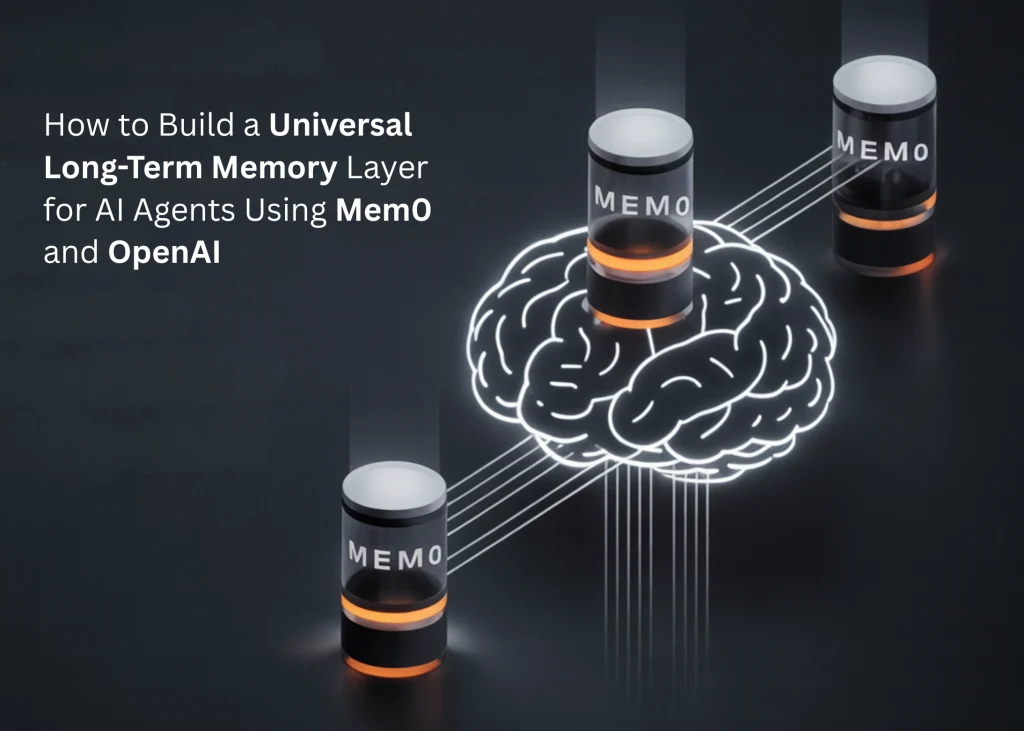
The evolution of artificial intelligence has reached a critical juncture where the focus is shifting from simple generative capabilities to the creation of autonomous agents capable of sustained, contextual reasoning. While Large Language Models (LLMs) like OpenAI’s GPT-4 demonstrate remarkable reasoning abilities, they have traditionally operated in a "stateless" manner, meaning they do not inherently retain information from one interaction to the next once the context window is cleared. To address this limitation, developers are increasingly turning to sophisticated memory management systems. A new technical framework utilizing Mem0, OpenAI, and ChromaDB has emerged as a leading solution for building a universal long-term memory layer, allowing AI agents to store, retrieve, and evolve their understanding of users over extended periods.
The Architecture of Persistent Intelligence
In the standard paradigm of AI development, "memory" is often conflated with "chat history." However, chat history is linear and ephemeral; as a conversation grows, older messages must be truncated to fit within the model’s token limits, leading to "AI amnesia." The implementation of a universal memory layer replaces this linear approach with a structured, semantic system. By integrating Mem0—a specialized memory orchestration layer—with OpenAI’s embedding models and ChromaDB’s vector storage, developers can create agents that possess "contextual continuity."
This architecture functions by extracting discrete facts from natural language conversations. When a user mentions a preference, a professional detail, or a personal hobby, the system does not just store the sentence; it distills the information into a structured memory. These memories are then converted into high-dimensional vectors (embeddings) and stored in a database that allows for semantic retrieval. This means the agent can "remember" a user’s preference for dark mode or their professional focus on fintech even if those details were mentioned weeks or months prior.
Implementation Chronology: From Setup to Deployment
The transition from a stateless agent to a memory-augmented system involves a systematic technical workflow. The process begins with the synchronization of environment variables and the installation of core dependencies, including mem0ai, openai, and chromadb.
Phase 1: Environment Initialization and Configuration
The foundational step involves configuring the API environment. Security is paramount in this stage, often utilizing utilities like getpass to handle sensitive OpenAI API keys. Once the environment is secure, the Mem0 Memory instance is initialized. In a standard production-ready setup, the default configuration utilizes OpenAI’s gpt-4.1-nano for reasoning and text-embedding-3-small for generating vector representations. ChromaDB serves as the local vector store, providing a high-performance database for managing the lifecycle of these memories.
Phase 2: Automated Fact Extraction
The second phase involves the ingestion of conversational data. Unlike traditional databases that require manual entry, the Mem0 pipeline uses an LLM-driven extraction process. When a multi-turn conversation is passed to the system, the memory layer identifies relevant "long-term facts." For example, if a user named Alice mentions she is a software engineer building a RAG pipeline in VS Code, the system automatically segments these into distinct memory objects. This automation ensures that the agent’s knowledge base grows organically without requiring the user to fill out a static profile.
Phase 3: Semantic Retrieval and CRUD Operations
Once memories are stored, the system must be able to retrieve them intelligently. This is achieved through semantic search, where the agent queries the memory layer using natural language. If the agent needs to know "What tools does Alice use?", the system performs a vector similarity search in ChromaDB, returning the most relevant stored facts—such as her preference for Python and VS Code—ranked by a confidence score. Furthermore, a robust system requires full CRUD (Create, Read, Update, Delete) capabilities. This allows the agent or the developer to update outdated information or delete memories that are no longer relevant, ensuring the memory remains accurate and "clean."
Data-Driven Analysis of Memory Efficiency
The integration of a dedicated memory layer like Mem0 offers significant advantages over simple context-window stuffing. According to industry benchmarks in retrieval-augmented generation (RAG), systems that utilize structured memory extraction see a marked improvement in response accuracy and a reduction in token overhead.
Supporting data suggests that:
- Token Optimization: By retrieving only the most relevant five or ten memories rather than the entire chat history, developers can reduce prompt sizes by up to 60-80% in long-running sessions.
- Search Precision: Vector databases like ChromaDB, when paired with OpenAI’s
text-embedding-3-small, achieve high hit rates in semantic retrieval, often exceeding 90% accuracy in identifying relevant user context. - Latency Management: Local vector storage solutions provide sub-millisecond retrieval times, ensuring that the addition of a memory layer does not significantly degrade the user experience or increase the time-to-first-token.
Multi-User Isolation and Security Protocols
As AI agents move into enterprise environments, the necessity for multi-user isolation becomes a primary concern. A universal memory layer must be capable of distinguishing between different users to prevent data leakage. The Mem0 framework addresses this through "user-scoped" memory. By assigning a unique user_id to every memory entry, the system creates virtual partitions within the same vector collection.
In testing scenarios involving multiple users—such as "Alice," a software engineer, and "Bob," a data scientist—the system demonstrates strict namespace isolation. When the agent is queried about Bob’s preferences, it is programmatically barred from accessing Alice’s data. This multi-tenant architecture is essential for developers building SaaS platforms or internal corporate assistants where privacy and data boundaries are non-negotiable.
Professional Implications and Industry Reactions
The shift toward long-term memory layers is being met with enthusiasm by the developer community and AI researchers alike. Industry analysts suggest that the ability to maintain state across sessions is what will finally move AI from a "novelty tool" to a "reliable colleague."
"Statelessness has been the Achilles’ heel of the first generation of AI assistants," notes one industry perspective on agentic workflows. "By implementing a persistent memory layer, we are essentially giving the AI a ‘biography’ of the user, which allows for a level of personalization that was previously impossible."
Furthermore, the flexibility of the Mem0 configuration allows for "agnostic infrastructure." While the current tutorial emphasizes OpenAI and ChromaDB, the system is designed to be modular. Developers can swap the vector store for enterprise-grade solutions like Pinecone, Qdrant, or Weaviate, and the LLM can be replaced with open-source alternatives like Llama 3 via Groq or Ollama. This modularity ensures that the memory layer can scale alongside the evolving AI ecosystem.
Advanced Use Cases: Beyond Simple Chat
The implementation of a universal memory layer opens the door to several advanced agentic behaviors:
- Contextual Recommendation Systems: Agents can suggest tools, IDE setups, or weekend activities based on a deep understanding of a user’s historical preferences and professional background.
- Recursive Learning: As an agent interacts more with a user, it can update its own internal model of that user, refining its responses to become more aligned with the user’s specific communication style.
- Cross-Platform Continuity: Because the memory is stored in a centralized vector database, a user can interact with an agent via a web interface and later via a mobile app, with the agent retaining full knowledge of the previous interaction.
Analysis of Broader Impacts
The long-term impact of memory-augmented AI extends into the realms of productivity and human-computer interaction. When an AI remembers that a user is building a "fintech RAG pipeline," it no longer requires the user to re-explain their project in every new session. This reduces cognitive load and allows for more complex, multi-day problem-solving.
However, the rise of persistent AI memory also necessitates a discussion on "the right to be forgotten." The inclusion of robust deletion and cleanup modules in the Mem0 framework is a proactive step toward regulatory compliance (such as GDPR). As AI systems begin to store more personal data, the ability for a user to view their "memory profile" and selectively delete entries will be a cornerstone of ethical AI development.
Conclusion
The construction of a universal long-term memory layer using Mem0, OpenAI, and ChromaDB represents a significant leap forward in the quest for truly intelligent AI agents. By moving away from stateless architectures and embracing persistent, semantic, and isolated memory, developers can create systems that do not just respond, but understand. This framework provides the necessary tools for CRUD operations, semantic search, and multi-user management, forming the backbone of the next generation of personalized AI. As these technologies continue to mature, the integration of memory will likely become a standard requirement for any AI system intended for professional or personal use, turning the "context window" from a limitation into a gateway for lifelong digital companionship.