


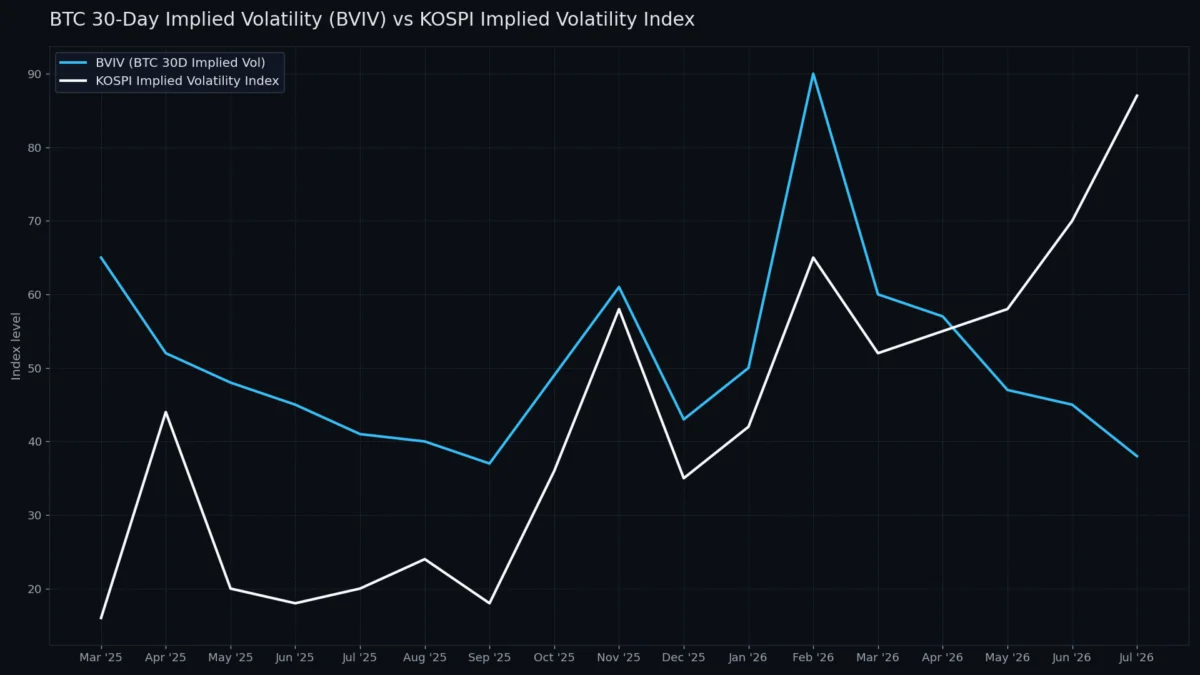
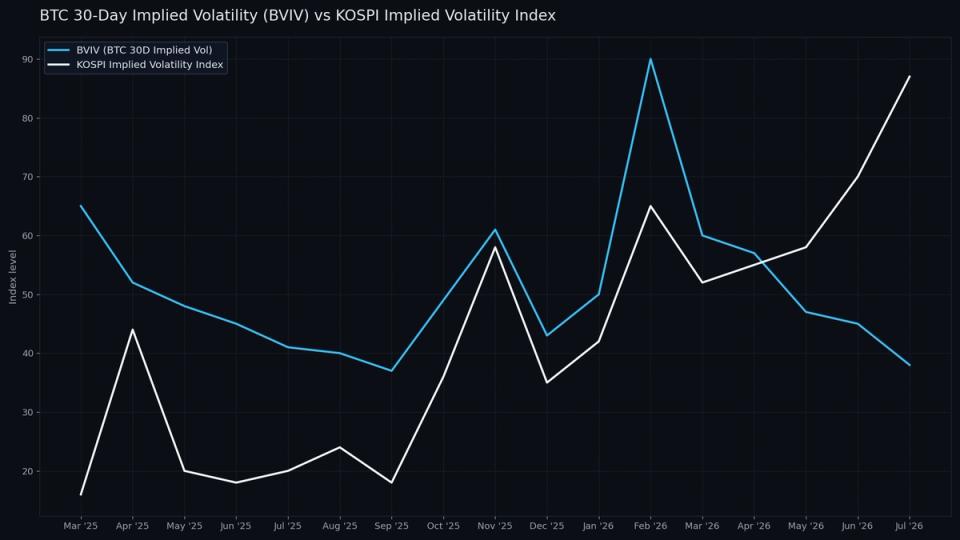
According to options market data from Bloomberg and Volmex, the 30-day implied volatility (IV) for the Kospi index has surged to an annualized 81%. This figure is more than double the Bitcoin Volatility Index (BVIV), which currently tracks at approximately 38%. This divergence marks a significant milestone in the maturation of the digital asset class and highlights the systemic risks currently permeating traditional equity markets that became overly concentrated in AI-related growth narratives.
The Volatility Inversion: Data and Market Dynamics
Implied volatility serves as a forward-looking metric derived from the demand for options contracts. High IV suggests that market participants are paying a premium to hedge against or speculate on large price movements. For much of its history, bitcoin has maintained an IV significantly higher than any major national stock index. However, the current landscape reflects a "risk-off" migration that has hit the high-tech sectors of East Asia with particular ferocity.
While the Kospi’s 81% IV reflects a market in distress, bitcoin’s 38% IV suggests a level of consolidation. For context, the S&P 500’s CBOE Volatility Index (VIX) remains below the 20% threshold, indicating that while bitcoin is becoming "tamer" than specialized equity indices like the Kospi, it still carries roughly twice the risk profile of the broader U.S. stock market. Analysts suggest that for bitcoin bulls, the ultimate "institutional validation" will occur if and when the BVIV consistently trades below the VIX, a scenario that remains a distant but increasingly discussed possibility.
Chronology of the AI Correction and the Kospi Slump
The current instability in the South Korean market is the culmination of a multi-year cycle of aggressive capital allocation toward AI semiconductors and infrastructure.
- Q1 2026 – The Peak of Euphoria: Global demand for High Bandwidth Memory (HBM) and advanced logic chips pushed South Korean tech giants to record valuations. The Kospi index reached all-time highs as retail and institutional investors rotated out of defensive sectors into "AI-pure plays."
- April-May 2026 – The Margin Surge: Encouraged by consistent gains, South Korean retail traders increased their use of margin accounts and leveraged Exchange Traded Funds (ETFs). Domestic brokerage data indicated that leverage ratios among individual investors reached levels not seen since the 2021 bull market.
- June 2026 – The Growth Stall: Early second-quarter earnings reports from global AI software providers began to signal a slowing of "AI ROI" (Return on Investment). This triggered a reassessment of the valuation multiples applied to hardware manufacturers in Seoul.
- Late June 2026 – The Liquidation Cascade: As the Kospi began its descent, the high level of retail leverage became a liability. A series of margin calls triggered a feedback loop of forced liquidations.
- July 2026 – The Current Crisis: Within the last four weeks, the Kospi has shed nearly a quarter of its value. The total volume of forced liquidations in the South Korean market has surpassed $2 trillion over the last 90 days, creating a liquidity vacuum that has spiked volatility to its current 81% level.
Bitcoin’s Resilience Amid Geopolitical and Macro Pressure
While the AI-driven equity selloff spreads, bitcoin has faced its own set of challenges, though it has displayed a surprising degree of price floor resilience. Geopolitical tensions, particularly in the Middle East, have historically triggered "flight to quality" moves into the U.S. dollar and gold, often at the expense of speculative assets like bitcoin.
Currently, bitcoin is trading at approximately $63,163.75, sitting below its 50-day moving average—a technical indicator often used to determine short-to-medium-term momentum. Despite this, the lack of a catastrophic breakdown in the face of the Kospi’s collapse is being viewed as a sign of institutional absorption.
Nicolai Sondergaard, a research analyst at Nansen, noted that "smart money" wallets—those characterized by high-volume, sophisticated trading patterns—have not engaged in a mass exodus to stablecoins. "This behavior is consistent with prior geopolitical flare-ups," Sondergaard stated. "Short-term leveraged longs get flushed out, creating a temporary dip, but the underlying accumulation by long-term holders remains intact. The fact that volatility is staying low relative to the tech sector suggests that the ‘weak hands’ have already exited the crypto market earlier in the year."
Regulatory Hurdles and the Washington D.C. Factor
A critical component of bitcoin’s current price action is the anticipation surrounding the "Clarity Act," a landmark piece of legislation moving through the United States Congress. The bill aims to provide a definitive regulatory framework for digital assets, clarifying the jurisdictional boundaries between the Securities and Exchange Commission (SEC) and the Commodity Futures Trading Commission (CFTC).
The Clarity Act faces what many observers call its "final test" in Washington D.C. today. The industry is advocating for its passage to unlock the "institutional bid"—trillions of dollars in pension and endowment capital that remains sidelined due to regulatory uncertainty. However, the bill has encountered friction due to provisions regarding potential conflicts of interest involving former President Trump’s business ties to the crypto industry, as well as general legislative gridlock ahead of the August recess.
Analysts at Marex emphasized the importance of this moment: "This is the regulatory clarity the institutional bid has been waiting for. If the Clarity Act clears these final Senate hurdles, we expect a significant reduction in bitcoin’s risk premium, further decoupling it from the high-volatility cycles of the tech equity markets."
Technical Analysis: The Ethereum-Bitcoin Ratio
As bitcoin stabilizes, the internal dynamics of the crypto market are shifting. The ETH/BTC ratio, which measures the relative strength of ether against bitcoin, is currently trapped between two key technical levels: the 100-day and 200-day simple moving averages (SMA).
The ratio recently broke above the 100-day SMA, a level that has acted as a ceiling for recovery rallies since January 2026. This move suggests that ethereum is beginning to regain ground as investors look for "beta" (higher sensitivity to market moves) within the crypto space. However, the 200-day SMA remains a formidable resistance point. A sustained move above the 200-day average would likely signal a broader "altcoin season," where investors move down the risk curve away from bitcoin into more speculative digital assets.
Broader Impact and Market Implications
The fact that a major sovereign stock index like the Kospi is now perceived as twice as risky as bitcoin has profound implications for global portfolio construction. For decades, the "60/40" portfolio and other traditional models have viewed equities as the growth engine and crypto as a volatile outlier. This narrative is being challenged by the reality of "concentration risk" in the AI sector.
- Re-evaluating "Safe" Assets: Institutional risk managers are forced to acknowledge that heavy concentration in specific technological themes (like AI) can lead to volatility profiles that exceed those of decentralized commodities.
- South Korea as a Warning: The $2 trillion liquidation event in Seoul serves as a cautionary tale for other markets—including the NASDAQ—where AI-driven gains have led to high levels of retail and institutional leverage.
- The Maturation of Bitcoin: As bitcoin’s volatility stays suppressed relative to high-growth tech, the "digital gold" thesis gains credibility. While it is not yet a "safe haven" in the traditional sense, its behavior during this AI correction suggests it is functioning more as a mature macro asset than a speculative tech derivative.
As the AI selloff spreads from stocks to other asset classes, the financial world is watching to see if the Kospi can find a bottom or if the "AI bubble" has further to deflate. For now, the crypto market remains in a state of watchful waiting, anchored by a newfound—and unexpected—relative stability. The upcoming legislative decisions in Washington and the resolution of geopolitical tensions in the Middle East will likely dictate whether bitcoin can maintain this lower volatility profile or if it will eventually be pulled back into the turbulence of the global "risk-off" wave.